
General Assembly passes budget with 8% average teacher raises, plus funds for literacy, math, and research
After months of negotiations, and nearly a year after the original deadline, Republican lawmakers finally put forth and passed a budget this week. North Carolina had not passed a state budget since 2023, causing strain for public institutions, especially public schools, in the interim. Now, the budget will go to Gov. Josh Stein, a Democrat, who is expected to sign it.
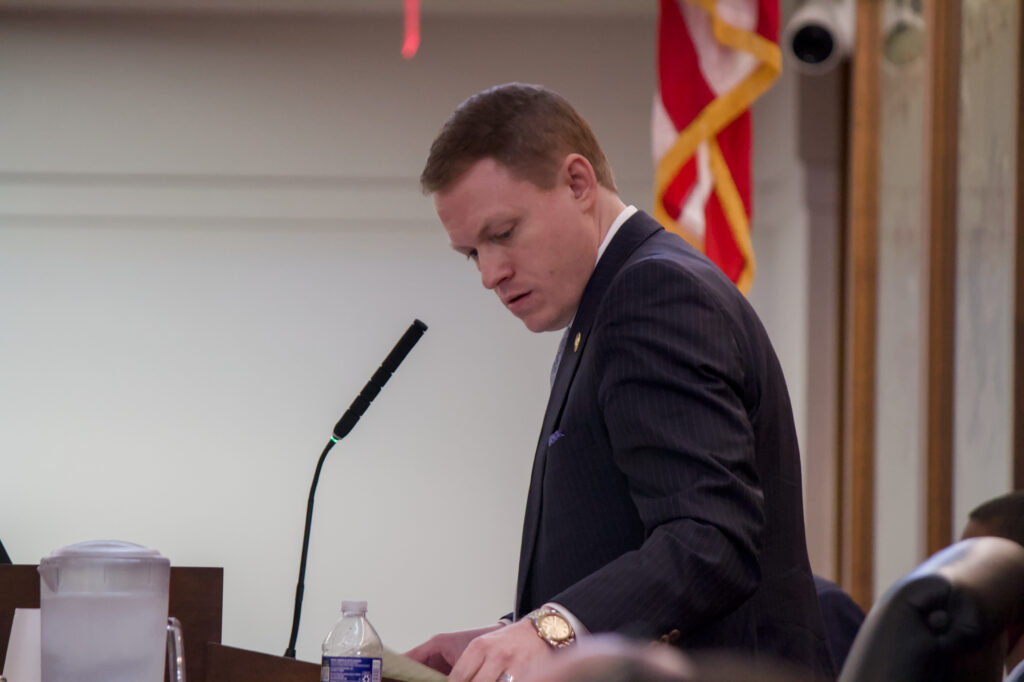
“We didn’t get here easily — we got here through a long series of negotiations and debates,” said Speaker of the House Destin Hall, R-Caldwell, on Wednesday. “… Ultimately, we got the right budget.”
Disagreements between the two Republican-controlled chambers of the General Assembly on taxes, teacher raises, and other issues contributed to the past year’s gridlock. But once an agreement was reached, the budget bill moved fast — it was approved quickly, by Thursday. July 1, the beginning of the fiscal year that the budget covers, was Wednesday.
Some Democrats took issue with the quick turnaround.
“North Carolinians deserve a budget process that is transparent and inclusive,” said Sen. Caleb Theodros, D-Mecklenburg. “Senate Democrats were excluded from budget negotiations, and after more than a year of stalled closed-door discussions, we were handed a conference budget exceeding 600 pages just one day before the final vote. A budget that impacts every North Carolinian deserves careful review, not a rushed process.”
Nevertheless, some Democrats in both chambers voted to approve the budget bill on Wednesday and Thursday.
The $34.4 billion budget appropriates $19.4 billion to education, $12.5 billion of which goes to K-12 items, including an average 8% raise for teachers that brings North Carolina’s starting teacher salary to just below the national average. When a budget framework was first announced in May, Democratic State Superintendent of Public Instruction Maurice “Mo” Green said he was grateful it “includes meaningful pay increases for our public school educators.”
In addition to K-12, the budget includes recurring funds for Propel NC, the community college system’s proposed funding overhaul, and $97 million recurring in federal funds to raise the state’s reimbursement rates for providers of subsidized child care services.
Some Democrats criticized tax cuts contained in the budget, warning that North Carolina is heading toward financial trouble.
Under the budget framework announced in May, North Carolina’s corporate income tax is still on schedule to be completely eliminated by 2030, and the budget released this week continues to decrease the personal income tax rate over the next decade, though more gradually than before. Earlier in the session, as part of the budget deal, the General Assembly also sent ballot measures to voters who will decide in November whether to limit local property taxes.
Education advocates have said that these tax cuts could hurt public schools.
“This keeps our promise to reduce the tax burden for all North Carolinians, while expanding access to incredible educational opportunities, keeping our communities safe, and solidifying North Carolina’s status as the best state in the nation,” Senate President Pro Tempore Phil Berger, R-Rockingham, said about the budget in a statement.
Below, see EdNC’s analysis of the education-related provisions of the state budget.
Here is the bill text, here is the money report, here is the technical corrections bill passed alongside the budget bill. After passing the budget, the General Assembly voted to adjourn until July 27.
EdNC’s other coverage about the new budget
K-12 teacher pay
Teachers and other state employees who went without raises last year will finally get raises in this budget.
As previously announced by Hall and Berger, the budget includes an average 8% raise for teachers with higher raises going to newer teachers, bringing North Carolina’s starting teacher salary to $48,000. The total appropriation for teacher salary increases and bonuses is nearly $600 million.
Sen. Michael Lee, R-New Hanover, said on Wednesday that when taking into account local and state salary supplements, “no teacher will be making less than $50,000” in North Carolina.
The raises are not retroactive, meaning they will go into effect for the 2026-27 fiscal year, which started Wednesday. See the full salary schedule, which displays monthly salary based on experience level, below.
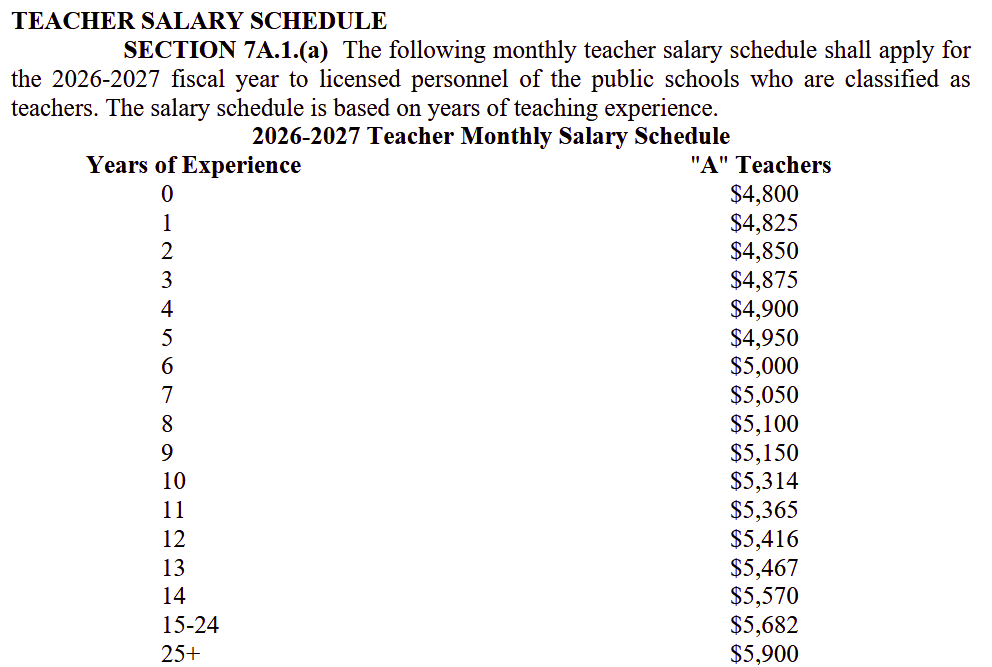
The budget does not include the restoration of master’s pay — higher pay for teachers with master’s degrees — or removal of the “pay plateau” for teachers with between 15 and 24 years of experience. Both the governor’s proposed budget and the House’s proposed budget would have included funds for both of those things.
Teachers, in addition to their salaries, will receive a one-time bonus next year depending on their experience level. Teachers with 15 or fewer years of experience will receive a bonus of $500; those with 16 or more will receive $1,000.
Teachers may also receive separate bonuses through a program “to reward teacher performance and encourage student learning and improvement,” which is once again funded in this year’s budget. Eligible teachers teach Advanced Placement (AP) or International Baccalaureate (IB) classes, teach Career and Technical Education (CTE) classes, or meet certain benchmarks.
The compensation section of the budget includes a new provision requiring school districts to report their local salary schedules for teachers, including supplements, to the Department of the State Auditor. Those district-level salary supplements will be published by the Department of Public Instruction (DPI) by Feb. 15 of each year.
Advanced Teaching Roles and TeachReadyNC
The Advanced Teaching Roles (ATR) program currently operating in some school districts will be expanded, with the budget nearly quadrupling its salary supplement appropriation for the 2026-27 school year, to a total revised appropriation of $40.9 million. However, the appropriation is smaller than indicated in Senate Bill 1006, which had a section expanding ATR.
On the Senate floor, Sen. Kevin Corbin, R-Macon, said “my goal would be to fully fund Advanced Teaching Roles as we move forward,” at a cost of $200 million total.
Through ATR, some districts have implemented a model that gives schools a new organizational structure. Lead teachers oversee a team of classrooms and receive $10,000 more annually. Some teachers are also designated as “Classroom Excellence” teachers, accepting higher pay in exchange for larger class sizes.
Like SB 1006, the budget changes the ATR structure, renaming ATR positions to “collaborative impact leader,” “teacher of distinction,” and “teacher of record.” Also included is a “partial-release collaborative impact leader” position.
A collaborative impact leader, among other requirements, is defined as leading a team of between four and eight teachers. Teachers of distinction have classrooms with at least 20% more students than average on their ATR team.
A partial-release collaborative impact leader, a new position in the ATR structure, is defined as leading a team of two or three teachers. See the full definitions for ATR positions on page 113 of the bill text.
ATR team members will be paid the following amounts in addition to their other compensation:
- $10,000 for collaborative impact leaders;
- $5,000 for partial-release collaborative impact leaders;
- $3,000 for teachers of distinction.
In a previous committee discussion about SB 1006, Lee said the waitlist of 16 districts hoping to implement ATR would be cleared and 16 more could be added to the program. But the appropriation increase for grant funding in the budget is only half of what was proposed in SB 1006 — $2 million — indicating that only the 16 districts on the waitlist will be admitted.
Meanwhile, TeachReadyNC, a new teacher apprenticeship program that was also outlined in SB 1006, made it into the budget. The program will collaborate with ApprenticeshipNC, North Carolina’s designated apprenticeship agency, with hopes of unlocking federal apprenticeship funding.
The $1 million in recurring funding appropriated in the previous budget for a Teacher Apprentice Grant Program, which this budget repeals, will instead go to TeachReadyNC, according to the bill text.
Finally, the budget repeals TeachNC, which “provides free support to those interested in becoming a North Carolina educator” according to DPI’s website, but allocates $880,000, nonrecurring, to keep the program going for the next year.
The Future Teachers of North Carolina program is also repealed in the budget. The program hosted symposiums which introduced high schoolers to teaching as a profession.
Teacher licensure requirements
Some teacher licensure requirements are modified in the budget, aligning with a bill discussed earlier in the year.
First, the budget makes it easier for people with teaching licenses outside of North Carolina to move to the state and become teachers, for both out-of-state and international teachers. Read more on page 104 of the bill text.
The budget also allows the State Board of Education (SBE) to convert a limited license to a continuing professional license if a teacher shows high performance for two of the three most recent years. It also removes the first-year exam requirement for licensure, but keeps the third-year exam.
In a separate provision, K-6 teacher licenses are expanded to include grades 7 and 8. “Notwithstanding any provision of law to the contrary, the State Board of Education shall adopt rules expanding elementary licenses to include teachers of grades seven and eight,” the bill text says.
Pay change for principals, other state employees
School principals will see a 3% increase to their salary schedule, plus a $1,000 bonus.
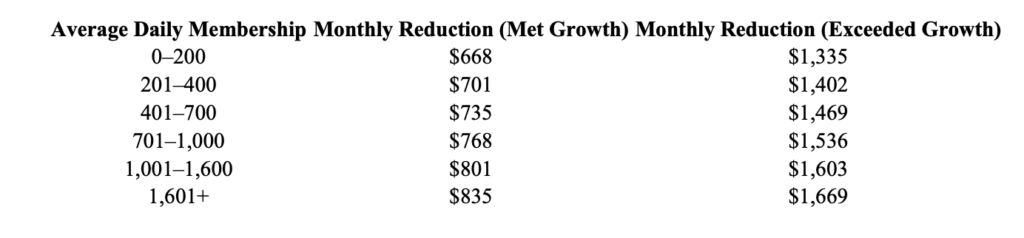
However, the budget includes a significant change to the principal salary schedule structure, which could result in monthly pay decreases ranging anywhere from $700 to $1,700, according to Patrick Greene with the NC Principal of the Year (NCPOY) Network.
Currently, the state’s principal salary schedule is tied to Average Daily Membership (ADM) and school growth. Principals earn a base salary, which increases according to ADM, and earn more if their school has met or exceeded growth.
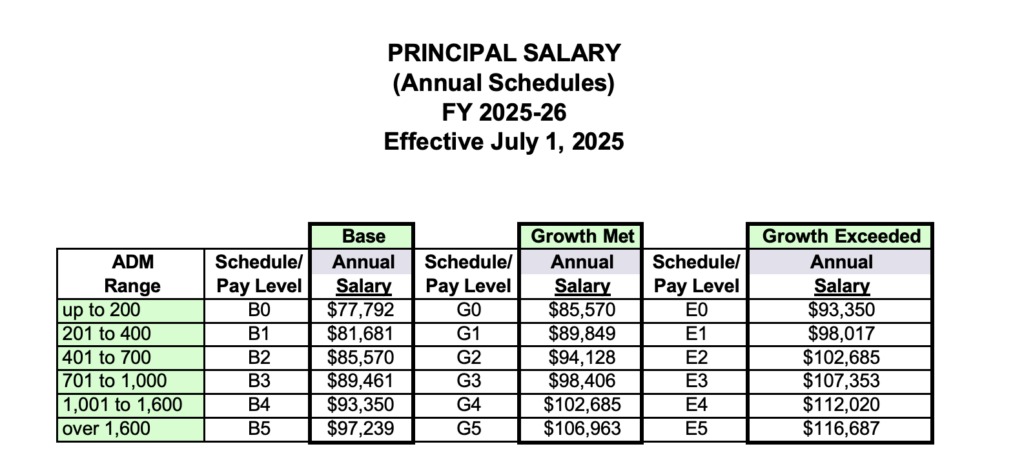
However, the budget changes that structure, only paying principals a base salary tied to ADM. Then, DPI would pay a salary supplement to principals accounting for their school’s growth status.
“This is taking salary dollars and paying them out like a bonus,” Greene said. “… That’s probably not the best way to pay people’s salaries when budgets and making house payments and college payments for kids.”
So while principals whose schools meet or exceed growth would be paid the same amount annually, their monthly pay will decrease significantly, Greene said. The salary tied to their retirement benefits would also likely decrease under this model. The NCPOY Network sent a letter on Wednesday asking for a hold or technical correction on this salary change.
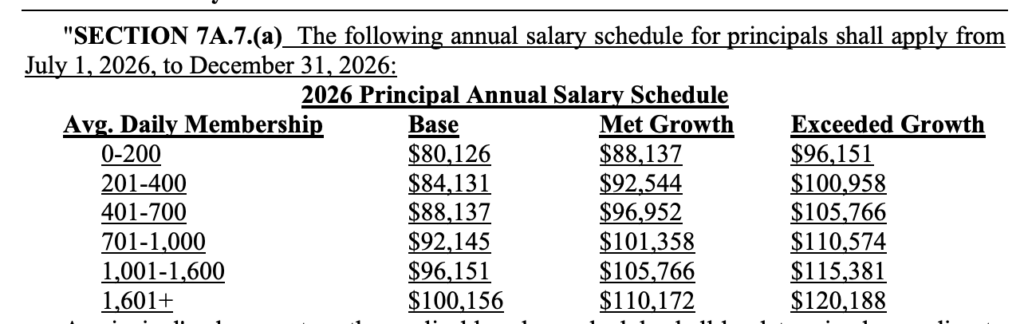
Following the sending of the letter, lawmakers passed a technical corrections bill on Thursday, along with the budget, which now delays the principal pay changes until January 2027. Below is a look at the salary schedule now in place through Dec. 31, 2026, including the 3% raise.
Greene said the NCPOY network has long advocated for principal pay reform to account for the work principals do in low-performing and high-poverty schools. Among other things, a proposed plan would add a retention bonus for principals and include factors such as how many multi-language and students experiencing homelessness a school has, in addition to school size and performance.
“I don’t know if this was (lawmakers’) attempt to say, ‘Well, this stabilizes pay for you,’ but I don’t think this is what anybody had in mind to remove money from your monthly salary as a way to stabilize,” Greene said.
Below is an estimation of the monthly reduction in salaries under the new principal pay schedule, now set to begin in January 2027.
The budget still includes a bonus program for principals of schools in the top 50% of school growth.
Other state employees
Like principals, central office employees, DPI employees, noncertified school personnel, and other state employees will see an across-the-board 3% raise and a bonus based on their salary — $1,750 for employees making under $65,000 annually, or $1,000 for those making more — which comes after increases in the cost of living and their health care costs through the State Health Plan.
“Legislators love to tell us how well North Carolina’s economy is doing, but this budget looks like the work of a state that’s struggling,” said State Employees Association of North Carolina Legislative Affairs Director Ardis Watkins, in a statement. “This year, most will only get 3% — which doesn’t keep pace with inflation for this year much less makes up for last year.”
The budget met the State Health Plan’s request of a 5% employment contribution for all state employees. In a statement, State Treasurer Brad Briner praised the budget.
“For the second year in a row, we asked lawmakers to make significant increases to the State Health Plan — which serves all of our teachers, state employees, retirees and their families. And for the second year in a row, they have provided the increased funding,” Briner said. “If legislators had not made this additional investment, totaling nearly $4 billion, it could have meant increased premiums by as much as $38 per member per month.”
The budget also funds retirement contributions for state employees with a one-time cost of living adjustment of 2.5%.
Finally, the budget cuts the equivalent of approximately 755 full-time state jobs, the vast majority which are currently vacant.
Opportunity Scholarships and school choice
Some small policy changes made in the budget will affect Opportunity Scholarships, North Carolina’s private school voucher program. Among other things, the budget establishes a consistent application window, clarifies residency requirements for receiving scholarships, and provides new accommodations for military-connected students.
It also authorizes the North Carolina State Education Assistance Authority (NCSEAA), which administers the Opportunity Scholarship program, to annually verify that schools receiving scholarship funds are properly keeping student testing records.
The budget also clears the waitlist for the Education Student Accounts (ESA+) program — which helps North Carolina families pay for education and services for children with disabilities — bringing the total appropriation to $94 million.
The 2023 budget said it is “the intent of the General Assembly to reinvest in the public schools any savings realized by the State each year, beginning in the 2025-2026 school year,” when a student from a public school accepts an Opportunity Scholarship amount less than 100% of the state’s per-pupil allocation.
The budget reinvests that money, which totals $35,751,409 as identified by DPI, as follows:
- $17,020,811 for a one-time bonus of $1,750 for locally and federally funded school nutrition and custodial personnel.
- $13,800,000 for middle school literacy professional development.
- $10,000,000 for the North Carolina Collaboratory to acquire a mathematics curriculum from another state and adapt it for use in K-8 mathematics classes.
Federal school choice program
The budget allows the use of up to $1 million in anticipated administrative costs for NCSEAA to implement the federal school choice program that North Carolina recently opted into after an override of Gov. Josh Stein’s veto.
Parents for Education Freedom
The budget includes $750,000 in recurring funding for the UNC System Office to coordinate with a nonprofit called Parents for Education Freedom in North Carolina (PEFNC) “to offer families marketing and outreach services related to school choice offerings in North Carolina.”
Enrollment and low-wealth supplement
The average daily membership (ADM) adjustment for public schools in the 2026-27 budget is negative this year, at -$104,570,906. Normally the adjustment is positive to account for an increase in public school enrollment.
This year, the negative adjustment aligns with decreasing public school enrollment.
The budget’s committee report document says the ADM funding is allotted for 1,506,908 students in 2026-27; the previous state budget had funding for over 40,000 more students at 1,549,792.
The budget includes about $21 million in additional funding for the Low-Wealth Counties Supplement, which funds salary supplements and instructional positions in school districts, bringing the total net appropriation for the supplement to $366.5 million in FY 2026-27.
The additional funding comes with a policy change limiting the year-to-year fluctuation of supplemental funding to counties. Under the new policy, the first school year that a county is ineligible to receive funds — when counties lose “low-wealth” status — the county will only receive a reduction in allocation of 30% for that year when compared to the prior school year.
The policy also prevents other counties receiving funds from gaining or losing more than 30% of their funding year over year.
School nutrition, wellness, and achievement
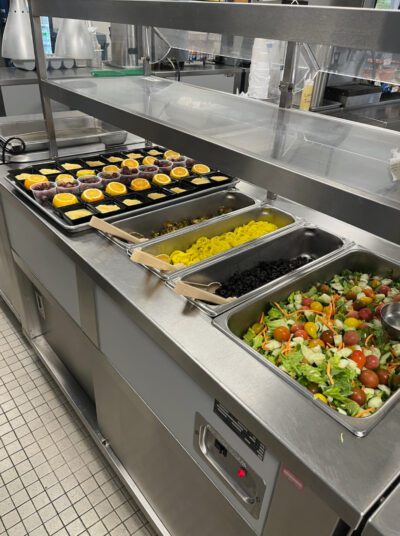
The budget amends the state law governing school meals to include a provision preventing schools from offering students different meal options depending on “pay status” — whether or not they have school meal debt, or qualify for free or reduced-price meals.
The CEP Meal Incentive Program, originally introduced in the 2023 budget, is codified by this year’s budget. The DPI-administered program is intended to expand public school participation in the federal Community Eligibility Provision (CEP) program, meant to increase the number of students with access to healthy and free meals at schools.
Relatedly, North Carolina’s Farm to School program, which links farmers to schools to provide locally-grown ingredients for meals, is provided $2.5 million in nonrecurring funds.
Read more

Student wellness provisions
The budget includes various policy changes related to student wellness, including a provision mandating diabetes education for parents. Districts are required to ensure that schools provide parents and legal guardians with information about Type 1 and Type 2 diabetes at the beginning of every school year, including risk factors and warning signs.
The budget also modifies a provision instructing DPI to regularly disseminate health information to school districts, adding mental health awareness, addiction, and substance abuse to a list of subjects. Read more about the N.C. Standard Course of Study for Healthful Living.
And money is appropriated for purchasing, installing, and replacing Automated External Defibrillators (AEDs) in schools. The $4 million allocation, which is more than advocates asked for previously, will also fund cardiac emergency response training.
The budget makes a net appropriation of nearly $82 million to the Center for Safer Schools, including $30 million nonrecurring for School Safety Grants which school districts can apply for.
The School Safety Grants program is intended to “improve safety in public school units by providing grants in the 2026-2027 fiscal year for (i) services for students in crisis, (ii) school safety training, (iii) safety equipment in schools, and (iv) subsidizing the School Resource Officer Grants Program,” the bill text says.
Finally, the budget instructs school districts to provide the Suicide and Crisis Lifeline and the NC Peer Warmline phone numbers to students, including by posting them physically in schools and by printing them onto student IDs in grades six through 12.
Partial funding — $1 million — of a bipartisan request to fund Mental Health First Aid training is also included in the budget.
Literacy and math investments
DPI and the SBE asked for additional funds to improve literacy and math instruction this short session.
The budget includes $1.4 million to expand the Dynamic Indicators of Basic Early Literacy Skills (DIBELS) reading diagnostic to 4th and 5th grade. Currently, the assessment is for grades K-3. As mentioned above, there is also funding for middle school teachers to receive professional development on the science of reading.
The budget also includes $500,000, nonrecurring, for DPI to “establish a pilot program that allocates funding to 6 counties for the purchase of literacy materials from Just Right Reader, Inc. to support implementation of Science of Reading and phonics-based instruction and promote early literacy.”
Under a new policy in the budget, students will now be automatically enrolled in advanced English Language Arts classes if they qualify. This policy already existed for mathematics classes.
The real focus in the budget, however, is mathematics. A section of the budget titled, “Foundational Mathematics Instruction and High-Quality Instructional Materials,” lays out many new math-related policies focused on low-performing schools. Read more on page 151 of the bill text.
Here are some of the new policies:
- “Low-performing schools shall provide at least 60 minutes of mathematics instruction per day in kindergarten through eighth grade that is on or above grade level.”
- “(L)ow-performing schools shall administer a mathematics screening assessment to all students in kindergarten through eighth grade at least three times per school year.” There is $6 million for this purpose.
- “Low-performing schools shall develop and implement (a Mathematics Success Plan) for any student in kindergarten through eighth grade who demonstrates substantial difficulty developing mathematics skills” and notify parents if a student is identified as having substantial difficulty learning math.
There is also $4 million for DPI to contract with Carnegie Learning, Inc. to “provide math professional learning opportunities and support other K-12 related mathematics initiatives.”
Finally, there is funding for the Wake County Public School System to “use at East Wake High School and Knightdale High School to work with Khan Academy, Inc. to create a gateway college mathematics course to be offered at the high-school level using the AI student tutoring program Khanmigo.” There are also funds for the community college system to establish “time-limited positions” at Wake Technical Community College to assist the high schools in implementation.
Instructional materials, K-12 research, and more
As part of the budget, the Textbook Commission is phased out and language throughout state law is updated to refer to “instructional materials.” The definition is more encompassing of modern learning methods, now including not only books but also digital resources, classroom kits, and activity-oriented programs.
At the same time, language around challenges to instructional materials has been updated and a provision changed so that school districts “shall” establish a community media advisory committee to investigate and evaluate challenges to instructional materials, rather than “may.”
Those committees will not be empowered to remove instructional materials, but will be able to make recommendations to the local board of education based on whether materials are “obscene;” “inappropriate to the age, maturity, or grade level of the students;” or “not aligned with the standard course of study.”
According to the budget, the committees must be made up of at least the following:
- Three principals, including a principal from a high school, a middle school, and an elementary school.
- Three teachers, including a teacher from a high school, a middle school, and an elementary school.
- A parent of a student in high school or middle school and a parent of a student in elementary school.
- Three school library media coordinators, including one from a high school, a middle school, and an elementary school.
You can compare the changes around the committees to the already-enacted law governing community media advisory committees.
Research in K-12
The North Carolina Collaboratory, established in 2016 by the General Assembly to assist in research, receives many assignments in the 2026-27 budget.
Notably, the bill text adds employees of the North Carolina Collaboratory to the definition of “legislative employees” exempt from public records law. That exemption was added last-minute to the last state budget, in 2023.
Other groups, agencies, and school districts also receive funding for pilots or research projects.
One such assignment to the Collaboratory’s Office of Learning Recovery and Acceleration (OLR) is the acquisition of a mathematics curriculum for use in K-8 classes mentioned in the Opportunity Scholarship section.
The OLR is also tasked with:
- Developing a series of mathematics support program pilot initiatives and evaluating their effectiveness ($5 million, nonrecurring);
- Evaluating providers of literacy professional development for teachers in grades 9-12 and conducting a study on the effectiveness of Lexia Aspire Professional Learning on literacy outcomes for students in grades 6-8 ($500,000, nonrecurring);
- Evaluating student achievement and outcomes of competency-based learning programs ($225,000, nonrecurring);
- Establishing a work group of experts in public education finance to study and develop a strategy to transition North Carolina to a weighted student funding model for K-12 education ($300,000, nonrecurring).
That final item, establishing a work group to develop a strategy to transition to a weighted student funding model, was discussed at a committee meeting earlier this year.
“A weighted student formula is incredibly important,” Lee said at the time. “We need to move forward with it.”
Read more


Another pilot included in the budget is one examining student attendance. The new Student Attendance Early Intervention Pilot Program, to be established by DPI, will “implement a data-driven attendance intervention system in select public schools to reduce chronic absenteeism,” the bill text says.
Other items
Career Development Adjustment
The superintendent of public instruction, presently Green, is tasked in the budget with establishing an Annual Career Development Plan Pilot Program to track rising seventh graders and “to evaluate the efficacy of reviewing Career Development Plans.”
A Career Development Plan is defined in the budget as an individual plan created by each student that establishes the student’s plan throughout middle and high school for graduation and career development, pursuant to G.S. 115C-158.10.
As part of the provision in the budget, Green will choose 12 representative schools for the pilot and parents will be encouraged to participate in the development of Career Development Plans.
Education Lottery funds
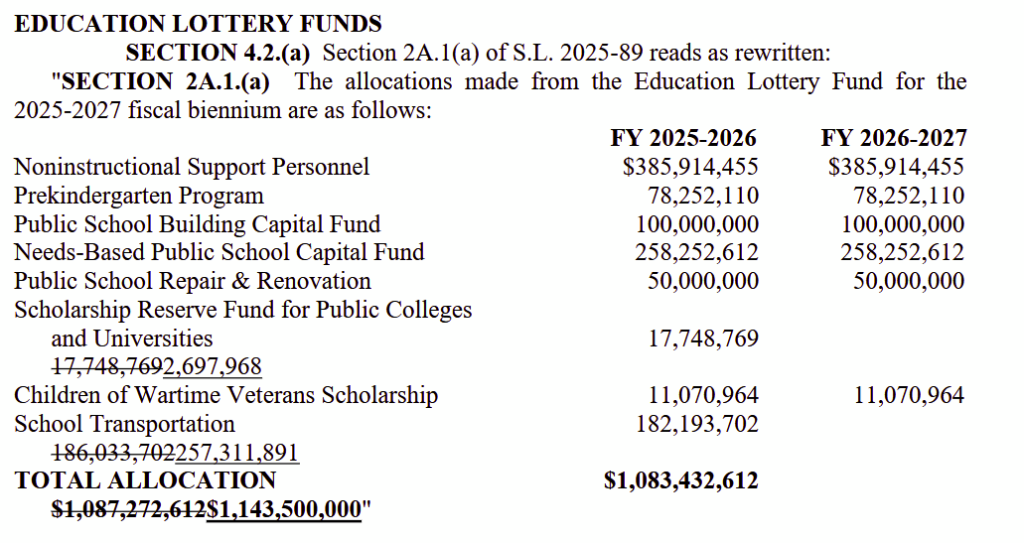
The budget largely keeps the same distribution of North Carolina Education Lottery (NCEL) funding from last year, which was outlined in last summer’s mini-budget. That includes lottery funding for $100 million to the Public School Building Capital Fund, $258 million to the Needs-Based Public School Capital Fund, and $50 million to Public School Repair & Renovation.
Meanwhile, lottery funding to the Scholarship Reserve Fund for Public Colleges and Universities is cut by about $15 million and lottery funding to School Transportation is increased by about $71 million.
Digital learning, innovation, and technology
- North Carolina will contract with Khan Academy at a cost of $2.5 million annually to provide the Khanmigo AI service, powered by ChatGPT, to grades six through 12. Read more about Khanmigo and the discussion about the program in a committee meeting here. The budget also includes $2.5 million to MagicSchool Academic Support Program, “a generative AI platform that supports students and provides AI tools for teachers.”
- The SBE is also instructed to adopt age-appropriate standards for instruction on AI literacy for grades K-12.
- The budget instructs DPI to develop a plan to transition all school districts to a single enterprise resource planning (ERP) platform under a statewide contract no later than Nov. 1, 2026.
- A nonrecurring $2 million allocation will go to the Educational and Competitive After-School Robotics Grant Program during the 2026-27 fiscal year. Schools can use up to $15,000 of grant money for purchasing robotics kits, making payments associated with participation in a robotics league, or providing transportation. See EdNC’s recent reporting on FIRST robotics teams in North Carolina.
- The Friday Institute at North Carolina State University is provided $400,000, nonrecurring, to “design, produce, and implement online training modules and resources for teachers related to artificial intelligence (AI).”
- The budget does not include funds for a one-to-one device refresh for student devices bought with COVID-relief funding.
Other items in the budget
- The budget includes a requirement that students be allowed to miss at least one hour per week of instructional time for religious instruction, provided off-campus by a private entity. Teachers must allow students to make up work missed during that time, the budget says, and school principals cannot authorize “excused absences totaling more than four hours of released time religious instruction in a single calendar week.”
- A grant of $3 million, nonrecurring, is provided to the North Carolina Community Schools Coalition “to establish or expand community schools programs across the State to increase academic achievement, improve school culture, and provide enhanced health and social support to students and families.”
- SparkNC, which offers CTE-related school-based labs, is expanded through an allocation of $4.5 million in recurring funds. This amount is less than what was included in a bill Lee previously said would expand SparkNC to every school district.
- The Reserve Fund for Early Graduate Scholarships is allocated $1 million, nonrecurring. The Early Graduate Scholarship Program will be a postsecondary education grant program for students who graduate from a public school within three years of entering ninth grade, to begin in the 2027-28 academic year.
- The budget provides $5 million to the NCSEAA to implement the Advise NC College Access Initiative, “which places college advisors in high-need regions of the State with the coordination of UNC constituent institutions and other partners. Funds expended for this purpose must annually be matched 1-to-1 with non-State funds.”
- The Extended Learning and Integrated Student Support (ELISS) competitive grant program is established in the budget “to fund high-quality, independently validated extended learning and integrated student support service programs for at-risk students that raise standards for student academic outcomes.”
- A provision in the budget instructs DPI to review school districts’ expenditures from specific state-funded allotments, and, if a school district has spent more than allotted, take action based on rules adopted by the SBE.
SNAP, Medicaid, Helene, and more
The budget includes more than $5.3 million to help North Carolina implement federal changes to the Supplemental Nutrition Assistance Program (SNAP), adjusting for requirements in H.R. 1, the 2025 federal budget bill. Starting in October 2026, North Carolina will be responsible for 75% of administrative costs, up from the previous 50% cost-share requirement.
In addition, the federal government previously covered 100% of SNAP benefits, but states will now have to share that cost based on their payment error rate, starting in October 2027.
North Carolina’s current payment error rate (PER) is 7.36%, a decrease from its 2024 rate of 10.21%. The state has taken significant effort to decrease its PER, and a continued effort for that purpose is reflected in this budget. According to analysis from the Food Research and Action Center, North Carolina will be subject to cover 5% of SNAP benefits, or a projected $153.5 million.
The budget explains that if the state’s PER results in a benefit cost-sharing fiscal obligation, a portion of each county’s sales tax allocation will be withheld and applied to the State’s FNS benefit cost share. The withheld portion of each county’s sales tax allocation will be determined based on their share of the payment error rate.
Some have criticized the fact that counties would be forced to absorb any future federal penalty costs.
“This budget does not provide state funding to help counties cover those costs,” said Executive Director of the NC Budget & Tax Center Alexandra Sirota, in a statement on the state budget. “Instead, legislative leaders would leave local governments to absorb the expense even as they seek to limit local revenue options this November through the proposed property tax levy limit amendment.”
The budget funds several IT enhancements for the state’s electronic case management system for SNAP and several new positions at the Department of Health and Human Services (DHHS), intended to support the administration of SNAP and understand what might be contributing to SNAP payment errors.
Roughly 1.4 million North Carolinians rely on SNAP, and funding allocations by the state and efforts to reduce the state’s PER have major implications for those residents’ continued food access.
SNAP also affects the ability for low-income students to receive free meals at school. The Community Eligibility Provision (CEP) allows eligible schools to serve all students free breakfast and lunch without collecting applications. As SNAP participation declines, fewer students will be directly certified for free meals, and schools will have to return to collecting applications, which are often difficult to get families to fill out.
Participating in SNAP also automatically enrolls children in SUN Bucks, a grocery benefit available in the summer.
The budget provides $5 million in state matching funds for SUN Bucks, which will subsequently earn $60 million in federal funding to provide summer food assistance to eligible children while school is out. Through the program, eligible children receive $120 during the summer break to pay for nutritious food.
Read more


Medicaid
The state budget funds the state’s Medicaid program, appropriating over $1 billion, including $847.2 million in state allocations. That rebase adjusts Medicaid funding based on changes in enrollment, costs, and federal match rates.
In April, Gov. Josh Stein had asked for $1 billion in Medicaid funding to cover the cost of sustaining the existing Medicaid program during fiscal year 2026-27. Later that month, House and Senate leaders announced they had reached a deal to put $319 million toward the state’s Medicaid rebase for the remainder of the 2025-26 fiscal year. This budget now tackles the rebase for 2026-27.
To support the non-federal share of Medicaid costs, the budget directs $200 million in nonrecurring receipts from the Medicaid Contingency Reserve to the Division of Health Benefits (DHB).
Furthermore, to decrease “fraud, waste, and abuse” and recover payments, it allocates $1.5 million to DHHS for the Government Data Analytics Center.
“While we’re glad we’re funding the Medicaid rebase requirements, this continues to be a cautionary tale of our increased health care costs we’re seeing across the state of North Carolina,” said Sen. Benton G. Sawrey, R-Johnston.
Below is a list of other Medicaid-related provisions in the budget:
- Strengthens oversight of certain high-growth Medicaid services by requiring health plans to establish closed networks for Peer Support, Research-Based Behavioral Health Treatment (RB-BHT), and Community Support Services.
- Increases Medicaid reimbursement rates to strengthen the Direct Care workforce serving individuals on the Innovations Waiver and those receiving Medicaid Personal Care Services.
- Creates 12 new positions at Medicaid’s Office of Compliance and Program Integrity.
- Appropriates $12.7 million to update the Medicaid Enterprise System to begin replacement of its legacy system in order to decrease enrollment errors.
Hurricane Helene
The budget adds $350 million to emergency response and disaster relief, and appropriates $706 million for Hurricane Helene-related items, including $450 million to cover the state and local share of costs for federal disaster recovery programs and $43 million to nonprofits for housing and private road or bridge recovery projects.
Property taxes
The state budget does not address a property tax loophole that has wreaked havoc on Wake County’s budget.
House Bill 1042, which has passed the House, would tighten requirements for an exemption meant for nonprofit affordable housing that allows some developments to avoid paying property taxes. That bill has not yet passed the Senate, and the language closing the loophole is not included in the budget.
Correctional officer pay
The budget substantially increases correctional officer pay, which comes during a dire shortage of correctional officers that, as EdNC has reported, is impeding the operation of prison education programs as well as basic prison operations. A 2025 report from the North Carolina Department of Adult Correction (NCDAC) said that some prison facilities are facing correctional officer vacancy rates as high as 50%.
Correctional officers will see a 13% raise in fiscal year 2026-27, bringing starting pay from between $37,621 and $41,558 to between $42,512 and $46,961.