
2026 budget includes funds for Propel NC, enrollment growth, and workforce programs for community colleges


Over a year after the original due date, lawmakers have passed a state budget. The North Carolina Community College System (NCCCS), amid enrollment growth and a pivot to a workforce-driven funding model, saw much of its legislative request met in the 2026-27 budget.
The budget appropriates a total of $1.86 billion to NCCCS, plus nearly $518 million in receipts. Among other things, the budget includes funding for Propel NC, the community college system’s proposed funding overhaul, along with pay raises for employees and funds for ApprenticeshipNC and other workforce programs.
“We are grateful to the General Assembly for its support and proposed investment in the North Carolina Community College System,” said Alex Fagg, the community college system’s vice president of government and external relations. “Propel NC will ensure our community colleges are equipped to meet the needs of all students and job creators across the state.”
On Thursday, July 8, the system said in a press release that the budget “delivers historic investment” in North Carolina community colleges.
 Sign up for Awake58, our newsletter on all things community college.
The budget includes an across-the-board 3% increase for all state employees, including most community college employees. There are also funds for a $1,750 one-time bonus for employees earning $65,000 or less and a $1,000 one-time bonus for employees earning more than $65,000.
In its legislative request for the short session, NCCCS asked for pay raises for community college staff and faculty “in line with state employee rates to ensure the recruitment and retention of a high-quality workforce.”
The budget also includes a one-time cost of living supplement to retirees of 2.5% in 2026-27, and funding toward the State Health Plan “to continue health benefit coverage for enrolled active employees.”
And there is $250,000 in additional funding for the system president’s compensation. A search for a new system president is currently underway, after former president Jeff Cox announced his retirement on Aug. 1, effective June 30.
Bill Carver is now the interim system president, as of Wednesday. State Board of Community Colleges (SBCC) Chair Tom Looney previously said he expects the interim president to serve at least until Sept. 1.
Here is the bill text, here is the money report, here is the technical corrections bill passed alongside the budget bill. After passing the budget, the General Assembly voted to adjourn until July 27.
Below, find the major community college-related provisions included the state budget.
EdNC’s other coverage about the new budget

Propel NC
The system’s legislative request focused on a block of $93 million in recurring funding for Propel NC, an overhaul of the system’s funding model.
The model’s goal is to move NCCCS toward a labor market-driven model of community college programs by prioritizing funding for high-wage, high-demand sectors. First launched by system leaders in January 2024, this marks the third time the system’s legislative funding request focused on Propel NC.
The budget includes $57.5 million in recurring funds for Propel NC’s “Workforce Tier Reorganization,” including $39 million to shift courses to higher value sectors and $18.5 million to create funding parity between workforce continuing education (CE) and curriculum programs.
The system’s request for $68.5 million in recurring funding to modernize the workforce sector funding formula was not fully met. However, this budget’s $57.5 million for that element of Propel NC is by far the largest included in any budget proposal to date.
Cox previously told EdNC that the system has planned for “several different scenarios that would work if we get partial funding.”
In a press release, Speaker of the House Destin Hall, R-Caldwell, said the budget “secures funding for the Propel NC workforce-driven funding model to ensure that North Carolina’s community colleges are prepared to meet the needs of all students and job creators.”
The system’s current funding model was created in 2010 and last updated in 2013. Under this model, the system allocates resources to the colleges in proportion to the number of full-time equivalent (FTE) students they enroll in each of their programs. Certain courses receive more state dollars than others based on a four-tier funding model.
Under Propel NC, funding based on FTE will remain in place, but the current FTE tiers will become “workforce sectors” instead. All curriculum and CE courses will reside in the same workforce sector, with sectors largely focusing on health care, technology, and trades.
Read more about Propel NC

The budget bill text says “the State Board of Community Colleges may revise its funding formula for community colleges and allocate funds under that revised formula, beginning with the 2026-2027 fiscal year.”
It adds that the Board “shall review and revise, as necessary, its workforce sector designations for curriculum, workforce continuing education, and Basic Skills courses at community colleges by July 15, 2029, and every three years thereafter.” NCCCS previously said courses would be ranked and valued by statewide salary job demand data.
“I could not be more excited to announce that this budget makes sure that our community college system aligns with industry,” said Sen. Brad Overcash, R-Gaston, on the Senate floor on Wednesday.
The budget also includes $6 million in nonrecurring funds to establish an enrollment increase reserve for community colleges with eligible enrollment increases that exceed budgeted enrollment levels — part of the NCCCS legislative request for Propel NC. The reserve is meant to help ensure stable funding for colleges which experience spikes in enrollment.
The budget does not include the $24.4 million in recurring funds requested to strengthen the system’s base funding and ensure colleges have the staffing, tools, and services “to support students and boost program completion.”
Enrollment growth
Beyond Propel NC, the system asked legislators for an estimated $102 million, nonrecurring, to fund “historic” enrollment growth.
The budget includes approximately $99.2 million to the system, “based on the change in college enrollment, which increased by 15,781 full-time equivalent (FTE) students, or 6.2%, compared to the amount budgeted for FY 2025-26.” Of that, $73.7 million is allocated through state funds and $25 million through receipts.
ApprenticeshipNC
NCCCS also requested $3.1 million, recurring, for ApprenticeshipNC, the state agency that registers apprenticeship programs and supports employers in setting up apprenticeship programs.
This request said the additional funding would backfill the loss of federal grants, allowing the agency to maintain the same staffing level and marketing capacity.
ApprenticeshipNC’s most recent annual report notes that U.S. Department of Labor grants supporting 65% of the agency’s operations were set to expire in June.
The budget includes $3.17 million toward ApprenticeshipNC “to support consulting services, communications and marketing, Community Colleges System Office (System Office) administration, and grant administration positions at ApprenticeshipNC.” The revised net appropriation is now $4.4 million for FY 2026-27.
The budget also directs ApprenticeshipNC to complete two studies on:
- The feasibility of designing and implementing state funding incentives for employers and sponsors to increase the availability of registered apprenticeship programs and improve apprentice enrollment, completion, post-completion education, and labor market outcomes. Due by Dec. 31, 2026.
- A plan to facilitate one or more expedited pathways for apprenticeship candidates to enter the teaching profession, in collaboration with the UNC Board of Governors, SBCC, DPI, and TeachNC. Due by March 15, 2027.
Workforce
The budget includes a number of other workforce investments, including $6 million to assist community colleges in starting high-cost workforce programs to meet workforce demands. The grant program requires community colleges to match a percentage of the total cash cost of the program with non-state funds based on a college’s total FTE, ranging from 5-15%.
There is also $1 million in nonrecurring funds to provide financial assistance of up to $750 per course for students who enroll in short-term workforce training programs that lead to an industry credential in fields with employer demand and competitive wages. The revised net appropriation for that item is now $2 million in FY 2026-27.
The budget also expands training programs for students with intellectual and developmental disabilities (IDD) to 10 more community college campuses through a $3.85 million recurring investment. The revised net appropriation is now $7.8 million in FY 2026-27.
Read more



Here is a look at other workforce-related items:
- $4.3 million, nonrecurring, to NCSEAA to “administer a nursing fellows pilot program at Western Piedmont Community College, Wayne Community College, and (Winston-Salem State University). The program will provide forgivable education loans and support services to nursing students who go on to serve as a nurse or nurse instructor in the State.”
- $5 million, nonrecurring, to the system office to contract with a third-party entity to implement digital wallet platforms across community colleges.
- $2.25 million, nonrecurring, to the system office to contract with third-party entities for a workforce diploma program that will assist adults aged 21 and older to obtain a high school diploma and develop employability and career skills.
- A one-time $1.5 million for Smart Start partnerships to launch child care teacher academies. The academies should prepare individuals to be lead child care teachers and may be located in Johnston and Wayne counties, the budget states, plus 10 other local partnerships to be chosen in collaboration with NCCCS.
- The establishment of North Carolina Economic Forecasting Initiative for the 2026-2027 and 2027-2028 fiscal years, located within the Kenan-Flagler Business School at UNC Chapel Hill. Among other things, the initiative will collect and disperse county-level economic data to “North Carolina policymakers, businesses, community colleges, economic developers, and other stakeholders.” Read more on page 225 of the bill text.
myFutureNC priorities
myFutureNC, the state’s attainment-focused nonprofit, asked lawmakers to fund its Workforce Act of 2026, an advocacy agenda “to modernize education-to-workforce pathways across North Carolina.” That agenda had requests for ApprenticeshipNC and Propel NC funding, included in the budget.
The Workforce Act also called for a one-time $1.5 million investment to improve the NCcareers.org website, which myFutureNC said is used by over a million North Carolinians to plan their careers. The budget includes $1.37 million “for DPI, in consultation with the Department of Commerce, to contract with Year13, Inc. to host the career development planning component accessed via the NC Careers website.”
myFutureNC also sought a nonrecurring $2.5 million investment “to improve transfer and reverse transfer systems,” and to improve the state’s digital transcript infrastructure by integrating North Carolina Independent Colleges & Universities (NCICU). The budget includes those funds, but does not include the provision regarding NCICU.
And the nonprofit requested a $1.35 million recurring investment in North Carolina Workforce Credentials to “enhance and update” the state’s list of credentials, expand financial aid, and increase enrollment in credential pathways. As mentioned above, the budget includes financial aid for short-term workforce programs, but it does not include operational support for NC Workforce Credentials.
The budget also includes a $7 million, nonrecurring, increase in funding for the NC Need-Based Scholarship for Private College Students.
Policy changes and more
While the overall investment in community colleges increased in 2026-27, the budget eliminates $18 million “from the Institutional and Academic Support allotment that are currently allocated to community colleges based on accountability measures and performance standards.”
Page 82 of the bill text clarifies that the budget reduces all performance funding with the exception of funds for basic skills.
Previously, the community college system received $24 million in recurring funds based on accountability measures and performance standards, with $18 million of that going through the institutional and academic support allotment. Now, following the reduction, the remaining $6 million goes toward basic skills.
Other reductions include:
- Reducing ERP funding by $3.5 million, though the budget says the SBCC may request additional funds “when the development of the new ERP system is complete. The revised net appropriation for this purpose is $4.8 million in FY 2026-27.”
- However, a separate item includes $25 million in receipts to upgrade ERP systems at individual colleges.
- Eliminating $810,000 provided for a program that aims to increase the progression and completion rates of minority male students. The initiative was renamed the Student Success Initiative in April 2025.
- Transferring nearly $785,000 for expanded mental health support for affected community college students to the Helene Fund.
The budget also adds the state’s Commissioner of Labor (or the commissioner’s designee) to the SBCC as an ex-officio member, bringing the board membership to 20 members.
And like K-12 schools, community colleges will also be required to provide students with phone numbers for the Suicide and Crisis Lifeline and the NC Peer Warmline.
Here’s a look at other policy provisions and allocations in the budget for community colleges.
- $10 million, nonrecurring, “to implement a system-wide CRM system, which will support enhanced functionality for recruitment, enrollment, and student engagement.”
- The SBCC must adopt a policy prohibiting state-funded scholarships or grants from going to “any student who has been convicted of assaulting an officer or employee of the State or any political subdivision of the State,” while enrolled as a student, beginning the semester or academic term following the conviction. This policy also applies to the UNC System.
- Under the budget, records related to disciplinary proceedings at public universities and community colleges — including records related to sexual misconduct with personally identifiable information — are now exempt from the state public records law. Read more on page 211 of the bill text.
- The budget codifies the North Carolina Patriot Star Family Scholarship Program, which provides “scholarships to eligible children and eligible spouses of certain veterans, eligible children of certain currently serving members of the Armed Forces, and eligible disabled veterans to attend eligible postsecondary institutions,” including community colleges.
- On page 564 of the bill text, the budget lays out powers of the SBCC regarding certain fee negotiations, contracts, and capital improvements.
Funds for individual colleges
The budget also includes a number of allocations for individual colleges or partnerships.
The system’s agenda requested funding for SBCC-approved multicampus centers at Alamance, Forsyth Technical, and Wake Technical community colleges. The budget includes $2 million for those centers.
There is also $3.75 million to Fayetteville Technical Community College and Wilkes Community College to “establish the Community College Seamless Skills Initiative to create a competency-based educational model connecting high school and community college.”
Regarding competency-based education, the budget also establishes the Competency-Based High School and Healthcare and High-Tech Pathways Program for the 2026-27 and 2028-29 school years. Mooresville Graded School District (MGSD) will partner with Mitchell Community College to implement the program.
The bill text says the program’s purpose is to “create pathways that will utilize competency-based education (CBE). Pathways will result in obtaining either an associate degree or an industry recognized credential/certification/licensure based on the student’s goal of employment or enrollment.” The budget includes $4 million for MGSD to contract with a “third-party expert.”
The budget also directs MGSD, Mitchell Community College, Wake Tech, Wake County Public School System, Fayetteville Tech, Wilkes Community College, and SparkNC to “collaborate to create a Competency-Based Education and High School Redesign Strategic Network for the 2026-2027 through 2029-2030 fiscal years.”
“The goals of the Network shall be to advance the goals of developing a CBE approach to education across the State,” the bill text says.
Here is a look at other individual allocations:
- $12 million, nonrecurring, to Wilson Community College to support the development of its biologics training center.
- $5 million, recurring, to Gaston College to support the operations of the Center for Applied Textile Technology. The revised net appropriation is $5.8 million in FY 2026-27.
- $4 million, nonrecurring, to Central Piedmont Community College to purchase public safety equipment for use in public safety training programs.
- $2 million to Blue Ridge Community College to be used for “repairs and renovations at the College’s campus in Brevard as well as for operating deficits due to enrollment loss at that campus.”
- $1 million to Southwestern Community College for roof repairs to the college’s Swain Center.
You can see more individual allocations for community colleges, laid out through special provisions in Section F of the budget, in the article below.
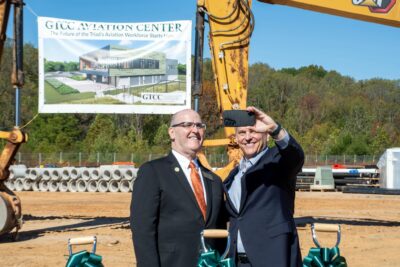
Guilford Technical Community College led the way among community colleges with $9.6 million for its aviation center. However, a technical corrections bill passed on Thursday reduced that amount by $2,123,000.