
Advocates tell lawmakers a property tax rate limit amendment could hurt public schools

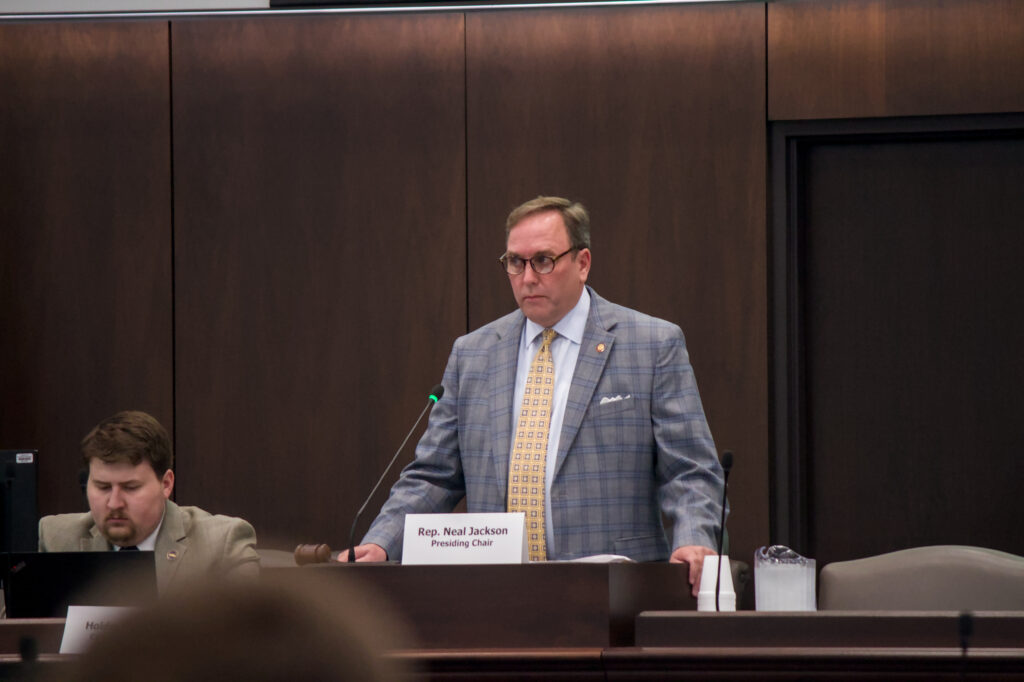
On Tuesday, the House Finance Committee moved forward House Bill 1089, which aims to amend the North Carolina constitution to require the General Assembly to limit local property tax rates.
Despite bipartisan sentiment that property taxes are too high, Democratic lawmakers expressed reservations about restricting local revenue while state funds don’t sufficiently cover programs like public education. Advocates from education organizations present at the committee meeting said the amendment would threaten local public school revenue at a time when the state legislature is leaving gaps that local governments have to fill.
HB 1089 advanced through the committee after a voice vote with no audible “no” votes. If the bill passes the General Assembly with a three-fifths majority in each chamber, the amendment would be put on a ballot measure that a majority of North Carolina voters would need to approve.
Later on Tuesday, Senate President Pro Tempore Phil Berger, R-Rockingham, told reporters during the announcement of a newly reached budget framework that both chambers will pass HB 1089.
“Both chambers want to deliver additional tax relief to the citizens of North Carolina, and other discussions will take place on other tax policy as we move forward with the budget process,” Berger said.
 Sign up for the EdDaily to start each weekday with the top education news.
The bill is a product of the House Select Committee on Property Tax Reduction and Reform (PTRR Committee), created by Speaker of the House Destin Hall, R-Caldwell, in December. Rep. Brian Echevarria, R-Cabarrus, a member of the PTRR Committee, said the amendment would ensure that property tax increases are “deliberate, transparent, and constrained,” and that “homeowners, renters, and business owners” are protected.
“Over the last five months, (the PTRR Committee) has done a lot on this. We heard extensively from staff, stakeholders, and subject matter experts,” Echevarria said. “The resulting debate led to the conclusion that asking the people whether they want a constitutional amendment requiring limits on property tax increases by local governments is the next step toward a modern, fairer, and more predictable property tax system.”
North Carolina law already limits the local property tax rate to $1.50 per $100 of appraised value. The average property tax rate was $0.58 per $100 in fiscal year 2025-26. No county had a tax rate over $1 per $100 of value.
The property tax rate is just one variable that affects how much property owners pay — the other is the value of their property. Property values in fast-growing areas of North Carolina have been surging in recent years, prompting more frequent revaluations by municipalities.
Another bill, Senate Bill 889, introduced by Berger, would target that second variable by putting a moratorium on property tax revaluations. SB 889 passed the Senate last week, with some Democrats voting yes.
“North Carolinians are shouldering the burden of massive increases in local budgets,” Berger previously said in a press release. “It doesn’t matter to our citizens if a tax is paid to the state or a local government; it’s their money coming out of their pockets.”
See EdNC’s previous reporting on property taxes in the article below.
What lawmakers are saying
During the committee meeting, Rep. Eric Ager, D-Buncombe, agreed that property taxes are too high but said high property taxes are a symptom of a problem caused by the General Assembly.
“The real challenge is what we’ve done here in this body to cut taxes for corporations and for other folks on the income side,” he said. “You know, when you squeeze the balloon up top, that balloon is going to pop out somewhere else, and right now it’s popping out in property taxes.”
Ager said education is the main thing affected by “less and less” state funding. Rep. Brandon Lofton, D-Mecklenburg, focused on the effect limited local revenue would have on education as well.
Lofton said the chair of the Charlotte-Mecklenburg Schools (CMS) Board of Education said that there are 700 teaching positions within CMS that are completely funded by the county.
“So that means, without the county stepping in to fill that gap, there’ll be 700 fewer teachers within Charlotte-Mecklenburg Schools,” he said. “The best way to relieve the pressure of property taxes is to stop shifting costs down to the county and down to local governments. (If) we want to be serious about addressing this issue, we need to stop shifting those costs onto property taxes.”
Rep. Tim Longest, D-Wake, agreed.
“I think that it’s important that we tackle property taxes and we make sure that people are able to afford to stay in their homes and to live there,” Longest said. “I also think it’s important that we take a square look in the mirror and do our own job to pass a budget so that counties are not forced to shoulder these burdens.”
Rep. Deb Butler, D-New Hanover, alluded to the political incentive Republicans have for lowering property taxes in an election year.
“I understand why levy limits are appealing politically — property taxes are too high,” she said. “The truth is, property taxes are not rising because cities and counties suddenly went on a wild drunken bend and started, you know, spending like sailors. It’s because of the cost shifting that we have done from this body.”
Rep. Keith Kidwell, R-Beaufort, supported the amendment but said it “really just brushes the top of the problem.” He said local governments have a “spending problem” and that “we need to limit what cities and counties can spend money on.”
“So I’m going to say to the committee, let’s vote ‘yes’ and move this out. Let’s go back to work and look at a deeper dive on how we truly bring the cities and counties into alignment with how money should be spent when you’re taxing,” Kidwell said.
Rep. Stephen Ross, R-Alamance, said the property tax issue still “needs a lot of work.” He said one contributing factor to high property taxes is an “unprecedented, one-time” surge in real estate prices caused by the COVID-19 pandemic and that the “real reason” for property tax increases is climbing real estate values.
“As we move this forward, I’m hoping that we can dig in and really get at the core issue and quit just throwing up the idea that it’s frivolous overspending on the part of local governments, because I don’t think that’s the case for the most part,” he said.
Money for schools and local control
During the public comment period, North Carolina Association of Educators (NCAE) President Tamika Walker Kelly connected the property tax amendment to the broader conversation around taxes at the General Assembly. How much to cut the personal income tax is central to the conflict between House and Senate Republicans that left North Carolina without a new state budget last year; meanwhile, the state’s corporate tax rate is scheduled to be eliminated by 2030.
NCAE has supported a bill that would raise the corporate tax rate in North Carolina to 5%.
“House Bill 1089 will take away one of the few tools that those communities have left,” said Kelly. “And when local revenue is constrained, schools feel it immediately: overcrowded classrooms, aging school buildings, and educators stretched too thin.”
“It is a very real dilemma that homeowners and property owners find themselves in, with the increase in property tax — but the solution is not to limit the role of local government,” Kelly told EdNC.
Joy Hicks, director of advocacy and policy for the North Carolina Association of County Commissioners (NCACC), was present at the meeting. NCACC represents county commissioners, local government officials whose autonomy would be limited by the constitutional amendment.
Hicks was concerned about the transfer of power from local governments to the state, and said property taxes are the majority revenue source that drives county governments and the services they provide to residents.
“There’s often been a policy around here that local governance is best,” Hicks said. “This is a change in that philosophy, and we regret that, because all 100 counties are very different. We have a saying that when you’ve been to one county, you’ve been to one county.”
The Public School Forum’s Local School Finance Study
Lauren Fox, interim president/CEO of the Public School Forum of North Carolina, said after the committee meeting that school districts are relying heavily on property taxes as a way to fund public schools, particularly in light of what she said is low state investment in public schools.
North Carolina ranked last in public school funding effort in an Education Law Center report released last year, and ranked 43rd in average teacher pay according to National Education Association (NEA) data — lower than all of its neighbor states.
The Public School Forum conducts a local school finance study each year “to examine the capacity and actual effort of counties to support public schools.” Fox said data from the most recent year revealed that 26% of total funding for operational costs for public school districts came from local governments.
She said that the proportion of school funding that has come from local governments has increased in recent years, after state funds didn’t replace an influx of federal funds that disappeared after the pandemic.
“Locals are filling that gap instead,” Fox said. “We have entire positions, many positions that are funded at the local level that could be in jeopardy, that could have to be cut if there are limits put on property tax rates.”
Fox said funding for public schools is increasingly important as costs rise and teacher recruitment and retention challenges persist.
“If the state is not going to step up and do it, then the locals need to have the ability to do so,” she said.