
Legislative preview | Teacher pay, school choice and funding, and more K-12 issues on the table this short session

What other K-12 issues are you paying attention to? Email me at hmcclellan@ednc.org to let me know.
In North Carolina, this year’s legislative session started last week — and it is not going to be a normal short session.
Last year, during the long session, North Carolina was the only state to not pass a new comprehensive budget due to disagreements between the Republican-led House and Senate. That means that in addition to normal short session items — bills that have passed one house and recommendations from a study commission — the General Assembly will also continue negotiations for a new state budget.
At the same time, the legislature is facing a major leadership shift. In November, Senate Pro Tempore Phil Berger, R-Rockingham, lost his Republican primary to Rockingham County Sheriff Sam Page. Berger — who has led the Senate for 15 years — continues his term in the General Assembly through December; a new Senate leader is expected to be selected in early 2027.
 Sign up for the EdWeekly, a Friday roundup of the most important education news of the week.
In March, the state’s nonpartisan Consensus Forecasting Group (CFG) released a revised consensus General Fund Revenue forecast for the 2025-27 biennium, showing that North Carolina has a projected surplus of $370 million in state revenues through Fiscal Year (FY) 2026, a 1.1% increase from the certified budget. For FY 2026-27, there is an estimated $951 million surplus, which is a 2.8% increase from the forecast.
While the forecast predicts growth in the general fund over the biennium, it cautions that FY 2026 is set to see “a 1% ($360M) decrease in revenues compared to the consensus forecast for FY 2025-26.”
The forecast says that previously enacted reductions in income tax rates will further reduce revenue collections in FY 2026-27. The Republican-led General Assembly previously passed a series of scheduled tax cuts to go into effect when certain triggers are met. Unless the legislature passes new rules, the forecast says anticipated revenue collections will automatically lower the personal income tax rate to 3.49% in 2027 and then to 2.99% in 2028.
Disagreements between the House and Senate about pay raises and personal income taxes led to the budget impasse last year.
While the forecast is positive news for the biennium compared to the May 2025 forecast, it doesn’t necessarily remove the cause of disagreements between the House and the Senate, according to budget consultant Dan Gerlach. After 2027, the effects of the tax triggers will also likely mean less revenue for the state.
Any surplus is good, Gerlach said, but much of the surplus will likely go toward additional state Medicaid funding, following federal funding cuts, and a raise for teachers and other state employees.
Last Tuesday, House and Senate leaders announced they had reached a deal to put $319 million toward the state’s Medicaid rebase for the remainder of the fiscal year. In North Carolina, more than 3 million people are enrolled in Medicaid, including students and their families.
As lawmakers consider pay raises — along with other needs across North Carolina — they will likely need to identify new sources of funding to fulfill mounting requests, particularly amid federal funding shifts.
Earlier this month, a recent decision by the N.C. Supreme Court also ended decades of school finance litigation, and in March, a bipartisan Blue Ribbon Commission on Public Education was formed to study teacher training and student advancement, administrative operations, educational leadership, and accountability.
Needless to say, there are a lot of variables likely to impact this year’s short session and budget process — and with them, which priorities get passed and funded concerning public education. Take a look at the issues EdNC is following in the subheadings below.
EdNC’s legislative previews

More on raises
Historically, education is the largest area of the state budget. In the 2023-25 budget, appropriations for education — including K-12, community college, and the UNC System — made up 58% of each spending plan. Of the $17.9 billion appropriated toward education in 2024-25, $12 billion went to the Department of Public Instruction (DPI) and K-12 items.
The state has traditionally funded most operational expenses, including salaries, in North Carolina. According to DPI’s latest “Highlights of the North Carolina Public School Budget” report, 93% of all the 2024-25 state expenditures by DPI went toward salaries and benefits. That’s a lot of money.
This short session, raises to those salaries are expected to continue to be a major budget discussion item. While DPI and the State Board of Education have a long list of requests for lawmakers this session, State Superintendent Mo Green recently urged lawmakers if they only have the capacity to focus on one thing, to focus on educator compensation.
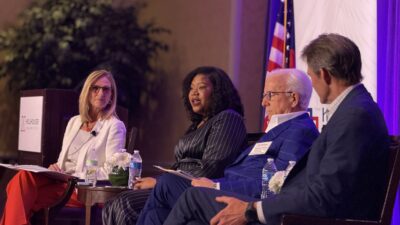
“I need us to now fund our educators,” Green said at this year’s annual Holshouser Legislators Retreat. (You can view all of DPI’s legislative requests here.)
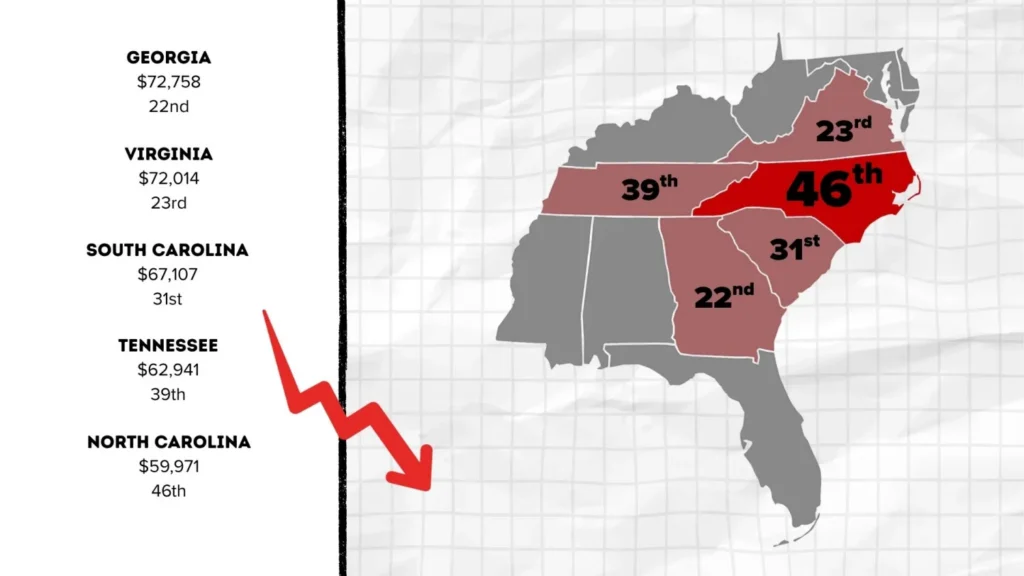
According to a 2026 report from the National Education Association (NEA), the average teacher salary — defined as base salaries plus local supplemental pay — was $60,323 last school year in North Carolina, or 43rd in the nation. North Carolina’s average teacher salary is behind all of its neighboring states. However, the report estimates that North Carolina has fallen three spots this school year to 46th nationally.
Average starting teacher pay is $44,952, per the NEA data, or 38th in the country. This ranking has improved in recent years, as the General Assembly has given higher raises to beginning teachers.
Still, according to the Reason Foundation, a libertarian think tank, from 2002 to 2022, teacher salaries in North Carolina dropped by more than 20% when accounting for inflation. And BEST NC recently estimated that 51,000 out of 101,775 teachers across the state did not earn a living wage in 2023-24, using the MIT Living Wage Calculator.
This year, DPI and the State Board’s top legislative priority for fiscal year 2026-27 is to strengthen public schools by raising all public school employees’ pay, with the goal of having the highest teacher salaries in the Southeast.
“I have multiple teachers that work multiple jobs — Walmart, Costco, Old Navy, gas stations,” Jason Johnson, the 2025 Wells Fargo Principal of the Year and adviser to the Board, said in December. “Teacher pay has to be a focus.”
Last long session, the House and Senate separately proposed teacher raises in their proposals. The Senate’s proposal included an average 2.3% pay increase for teachers in FY 2025-26 and an average increase of 3.3% over the biennium, along with a $3,000 bonus. The House called for an average 8.7% raise for teachers, with higher raises going toward beginning teachers — a nearly 22% raise.
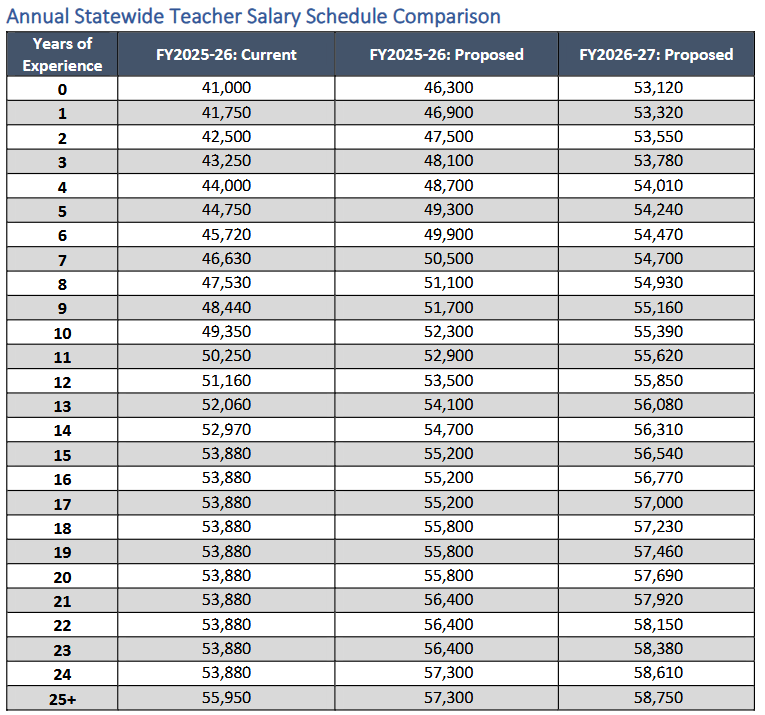
Gov. Josh Stein released his budget proposal for FY 2026-27 last week, calling for an average 11% pay raise for teachers, and bringing starting teacher pay to the highest in the Southeast.
Starting teacher base pay is currently $41,000 in North Carolina. Under Stein’s proposal, that would rise to $53,120 by fiscal year 2026-27. During the same time period, teachers with 25 years or more of experience would go from making $55,950 to $58,750.
You can see Stein’s proposed salary schedule below:
Advanced teaching roles and master’s pay
As a reminder, teachers can earn more on top of their base salary through local supplements and local and statewide bonuses.
One of those initiatives is the Advanced Teaching Roles (ATR) Program, which was implemented by 26 districts during the 2024-25 school year. The program enables highly effective teachers to earn additional pay by taking on more students or mentoring fellow educators. These roles include Adult Leadership teachers, who oversee small teams and earn supplements of at least $10,000, and Classroom Excellence teachers, who teach more students and receive a minimum supplement of $3,000.
That program has faced funding issues, however. For example, a Friday Institute report found that, despite high median supplements, some districts are offering supplements as little as $1,000. Last fall, DPI officials said the number of advanced teachers in some districts has outpaced the funding available to provide the full supplements.
This short session, DPI is asking for funds to meet funding demands while also expanding the program.
Brenda Berg, president and CEO of BEST NC, advocated for funding to ATR at a Joint Legislative Education Oversight Committee meeting earlier in April. Berg said the total cost of ATR, if implemented across the state, would be $200 million.
Stein’s budget included $38 million for over 3,200 new ATR salary supplements and $2 million for design and implementation costs. His proposal says “advanced teachers create a multiplier effect to improve quality school-wide by coaching novice teachers and reaching more students.”
During the long session, the Senate included additional funding for ATR supplements; the House did not.
Another long-discussed issue in the budget is master’s pay, which includes a 10% monthly supplement for teachers with advanced degrees in the subject they teach. The last few sessions, the House has included master’s pay funding in its proposals, but the Senate has not. Master’s pay was funded statewide in North Carolina until 2013.
Stein’s proposal also included funding to restore master’s pay.
Read more

School funding and choice
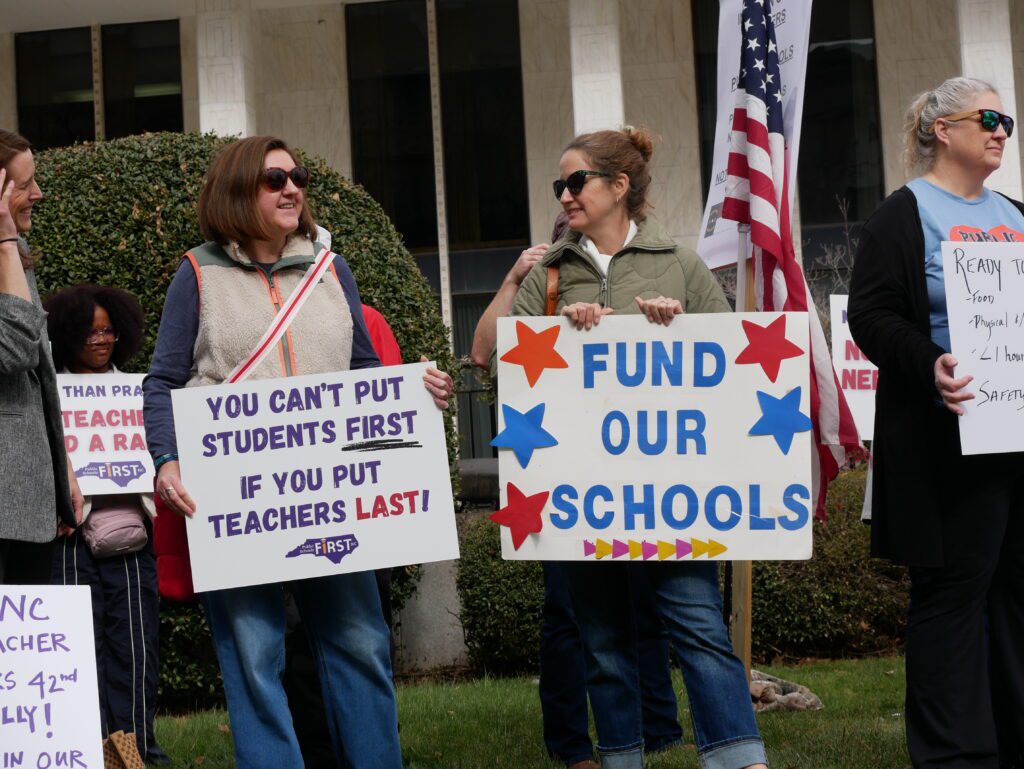
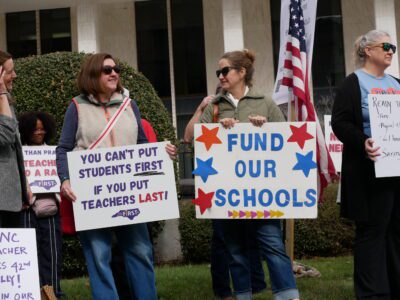
This year, the N.C. Association of Educators (NCAE) is planning “the biggest march for public education North Carolina has ever seen” on May 1 from 10 a.m. to 3 p.m. on the Halifax Mall in downtown Raleigh.
According to a press release from NCAE, the marchers will be “demanding increased funding for public schools, accountability for voucher spending, and an end to policies prioritizing tax cuts over students.”
In February, NCAE released a report outlining “a vision for what North Carolina’s public schools could achieve with full, sustained investment.” Among other things, the report calls for rolling back tax cuts and the expansion of private school vouchers through the Opportunity Grant Scholarship Program.
In 2023, the N.C. General Assembly passed a state budget including what Republicans called the “largest expansion of school choice” in 10 years. Among other things, that budget expanded funding for the program and eligibility for awards to families from all income levels. Later, the General Assembly passed additional funding to effectively clear the waitlist for vouchers.
DPI and the State Board are also asking lawmakers to pause the expansion of funding for Opportunity Scholarships. They are asking lawmakers to “redirect the funding appropriated for new Opportunity Scholarships for the 2026-27 fiscal year to addressing needs in our public schools.”
“Future funding increases for the Opportunity Scholarship program should be limited to the annual percentage increase in funding for the State Public School Fund,” the Board’s presentation on legislative requests says.
Stein’s budget proposes winding the voucher program down by not providing any new awards. Under his proposal, only families with children in grades K-12 making 150% or less of the eligibility income would be able renew their awards.
While it is unlikely the Republican-led General Assembly will fully stop providing new awards for vouchers, it is possible — particularly given funding pressures — that smaller policy changes are made.
Disagreement regarding universal vouchers was a prominent issue in the recent election between Berger and Page, for example.
Ray Gronberg with the N.C. Tribune reported that Page’s campaign website said he believes school “vouchers should be targeted to families who need them most.” That means, writes Gronberg, “income caps on school voucher eligibility to help working families, not the wealthy,” and “policies to prevent private schools from inflating tuition due to vouchers.”
Another possible voucher-related item that could come up this session is the reinvestment of “any savings realized by the State each year, beginning in the 2025-2026 school year” by the General Assembly, as laid out in the 2023 budget. This “savings” refers to differences between the voucher funds awarded and the average state per-pupil allocation for students enrolled in public school units.
A 2025 report from DPI found that 5,955 students received scholarships in the fall or the full 2024-25 school year. This group collectively received $34.4 million in Opportunity Scholarships. In comparison, the report found the average per-pupil allocation for this group would have been $44.5 million if those public school students hadn’t left.
“The amount needed for reinvestment in FY 2025-26 is $10,092,663,” the report says.
Spring-only recipients received about $2 million in voucher funds, but the report did not factor that funding into the recommended savings number. The savings numbers for the 2025-26 school year have not been published yet.
Read more
School choice through public schools is also likely to be a topic of discussion. In recent years, Republican lawmakers have passed legislation that grants charter schools greater flexibility and oversight.
In the past, charter school applications were reviewed by the Charter School Advisory Board, which recommended to the State Board of Education which ones should be approved or denied.
Following a change in 2023 law, the Charter Schools Review Board (CSRB) was created and now has sole authority to review, approve, deny, and renew charter applications. Last long session, Session Law 2025-80 further strengthened the authority of the CSRB and gave charter schools more operational flexibility.
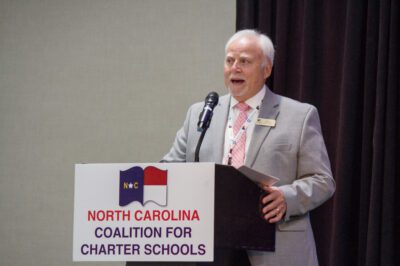
The North Carolina Coalition for Charter Schools’ legislative agenda this year include three priorities: fair funding, oversight and accountability, and autonomy and flexibility.
While charter advocates recently said they were optimistic about recent regulatory changes, some members expressed the desire for further streamlined regulation, citing disagreements with the State Board.
At the coalition’s March advocacy summit, a federal education official also encouraged North Carolina to enroll in the federal school choice tax credit program introduced by the Trump administration last year. The General Assembly passed a bill, House Bill 87, enrolling North Carolina, but it was vetoed by Stein.
The official said the tax credit doesn’t just apply to students in private schools, but traditional public schools and charter schools as well. Allowable uses of the credit include tutoring services, services for students with disabilities, and homeschooling materials.
When Stein vetoed the bill, he said that while he supports school choice, he does not agree with funding private school choice initiatives while “cutting public education funding by billions of dollars.”
“However, I see opportunities for the federal scholarship donation tax credit program to benefit North Carolina’s public school kids,” said Stein. “Once the federal government issues sound guidance, I intend to opt North Carolina in so we can invest in the public school students most in need of after school programs, tutoring, and other resources.”
House Bill 87 has been scheduled multiple times for a veto override, but it has ultimately been removed from the calendar each time. It is eligible to be taken up this session.
Read more
Property tax changes and school closures
Ahead of the short session, House Speaker Destin Hall, R-Caldwell, said the North Carolina House Select Committee on Property Tax Reduction and Reform had recommended a state constitutional amendment that would place limits on local property tax increases. If passed by the General Assembly this session, the amendment would be placed on the statewide ballot in November.
According to the press release, the proposed amendment would require the General Assembly to “enact property tax levy limits, preventing local governments from increasing property taxes beyond a certain threshold, likely tied to inflation and population growth.”
“Property tax hikes are overburdening North Carolina families, who are footing the
bill while some local governments take in far more than inflation and population growth can justify,” Hall said. “I applaud the House Select Committee on Property Tax Reduction and Reform for pursuing real reforms like the constitutional amendment on levy limits, which would ease this burden so North Carolinians can keep more of their hard-earned money.”
But lower property taxes, as EdNC previously reported, could represent losses to students and communities, particularly as districts face federal cuts and uncertain state funding. North Carolina public schools receive more than $4 billion in local funds, the majority of which come from property taxes. As the primary funding source for local governments, property taxes also fund infrastructure, public safety, and other essential services.
EdNC will be covering the possibility of a constitutional amendment to place limits on property tax increases, and the potential losses to students and schools such limits could pose.
At the same time, many school districts across the state are facing budget challenges, with several considering school closures. EdNC will also be looking out for any state legislation concerning school district mergers and school closures.
Literacy and math instruction, curriculum
DPI and the State Board are again asking for additional funds to improve literacy and math instruction.
Those asks include:
- Expanding DIBELS Diagnostic to fourth and fifth grades (estimated $1.4 million recurring and $966,508 nonrecurring).
- Expanding literacy professional development and support to middle grades ($15.4 million recurring and $25 million nonrecurring).
- $44 million for a K-8 math screener.
- DPI flexibility for placement of early literacy specialists helping with Science of Reading implementation.
Stein’s proposal includes $15 million recurring and $23.6 nonrecurring to expand the early grades literacy initiative to sixth through eighth graders.
Stein, DPI, and the State Board also requested funding to continue support for North Carolina’s low-performing schools.

While local districts have control over instructional materials, DPI and state lawmakers set rules and guidelines about curriculum.
In 2023, Session Law 2023-106, known as the “Parents’ Bill of Rights,” banned curriculum on gender identity, sexual activity, or sexuality in kindergarten through fourth grade. The law also requires schools to notify a parent about their child’s physical and mental health, including any school health care services they use, changes to their well-being, or requests to change a student’s pronouns; and allows parents to review all curriculum and establishes remedies and timelines for parental concerns.
In December, members of a House committee told leaders of the Chapel Hill-Carrboro City Schools they had defied provisions in the law, and to expect legislative retaliation.
Last Thursday, the House oversight committee continued discussion of the law with Chapel Hill-Carrboro City Schools, regarding 155 library books that Republican leadership says are “currently embedded across your elementary schools, in direct conflict with the Parents’ Bill of Rights.”
Finally, diversity, equity, and inclusion (DEI) initiatives in education may also resurface this session.
In summer 2025, Republicans in the North Carolina General Assembly passed three bills that would ban DEI in public schools, higher education institutions, and state agencies.
Stein, a Democrat, vetoed the three anti-DEI bills, Senate Bill 227, Senate Bill 558, and House Bill 171, on July 3. So far, the vetoes have not been taken up for final overrides, though the bills have been calendared multiple times.
Technology
House Bill 959, which passed in summer 2025, included a provision limiting student cellphone use during instructional time, went into effect on Jan. 1 and has been praised by educators across the state. It is possible lawmakers propose additional provisions.
It is also likely that lawmakers discuss the usage of Artificial Intelligence (AI) in schools. Already this week, three Democrats filed a bill that would require the State Board of Education to “adopt standards for age-appropriate instruction on artificial intelligence (AI) for kindergarten through grade 12.”
Related to technology, DPI is also asking for funds for a one-to-one device refresh for student devices bought with COVID-relief funding, school cybersecurity support, and school business systems modernization.
School funding and accountability
In April 2023, Senate Republicans filed Senate Bill 670, which would abolish “all funds, grants, allotments, and other sources of funding that expend their funds from the State Public School Fund,” to enact a weighted student funding model.
That proposal did not make it into the 2023 budget. However, the bill text of the budget did direct DPI to study and create a weighted model for Exceptional Children (EC) students. The model should fund children “on the basis of the reported cost of services provided.” DPI was required to report back to lawmakers by Jan. 15, 2024 with such a model, along with a comparison to funds under the existing model.
In 2025, DPI and the State Board asked for $229.8 million to implement the weighted model for EC students. Partial funding for the model was included in the House proposal last year and the governor’s proposals.
This short session, DPI and the State Board are asking for nearly $120 million — made up of recurring and nonrecurring funds — to implement the model.
According to DPI, a weighted model would “generate varied funding based on the weights applied to the service level categories rather than a fixed level per student.” It would also “generate funding and a distribution of that funding to more closely align with the students and their service delivery needs.”
While implementing a new model is expensive, as the General Assembly continues discussions around expanding school choice, it is possible that lawmakers again bring up weighted student funding, which many school choice advocates say funds individual students, rather than school “systems.”
DPI and the State Board are also asking for $117 million toward the Needs-Based Public School Capital Fund and $25 million to Public School Repair and Renovation Fund, to help address both the nearly $13 billion in school construction needs.
Read more
Last October, the State Board created a task force to redesign North Carolina’s accountability system.
In North Carolina, school performance grades are determined using a formula that assigns 80% of the score to achievement indicators, such as standardized test results, and 20% to measures of student growth. Education leaders have said for years that this calculation does not reflect the full scope of work taking place in the state’s public schools.
DPI has long discussed the issue, and in 2024, created a plan to redesign school performance grades during former state Superintendent Catherine Truitt’s tenure. Though lawmakers proposed legislation last long session moving forward parts of the plan, it was never turned into law.
Although DPI’s current task force doesn’t plan to present its new recommended model to the State Board until May 2027, it is possible lawmakers revive previous school accountability proposals.
You can view all of EdNC’s reporting on school performance grades here.
Student safety, well-being, and access
In recent years, the General Assembly has allocated funds for school safety grants. This session, Stein’s proposal includes $20 million to school districts for equipment including cameras, exterior locks and fences, weapon detection, and metal detectors.
Stein’s proposal also funds School Resource Officer (SRO) positions, including $50 million to place one SRO in every middle school.
There is also $32 million to fund 360 new school health personnel positions, which include support staff like counselors, psychologists, nurses, and social workers. Stein’s proposal says this investment will move North Carolina toward the recommended ratios for the positions in schools, the proposal says.
“Research consistently shows that these roles help reduce absences and disciplinary issues and contribute to improved academic outcomes,” his proposal says.
DPI requested roughly double that amount for school health personnel, at $64.3 million. DPI and the State Board also requested funding for universal free breakfast and lunch for students, which they said would cost $377 million.
Stein’s budget calls for universal breakfast at no cost to students. His proposal also allocates $5 million in state funds for the Summer Electronic Benefits Transfer Program for Children (SUN Bucks) program, which would allow North Carolina to receive federal matching funds.
Finally, the governor’s budget allocates $15 million to ensure North Carolina can continue to operate the Supplemental Nutrition Assistance Program (SNAP) following federal funding cuts.
In a statement, NC Alliance for Health Executive Director Abby Emanuelson praised Stein’s investment in Medicaid and nutrition programs.
“Governor Stein’s recommended budget sends a clear and welcome signal: smart, targeted investments in nutrition and public health deliver real, measurable benefits for North Carolina families,” Emanuelson said. “We urge the North Carolina General Assembly to fully fund these priorities, which together represent a practical, proven approach to improving health, reducing hunger, and building a stronger North Carolina.”
Read more

Finally, EdNC will be tracking any state responses to federal shifts concerning access to education for all students.
For more than 40 years, students without legal status have been allowed to attend public schools free of charge in districts across the United States, and over time that has included access to early education and postsecondary opportunities.
The 74 reports, “From cradle to career, President Donald Trump has launched a comprehensive campaign to close off education to undocumented immigrants, undercutting, advocates say, the very reason many came to the United States: for a chance at a better life.”
Read more
Other issues to look out for
Here is a list of other issues we will be paying attention to:
- Funding for recovery from Hurricane Helene, particularly for schools.
- Additional legislative funding for the State Health Plan, which provides coverage to nearly 750,000 teachers, charter school employees, community college employees, other state employees, retirees, and dependents
- Principal pay reform, which has previously been discussed by lawmakers and is part of DPI’s legislative request.
- State responses to the dismantling of the U.S. Department of Education. Already this short session, a group of Republicans have filed a resolution calling for members of Congress to “support the devolution of power from the U.S. Department of Education to the states.”
- Efforts to increase dual enrollment participation and career exploration from an earlier age and to grow NC College Connect, which offers eligible students direct admission to participating colleges and universities.
- Continued debates around calendar flexibility for schools, and district requests for funding and remote instruction flexibility following inclement weather.
- Bills to increase the number of partisan elections of school board of educations.
- Efforts to implement competency-based education.
- What happens to a previous $500 million allocation to NCInnovation, a nonprofit that helps university researchers turn their work into business ideas. Awarded in 2023, lawmakers have since proposed using that allocation to support Helene recovery or a new children’s hospital.
Behind the Story
This article includes reporting from Ben Humphries, Mebane Rash, and Sergio Osnaya-Prieto.