
Bill to explore weighted student funding model passes Senate education committee — and other news from the legislature
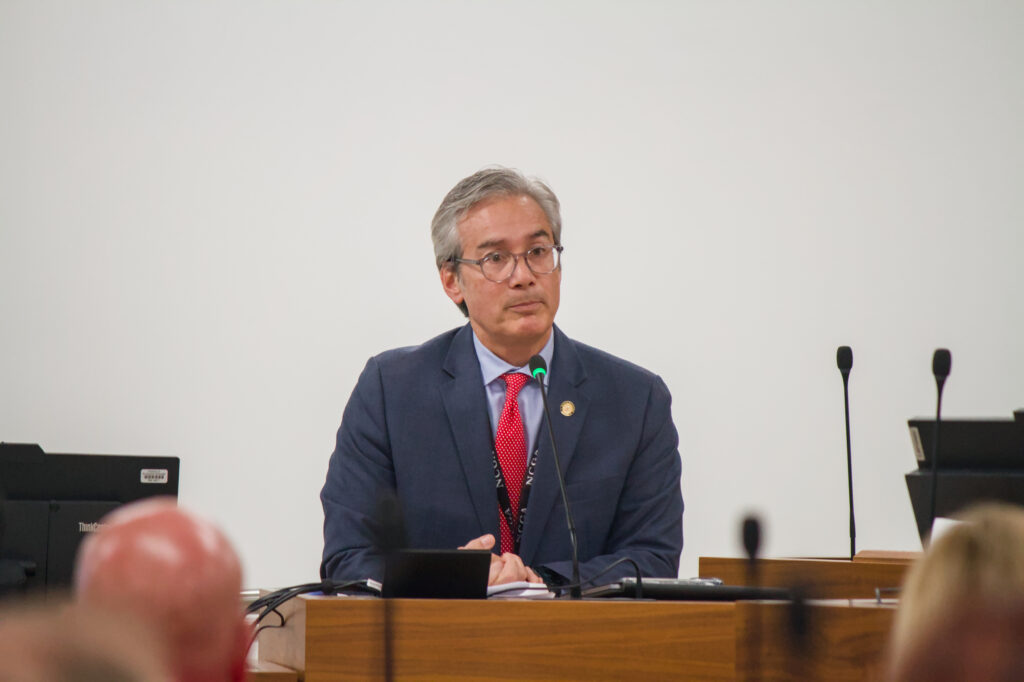
The Senate Education/Higher Education Committee advanced three bills on Wednesday, including one that would fund a work group to examine how North Carolina could implement a weighted student funding model. North Carolina’s current funding model for schools uses a hybrid of a resource-based and program-based allocations.
Student-based funding models have been on the rise in school systems across the country. Sen. Michael Lee, R-New Hanover, who sponsored a bill in a previous legislative session that would have established a weighted student funding model, introduced Senate Bill 990 to the committee.
SB 990 instructs the Office of Learning Research (OLR) at the North Carolina Collaboratory to establish a work group of “experts in public education finance,” including the Department of Public Instruction (DPI) and Business for Educational Success and Transformation (BEST NC), and other unnamed stakeholders. The group would be tasked with exploring the following:
- Options to do at least the following under the new funding formula:
- Consolidate non-teaching support funds into a per pupil-based allotment with significant flexibility.
- Transition teacher pay from a position allotment to a dollar allotment based on average daily membership in order to maintain student-based funding with greater average teacher pay transparency and flexibility.
- Reassign all project- or resource-based funding into a set of designated line items.
- Determine whether need-based funds can be consolidated and transitioned into a per-pupil figure.
- Report on spending and provide any other needed accountability for the use of state funds.
- Whether to transition from DPI to the North Carolina State Education Assistance Authority (NCSEAA) the responsibility of disbursing any funds to local school administrative units.
“A weighted student formula is incredibly important,” Lee said to the committee. “We need to move forward with it.”
 Sign up for the EdDaily to start each weekday with the top education news.
Lee said the work group laid out in SB 990 would be a first step. He envisions a weighted student funding model being phased in and having a “kind of status quo to make sure no (local education agency) is losing.”
Over the past two years, the Public School Forum of NC has “convened a large and representative working group of more than 80 education leaders, including superintendents, school finance officers, representatives from both chambers and both sides of the aisle in the NC General Assembly, and statewide education associations and nonprofits to build understanding and gather input on a potential shift to a weighted student funding model in NC,” according to a statement from the Forum.
The Forum partnered with Bellwether Education Partners, a national organization that has supported other states in the design and implementation of weighted student funding systems, and brought in experts from other states that have recently shifted to a weighted student funding model.
Informed by the priorities and input of the working group members, the Forum also gathered comprehensive school funding data and ran multiple weighted student funding model simulations to show the potential cost and impact of a variety of model scenarios on school district budgets.
The goal of this working group was to create an inclusive and data-informed process to ensure that any major changes to our school funding system are informed by a wide range of stakeholders perspectives. Together, the working group agreed on a set of guiding principles, priority weights, and recommended non-negotiables to consider if North Carolina moves toward implementation of a weighted student funding model.
— Public School Forum
Sen. Sophia Chitlik, D-Durham, asked Lee about the outcome of that work group, which included BEST NC. Lee acknowledged the work group and said that any groups involved in that work could be included in the work group laid out in SB 990.
Chitlik expressed concern about the second task for the SB 990 work group: determining whether to transition to the NCSEAA the responsibility of disbursing funds to school districts. Currently, DPI disburses funds to school districts.
NCSEAA is the state agency designated by law to administer K-12 scholarship programs, including Opportunity Scholarships and Education Student Accounts.
“It may come back that it’s not a good idea,” Lee said. “But until we look at something, we can’t determine if it works or not. So that’s all this is doing.”
The bill includes $300,000 in nonrecurring funds to the Collaboratory for the OLR to establish the work group to “develop a strategy to transition North Carolina to a weighted student funding model.”
Two other sections are included in SB 990. One would exempt personally identifiable student disciplinary records from North Carolina’s public records law, which Lee said aims to protect not perpetrators of harm, but victims.
The final section would instruct NCSEAA to run a “student-based educational wallet pilot program” with one school district “to establish a streamlined process for students to participate in credit-bearing activities.”
SB 990 passed the committee after a voice vote.
Math instruction, I/DD workforce training, and teacher apprenticeships
Two other bills passed the committee on Wednesday: Senate Bill 1044, the “Foundational Mathematics Act,” and Senate Bill 991, the “Community College Workforce Readiness Act.”
SB 1044, among other things, would require school districts to provide high-quality math instruction in grades K-8, would provide for math screening in those grades, and would require districts to implement math success plans for struggling students. The bill includes $21 million in recurring funds that would go to DPI to implement the requirements for districts.
SB 991 includes funds to expand a training program for people with intellectual and developmental disabilities (I/DD) from 15 to 25 community colleges, and would direct ApprenticeshipNC to collaborate with DPI and other groups on a study of expedited pathways for teacher apprenticeships.
House and Senate announce beginnings of a budget deal
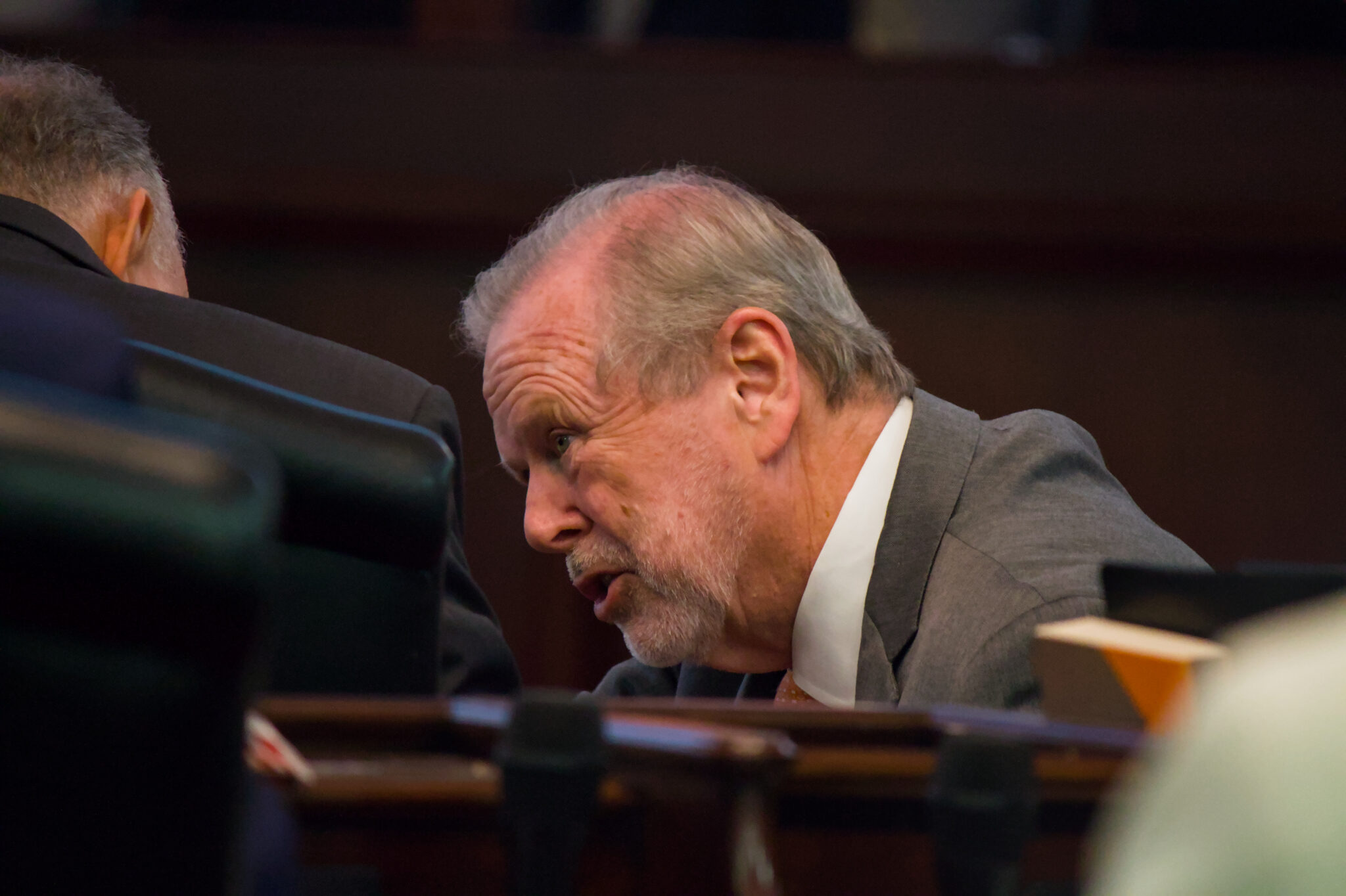
Speaker of the House Destin Hall, R-Caldwell, and Senate President Pro Tempore Phil Berger, R-Rockingham, held a press conference on Tuesday to announce the beginnings of a budget deal. The deal comes after House and Senate Republicans failed to compromise on a state budget last year.
“This is a starting point. There’s still a lot that will need to be decided and discussed between the two chambers, but this agreement sets out a good framework for us to move forward,” Berger said. “I’m hopeful that as we begin the full budget conference process, we’ll be able to move quickly.”
Later, while talking to reporters, Berger said he expects a vote on the budget deal in mid-June.
Hall said the budget will be an “unprecedented” budget for education. He said the average pay raise for teachers will be 8% — later clarifying that raises would not be retroactive and will go into effect shortly after the budget bill is passed. He said teachers with over 16 years of experience would receive a bonus of $1,000 and teachers “under that experience level” would receive a bonus of $500.
Berger said the budget will bring starting pay for teachers to $48,000 before supplements.
The leaders said their compromise hinged on a promise to pass two bills that would put constitutional amendments to North Carolina voters: one requiring the General Assembly to limit property tax rate increases, and one capping North Carolina’s income tax rate at 3.5%.
Earlier the same day, the amendment to limit property tax rate increases passed the House Finance Committee after Democrats and advocates voiced concerns. Read EdNC’s coverage below.
The degree to which to cut taxes was central to the budget conflict between the two chambers. The deal announced by Berger and Hall would maintain the complete phaseout of the corporate income tax by 2030 and set a new schedule for income tax cuts.
Gov. Josh Stein released a statement on the latest budget negotiations: “It is past time that our teachers, state law enforcement officers, and state employees get a meaningful pay raise and recognition for their service to the people of North Carolina. Today’s announcement is only a framework, but if the final budget actually includes real salary increases, it would be welcome.”
He added, “The proposed constitutional amendment would put North Carolina in a financial straight jacket that could wreak havoc on our public schools and public safety. If we want to continue to be the best state to live, work, and raise a family for years to come, we must be fiscally responsible and not make working families bear an unfair burden.”
State Superintendent Mo Green posted a statement about the budget framework on social media, saying he was grateful it “includes meaningful pay increases for our public school educators.”
The North Carolina Association of Educators (NCAE) released a statement criticizing the budget framework, including its lack of back pay; and the corporate income, personal income, and property tax policies that are part of the deal.
“North Carolina’s teacher salaries are more than 25% behind the national average. After 3 years without passing a budget, 8% won’t cut it,” said Tamika Walker Kelly, NCAE president, in the statement.
Bipartisan group of House members introduces bill on teen mental health
Editor’s note: This section mentions suicide. If you or someone you know is experiencing a mental health crisis, call or text 988 or chat with the 988 Suicide & Crisis Lifeline at 988lifeline.org.
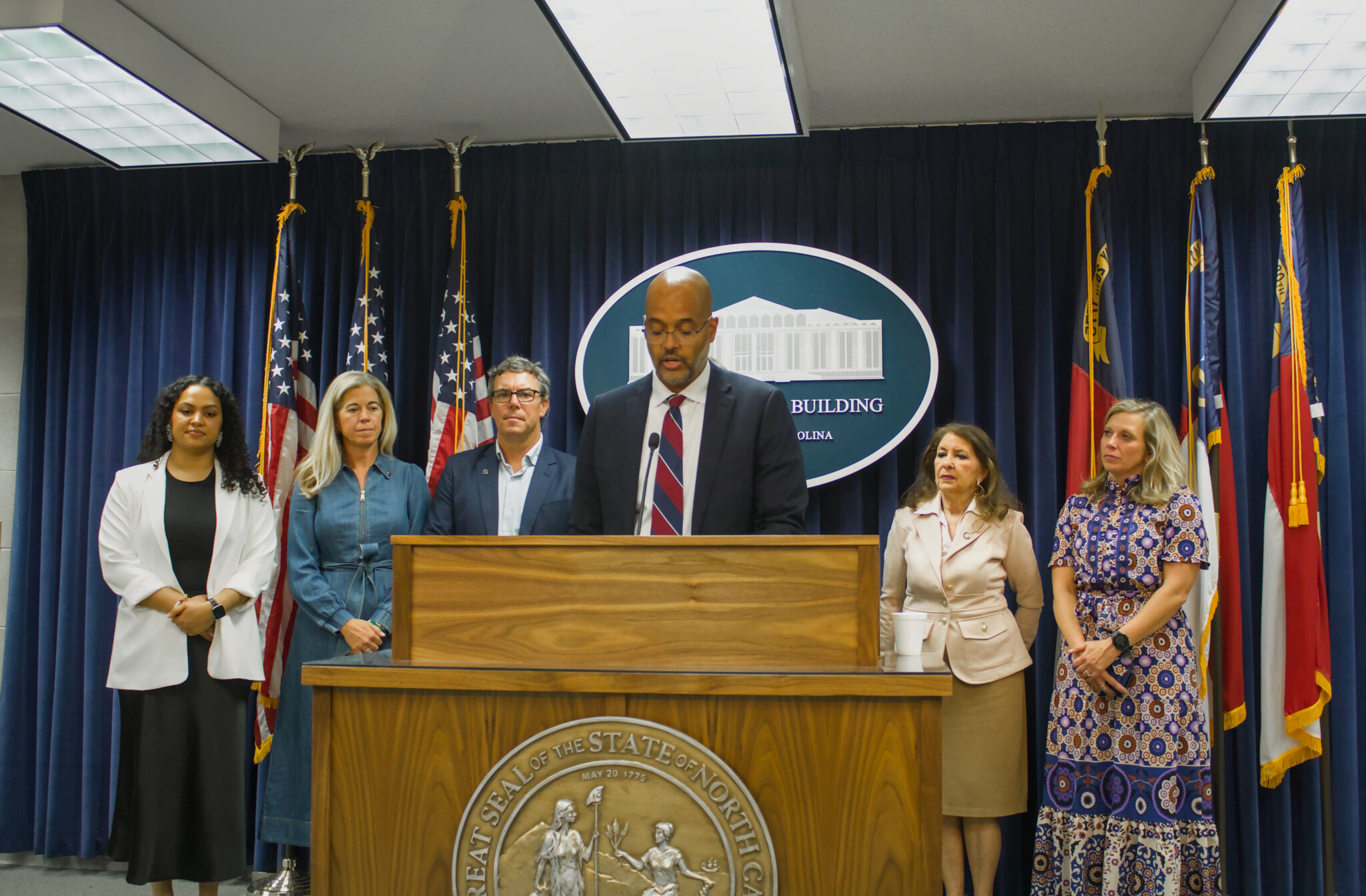
On Wednesday, Rep. Brandon Lofton, D-Mecklenburg, held a press conference alongside Republican and Democratic colleagues introducing House Bill 1159, titled “Investing in Teen Mental Health.”
The bill would appropriate nearly $1.3 million to expand access to Youth Mental Health First Aid training and Teen Mental Health First Aid training. Lofton said the training would reach an 15,000 more students in 75 additional high schools.
The lawmakers were joined by parents from Charlotte who lost their son Parker to suicide. Parker’s mother, Danielle South, said Parker was the last person you would have ever thought to be in crisis.
“And we truly believe that because of the lack of conversation and education, and because of the stigma surrounding mental health, that Parker did not know that what was happening to him was a health issue, and that it was temporary, and that it could be fixed,” she said.
Rep. Donna White, R-Johnston, said that she has seen students struggle firsthand through her work as a nurse.
“Too many teens across North Carolina are facing anxiety, depression, substance abuse, and even thoughts of suicide or acting out in suicide,” Johnston said. “This bill takes a proactive approach by expanding evidence-based Mental Health First Aid training in our schools and communities. By helping students and adults recognize warning signs early and connect young people to trusted support, we can intervene sooner, reduce stigma, and potentially save lives.”
Asked about the shortage of guidance counselors, psychologists, and other specialists in North Carolina schools, Lofton said the Mental Health First Aid training is just one tool contributing to student well-being.
“We know we need the counselors, we know we need the psychologists, but we also need the peers in the schools to be trained on how to recognize and refer,” he said. “So it’s not in place of, but it’s in addition to.”
Alicia Freeman of the University of North Carolina at Chapel Hill School of Social Work, who is an organizer of existing Mental Health First Aid training, said schools would be able to volunteer to receive in-person training if the bill funding expansion is passed.
“I want to thank the representatives for sponsoring this bill. It’s a no-brainer. You know, the awareness and mental health is not there for kids this age,” said Bo South, Parker’s father. “And so we’re super thankful for what everyone’s doing here.”
Related reads
HBCU Advocacy Day
by Chantal Brown
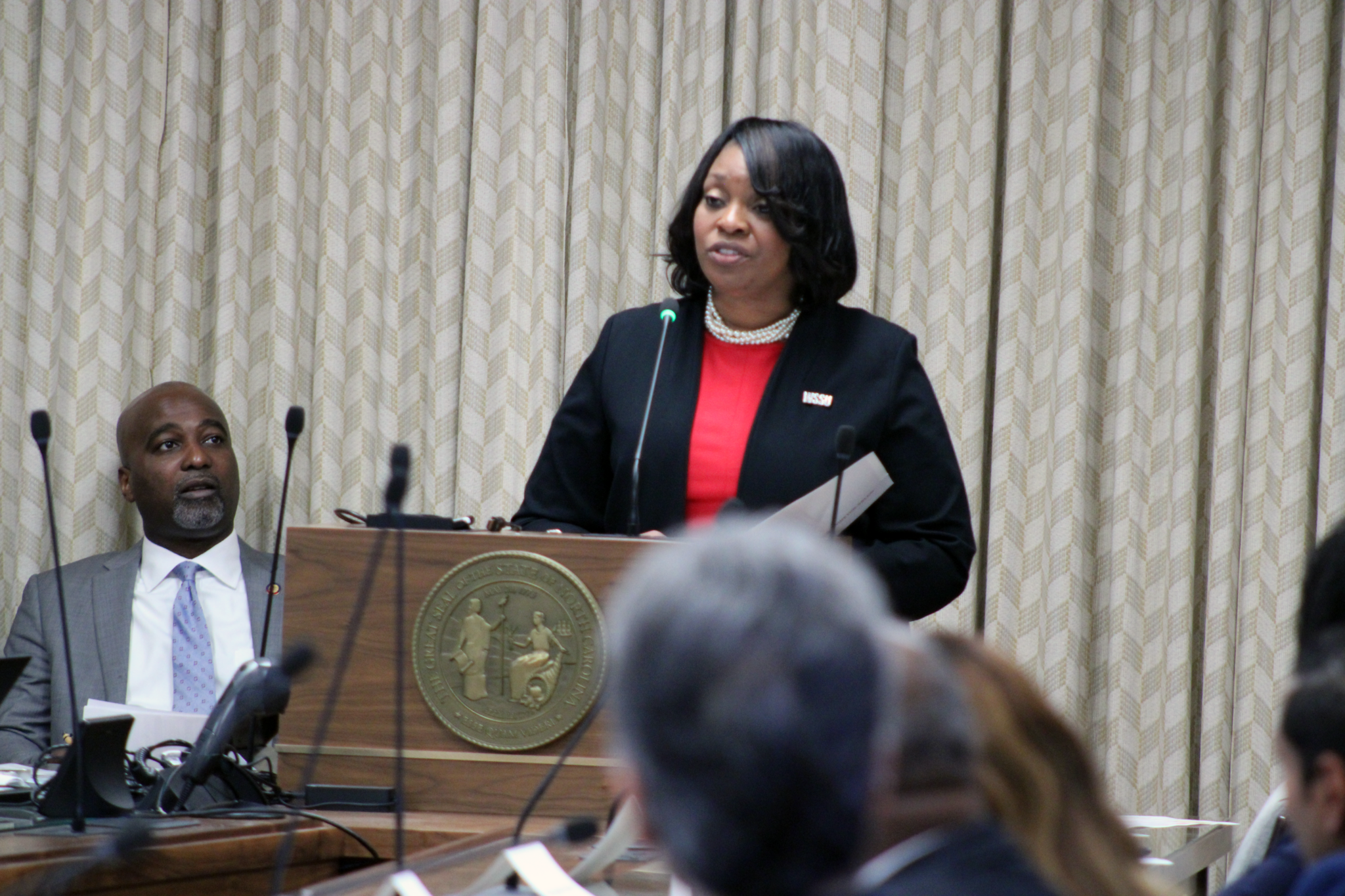
Leaders of nine North Carolina Historically Black Colleges and Universities (HBCUs) met with lawmakers on Tuesday to advocate for their annual legislative priorities.
Four of the HBCUs that were in attendance are private institutions: Bennett College, Johnson C. Smith University, Livingstone College, and Shaw University. As a subgroup, they advocated to be included in the distribution of funding the state earns from sports betting. Currently, 13 colleges that are a part of the University of North Carolina System have been appropriated $300,000 each per year, from the tax proceeds from sports betting earnings, according to the law passed in 2023. The funds are meant to support collegiate athletic programs. The private HBCUs said that they would benefit from the extra funding if they were included in the funding distribution.
“Our students have to compete, and some schools have an unfair advantage. We want you to help level that playing field,” said Anthony J. Davis, president of Livingstone College.
HBCU leaders also asked for funding support to go toward infrastructure needs, such as repairing buildings. Chancellors of Winston-Salem State University and North Carolina Central University mentioned how deferred maintenance impacts their ability to house their students.
“I can’t provide a 21st-century education with dilapidated buildings,” said Winston-Salem State University Chancellor Bonita J. Brown.
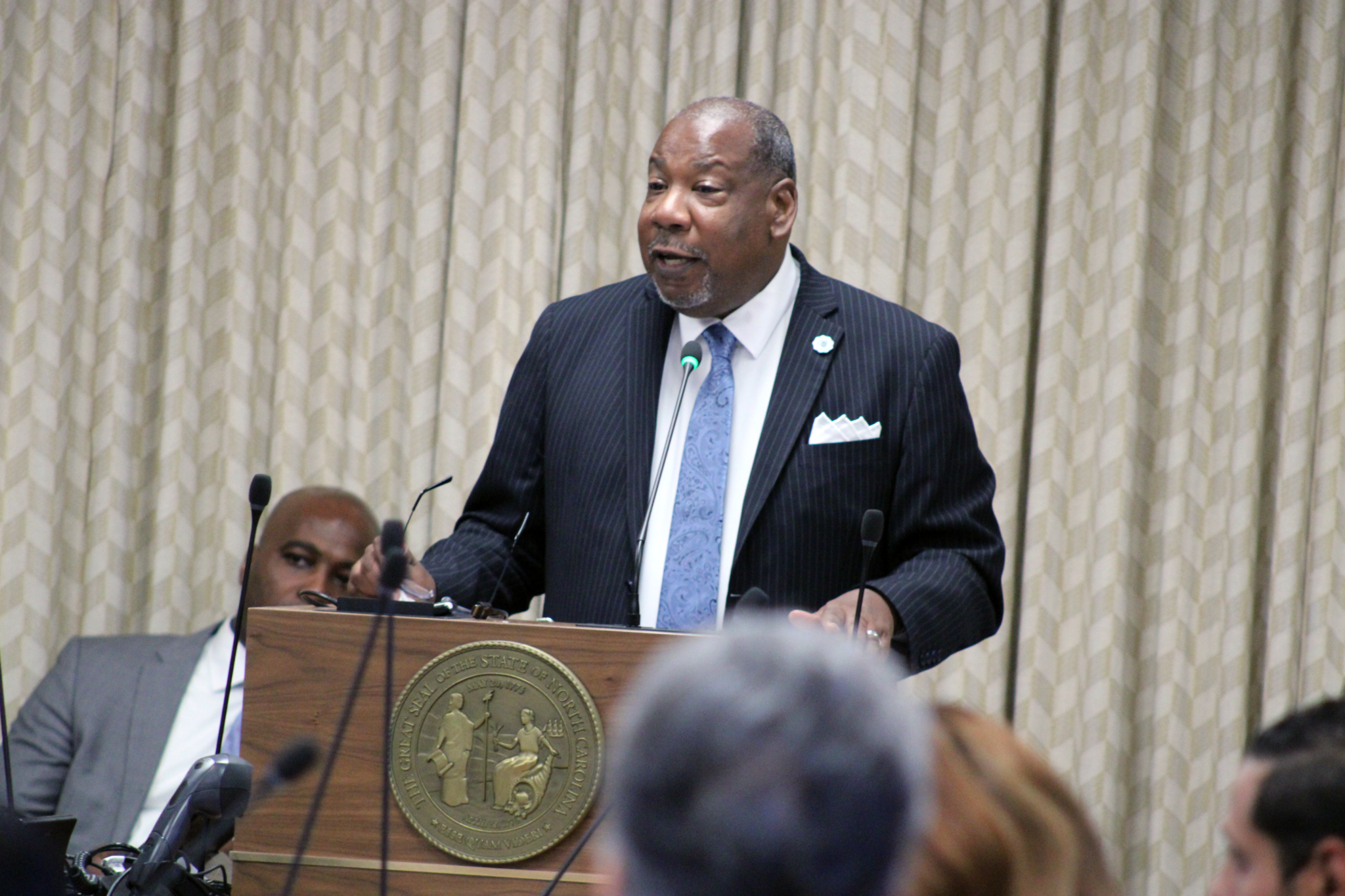
The HBCUs that presented also praised lawmakers for the proposed appropriations included in House Bill 1133, titled “HBCU/HMSI Omnibus,” which is now waiting to be reviewed by the House Appropriations committee.
Over a dozen lawmakers attended throughout the legislative day. After hearing the presentations, Rep. Amber M. Baker, D-Forsyth, encouraged the institutions to think of ways that they can work together, specifically when it comes to nursing programs.
“I challenge you guys to begin to think about how you can do some collaborative learning,” Baker said. “Because we know, as our funds continue to be reduced, particularly at our HBCUs, how can we be forward thinking in terms of being able to continue to offer our programs?”
Rep. Ray Pickett, R-Alleghany, talked about the role that HBCUs can play in addressing the demand for nurses, and that he plans to support their existing programs.
“We’ve got to do it. We’re a growing state. We’re also an aging state that’s going to need a lot of nursing. And if we don’t get the schools at the top of their performance, you’re going to be falling behind,” Pickett said.
Pickett also encouraged the institutions to continue to advocate for themselves.
“These schools are great schools. They have turned out leaders that sit right here in this chamber every day and work for the state, and show what kind of leaders HBCUs produce, and they’re across the country,” Pickett said.