
State House Dems call for budget with raises for educators — and other updates from the start of short session

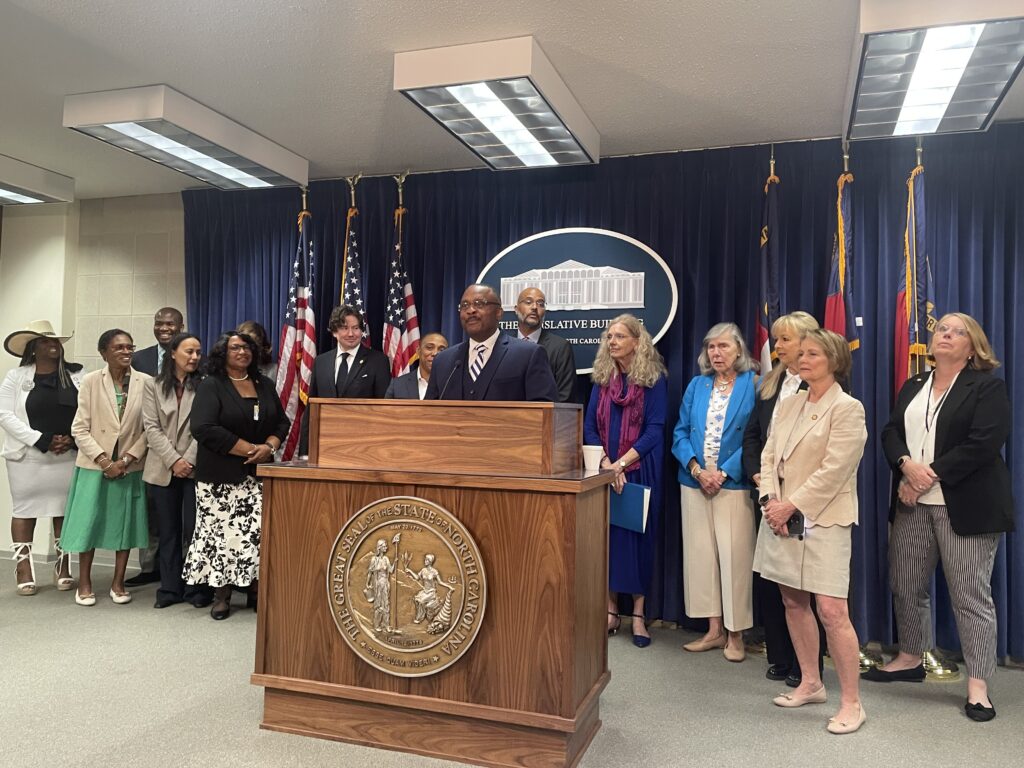
A group of House Democrats led by Minority Leader Rep. Robert Reives, D-Chatham, gathered on Wednesday to highlight the need for a budget and the impact that no budget has had on public safety, health care, the cost of living, and public education.
North Carolina was the only state in the nation not to pass a state budget last year after stalled negotiations between House and Senate Republicans.
“The people of North Carolina deserve better leadership than what they have seen so far from us,” Reives said. “Our state’s gone more than 900 days without a comprehensive state budget.”
 Sign up for the EdWeekly, a Friday roundup of the most important education news of the week.
Reives said teachers are being asked to do more with less, and that they have gone without pay raises while “every aspect of life has gotten more expensive.”
Rep. Brandon Lofton, D-Mecklenburg, said that North Carolina ranks 43rd in the country for average teacher pay, and 48th for per-pupil funding.
“But what can get lost in those numbers is what that actually means for our children,” Lofton said.
Lofton said House Democrats are fully committed to supporting meaningful teacher raises “so that our children can have the best shot at a high-quality education.”
Last year, some House Democrats voted with Republicans to approve the House’s version of a budget that would give higher raises to teachers than the Senate’s version.
Gov. Josh Stein’s most recent budget proposal, released on Tuesday, would give an average 11% raise to teachers and raise starting pay by over $12,000 by fiscal year 2026-27.
Reives stressed the importance of arriving at a budget deal quickly.
“Our first priority has to be getting a budget done. Nothing else. No hearings, no inquisitions,” Reives said. “We should be working on a budget and nothing else.”
Oversight chair implies CHCCS violated the law in ‘Parents’ Bill of Rights’ hearing
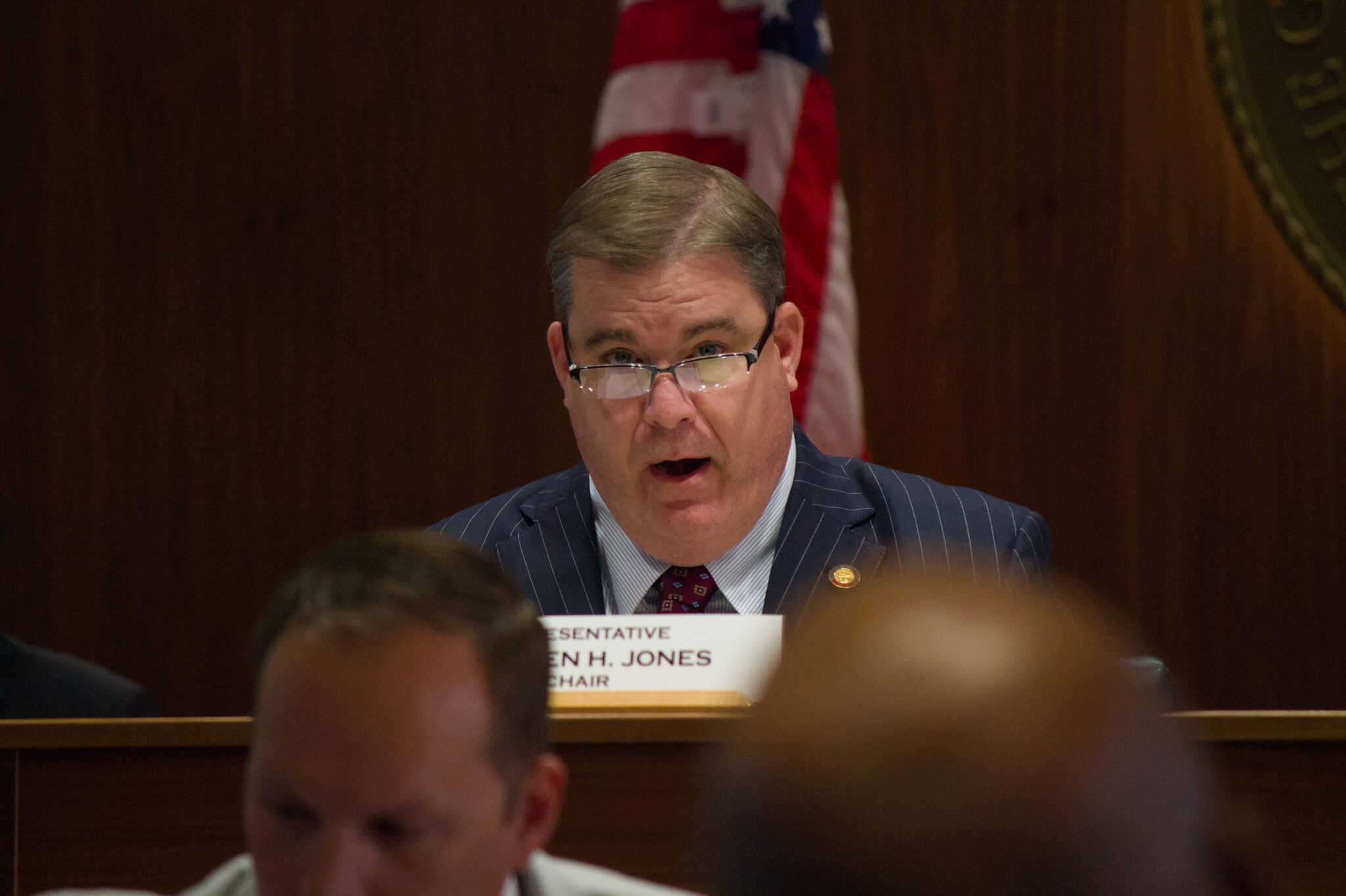
On Thursday, the House Oversight Committee brought Chapel Hill-Carrboro City Schools (CHCCS) Superintendent Rodney Trice to Raleigh to testify about his district’s implementation of Senate Bill 49, also called “The Parents’ Bill of Rights,” which was passed in 2023.
Committee Chair Rep. Brenden Jones, R-Columbus, implied CHCCS violated the law and tried to deceive state legislators. Jones cited emails sent between school district staff when claiming guidance was lacking around the requirement to notify parents when a student chooses to go by a different name or pronouns at school.
Trice refuted that claim, saying CHCCS was fully compliant with the law. He said he wasn’t familiar with the email Jones cited, but would follow up on the matter.
Republican committee members questioned the inclusion of books with “sexuality, gender identity, and sexual activity,” in CHCCS libraries.
When asked whether it is appropriate to have materials that illustrate or describe sexual acts in elementary school libraries, Trice said that “we don’t have any resources in our libraries that depict that.”
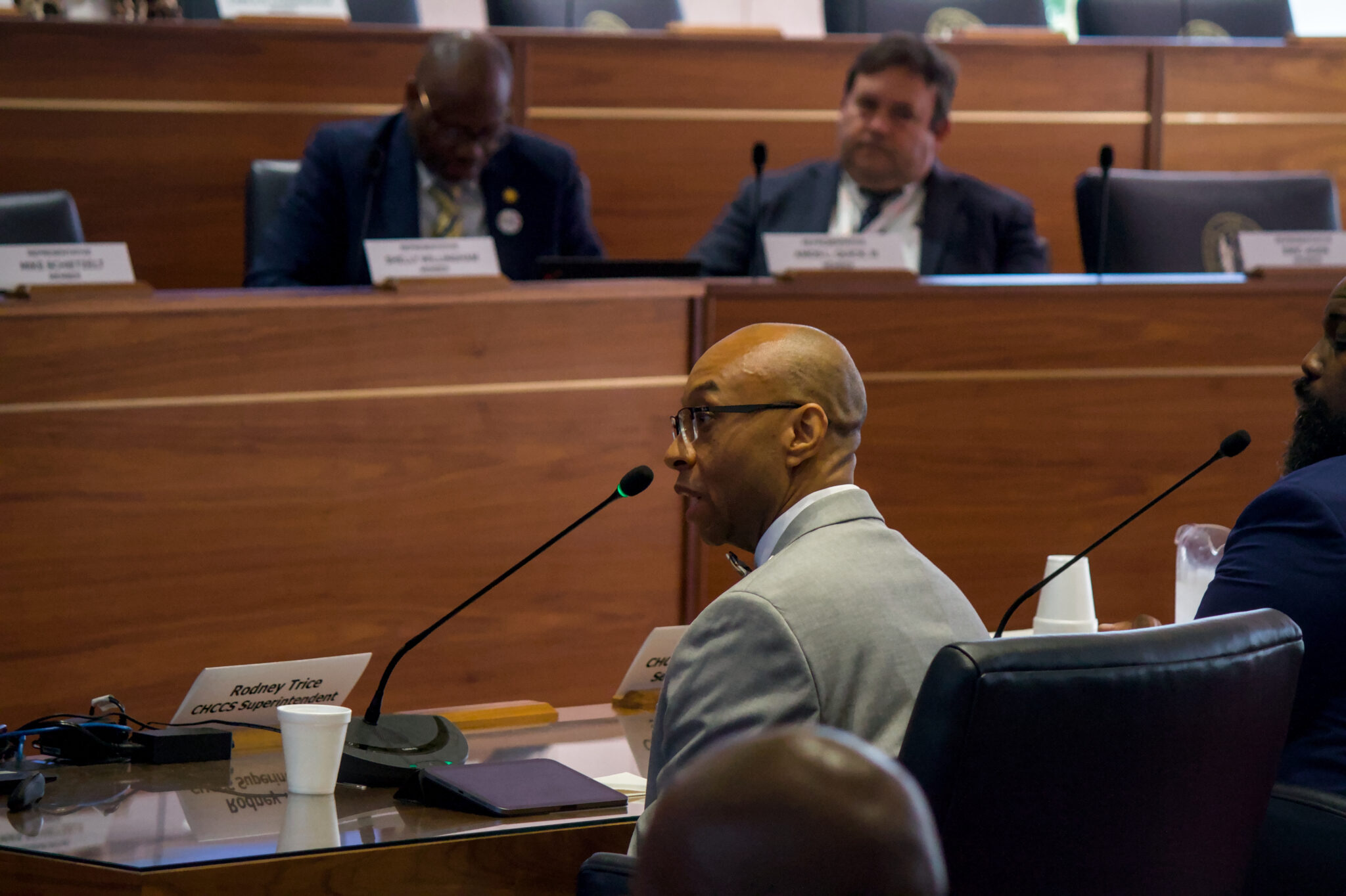
“If you are running the same playbook as (CHCCS), you’ll be here,” Jones warned other districts. “What you’re watching right now is what happens next: same table, same chair, same microphone, same button, same camera, same parents in the gallery wanting answers.”
LGBTQ+ pride flags and T-shirts advocating against book bans were visible in the gallery.
EdNC’s past reporting on the ‘Parents’ Bill of Rights’
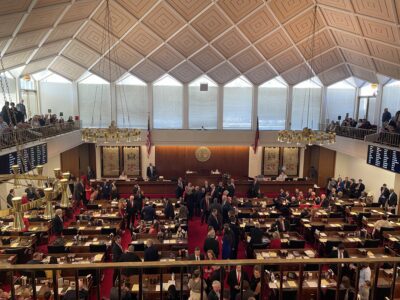
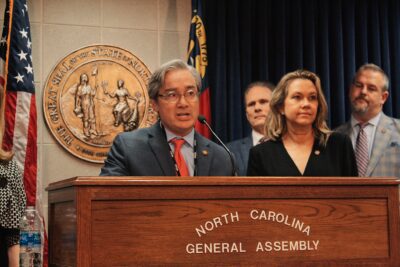
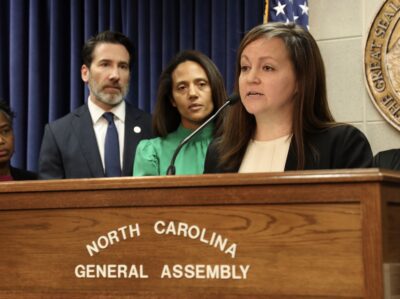
Rep. Amos Quick, D-Guilford, told Trice that the committee was targeting his district.
“In my opinion, you’re being brought here to be the political victim, the political punching bag,” Quick said.
After the hearing, Jones filed House Bill 1043 — “The CHCCS Act” — which would add new circumstances in which school districts would need to notify parents, such as prior to the school taking action involving “sensitive matters” related to a child.
The bill would also authorize the State Auditor and the Department of Public Instruction (DPI) to investigate “Parents’ Bill of Rights” violations and would withhold central office administration funding from districts that do not comply.
“Upon a determination by the State Auditor that a noncompliant public school unit has made sufficient changes to be compliant with this Article after the end of the cure period, any funds withheld shall be released to the public school unit and any administrative penalties assessed shall be forgiven,” the bill says.
You can view materials from the meeting here.
Senator to file a ‘Kids Over Corporations’ bill ahead of May 1 NCAE rally
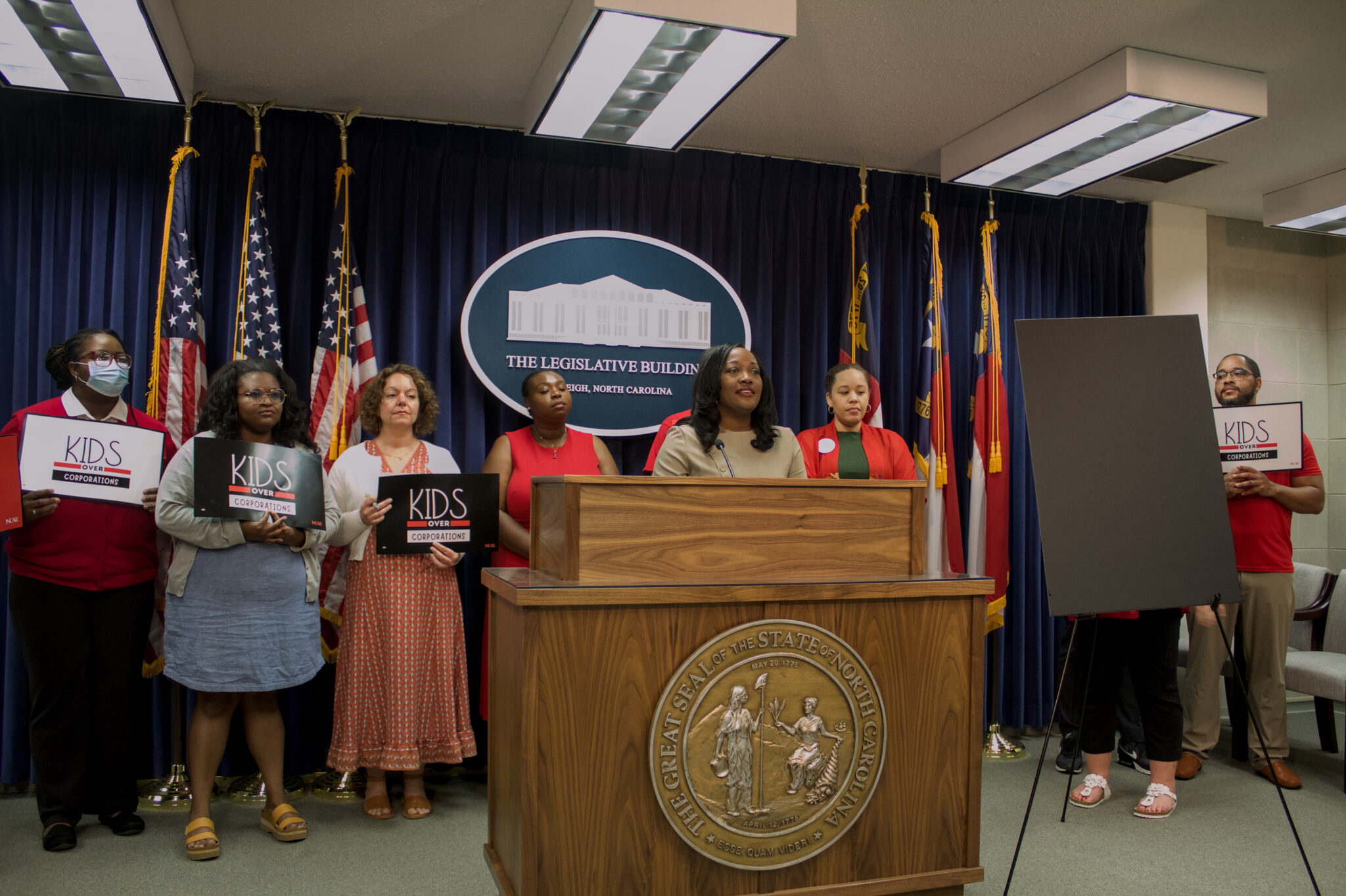
Sen. Natalie Murdock, D-Durham, held a press conference on Thursday alongside representatives from the North Carolina Association of Educators (NCAE) to announce a bill that would set North Carolina’s corporate income tax rate at 5% starting with the 2026 tax year.
North Carolina’s current corporate tax rate is 2%, and under state law, it would decline and be fully eliminated by 2030.
“Corporations are not asking for this,” Murdock said. “I talk with them regularly. They want to pay their fair share.”
Murdock declined to share the names of the corporations she was referring to.
Stein, in his proposed budget released on Tuesday, called for the corporate tax to remain at 2% and for the personal income tax to stay at 3.99%. He said North Carolina, without action, will approach a fiscal cliff.
The title of Murdock’s bill will be “The Kids Over Corporations Act.”
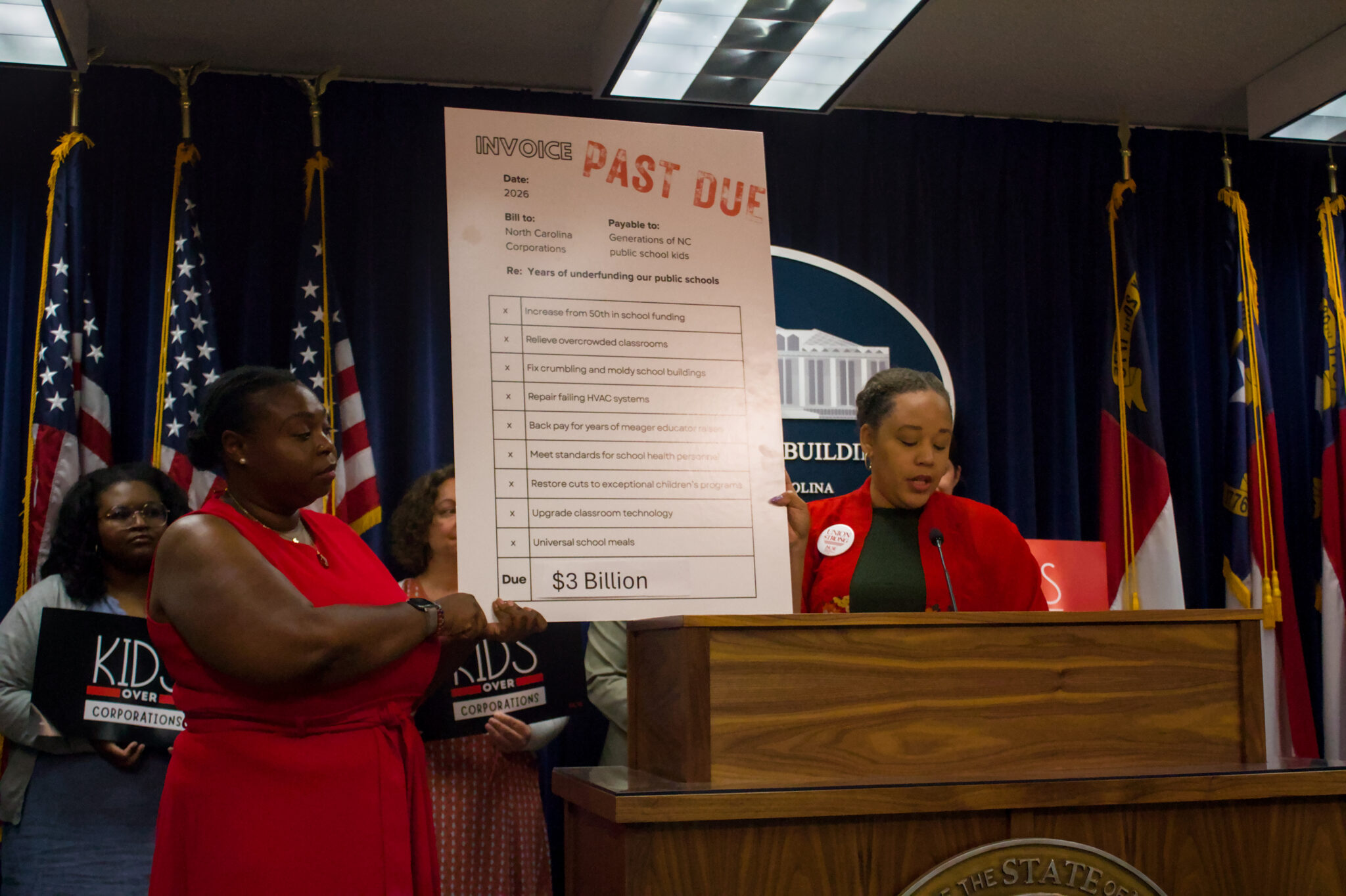
NCAE’s “Kids Over Corporations” rally, being held outside of the state legislature on May 1, is expected to draw large crowds of teachers, advocates, and community members. NCAE President Tamika Walker Kelly linked public schools to the talk of a state fiscal cliff.
“There has been a lot of talk in Raleigh about a fiscal cliff, but I will tell you that North Carolina public schools have been falling off a fiscal cliff for years,” she said. “We are here to say that it is enough — it is time to stop the giveaways and fund what really matters.”
A fact sheet distributed by NCAE cites Education Law Center data ranking North Carolina as 50th in education funding level. According to the sheet, South Carolina, Georgia, Tennessee, and Virginia all have corporate tax rates greater than or equal to 5%.
Legislators reach a deal on Medicaid funding
House and Senate leaders announced on Tuesday that they had reached a deal to put $319 million toward the state’s Medicaid rebase for the remainder of the fiscal year.
Federal cuts, along with inflation and rising health care costs, had put Medicaid in jeopardy. The North Carolina Medicaid website says that the division first alerted the General Assembly’s Fiscal Research Division that more money would be needed on May 9, 2025.
“Without action from the General Assembly, there will be major cuts and disruptions to people’s ability to get care,” the website says.
It appears action will be taken. Both the House and the Senate held votes on Wednesday approving House Bill 696, which includes the funding, along with new oversight rules.
“Medicaid should serve the people who truly need it, and this bill makes sure that happens,” House Speaker Destin Hall, R-Caldwell, said in a press release on Tuesday. “… North Carolina taxpayers deserve confidence that their money is being spent wisely, and patients deserve a system that prioritizes care for those who depend on it the most.”
The deal comes after Stein has asked for months for the $319 million. In Stein’s budget proposal, released on Tuesday, Stein also asked for over $1 billion to “cover the cost of sustaining the existing Medicaid program” during fiscal year 2026-27.
“More than 3 million North Carolinians — about a quarter of the entire state, including children, pregnant and postpartum women, people with disabilities, older adults, working families — have Medicaid,” Stein said at a press conference on Tuesday. “My budget ensures that we fully fund Medicaid so that the millions of North Carolinians can stay healthy, and the entire health care system, which depends on it, can remain strong.”
Read more about the Medicaid deal from NC Newsroom or NC Health News.