
Perspective | The other half of school funding reform


North Carolina is approaching the most important decision it has made about public school funding in a generation.
In the budget that the legislature released this week, a provision is included funding a weighted student funding formula working group.
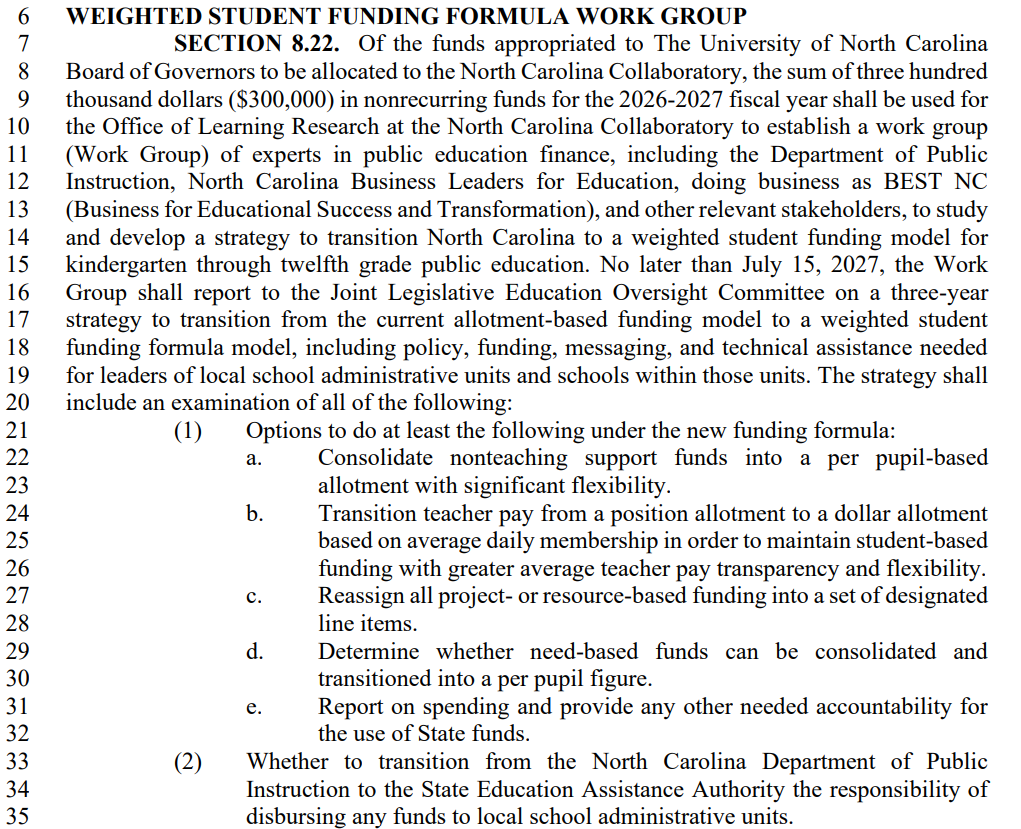
After more than three decades of paying for our schools through a resource allotment system — where the state distributes positions, dollar lines, and categorical pots, and audits whether each was used as prescribed — the General Assembly is taking a serious look at moving to a weighted student funding formula, where dollars follow each student to school and we invest more in students who need more to thrive.
I think we should make that move. But I also believe the conversation in Raleigh right now is missing half the design.
The current debate, as I have heard it in committee and in conversations with educators across the state, has centered almost entirely on inputs. How large should the base per-pupil amount be? Which students should carry additional weights, and how much should those weights be worth? How do we protect small, rural districts during a transition? Those are real questions, and they deserve serious answers. But they are only half of the system we are being asked to build.
The other half — what we ask of schools on the back end of the formula — is barely part of the public conversation. And in my judgment, it is the half that will determine whether this reform succeeds or fails.
Here is the core trade. Under our current allotment system, the state controls the inputs and audits compliance. Under a weighted formula, we trust districts and schools to deploy resources based on local judgment. But the trust only works if we modernize accountability at the same time. Flexibility on inputs without rigor on outputs is not reform. It is risk — to taxpayers, and more importantly to the students we are making promises to.
Some will hear the word “accountability” and brace for another round of testing fights. That misreads what is at stake. The question is not whether to test more or less. The question is what evidence the public should expect, from every school that receives weighted dollars, that our investment is reaching the students it was designed for and producing results for them.
 Sign up for the EdDaily to start each weekday with the top education news.
In my view, four things have to be true.
First, accountability has to be multi-measure and growth-based. If we are investing more in students who need more, we cannot then evaluate their schools on status alone. North Carolina already has one of the strongest student growth models in the country in EVAAS. We should build on it, not abandon it.
Second, outcomes have to extend past graduation. A diploma that does not translate into postsecondary success or a good job is a promise we did not keep. We have the data infrastructure in this state to follow students into college, into the workforce, and into the labor market. A serious accountability system uses it.
Third, where the dollars actually land has to be measured at the school level, not the district level. Weighted dollars can quietly be absorbed into central overhead if no one is watching. Site-based budget transparency — where every parent can see what their school received and how it was invested — is the price of admission for the flexibility a weighted formula provides.
Fourth, the weights themselves have to be recalibrated on a regular cycle. If a weight is not producing the outcomes it was designed to produce, the legislature needs to know, and the formula needs to respond. That requires a standing adequacy and cost study every four to five years, written into statute and insulated from the politics of any given session.
None of this is hostile to local control. The opposite is true. The whole point of a weighted formula is to give local educators room to do their work, and the whole point of strong accountability is to make sure the room we give them produces real results for kids. The two reinforce each other.
I have come to believe that the deepest weakness of our current system is not how much we spend, though that matters. It is that we do not have a clear, honest, shared answer to the question of whether our investment is reaching the students it was meant to serve, and what it is doing for them when it gets there. A weighted student funding formula gives us the chance to ask that question seriously. It does not, by itself, answer it.
A weighted formula would be a serious step toward meeting our state constitutional obligation. But it is only half the design. If we want this reform to work — and I believe we should — we have to build the other half with the same care.
We owe parents and students more than a new way of moving money. We owe them a system that tells the truth about whether the investment is working.