
North Carolina school board election results by district

School boards have been thrust into the spotlight over the past few years by livestreamed board meetings, book banning controversies, and “parental rights” movements. They are also increasingly partisan — literally.
This November, 52 school districts in North Carolina held partisan elections, where candidates’ party affiliations are listed on the ballot, versus 41 in 2022. Prior to 2013, there were only 10 partisan districts in North Carolina. And the number is continuing to grow — this November, the Rowan-Salisbury Schools district voted in favor of changing their elections from nonpartisan to partisan, with just over 55% of voters voting for the proposal.
 Sign up for the EdDaily to start each weekday with the top education news.
This November, there were 292 seats up for election across 87 of North Carolina’s 115 public school districts.
EdNC analyzed election results from the North Carolina State Board of Elections (NCSBE) dashboard to determine the winners of each race, the makeup of partisan school boards across the state, and how many seats went to each party. Counties were supposed to certify their results on Nov. 15, but close races could still be subject to recounts.
Some current school board members’ party affiliations were unclear or missing based on past election records. In the analysis, they were left out of calculations to determine majority control of school boards.
Who controlled school boards before the election?
Before the November election, 31 of the 52 partisan school districts were majority-controlled by Republicans. Democrats held only six majorities, in the following districts: Anson County Schools, Guilford County Schools, Lenoir County Schools, Madison County Schools, Vance County Schools, and Washington County Schools.
After the November election
Of the 170 school boards seats that were up for election in partisan districts this November, 138 were won by Republicans, 26 by Democrats, and six by candidates that are unaffiliated.
Since some districts held partisan elections for the first time, there were 41 seats that had no previous party affiliation. Of those 41, 38 went to Republicans and three went to Democrats.
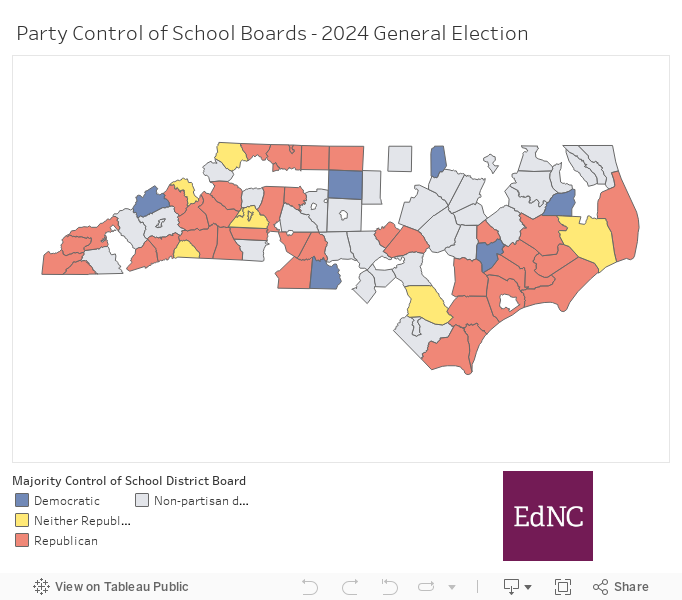
After the dust settles, and notwithstanding recounts, 38 of the 52 partisan school districts will be majority-controlled by Republicans, meaning in districts that are newly partisan, Republicans gained majorities. Democrats will hold the same six districts they controlled before the election. (The remaining districts include members that haven’t yet run in a partisan election, and therefore their party affiliation isn’t taken into account in the analysis.)
There were only a few seats that flipped from one party to another. Two formerly Republican seats were taken by Democrats and eight formerly Democratic seats were claimed by Republicans statewide.
See the results mapped
Below is a map of districts that held elections this fall. Hover over each district to see the winners. The color indicates partisan control of the school boards in each district after the election. (If a county isn’t on the map, it didn’t have any school board seats up for election this November.)
This article is a continuation of EdNC’s previous article on election results. To read more about partisan school board elections, see an analysis from before the election.