Even fewer new NC families apply for vouchers this year

In 2023, the N.C. General Assembly passed a state budget including what Republicans called the “largest expansion of school choice” in 10 years.
Following the expansion, two years ago, the North Carolina State Education Assistance Authority (NCSEAA) received 69,511 applications for Opportunity Scholarships by the deadline on March 1, 2024.
 Sign up for the EdDaily to start each weekday with the top education news.
Opportunity Scholarships are state-funded vouchers families can use to pay for eligible private schools. NCSEAA is the state agency designated by law to administer K-12 scholarship programs.
Most of those students were already attending private schools, according to data released in June 2025.
The next year, NCSEAA reported it received 40,089 new applications for vouchers by the March 6, 2025 deadline — 29,422 fewer than the year before.
According to the most recent data from NCSEAA, the total number of new applications for vouchers by the March 2, 2026 deadline was 27,682 — 12,407 fewer than the year before.
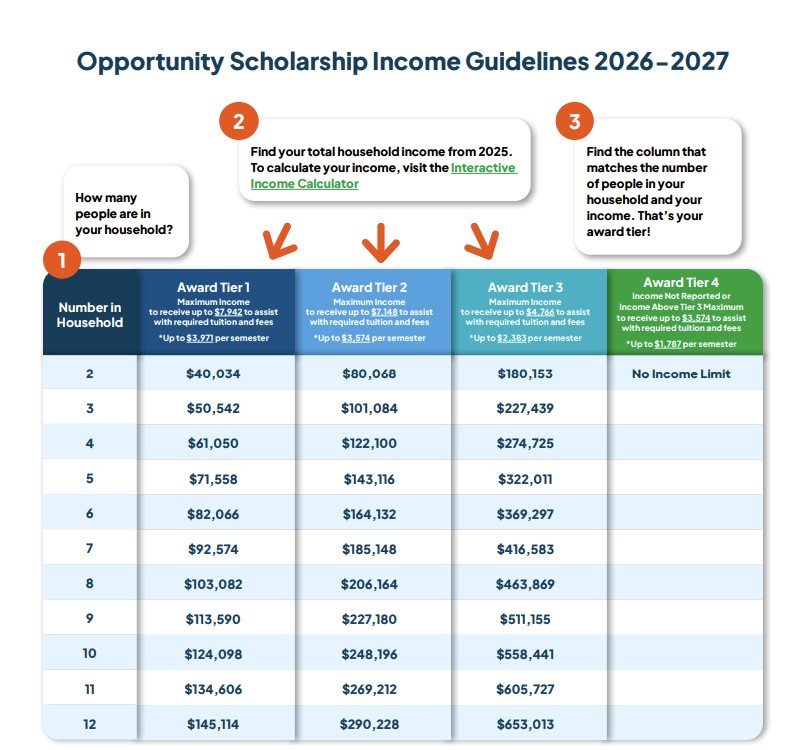
Depending on family income, recipients will be eligible for between $3,574 and $7,942 in 2026-27, based on the tuition and fees charged by the private school they will attend.
In this table, you can see the number of new applicants by award tier.
| Award Tier | Maximum amount of voucher by tier* | # of new applications | % of total new applications* | Cost to fund all new applications by tier** |
| Award Tier 1 | $7,942 | 7,897 | 29% | $62,717,974 |
| Award Tier 2 | $7,148 | 8,348 | 30% | $59,671,504 |
| Award Tier 3 | $4,766 | 7,518 | 27% | $35,830,788 |
| Award Tier 4 | $3,574 | 3,919 | 14% | $14,006,506 |
| Total | 27,682 | $172,226,772 |
In this graphic, you can see the income guidelines for each award tier.
Families of 26,643 students received 2026-27 new award offers, according to NCSEAA. The final deadline to accept the offer is April 17 at 11:59 p.m. NCSEAA says the difference between the number of applications and offers is because “not all who apply are eligible.”
The politics of universal vouchers
Michael Petrilli, president of the Thomas B. Fordham Institute, in an article titled, “School choice need not mean an expensive windfall for the rich,” says under the surface of school choice expansion there is an important debate: “how to balance the drive for educational freedom with other essential values, including fairness and fiscal responsibility. Simply put: Must the expansion of school choice result in windfalls for America’s wealthiest families, particularly those that already send their children to fancy private schools? Especially when that means blowing big holes in state budgets?”
This was a prominent issue in the recent election between the current leader of the N.C. Senate Phil Berger, who lost the Republican primary for the race to Rockingham County Sheriff Sam Page.
Ray Gronberg with the N.C. Tribune reported that Page’s campaign website said he believes school “vouchers should be targeted to families who need them most.” That means, writes Gronberg, “income caps on school voucher eligibility to help working families, not the wealthy,” and “policies to prevent private schools from inflating tuition due to vouchers.”
The data
Here is NCSEAA’s data on vouchers. Note there is a tab in the upper left of the map for 2025-26 county data, and a tab to the right of that for 2025-26 state data. On either tab, you can download an Excel spreadsheet, which includes data on students by grade, race, and ethnicity; funds by county and funds by school; and students by county.
As of April 6, 2026, 106,789 students in North Carolina receive vouchers.
Data on the NCSEAA website indicates that the number of vouchers disbursed has increased since school choice expansion from 32,549 as of June 30, 2024.