
Highlights from the Coalition for Charter Schools’ 2026 advocacy summit

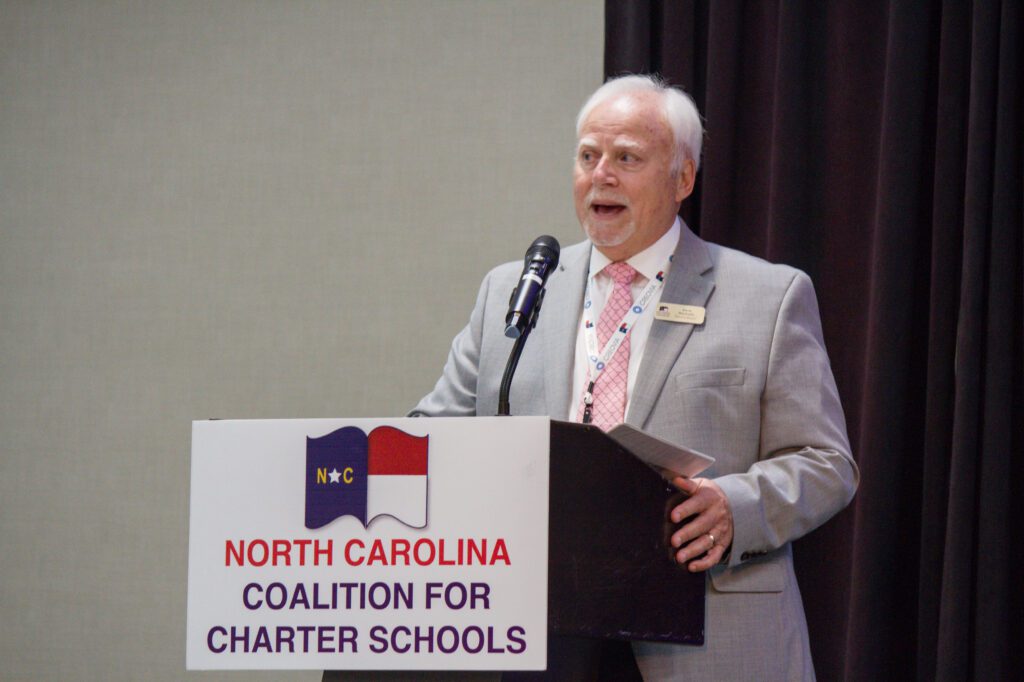
The North Carolina Coalition for Charter Schools held its annual advocacy summit in Raleigh this week, discussing its legislative agenda and the new state political landscape following the 2026 primary elections. The coalition is a trade association that advocates for charter schools in North Carolina, including by lobbying.
“The public charter schools in North Carolina are strong,” said coalition Executive Director Dave Machado during his opening remarks on Wednesday. “North Carolina is truly a charter school-rich environment, and we’re going to talk about how that’s happened over the years this organization has been in existence.”
 Sign up for the EdWeekly, a Friday roundup of the most important education news of the week.
The summit featured remarks on the federal landscape for charter schools and school choice, the coalition’s 2026 legislative agenda, a new poll regarding school choice, the Charter Schools Program (CSP) Grant, the approval of virtual academies, the Charter Schools Review Board (CSRB), which oversees and approves charter schools in North Carolina, and more.
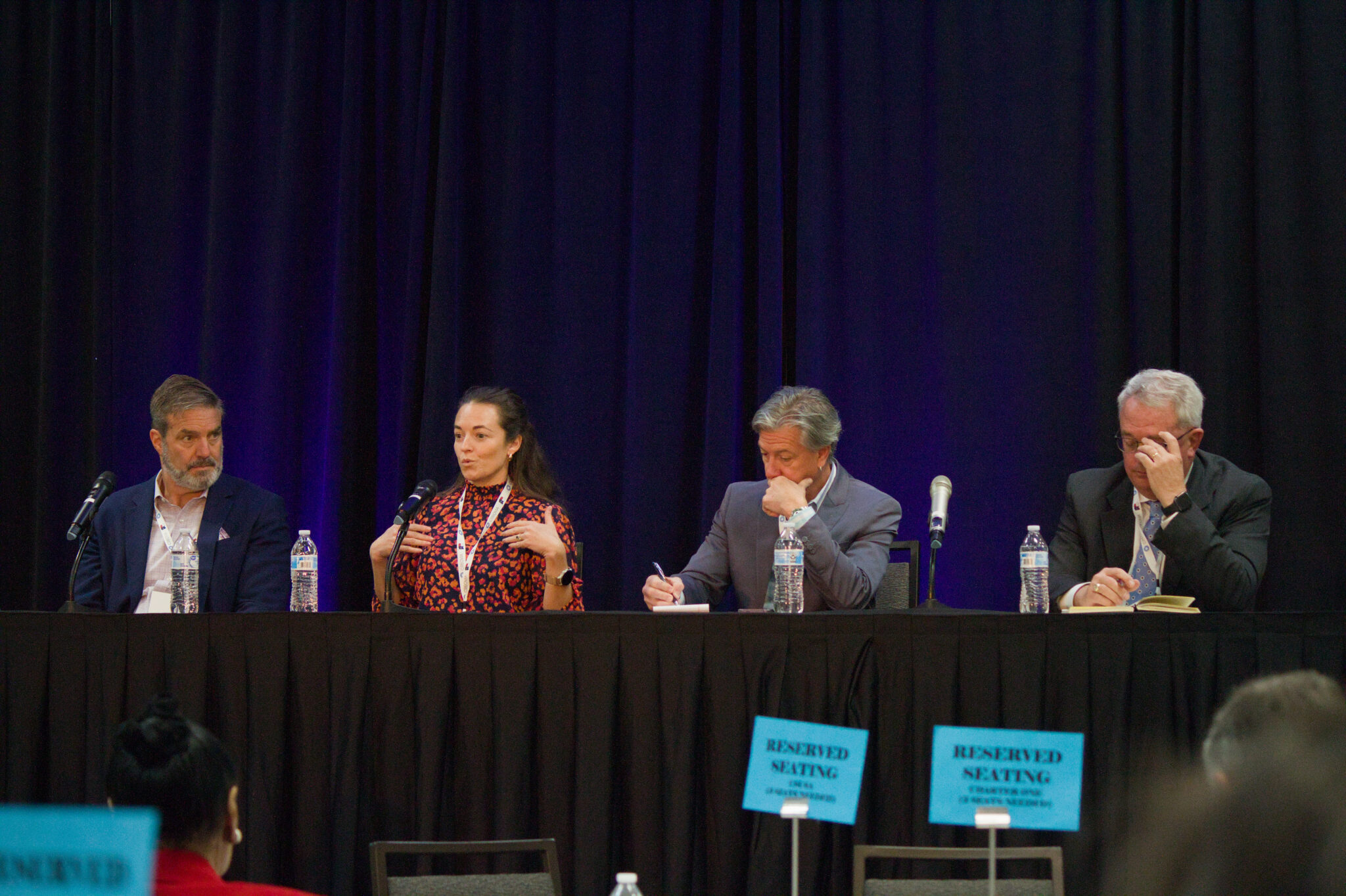
The event was attended by charter school stakeholders from across the state and featured speakers and panelists including Lt. Gov. Rachel Hunt and the chiefs of staff for House Speaker Destin Hall, R-Caldwell, and Senate Minority Leader Sydney Batch, D-Wake. During a legislative panel, Neal Inman, Hall’s chief of staff, said “teacher pay is going to be the top education issue of the session.” In North Carolina, raises for state employees include most educators at both charters and traditional public schools.
Hunt, in her speech, said charter schools are important and noted that her son attended a charter school.
“If we want strong local economies, we need strong schools, and that includes schools that are willing to innovate, adapt, and meet students where they are,” Hunt said. “That’s where charter schools are doing such a great job in many communities across our state. So my message to you today is this: keep going.”
The coalition’s 2026 legislative agenda, passed out on sheets of paper at the event, listed three priorities: fair funding, oversight and accountability, and autonomy and flexibility.
The first priority is ensuring “fair funding for charter schools at both the state and local level.” Under that umbrella included removing the cap on Exceptional Children (EC) student funding; securing more equitable funding for School Resource Officers (SROs); and ensuring “uniformity” in local funding payments to charter schools, with funding spanning all 12 months of the year.
The political scene and ‘254’
The next priority — oversight and accountability — centers around the enforcement of Session Law 2025-80, passed last year by the General Assembly under the name Senate Bill 254. That law, which Gov. Josh Stein vetoed before it was overridden, further strengthened the authority of the CSRB, transferring additional power from the Department of Public Instruction (DPI) and State Superintendent of Public Instruction Maurice “Mo” Green.
At the time, Stein and General Assembly Democrats called the bill unconstitutional, saying it transferred power designated to the state superintendent by the North Carolina Constitution.
The CSRB was formerly the Charter School Advisory Board, which made recommendations to the State Board of Education. Following a change in 2023 law, the CSRB was created and now has sole authority to review, approve, deny, and renew charter applications.
Related reads


Speakers at the summit reinforced their support of the direction of state legislation related to charter schools, which has generally been in line with the coalition’s asks and priorities under the Republican-majority legislature. Three Democrats helped override the veto of SB 254, but all three resigned or lost their primary elections, meaning Democratic support is less likely after the general election in November.
“We lost every Democrat in the House who voted with us on charter school issues,” said Dylan Reel, a charter school lobbyist, at the summit.
Another loss, he said, is Senate President Pro Tempore Phil Berger, R-Rockingham, who recently conceded his primary race.
“We are losing our biggest charter school advocate,” Reel said of Berger.
However, the room was still optimistic about the changes following SB 254. Responding to a question, Steven Walker, CSRB counsel, told the room of charter school advocates that regulation shouldn’t be as big of a burden.
“If you want to call the CSRB a regulatory body — you’ve got people that are doing the regulating now that have been in your shoes, right? And so they know what’s going on day-to-day inside a charter school,” he said. “I think you’ve got about as friendly a group as you can have.”
Bruce Friend, CSRB chair, added that doesn’t mean the board won’t be holding schools accountable.
“With this greater autonomy, the flexibility (of) 254, the power it gives us — I guess I would also say, don’t confuse that with a friendly Charter Schools Review Board,” Friend said.
Speakers at the summit, including CSRB members, alluded to some disagreements with the State Board of Education.
“We don’t want multiheaded regulation by multiple entities,” said Matthew Tilley, counsel for the coalition.
John Eldridge, vice chair of the CSRB, said there should be better communication between offices within DPI, and that there have been examples of charter schools being put on financial noncompliance cautionary or disciplinary status hours before the school comes before the CSRB.
“I think that’s going to be ongoing conversations with Mr. Green,” he said.
Funding from local governments
Tilley also touched on funding from local governments to charter schools, saying that the CSRB can set rules for local education agencies (LEAs) but has no way to enforce them.
“We need enforcement authority now, because we got the rules,” he said. “I think it’s that next step of getting all of that on the paper, putting it out there, and seeing how they are not following that will tee that conversation up.”
Eldridge floated the idea of the state taking more or all of the funding responsibility for charters, but noting it is an “unstudied” idea.
Virtual academies
Virtual charter academies have been in the headlines recently, with Sen. Jay Chaudhuri, D-Wake, calling their expansion “educational malpractice.”
The third and final priority listed on the coalition’s legislative agenda is “autonomy and flexibility,” including “protecting charter schools from regulations that undermine their statutory autonomy” and ensuring charter schools “retain ongoing flexibility to pursue alternative models of instruction, such as fully remote or blended academies.”
The CSRB has recently approved new virtual schools and approved the conversion of the virtual academy of a charter school to its own stand-alone school.
“This one is kind of the hot topic right now,” said Amanda Falkenbury, another charter school lobbyist. “We would just want to ensure that parents have the right to choose the best method of instruction for their child, in addition to the best school for their child.”
Stephen Gay, a CSRB member, said regarding virtual academies that the board needs to be open-minded and allow charter schools to be innovative. He also cautioned that a lot is unknown.
During the March CSRB meeting, board members — including Gay — discussed the need for guardrails and best practices around remote learning.
“We don’t have the data yet to see — we don’t have an example yet of a successful virtual school yet, but I think the opportunity is out there,” Gay said at the summit.
The federal charter landscape
Hayley Sanon, principal deputy assistant secretary and chief strategist in the Office of Elementary and Secondary Education at the U.S. Department of Education, gave a brief talk about the federal school choice and charter landscape.
Sanon encouraged North Carolina to enroll in the federal school choice tax credit program introduced by the Trump administration last year. The General Assembly passed a bill enrolling North Carolina, but it was vetoed by Stein.
Sanon said the tax credit doesn’t just apply to students in private schools, but traditional public schools and charter schools as well. Allowable uses of the credit include tutoring services, services for students with disabilities, and homeschool materials, she said.
“I really want to highlight the flexibility of that program, and that it is going to be so driven by education organizations at the state level and donors and families,” Sanon said.
Read more

She also highlighted last year’s record high of $500 million allocated to the Charter Schools Program (CSP), which provides federal funds to “create promising new public charter schools” and “replicate high-quality public charter schools,” according to the U.S. Department of Education website.
A $52.9 million CSP grant was awarded to the North Carolina Association for Public Charter Schools (NCAPCS) last year. A panel at the summit presented information detailing a planned distribution of subgrants over the next few years. The proposal deadline, according to the NCAPCS website, is April 14.
John Locke Foundation poll on school choice
Donald Bryson, CEO of the John Locke Foundation, a conservative think tank, presented the results of an annual poll on school choice and charter schools.
The data showed a slight decline in opinion of charter schools, which Bryson said calls for more promotion of charter schools.
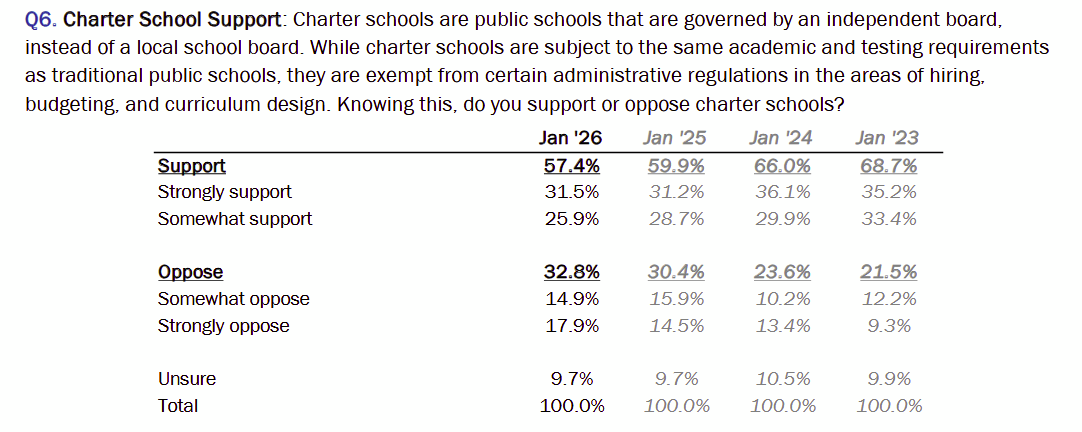
“(The) good news is that a majority of people still support public charter schools in North Carolina,” he said.
You can see the full results of the poll here.