
EdExplainer | What’s the status of teacher pay and benefits in North Carolina in 2026?

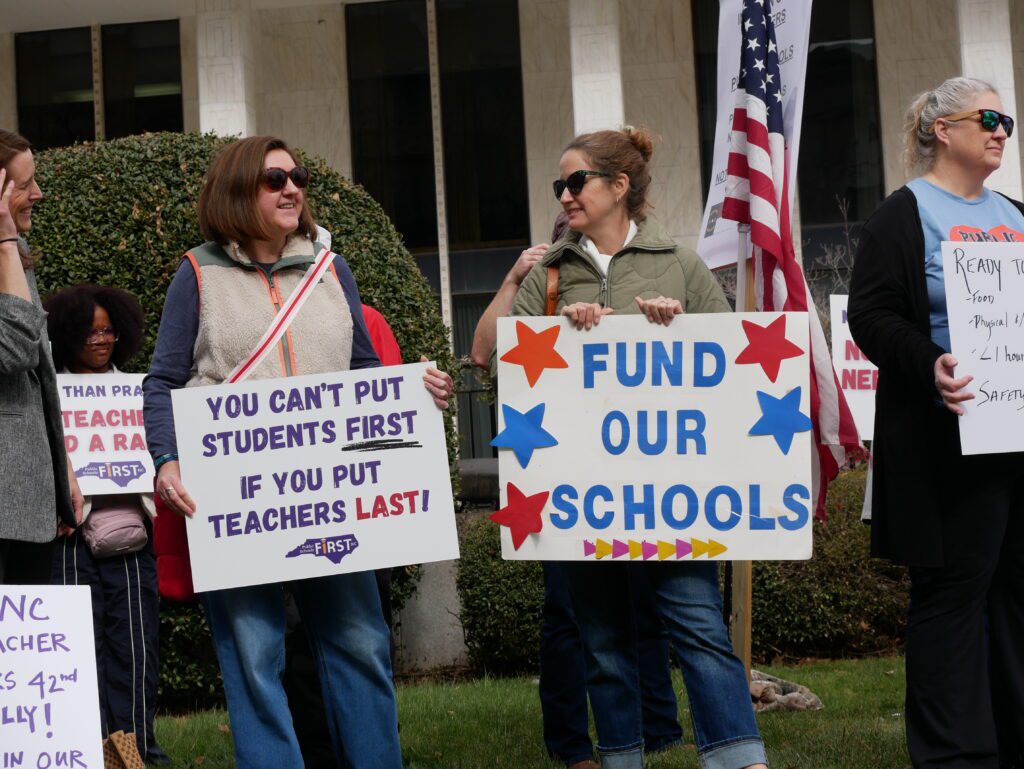
Steve Hanf has taught journalism for 11 years at First Flight High School in Dare County — following five years of teaching in Winston-Salem and a long journalism career. He’s also the school’s newspaper and yearbook adviser. When he can, he freelances for local publications. Over the summers, he works at journalism camps. At least once a month, he’s working behind the wheel, driving activity buses or school buses for the district.
“It’s much harder to find a teacher who doesn’t have a second job or a third job or three side hustles, just to pay for all the things,” Hanf told EdNC.
 Sign up for the EdDaily to start each weekday with the top education news.
He’s not alone. Kimberly Jones, the 2023 North Carolina Teacher of the Year, knows teachers working in restaurants and in retail. Jones herself worked every summer at the North Carolina Governor’s School for 14 years to supplement her salary, and now spends her summers working with The Olga Lengyel Institute for Holocaust Studies and Human Rights. During the school year, she’s an educational consultant.
“There are very few teachers that I know who only teach,” Jones said.
Her role as Teacher of the Year, she said, was to be an ambassador for public schools, traveling “the equivalent of Murphy to Manteo” talking to teachers. When she asked teachers about their compensation, the message was clear.
“It was a pretty collective message that our salaries have not remained commensurate with like professions,” Jones said. “They haven’t remained in step with the cost of living. They haven’t remained in step with things like our health care premiums.”
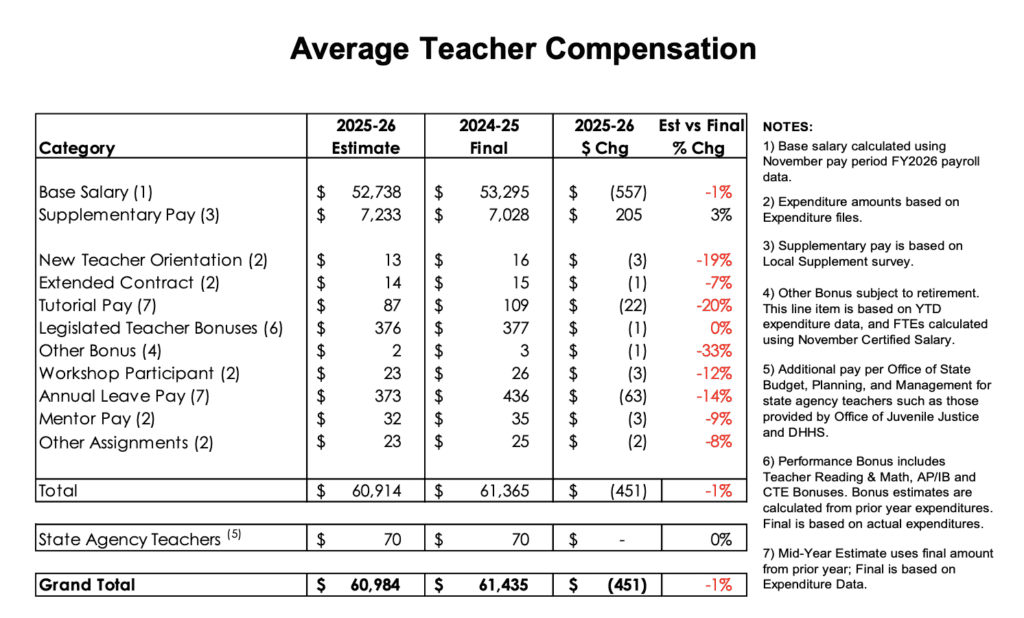
BEST NC, a nonprofit business leader coalition focused on education, found that average teacher pay was $58,292 in 2023-24 and average starting pay was $40,136 in 2022-23. According to the Department of Public Instruction’s (DPI) latest “Highlights of the North Carolina Public School Budget” report, average teacher salaries as defined by the National Education Association — base salaries plus local supplemental pay — were $59,971 in 2026 and $60,323 in 2025. After including bonuses, the estimated average compensation for 2025-26 was 1% lower than 2024-25.
In February, Geoff Coltrane, senior director of government affairs for DPI, presented 2023-24 data about teacher pay to the State Board of Education. The state ranked 43rd for average teacher salary nationwide, he said. And after accounting for inflation, the state’s teachers were earning more in 2013 than in 2023.
That’s a decades-long problem, according to the Reason Foundation, a libertarian think tank. From 2002 to 2022, teacher salaries in North Carolina dropped by more than 20% when accounting for inflation. During the COVID-19 pandemic — from 2020 to 2022 — North Carolina salaries decreased more when adjusting for inflation than in any other state at 9.6%, the Reason Foundation found.
Those numbers are taking their toll. BEST NC estimated that 51,000 out of 101,775 teachers across the state did not earn a living wage in 2023-24.
“While average teacher pay is above the living wage level, the structure of our pay schedule creates a significant gap early in a teacher’s career when they are reaching their professional capacity but still far from the peak of their earning potential,” reads the nonprofit’s “Teacher Pay in North Carolina: A Smart Investment in Student Achievement” report. “In other words, the average starting teacher pay is well below the average living wage in North Carolina.”
For some North Carolina teachers, even salaries at the top of the pay scale don’t ease the financial strain.
“I love what I do, and I don’t want to leave the classroom,” Hanf said. “I just wish that I could not spend so much time doing other things outside of the classroom to bring home a reasonable salary.”
Lawmakers gave teachers an average pay raise of 7% in the state’s last comprehensive budget. But that covered the 2023-25 biennium, and a legislative stalemate in Raleigh has left North Carolina without a comprehensive budget since then — making it the only state in the nation without a new budget at the end of 2025. During the long session, disagreements about pay raises for state employees — including teachers — personal income taxes, and other budget items led to delays in the negotiation process.
The General Assembly is set to convene in Raleigh on April 21 to kick off its short session. Lawmakers are expected to consider bills already approved by one chamber, proposals from a study commission, and budget-related matters.
Gov. Josh Stein has already released a “critical needs budget” proposal with an average 5.8% raise for teachers — including a 13% raise for beginning teachers.
According to a revised consensus General Fund Revenue forecast for the 2025-27 biennium released last month, North Carolina has an estimated $951 million surplus for Fiscal Year 2026-27, which is a 2.8% increase from the prior forecast. Much of that surplus is expected to go toward additional state Medicaid funding and a raise for teachers and other state employees.
So far, however, the House and Senate have not been able to agree on how much that raise should be. The Senate’s proposal included an average 2.3% pay increase for teachers in FY 2025-26 and an average increase of 3.3% over the biennium, along with a $3,000 bonus, while the House called for an average 8.7% raise for teachers, with higher raises going toward beginning teachers — a nearly 22% raise.
Read more
First, how teachers are paid
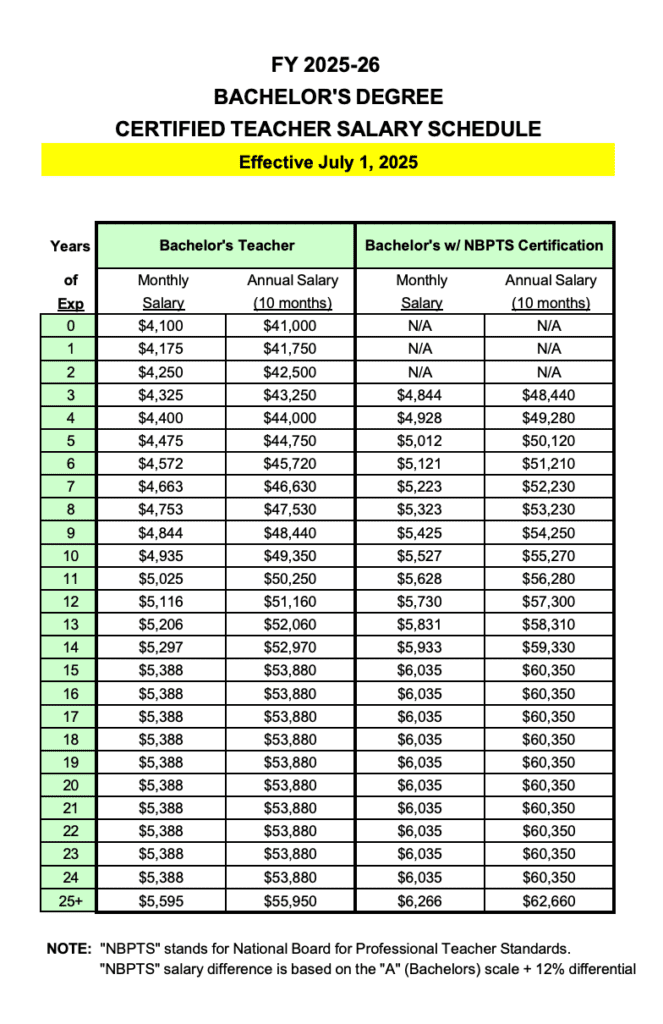
North Carolina uses a “step-and-lane” salary schedule for all traditional public school teachers, according to BEST NC, set by the General Assembly. Teachers receive an automatic pay bump for additional years of experience — a “step” up the ladder — but lawmakers can choose to provide additional raises, increasing the pay for each step on the ladder.
“Certified Educator Salary Schedules include teachers, certified instructional support and school based administrators,” according to DPI. “All certified educators working in Local Education Agencies (LEA) are required to be paid from the legislated salary schedule.”
Legislators typically change the schedule year-to-year, based on the state budget. For example, in the 2023 comprehensive budget, base salary raises ranged from 3.6 to 10.8% over the biennium. But, given the state’s absence of a budget, the schedule has been left intact since then.
Following years of salary freezes caused by the Great Recession, a 2013 General Assembly task force redesigned the salary schedule to front-load the pay schedule, per BEST NC. Under this model, teachers would get pay boosts earlier in their careers. Before this redesign, teachers took 30 years to reach $50,000 salaries; afterward, that time was halved, taking 15 years to reach that salary.
That strategy remains, as certified teachers with a bachelor’s degree see yearly pay increases through the first 15 years of their career. Base pay in the schedule currently starts at $41,000 for new teachers, rises to $53,880 by year 15, then increases once more to $55,950 at year 25.
BEST NC’s report says the state’s choice to front-load the salary schedule is supported by research showing “increases in teacher effectiveness are most significant during the first three years of a teacher’s career and level out after year five.” As teachers’ skills improve, their pay improves.
But the salary schedule can also leave experienced teachers, who often take on additional responsibilities in their schools, without step raises — or guaranteed pay increases — for years at a time.
For example, Hanf’s journalism career counted as relevant years of experience toward his teaching license, placing him at the top of the salary schedule. But he said raises for veteran teachers have been small and scarce.
“With the costs of living going up,” Hanf said, “it feels like it’s been a long time since we’ve had any kind of meaningful pay bump.”
Brenda Berg, president and CEO of BEST NC, said that, in practice, veteran teachers at the top of the salary schedule have still seen increases thanks to budget raises.
“The pay schedule can be hard to understand. While it looks like a teacher does not get a pay increase from year 15 to year 24, the reality is very different,” Berg said. “The schedule itself rises with budget increases. So a teacher currently sitting at step 24 has actually seen a 24% pay increase from their 15th year. That is a compounded 2% per year, in spite of a pay freeze for COVID for two of those ten years.”
Jones said the state should do better for its beginning teachers — but sees pay issues for veteran teachers as a “yes, and” situation.
“Yes, our beginning teachers must be paid a competitive wage, and our veteran teachers deserve pay that is commensurate with their experience, their skills, their results, the work that we ask them to do in support of those beginning teachers,” Jones said.
Berg said the current salary schedule is misaligned, making teachers wait decades to reach their full earning potential.
“What we’re saying is, it shouldn’t take you 25 years to get to the top of the pay schedule,” Berg said. Instead, she said teachers should be able to reach the top of the ladder sooner in their careers, receive raises through the budget, and supplement their salaries as they gain additional skills or take on extra responsibilities.
“This should be something that teachers want, basically to say, ‘Hey, if I’m doing as good of a job as I reasonably can as a teacher, I’m a fully prepared, competent teacher — why do I have to wait 25 years to get to the top of the pay schedule?'” Berg said.
Pay supplements
Teachers may also be eligible to receive supplements on top of this base pay, depending on their district and role. Districts supplement salaries using local tax revenue, normally as a percentage of base pay. According to BEST NC, the average local salary supplement in 2023-24 was $6,508, though it maxed out at $10,650 in Chapel Hill-Carrboro City Schools and three districts did not provide one.
The state has created several funding allotments to help some districts provide more competitive supplements.
According to BEST NC, all but four districts are eligible to use the Supplemental Funds for Teacher Compensation (SFTC) allotment, a $200 million recurring fund to improve local salary supplements in districts with $50.9 billion in taxable property or less.
“In our teacher pay report, we demonstrated that the local salary supplements are highly correlated with the increases in cost of living. This is important because it shows that this mechanism is generally working,” Berg said. “In other words, districts that have additional revenue to spend on supplements also have additional costs to live there. So, unless you are driving from a lower-cost area to a place with a supplement, the supplements are generally just making up the fact that costs are higher where you are.”
Seventy-eight districts are also eligible for the Low Wealth Supplemental Funding, which can be used for “salary supplements for instructional personnel and instructional support personnel,” according to DPI.
Master’s pay was funded statewide in North Carolina until 2013, allowing teachers with a master’s pay to receive a 10% salary bump. Currently, there is at least one school district — the Wake County Public School System — that has reinstated that 10% salary increase using local recurring funds.
Regarding master’s pay, BEST NC’s report says: “Although advanced degrees are very common, research does not support the idea that encouraging teachers to obtain master’s degrees through pay incentives is an effective investment in student achievement.”
National Board certification, Advanced Teaching Roles, and other bonuses
In addition to base and supplemental pay, there are also a number of bonuses eligible teachers can receive.
Teachers who get a certification from the National Board for Professional Teacher Standards (NBPTS) can boost their base pay. Certification requires three years of experience, so the salary schedule remains the same during that period; however, by year four, nationally certified teachers see a 12% pay increase.
North Carolina has consistently had the highest number of teachers with NBPTS certifications nationwide by far. In 2025, the state had 13,476 teachers with national certification — over 4,600 more than the second-highest state, Washington. When it comes to the total number of certifications ever issued by the NBPTS, the state had nearly 26,000, or almost double that of Florida, the second-highest.
During the 2024-25 school year, 26 districts implemented the Advanced Teaching Roles Program, which enables highly effective teachers to earn additional pay by taking on more students or mentoring fellow educators. These roles include Adult Leadership teachers, who oversee small teams and earn supplements of at least $10,000, and Classroom Excellence teachers, who teach more students and receive a minimum supplement of $3,000.
Nearly 90% of Adult Leadership teachers received at least $10,000, and 85% of Classroom Excellence teachers received $3,000 or more.
That program has faced funding issues, however. For example, a Friday Institute report found that, despite high median supplements, some districts are offering supplements as little as $1,000. Last fall, DPI officials said the number of advanced teachers in some districts has outpaced the funding available to provide the full supplements.
“They serve a critical role in the retention cycle, having an accomplished teacher to provide in building support, especially for our beginning and residential teachers who are coming into the field from other professions,” Jones said. “That support helps us to retain teachers.”
In 2017, North Carolina created the Highly Qualified Teacher Supplement to provide additional pay for new teachers graduating from approved in-state programs who meet certain GPA and licensure assessment requirements.
Through the program, eligible teachers can receive extra step increases on the state salary schedule — up to three steps for those working in low-performing schools, two steps for Exceptional Children (EC) and STEM teachers, and one additional step for other qualifying teachers.
Teachers are also eligible for bonuses if they teach third through fifth grade reading or fourth through eighth grade math and meet certain EVAAS student growth scores. Career and Technical Education (CTE) teachers are also eligible for bonuses.
EdNC has previously reported on all these supplements and bonuses, which you can view in the article below.
Benefits
As state employees, teachers are entitled to several benefits — including health insurance, retirement benefits, and paid leave.
Teachers are part of the nearly 750,000 individuals who receive health care coverage through the State Health Plan (SHP). In 2026, the SHP offers two Preferred Provider Organization (PPO) plans:
- The Standard PPO Plan (formerly known as the Base PPO 70/30 Plan)
- The Plus PPO Plan (formerly known as the Enhanced PPO 80/20 Plan)
The state rolled out salary-based premiums this year for the Plan. EdNC previously reported that premiums increased from a standard $25 to a range of $35 to $80 for the standard plan, increasing by salary bands, and $66 to $160 for the plus plan.
Jones, one of three governor appointees to the SHP’s Board of Trustees, voted in favor of premium increases in August 2025, but urged lawmakers to increase the state’s investment in educators going forward.
“We have very much thanked our legislators for their investment,” Jones said during the August SHP Board meeting. “I would add that as we move forward, my hope is that they see the input of the state employees and that they pass a budget that includes reasonable salary increases so that our teachers and our state employees don’t see this very necessary increase in premiums as an even greater hit to their bottom line.”
The Teachers’ and State Employees’ Retirement System (TSERS) is a pension plan administered by the North Carolina Total Retirement Plans within the Department of State Treasurer (DST).
Teachers can retire with an unreduced service retirement benefit after:
- Reaching age 65 and completing five years of membership service.
- Reaching age 60 and completing 25 years of creditable service.
- Completing 30 years of creditable service at any age.
They can retire early with a reduced retirement benefit after:
- Reaching age 50 and completing 20 years of creditable service.
- Reaching age 60 and completing five years of membership service.
In the past, teachers in North Carolina were eligible for state-provided health benefits during retirement, but that policy has recently changed. Educators hired after Jan. 1, 2021 no longer qualify for any state health coverage once they retire.
According to the Reason Foundation report, North Carolina nearly doubled its spending on K-12 employee benefits per student — such as pensions, health insurance, among other expenses — between 2002 and 2023. That gave the state the 13th highest growth rate for these expenses during that time period, though it still ranked 34th nationwide in 2023 for K-12 employee benefit spending per student.
“With more money paying for healthcare and the pensions of retired teachers, less is left over to support salary increases for teachers currently working in schools,” BEST NC’s report says.
The State Board of Education also approved a paid parental policy in October 2024. The permanent policy provides paid parental leave at 100% of an eligible employee’s regular salary. It grants “birthing parents” up to eight weeks of leave, split evenly between “four weeks for mental and physical recuperation” and “four weeks for bonding with the child.” When a child is placed for adoption or foster care, birthing parents are limited to four weeks of leave.
State policy also sets the amount of paid leave teachers are eligible to receive, laid out in the North Carolina Public Schools Benefits and Employment Policy Manual. Teachers can earn one day of sick leave per month worked, which carries over indefinitely if unused, as well as up to two days of personal leave. Districts can also provide a few additional leave days, but these vary depending on local policy.
Officially, most teachers are paid on a 10-month schedule, and all information in the salary schedule is for 10 months. That means teachers should have summers off, just like their students. But for teachers like Hanf, Jones, and many others across the state, in practice, that is not the case.
“If you’re spending that entire time off working two other jobs, then it’s hard to come back rejuvenated for that school year,” Hanf said.
BEST NC’s report cites self-reported data from teachers compiled by the National Center for Education Statistics, which found teachers work 52 hours per week — the equivalent of “a full-time, 12-month work year.”
“We consider teaching a full-time job and summers off as part of the benefits package for a job that otherwise has an inflexible daily schedule and lacks the general workplace flexibility that many other high-skilled professions enjoy,” the report says.