
Highlighting the role of education in getting to a good job, 2026 Holshouser Legislators Retreat convenes ahead of short session

Dr. Javaid Siddiqi, the president and CEO of The Hunt Institute, kicked off the annual Holshouser Legislators Retreat this weekend ahead of the short session of the N.C. General Assembly, which convened on Tuesday, April 21. The institute is celebrating its 25th anniversary this year.
In the spirit of North Carolina’s education governor Jim Hunt, Siddiqi said “we are committed to making sure Republicans and Democrats work together with dedicated time to focus on education policy.”
This year’s retreat was co-chaired by Sen. Brad Overcash, R-Gaston; Sen. Sydney Batch, D-Wake; Rep. David Willis, R-Union; and Rep. Zack Hawkins, D-Durham.
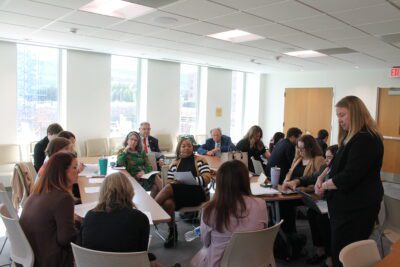
The goal of the retreat is to inspire leadership and legislation and “strategic action for greater educational outcomes and student success.” More than 50 legislators attended the retreat and were provided with research on the issues discussed.
Introducing his colleague, Sen. Michael Lee, R-New Hanover, said former Sen. Howard Lee’s “entire life proves the work of education rises above party lines.”
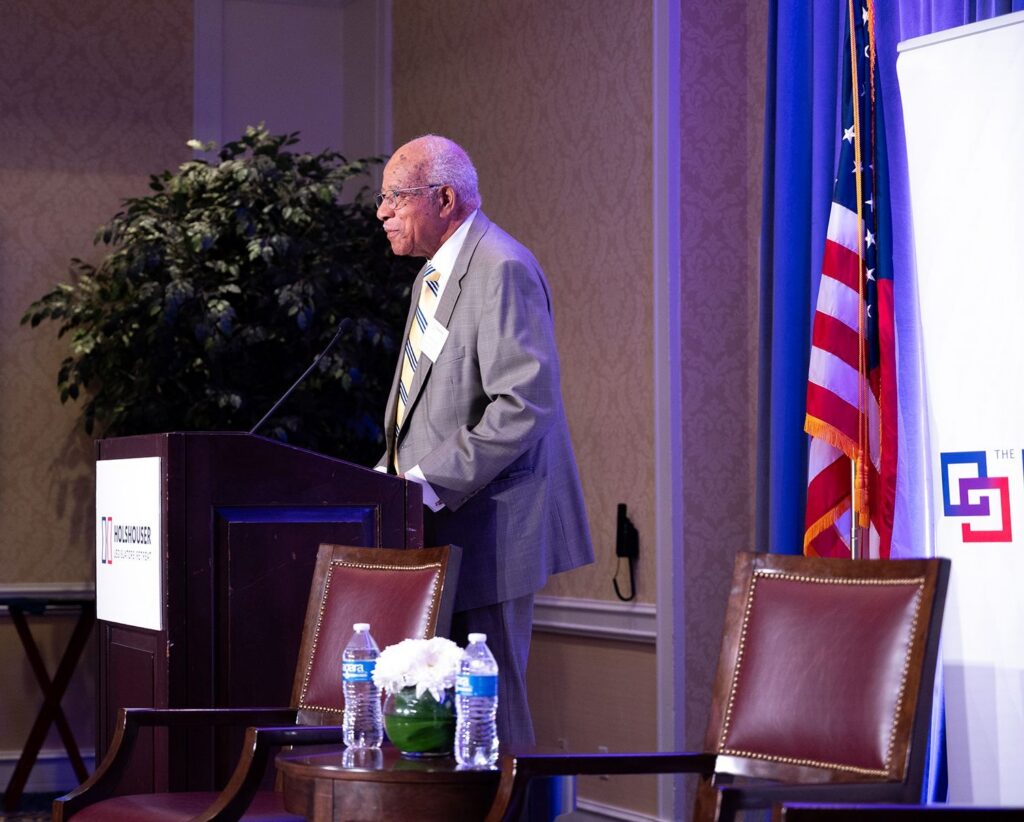
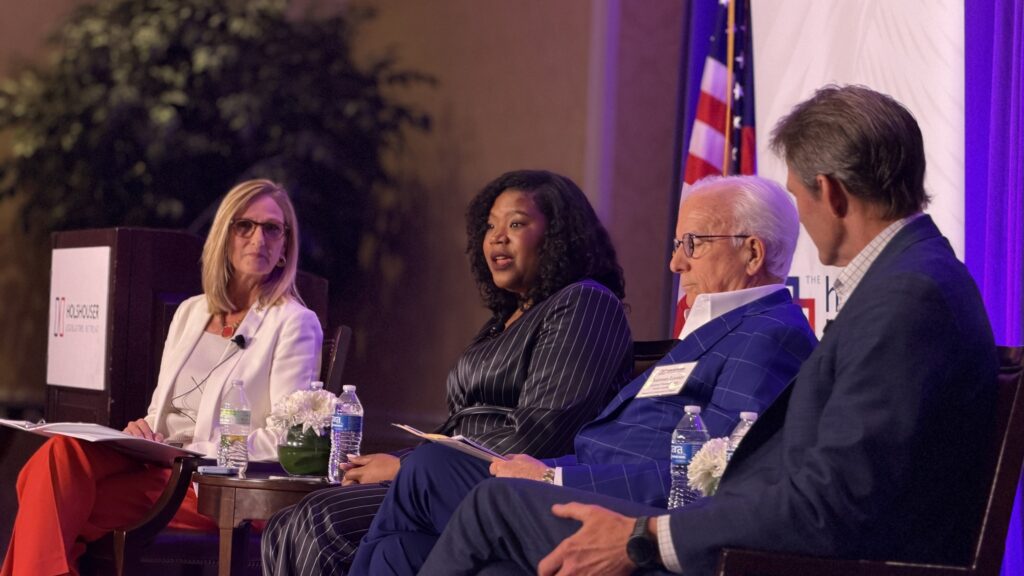
“I have always felt we needed a place where legislators could come together away from the pressure of the legislative building and the legislative process, and be able to sit and talk, engage with each other, and not feel competition,” said Howard Lee. “I hope you can look at each other as individuals. I hope you can respond to each other respectfully. I hope you can engage in a way that you can share your opinions and not feel judged in any way.”
At the retreat, legislators heard from elected officials about legislative priorities for education, learned more about the biggest challenges across the educational continuum from early education to workforce development, had an opportunity to better understand how public policy changes translate into changes in classrooms and schools, and were briefed about key issues the legislature will be asked to consider moving forward.
Stein and Green present legislative priorities for education
Gov. Josh Stein, in his longest address to legislators on his education priorities, outlined his proposed investments in North Carolina’s teachers and students and called on the General Assembly to pass a comprehensive budget.
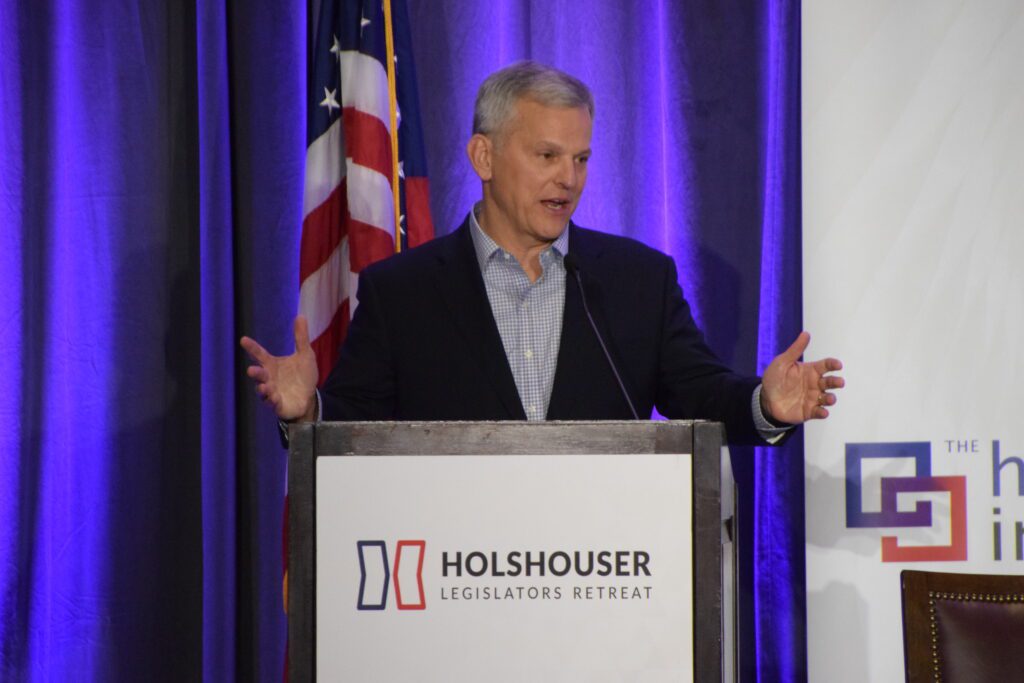
He also highlighted his partnership with Speaker Destin Hall and President Pro Tem Phil Berger to convene a Blue Ribbon Commission on Public Education. The commission will examine teacher training and student advancement, administrative operations, educational leadership, and accountability.
Stein compared investments in education in North Carolina to neighboring states, suggesting that investments now will have the kind of long-term dividends the state is now enjoying as it celebrates its No. 1 state for business ranking.
“We are not a poor state,” the governor noted.
“These are choices,” he later said to legislators.
Stein said circumstances have changed since the legislature passed the tax cut triggers, including the impact of Hurricane Helene on western North Carolina.
“When circumstances change, leaders make adjustments,” said Stein. “We can chart a new course forward that invests in our children, that chooses our children. It’s our first priority.”
Gov. Jim Hunt, whom The Hunt Institute is named for, was known for taking colleagues by the elbow as he shared with them the support he needed to advance better policies for children.
“Team, I need you,” said Superintendent Maurice “Mo” Green to legislators. “I am grabbing you by the elbow. I am asking you as respectfully as I can to do right for our children.”
Green went on to outline what he called his “long list of needs” to meet his strategic plan’s goal to be the best in the nation. He said the long list was warranted given the state’s investment in public education.
But Green also narrowed his priorities for legislators, urging them if they only have the financial capacity to focus on one thing to focus on educator compensation.
“I need us to now fund our educators,” said Green.
 Sign up for the EdDaily to start each weekday with the top education news.
Better understanding education issues across the continuum
Early learning as an economic driver in North Carolina
Early childhood education affects North Carolina’s economy and workforce readiness.
“It all starts with early childhood learning,” said Rep. Willis, who owns and operates an early child care center. “If parents don’t have some place that they can send their child that they trust, then they’re not going to be able to go to work.”
Exploring NC Pre-K, Head Start, and Smart Start — including the effects of federal funding changes and local factors in smaller counties, such as declining enrollment and limited tax capacity — legislators heard about strategies to sustain and strengthen programs, improve reimbursement processes, and ensure access and quality for young children across the state.
Legislators heard from state leaders, including Samantha Cole, child care business liaison for the N.C. Department of Commerce; Amy Cubbage, president, North Carolina Partnership for Children; and Candace Witherspoon, director of the Division of Child Development and Early Education in the N.C. Department of Health and Human Services.
The retreat highlighted three policy considerations:
Increase the supply of high-quality child care to address gaps that constrain workforce participation and economic stability;
Expand mixed-delivery models and preschool access to strengthen availability of high-quality early childhood education, particularly in rural and underserved communities; and
Examine and build on existing compensation initiatives for early educators to reduce attrition, stabilize the workforce, and sustain program quality.
— The Hunt Institute issue brief
Experts said the whole state is considered a child care desert with five families competing for every one spot.
The child care economy in North Carolina is shrinking, they said, and the upshot is that parents can’t afford the care, teachers can’t afford to stay in these jobs, and our children are paying the cost.
Legislators heard the stark reality of early education in North Carolina, including the 8,000 children currently on the waitlist for child care subsidies as of February 2026.
But they also heard about bright spots, from the work the Boone Chamber of Commerce has been playing post Hurricane Helene, a pilot in Yadkin County called Early Ed Flex Plex, and the possible creation of a child care endowment.
EdNC’s reporting on these bright spots

How North Carolina is preparing its workforce for a rapidly evolving economy
North Carolina’s 2025 recognition as the nation’s top state for business is well known.
At the retreat, legislators learned more about the strategies to align education with workforce development, especially when it comes to practical, skills-based training to preparing students for good jobs, including:
- Regional needs,
- Alternative pathways beyond four-year institutions, including dual enrollment and early college models, and
- Workforce-building approaches in sectors such as STEM, technology, health care, and textiles.
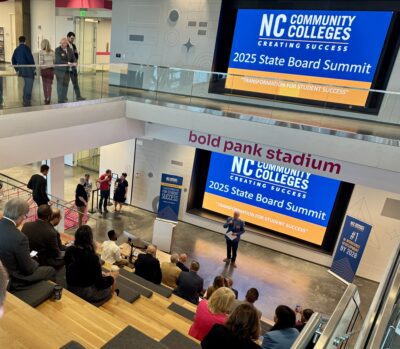
Cecilia Holden, president and CEO of myFutureNC, led a panel including Jasmine Cox-Wade, executive director of the Textile Technology Center at Gaston College; Tom Looney, chair of the North Carolina Board of Community Colleges; and JB Buxton, president of Durham Technical Community College.
Sen. Overcash noted that the Joint Legislative Education Oversight Committee, which he co-chairs, also heard recently about the Textile Technology Center at Gaston College.
He said it would have been easy for North Carolina as a state to walk away from the textile industry, but instead he cited how business, philanthropy, education, and government came together to move from a focus on labor to a focus on high-tech testing, quality, research, and development.
“It’s the absolute envy of the world,” he said.
Looney updated legislators on the status of the search for the next president of the community college system, and Buxton praised legislators for the state’s ongoing investment in career and college promise, which he called “the best postsecondary policy in the country.”
Read more
Connecting practice to policy: AI and student device use
While state and national leaders are excited about technology and the future, they are worried about the present, prompting a conversation about what responsible ed tech looks like with regards to public policy changes and classroom implementation.
The retreat also offers the opportunity for legislators to hear directly from school and district leaders.
House Bill 959, which passed in summer 2025, limited student cellphone use during instructional time, and The Hunt Institute provided guiding questions for legislators to hear about practical outcomes of the changes to policy.
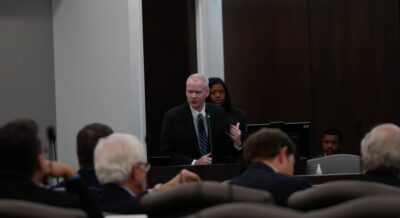
Dr. Mitch Prinstein, distinguished professor of psychology and neuroscience at The University of North Carolina at Chapel Hill, pointed legislators to the American Psychological Association’s health advisory on social media use in adolescence and even newer research on the risk of content, features, and functions of social media.
Prinstein said recent research in classrooms across North Carolina showed that even with the legislation in place when students are still checking in on their phones it is most often because of boredom or loneliness, and interestingly they are most often connecting with their parents during the school day. He said students report a love-hate relationship with their devices and 45% of ninth grader report experiencing digital stress.
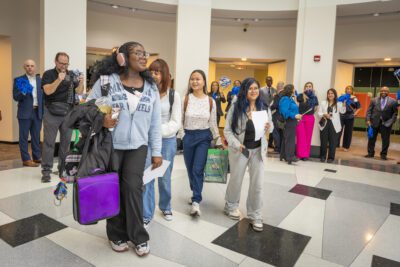
Rep. Julia Greenfield, D-Mecklenburg, shared her experience visiting a high school in her district last week as part of Legislators in Schools Week. The school is implementing the policy using the honor system.
“There were no cellphones out,” said Greenfield. “I went to lunch. I went into the classrooms. The kids were talking to each other. They were really engaged with one another. And you could just feel a calmness in the atmosphere, in the whole school.”
Legislators reported out learnings including the need to know more about the ripple effect on at-home social media engagement and device use, enlisting parents as partners, and the role of ed preparation programs in training teachers on AI.
They also discussed that one-size-fits-all policies don’t work given the differences in elementary, middle, and high school learning environments, the risk of making public schools the most restrictive settings with regards to ed tech, causes of boredom from attention span to teaching strategies, industry demand for AI fluency, the ongoing need for students to still learn critical thinking, and the challenges and opportunities for educators integrating AI in the practice of both teaching and learning.
Read more

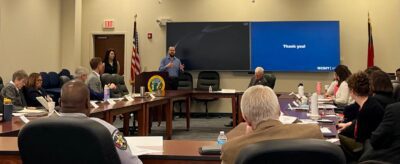
Highlighting key challenges and opportunities moving forward
Education to Good Jobs: Building North Carolina’s workforce
Nation Hahn, in his new role as managing director for the John M. Belk Endowment, announced Good Jobs Western North Carolina to the legislators at the retreat. The coalition was introduced nationally last week at the ASU+GSV summit where 80 national funders were exposed to the America Achieves good jobs economy framework.
Good Jobs WNC is a locally led, regionally coordinated, and nationally connected coalition across 23 counties. The effort brings together 11 community colleges, employers, foundations, and regional partners around a shared goal of connecting 1,200 residents to good jobs over the next three years in high-demand sectors including health care, manufacturing, and the skilled trades, serving as a prototype for what’s possible statewide and beyond.
With more than now $3.1 million in early philanthropic commitments alongside Stein’s proposed $600,000 budget request, the coalition is building a strong public-private foundation and is now seeking additional investments toward a $12 million capital goal.
Jon Schnur, CEO of America Achieves, said he believes that initial state investment could be leveraged by more than 10x with in-state private philanthropy with national funders then possibly driving a 20x investment.
The coalition is looking to best practices in other counties including Singapore and Switzerland: Singapore’s alignment of education, workforce training, and economic development, including applied learning pathways and national workforce strategies; and Switzerland’s model of deep employer engagement, where businesses play a direct role in shaping training programs and
credentialing.
Hahn said while Good Jobs WNC needs to be seeded with private philanthropy and state funding, longer-term financial sustainability statewide is possible through enrollment, potential shifts in state funding through Propel NC, and changes in federal funding including Workforce Pell.
Good Jobs WNC is designed to align workforce development, employer partnerships, and community investment in western North Carolina as the region rebuilds after Hurricane Helene, but also serve as a proof point nationally about the role of regional economic development — especially after a crisis that causes economic disruption.
Strengthening special education in North Carolina
Dr. Ereka Williams, vice president of education at Dogwood Health Trust, led a discussion about strengthening special education in North Carolina in the face of increasing financial pressure to serve these students well, from federal funding reductions to state caps and restrictions on per-school budget flexibility.
EdNC will be reporting more on these issues as the short session kicks off.
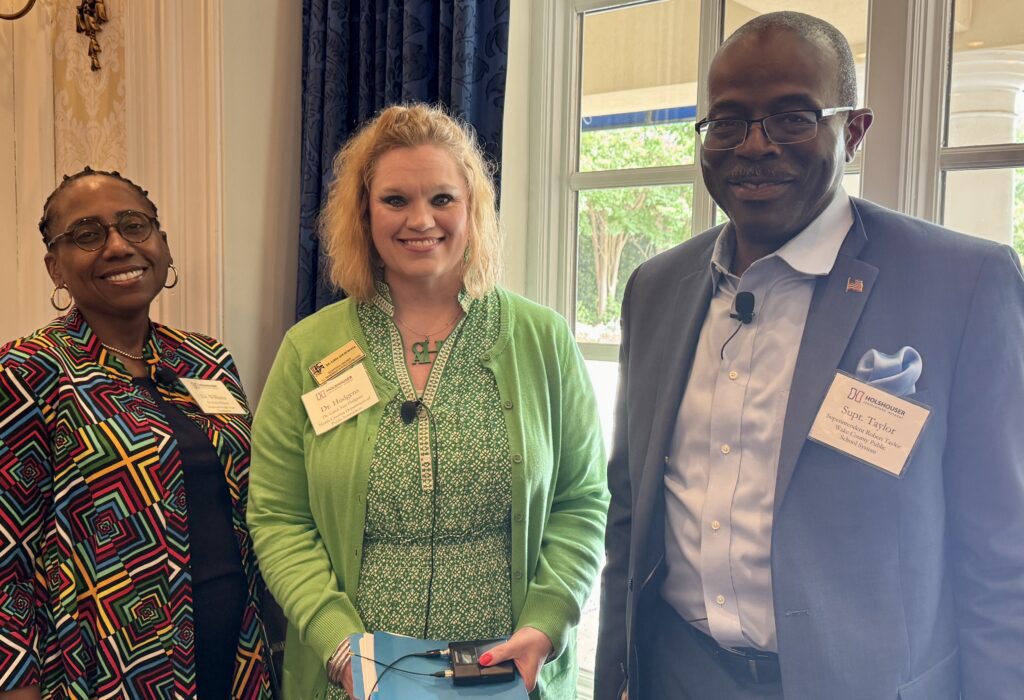
Unpacking North Carolina teacher pay and per-pupil spending
Legislators were briefed on how much North Carolina spends on public education and how those dollars translate into teacher compensation, workforce strategy, and student opportunity.
State leaders — including Michelle Fockler, senior managing director of alumni impact for Teach for America North Carolina; Brenda Berg, president and CEO of BEST NC; and Dr. Andrew Smith, senior policy advisor for the North Carolina Senate — urged legislators to look beyond broad debates about “more spending” versus “better spending” and focus instead on how North Carolina can align funding decisions with educational priorities and long-term improvement by connecting teacher pay, spending patterns, and system design.
Berg said the state has 100,000 teachers, and year to year across the state 10,000 teachers need to be hired. “There is no other industry hiring that many for one position,” she noted. “Our system is not structured to do this well.”
Teachers need to earn a living wage earlier in their career, she emphasized. “We are not where we need to be on starting pay,” she said.
Smith — who has worked in school districts, at the Department of Public Instruction, and now supports legislators — said friction exists between how we fund schools and how strategic plans at the district and state level drive change. He noted that strategic plans don’t often reference the budgetary line items that will fund the change needed.
Bridging the gap with NC College Connect
NC College Connect is North Carolina’s statewide initiative that streamlines college admissions for eligible North Carolina public high school seniors.
Dr. John D. Denning, a senior advisor with the John M. Belk Endowment, moderated a panel including Ni-Eric Perkins, the director of the Carolina College Advising Corps (also known as Advise NC) and Dr. Jeff Cox, the president of the North Carolina Community College System.
Legislators learned more about how the initiative removes barriers, provides direct college admission, and supports students’ transitions with guidance and resources.
They also heard about measurable successes, including increased enrollment from rural, urban, and underserved communities; local partnerships and community engagement; and opportunities to expand the initiative.
Cox said in the next iteration of NC College Connect, every high school senior will be notified in August 2026 that community college is a higher education option for all students across North Carolina.
How to scale NC College Connect and the infrastructure and funding needed to support growth is the challenge ahead for legislators.
Denning said the initiative is an important signal to students and families that the state believes in them.
Other news from the retreat and The Hunt Institute
Legislators were also briefed on the use of data and research to improve education and education outcomes in North Carolina, including best practices in student success, workforce development, and long-term leadership in health and the economy.
Dr. Sam Houston, the president and CEO of the North Carolina Science, Mathematics, and, Technology Education Center, thanked legislators for attending the retreat and concluded by reminding them that he believes their most important role is “supporting the educational opportunities of our young people.”
In other news, former Teacher of the Year Maureen Stover is back at The Hunt Institute serving as a fractional managing director.
Editor’s note: The John M. Belk Endowment and Dogwood Health Trust support the work of EdNC.