
New school accountability task force begins latest effort to redesign system

The State Board of Education’s task force to redesign North Carolina’s school accountability system kicked off its work Thursday with a discussion of the new model’s theory of action.
The Board voted to create the Task Force on Accountability last October in line with the joint strategic plan of the Board and the Department of Public Instruction (DPI), and members met for the first time in December. The task force includes stakeholders from across the state’s education system, including Board members, legislators, county commissioners, business leaders, district leaders, teachers, parents, and students. You can view all the task force participants here.
“We need to find a good accountability system that accurately reflects — or as close to accurate … how we are doing and how our children are doing, but do it in a way that’s more inviting to children and more reliable for their parents, and a lesser sense of anxiety, lesser sense of pressure, and a greater sense of feeling support,” said Alan Duncan, vice chair of the Board and a co-chair of the task force.
 Sign up for the EdWeekly, a Friday roundup of the most important education news of the week.
In North Carolina, school performance grades are determined using a formula that assigns 80% of the score to achievement indicators, such as standardized test results, and 20% to measures of student growth. Education leaders have said for years that this calculation does not reflect the full scope of work taking place in the state’s public schools.
DPI has long discussed the issue, and in 2024, created a plan to redesign school performance grades during former state Superintendent Catherine Truitt’s tenure. Though lawmakers proposed legislation moving forward parts of the plan, it was never turned into law. You can view all of EdNC’s reporting on school performance grades here.
On Thursday, Superintendent Maurice “Mo” Green said the new accountability system should reflect the successes of the state’s public schools, referring to recent records broken in four-year graduation rates, Advanced Placement (AP) participation rates and scores, and Career and Technical Education (CTE) credentials earned.
“Our accountability system also needs to be sure that we are telling the story in a way that says, yes, there’s work to do, but by gosh, North Carolina’s public schools, I could actually argue, may not have ever been better for more kids in our history,” Green said.
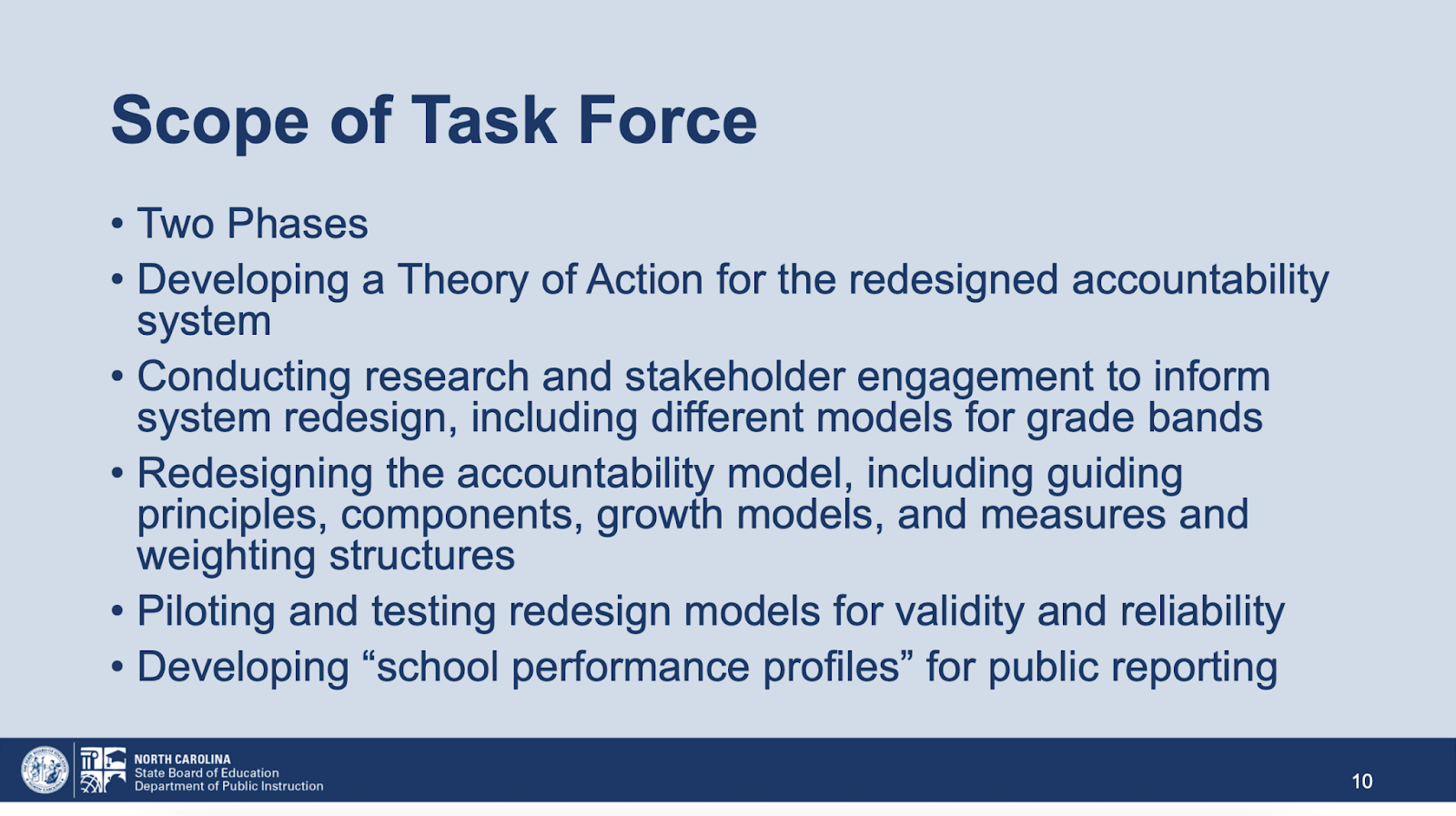
The task force’s purpose is to design a new theory of action and design principles for the accountability system. Members will work with the Center for Assessment, a nonprofit supporting districts and states through the design, implementation, and evaluation of school accountability systems. The Center for Assessment worked with DPI on the early development of Truitt’s accountability system plan in 2022.
The theory of action will lay out assumptions, mechanisms, and goals that will support the system’s long-term objectives, said Dr. Juan D’Brot, associate director at the Center for Assessment. The design principles will be the “guardrails” guiding the system, informing its design, and addressing competing priorities, according to a Center for Assessment presentation.
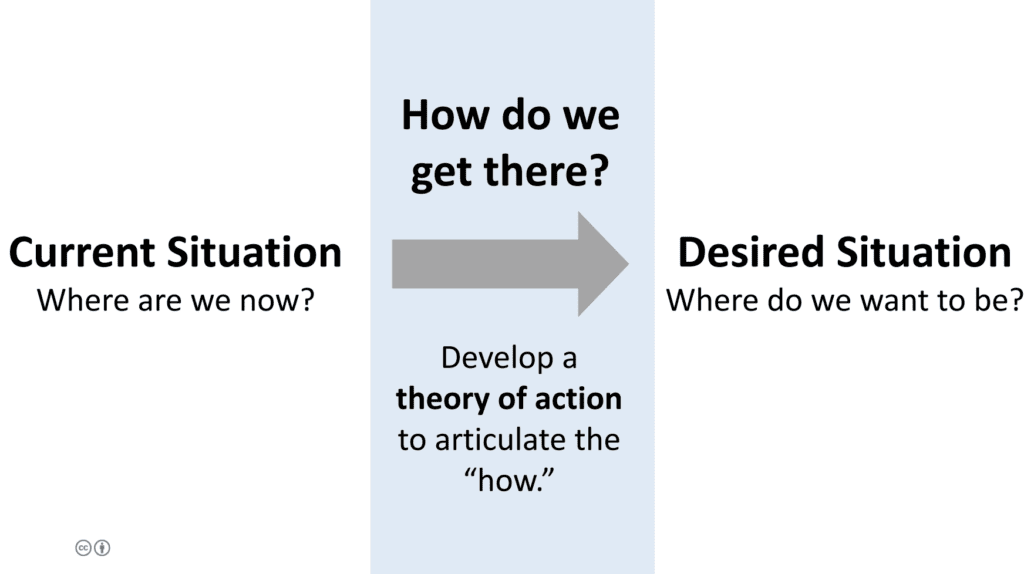
Members spent the majority of Thursday’s meeting working through guided exercises and discussions to establish a vision for the new accountability system. Members answered questions about future graduates’ preparation and qualifications, their priorities for the accountability system, and the roles and responsibilities of different stakeholders within the system.
A DPI work group will succeed the task force to assess the new system’s characteristics and features — choosing specific indicators, defining reporting measures, and making design decisions. D’Brot said this group will send their recommendations back to the task force for approval, and DPI will be charged with ensuring the system complies with all rules and regulations.
“A key challenge this task force will face is not getting into the weeds of indicators, measures, aggregation methods, etc., but rather staying at the theory of action and design principles level and then providing feedback on the indicators, measures, aggregation methods, etc. suggested by the work group,” the Center for Assessment presentation says.
The task force is set to meet five more times this year, according to a draft document — April 16, June 18, Aug. 20, Oct. 15, and Dec. 17. Members will begin drafting their report and recommendations in December, according to a draft timeline presented during the December meeting.
The task force plans to present its model to the State Board in May 2027, with the hope of being voted on in June 2027. Statewide implementation of the new model would begin in October 2027, dependent on legislative approval.