Program serving students with IDD expands to 10 more community colleges, and more from the SBCC

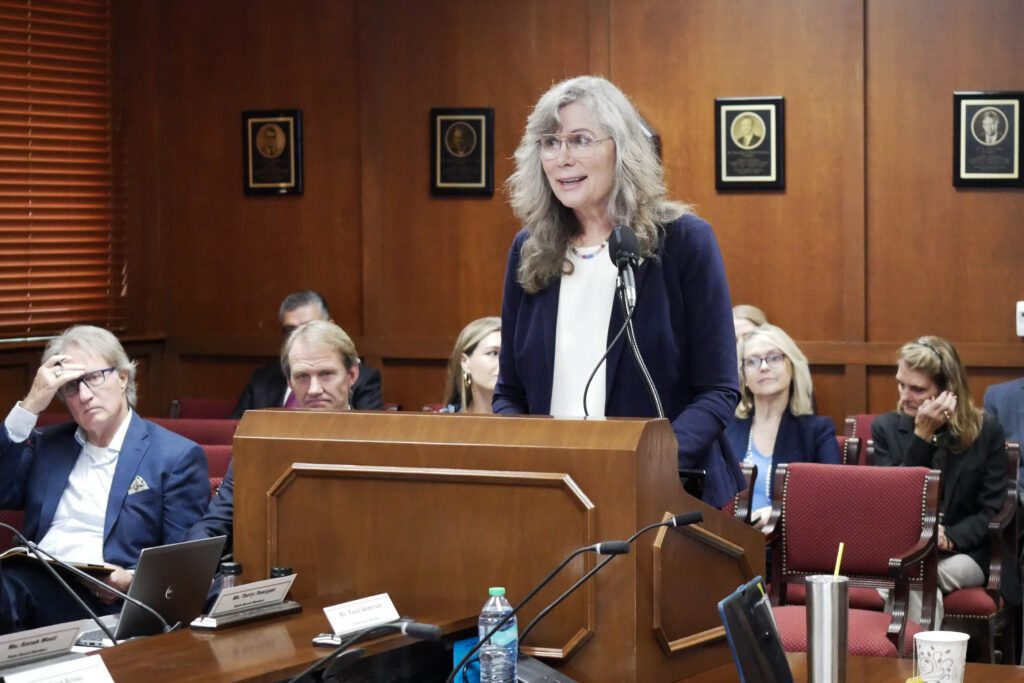
The State Board of Community Colleges approved a $1.94 million allocation to expand Access to Achievement on Friday, meaning more students with intellectual and developmental disabilities (IDD) across the state will be able to take advantage of the program.
The N.C. Community College System’s (NCCCS) Access to Achievement is a state-funded workforce training program that serves students with IDD. The program was initially piloted in 2022 at two colleges, and later expanded to a total of 15 colleges. This new allocation — which was appropriated by the General Assembly in the new state budget — will expand its operation to 10 additional colleges, bringing the total to 25.
“Our funding is employment-focused and career-preparation-focused,” NCCCS Director of Career Pathways of IDD Nancye Gaj told the Board regarding the program. “We’re very much about career pathway development… We are very focused on employment and movement through the system.”
In order to facilitate those goals, Gaj said the Access to Achievement coordinator at each college supports students by assisting them in creating a person-centered career plan, supporting them as they move through the process of education and credential attainment.
Board member Lisa Estep, chair of the finance committee, discussed the importance of Access to Achievement, which she said creates space for students in postsecondary education who may not have previously had access.
“This is obviously very, very important to me. I think it should be important to this Board, and I hope it continues to be important after I leave next year,” said Estep. “Because it’s a group of students who obviously have wanted to be a part of curriculum, who have wanted to be a part of short-term workforce training, and really haven’t had as much of an opportunity as I think they should have.”
Gaj said the majority of students in Access to Achievement take classes alongside curriculum students, meaning they are not in specialized programs. The Access to Achievement program provides support to help them be successful in general education courses.
The last time Gaj gave an update on Access to Achievement to Board members, she reported that 809 individuals participated in the program during the 2025-26 school year. But once all the data was completely collected, the number of individuals served was closer to 1,100, according to Gaj. Estep noted the interest they have seen in the program across the state.
“We’ve received emails from individuals, asking, ‘Hey, why aren’t you in our area? What can we do to facilitate conversations? Can you come to our advisory council?’” said Estep. “So I think the interest is there. Obviously the numbers support that, having over a thousand students (participate).”
During her presentation, Gaj said the expansion of the program was because of the success seen so far.
“Due to the success of what has happened at the 15 initial colleges, the General Assembly saw fit to allocate us an additional $3.8 million dollars,” said Gaj.
Once the budget was signed into law in July, the system office put out a request for proposals for schools to apply for part of that new funding. According to Gaj, a review panel, made up of internal and external stakeholders, selected the 10 colleges. The expansion of Access to Achievement to these 10 schools, Gaj said, “is a dramatic change for us” because of their size, which Estep also highlighted in her remarks.
“We have almost all of the largest colleges represented,” said Gaj. “And it’s going to have a really big impact on how many students we serve, how many moving parts there are, and many other things.”
The following community colleges will launch Access to Achievement, each receiving $194,000:
- Bladen Community College
- Cape Fear Community College
- Central Carolina Community College
- Durham Technical Community College
- Fayetteville Technical Community College
- Gaston College
- Isothermal Community College
- Pitt Community College
- Southwestern Community College
- Wake Technical Community College
In August, the State Board also approved a $640,000 allocation to the system office to support the expansion of Access to Achievement, including the creation of two full-time positions focused on business engagement and workforce development activities. The state budget also directs the system office to use up to $810,000 for “marketing evaluation, online resources, professional development, and infrastructure support.”
 Sign up for Awake58, our newsletter on all things community college.
Gaj went on to explain that the system office will hold a virtual orientation for all of the new colleges on Oct. 28. During this orientation, she said they will discuss the importance of employing a coordinator to assist with the operation of Access to Achievement — a role vital to the on-the-ground success of the program.
The orientation will also discuss budgeting. Gaj said she wants to ensure each recipient has budget guidance from the system office as well as a fiscal plan for the program.
“We want to make sure (the colleges) make investments that benefit not just the students who directly sign up to have a person-centered plan, but the whole campus, to make the campus more accessible,” Gaj explained.
She also previewed two centers that will be established in the future, one in the west and one in the east, which will “put additional resources out there to help with the transition from public school to community college” for students with IDD and their families.
“We’re very excited to be at this point now. We plan to continue providing a lot of professional development at local colleges,” said Gaj. “Through these centers, we can expand — working with all the community colleges to make them a more welcoming and accommodating space for people with disabilities and learning challenges.”
Board Chair Tom Looney asked how students or parents find out about Access to Achievement and its services. Gaj explained that part of the allocation from the legislature was specifically designated for outreach to public schools — getting marketing materials, hosting regional meetings, and generally raising the profile of the program.
Raising the profile of the program, though, might not just be confined to spreading awareness in North Carolina. Estep said that there have been discussions about how to bring Access to Achievement to the national stage.
“I don’t think that (something like this) exists anywhere in the country,” said Estep. “So, we were talking, too, about maybe getting that conversation going at a national level, getting into more conferences. Right now there’s a lot of conversations around university programs that develop social skills. There are a lot of social programs at universities, and that’s not what this is. This is employment-based.”
Read more

Thirteen new programs receive High-Cost Workforce Funding
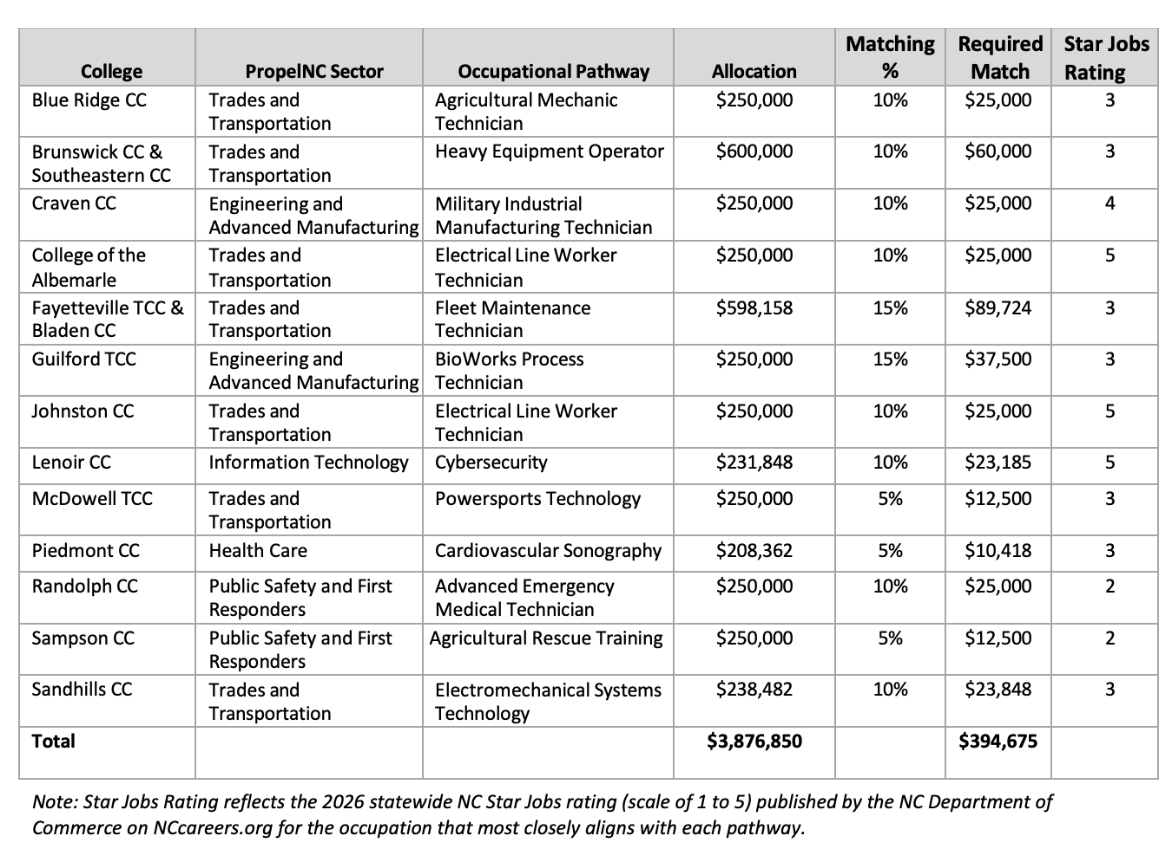
During the Board’s October meeting, members also allocated nearly $3.9 million in High-Cost Workforce Start-Up Grants to support 13 new programs across 15 community colleges, including two regional partnerships. The state budget directed the NCCCS to establish the program using nonrecurring funds appropriated to the system office.
Requests for proposals were released in July, and applications were due Sept. 4. Thirty-eight of the state’s 58 community colleges submitted or participated in one application, and five regional partnership applications involved 10 colleges.
“We have more requests than we have money,” said NCCCS Associate Vice President of Workforce Strategies Dr. Andrew Gardner. “So it was very well received by the colleges.”
Only programs aligned with Propel NC workforce sectors are eligible, and colleges are required to contribute a percentage in matching funds, the share of which ranges based on the number of full-time equivalent (FTE) students. Funds can be used for a variety of start-up costs, including instruction, faculty salaries, supplies, equipment, and accreditation.
The colleges selected to receive the funds include:
- Blue Ride Community College
- Brunswick Community College and Southeastern Community College
- Craven Community College
- College of The Albermarle
- Fayetteville Technical Community College and Bladen Community College
- Guilford Technical Community College
- Johnston Community College
- Lenoir Community College
- McDowell Community College
- Piedmont Community College
- Randolph Community College
- Sampson Community College
- Sandhills Community College
For more information, view the table below:
The Board also allocated nearly $1 million in additional funding for faculty recruitment and retention in hard-to-recruit and hard-to-retain positions.
The Board is defining those roles as those within the Propel NC workforce sectors of healthcare I and II, engineering and advanced manufacturing, trades and transportation, information technology, and public safety and first responders.
Related reads

ApprenticeshipNC releases annual report
The state budget allocated $3.17 million in recurring funding for ApprenticeshipNC, the state apprenticeship agency designated by the U.S. Department of Labor (DOL) to register and oversee apprenticeship programs.
Historically, ApprenticeshipNC was largely funded through federal grants, many of which expired this year. Now, with a total state appropriation of $4.4 million, ApprenticeshipNC can “move from grant-dependent growth to a deliberate and sustainable statewide expansion strategy,” according to the annual report.
On Thursday, John Loyack, vice president of economic development at the NCCCS, said the investment “fundamentally changes what’s possible” for the program. Board member Sarah West also echoed that sentiment, thanking the legislature for the additional funding.
“We’re very pleased to acknowledge our deep gratitude to the General Assembly for its significant recurring investment in the ApprenticeshipNC program,” said West.

The report states: “Due the recurring investment made by the General Assembly, ApprenticeshipNC will now have the ability to use DOL grant funds to provide direct incentives to employers and apprentices.” After the budget became law, ApprenticeshipNC requested a budget modification for the State Apprenticeship Expansion Fund (SAEF) Year 4 DOL grant award to support employer incentives, the report says.
Loyack presented the report to the Board, explaining that he wanted his presentation to walk them through a “future vision,” along with what ApprenticeshipNC did in the previous year. Despite the uncertainty of funding and staffing the program faced last year, Loyack said registered apprenticeships in North Carolina continued to grow.
“We enrolled 5,659 new registered apprentices last year. That’s up about 9% from the previous year. And pre-apprentices, we saw even greater growth,” said Loyack. “Pre-apprenticeship grew to 2,054 — that’s almost a 25% increase from one year to the next.”
Next year, the program hopes to grow from 10,286 active ApprenticeshipNC participants to 13,962. The growth strategy outlined in the annual report described the following steps:
- Strengthen regional presence
- Standardized program development
- Strengthen group sponsors
- Target high-impact employers
- Protect quality and improve outcomes
- Improve the employer and sponsor experience
- Focus growth strategically
- Align and mobilize the ecosystem
Loyack also highlighted one major initiative for the following year: developing state occupational frameworks.
“These frameworks will provide employer-validated work processes and stackable, related instruction, informed and standardized with the colleges so an individual or an employer can easily navigate their options,” said Loyack. “The goal is not to standardize employers — it is to standardize the starting point so that programs can be developed quicker and replicated easier.”
ApprenticeshipNC will also add the following roles in the 2026-27 fiscal year, with the goal of helping facilitate growth and deeper relationships: industry group programs lead, key account development lead, individual program quality assurance lead, and college group programs lead.
Explore more on apprenticeships
Other business items
The 2026-29 strategic plan is set to launch in February, but because of the pending confirmation of the new system president, which is likely to take place in November, the Board discussed scaling back what will be included in the plan. During the strategic planning committee meeting on Thursday, Board member Scott Ottman said the plan would be more “operational” and “tactical.”
There was also discussion from the Board about potentially decreasing the number of times they meet each year. Currently, the Board meets 10 times a year, and they are statutorily required to meet at least eight times per year.
The Board also adopted three new policies, all required by state law. The policies:
- Require colleges to evaluate certain variables when procuring technology, computer hardware, and software;
- Require colleges to provide students with the phone numbers for the Suicide and Crisis Lifeline and the NC Peer Warmline;
- Prohibit the system office and community colleges from providing state-funded scholarships or in-state tuition to students who are convicted of assaulting an officer or employee of the state.
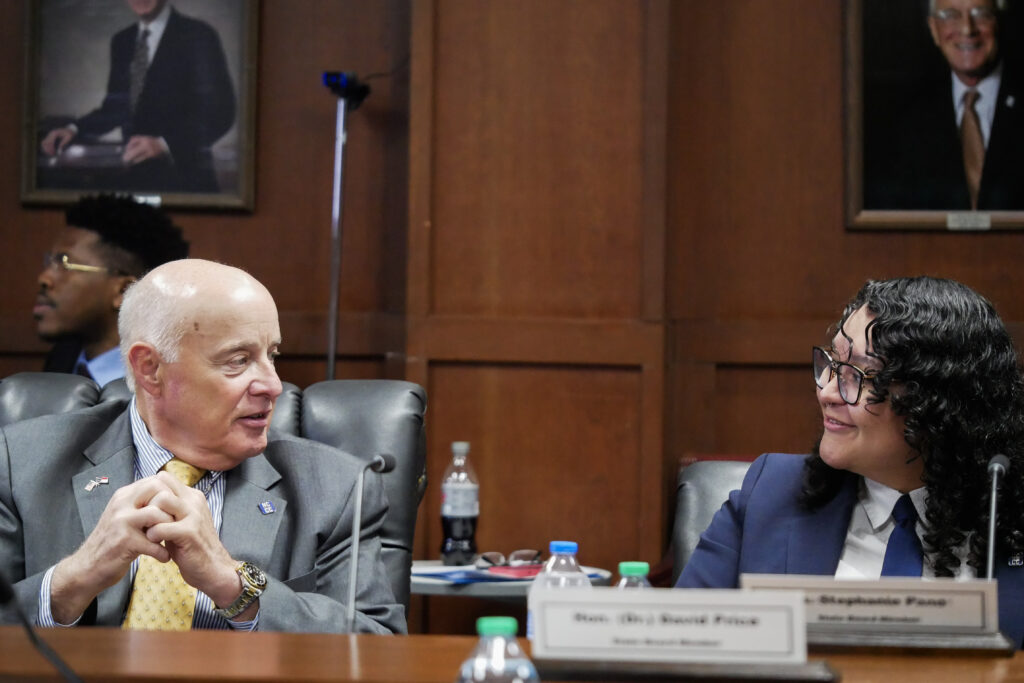
The Board also allocated about $31.7 million in excess tuition receipts to colleges due to the over-collection of budgeted receipts in the 2025-26 fiscal year. A breakdown of those allocations by college is available here.
Finally, the Board heard an update on efforts the system has taken to identify and prevent fraudulent student applications. A new registration process allows colleges to flag suspicious and confirmed fraudulent applications. That information is then available in the system’s data warehouse, allowing the system office to identify matching identities and notify colleges of any fraudulent applications that have not yet been flagged.
The Board will next meet on Nov. 19-20.
Editor’s note: Analisa Archer contributed to this article.