
RFP opens for Boost expansion to support NC community college students in healthcare


The North Carolina Community Colleges Foundation, alongside AmeriHealth Caritas North Carolina and the N.C. Community College System (NCCCS), will soon launch the Bridge pilot, which will provide funding for three N.C. community colleges to “launch first-of-its-kind supports for short-term healthcare credential seeking students,” according to a press release.
The Bridge pilot is a two-year, $3 million program designed to be a “student-focused economic mobility workforce training model that strengthens the connection between healthcare workforce needs and student access, credential attainment, employment, and continued advancement.”
“The Bridge pilot represents an important next step in the evolution of Boost — bringing proven wraparound support to more students and creating new pathways into the healthcare careers North Carolina communities need most,” says the release.
 Sign up for Awake58, our newsletter on all things community college.
The Request for Proposals (RFP) for colleges to participate in the Bridge pilot launched on Oct. 1, and it is open until Nov. 18. Colleges can access the RFP here, and they are encouraged to prepare their applications ahead of the Nov. 18 deadline. Colleges will be notified of their selection on Dec. 16, the release says.
You can explore details about the program here. Also, to learn more about the program, NCCCS is hosting several informational sessions:
- Virtual information webinar: Wednesday, Oct. 7 | 10:30-11:30 a.m.
- Office hours: Tuesday, Oct. 27 | 3:30-4:00 p.m.
- Office hours: Thursday, Nov. 5 | 2:00-2:30 p.m.
More on the Bridge pilot
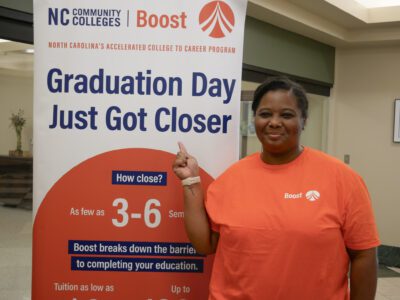
The Bridge pilot is the first adaptation of Boost, which is the state’s accelerated college-to-career program, designed to increase completion rates and move students into high-wage, high-demand jobs. The Bridge pilot will support “up to 1,000 students over two years as they pursue short-term healthcare credentials in critical roles,” the release says, in the following jobs:
- Certified Nursing Assistant (CNA I and II)
- Medication Aide, Medical Assistant (CE Pathway)
- Phlebotomy Technician
- EKG Technician
- Pharmacy Technician (CE pathway)
- Patient Care Tech
- Home Health/Patient Care Aide/Direct Support Professional
- Dental Assistant I
- Behavioral Health Tech, EMT (CE pathway)
Through the application process, three community colleges will be selected to receive $756,667 over two years to participate in the Bridge pilot.
“Selected colleges will use the funding to support eligible student expenses, success coaching, and institutional capacity needed to deliver the model and track program implementation strategies and student outcomes,” says the release.
The program is designed to meet the need for an adequate healthcare workforce, while assisting students overcome the financial, logistical, personal, and institutional barriers to rapid entry into the healthcare workforce.
“This community investment will help students overcome financial barriers that can derail their journey to a meaningful career in service to their communities,” said Heidi Chan, market president for AmeriHealth Caritas North Carolina, in the release. “We aren’t just paying for tuition and materials. We are helping to cover the life expenses that could derail a student’s path to graduation and the high-demand, high-earning potential job that waits for them.”
More on Boost
Healthcare in NC
Similar to trends across the country, North Carolina’s healthcare capacity is projected to decline over the next several years. Currently, the National Center for Health Workforce Analysis rates the state’s physician adequacy at 84%, with that adequacy predicted to drop to 78% by 2033.
Furthermore, research projects that North Carolina will have a shortage of nearly 12,500 registered nurses (RN) and 5,000 licensed practical nurses (LPN) by 2033. And in 2024, the N.C. Department of Health and Human services designated 97 of North Carolina’s 100 counties as having a healthcare professional shortage in the field of mental health.
This program aims to alleviate some of the pressure on the healthcare workforce, making the barrier to entry lower. The pilot intends to help students who previously would not have been able navigate entry to the healthcare workforce to have access.
“By helping students complete short-term healthcare training, the Bridge pilot will support both individual students and the communities that depend on a strong, skilled healthcare workforce,” says the release.