
Gov. Josh Stein signs budget into law, discusses investment in education

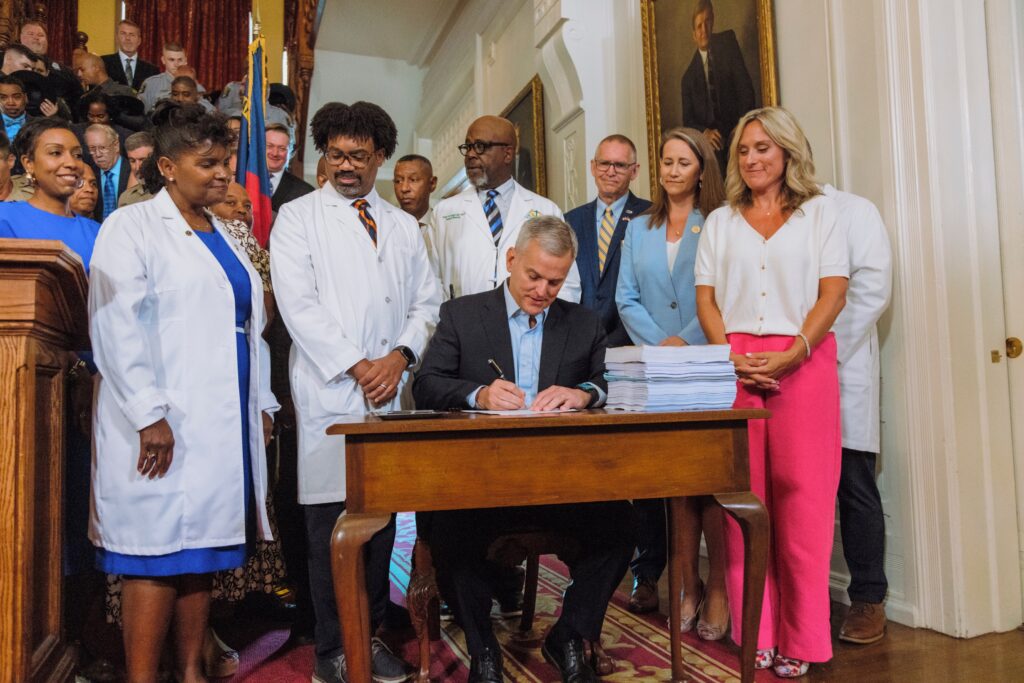
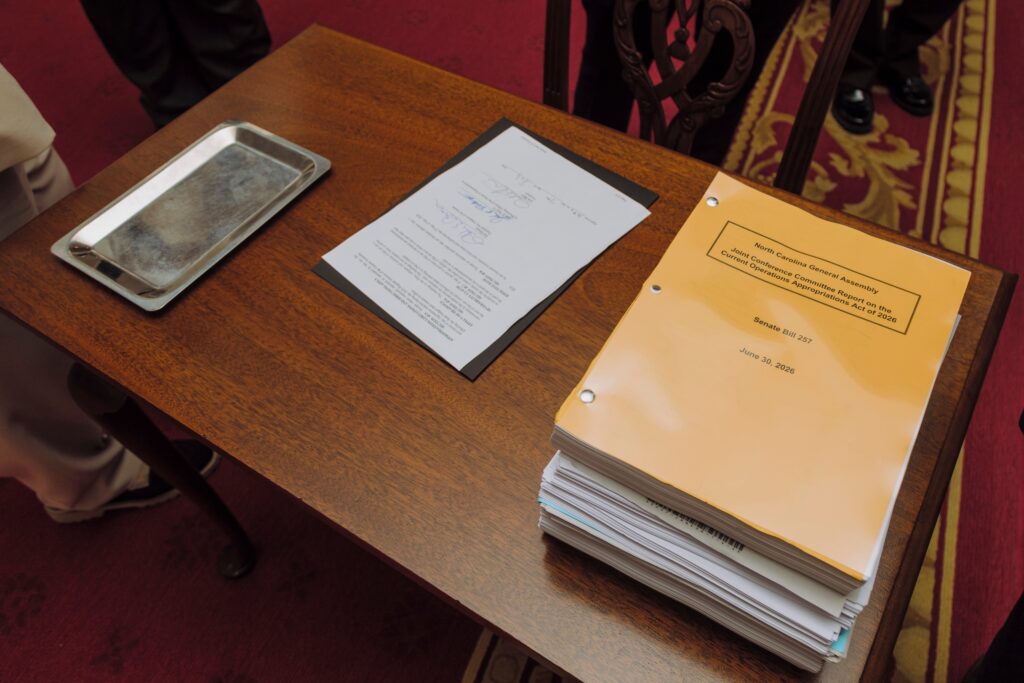
Gov. Josh Stein signed the new $34.4 billion state budget into law on Tuesday, highlighting its investment in public education. Among other things, the budget features an 8% average pay raise for teachers and increased funding for literacy and math efforts in North Carolina.
“This budget bill gets a lot of things right,” Stein said during an event where he signed the budget. “It delivers the largest starting teacher pay raise in nearly 50 years and the largest overall teacher pay raise in the last 15 years.”
Stein also highlighted the budget’s investment in North Carolina’s community colleges, including funding for Propel NC — the system’s new workforce-focused funding model — enrollment growth, and pay raises for most community college employees. The budget also includes many priorities of the Workforce Act of 2026, according to myFutureNC, including state funding to sustain and scale ApprenticeshipNC.
“The budget funds the community colleges’ Propel NC and ApprenticeshipNC to connect more people to good paying jobs and high-demand careers that can support a family,” Stein said.
Many provisions in the budget were in line with Stein’s budget recommendations from April, including funding for “advanced teaching roles, science of reading expansion, school safety grants, and apprenticeships.” However, on Tuesday, Stein said the budget fell short in some ways, like, for example, not investing enough “in our veteran teachers.”
Despite some concerns about the budget, Stein said he was ultimately signing because “North Carolinians expect their elected officials to come together across our differences to deliver for people.”
“Going forward, there is more work to do. We must continue to invest even more in public safety, public education, and other public services to be competitive with other states and to serve our people well,” Stein said in a press release.
Stein also signed House Bill 56, a technical corrections bill for the budget, which among other things, delays the implementation of a new principal pay salary schedule included in the budget until January 2027. Principals have said the new pay schedule would cause the monthly pay of principals at schools that are meeting or exceeding growth to decrease by $700 to $1,700.
More on teacher pay
“Hope is what starts a teaching profession, support is what sustains it,” said 2025 Southeast Regional Teacher of the Year Hannah Moon during Tuesday’s press conference, speaking directly after Stein.
Moon highlighted the budget’s raises for teachers, while adding that funding did not go far enough to support educators like herself.
“While the $1,000 bonus looks really good on paper,” Moon said many North Carolina teachers spend hundreds of dollars of their own money on school supplies every year. She said the school supplies that many teachers personally fund goes beyond notebooks and pencils, and includes things like winter jackets, personal hygiene products, prescription glasses, and food.
The budget includes an average 8% raise for teachers, with higher raises going to newer teachers, bringing North Carolina’s starting teacher salary to $48,000. The budget also comes with funds for a one-time bonus next year for teachers, depending on their experience level. Teachers with 15 or fewer years of experience will receive a bonus of $500; those with 16 or more will receive $1,000.
On Tuesday the Board of Education of Charlotte-Mecklenburg Schools — the second largest school district in North Carolina — said in a statement that “this budget represents meaningful progress,” but that “we must keep in mind that educators need compensation that grows with their commitment to students.”
“While a one-time bonus may provide short-term financial relief, it is not a substitute for meaningful, long-term compensation. It does not increase an educator’s base salary, strengthen retirement benefits, or provide the sustained income that supports longterm financial stability and helps educators live in the communities where they teach,” the press release says.
In his remarks, Stein praised the investment in teacher raises in the budget, but said further investments should be made. He told the story of one of the educators on his teachers advisory council, Christian Martin, who wanted to be a teacher ever since he was in high school and chose to pursue his passion despite the “financial sacrifice.”
“Beginning teachers are choosing to forgo other, more lucrative careers, and if they stay in North Carolina, they’re missing out on better salaries that they could earn in our neighboring states,” said Stein. The governor said there is still more to do to ensure North Carolina is competitive in educator compensation moving forward.
Read more of EdNC’s coverage of the budget

Early childhood investments
According to research, many families in North Carolina cannot afford the cost of child care, and child care providers have seen increased closures in recent years, especially in western North Carolina.
As EdNC has reported, the budget includes the biggest requests from early childhood advocates and the governor’s statewide task force: increasing the child subsidy rate and establishing a statewide subsidy floor rate.
On Tuesday, Stein said this investment will make it so “more parents can find child care that they can afford, especially in our rural communities.
“By establishing a statewide subsidy reimbursement floor, North Carolina’s elected leaders are taking an important step toward addressing one of the root causes of the crisis,” said ExCEL NC Director Dr. Kristi Maida in a statement. ExCEL NC, or Executives Championing Early Learning North Carolina, is forming a coalition of business owners and leaders to advocate for “statewide solutions and strategic, fiscally responsible solutions to the child care crisis.”
“Aligning reimbursement rates more closely with the actual cost of care will help stabilize providers, especially those in rural communities, preserve access for families, and strengthen the workforce that North Carolina’s economy depends on,” Maida said. “While more work remains, this investment represents significant progress toward a child care system that better supports families, employers, and communities.”
‘Access to health care and healthy food’
The budget also fulfilled the governor’s request to support state health resources, including fully funding the Medicaid rebase for this year. “3 million North Carolina and their providers are getting peace of mind and health care that they deserve,” said Stein. “This is a big win for North Carolina.”
The budget also includes funding for the Supplemental Nutrition Assistance Program (SNAP), which supports food access for 1.4 million North Carolinians. In addition, it provides $5 million in state funding for SUN Bucks, which will draw in $60 million in federal funding for the program. SUN Bucks helps keep “kids fed through the hungriest part of the year when they are not at school,” according to Stein.
“These investments recognize that access to health care and healthy food are fundamental to the well-being and productivity of North Carolina families,” said the North Carolina Alliance for Health in a statement. “We appreciate the work of legislative leaders to advance these priorities and strengthen programs that help children, families and communities thrive. … Every North Carolinian deserves reliable access to food and health care, and we look forward to working with lawmakers and partners across the state to build on this momentum.”
 Sign up for the EdDaily to start each weekday with the top education news.
The budget passed the General Assembly last week with bipartisan support. On Tuesday, Speaker of the House Destin Hall, R-Caldwell said that “today, the best budget in decades becomes law.”
“There is something in this budget for every North Carolinian, and the meaningful investments we’ve made will deliver real results that strengthen our communities, put more money back in people’s pockets, and improve lives across our state,” Hall said in a press release.
Despite some of the issues he highlighted, Stein said that it was important he support the many compromises in the budget for the good of the state and in the name of democracy.
“These are real wins worthy of celebration and worthy of my signature,” said Stein. “… As today’s budget proves, we can work together to get things done. I am eager to keep at it with the General Assembly to keep building on our momentum to create a North Carolina that’s safer, stronger, and more prosperous with opportunity for every person.”