‘A statewide celebration of reading’: DPI formally announces 10 Million Book Challenge

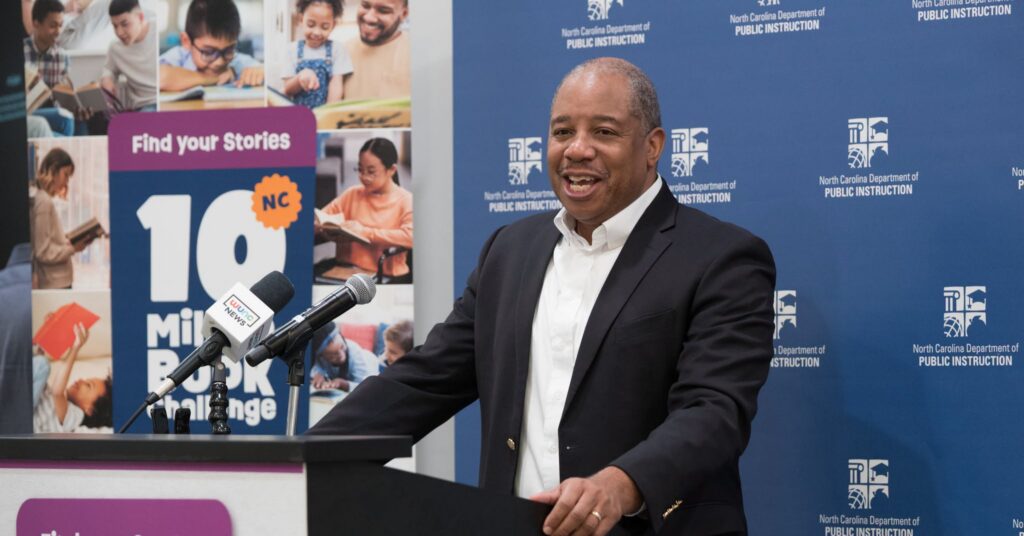
The N.C. Department of Public Instruction (DPI) officially announced the 10 Million Book Challenge, an initiative designed to encourage public school students across the state to read more, at a Tuesday press conference. The challenge will begin Jan. 1, 2027 and run until the end of the year. It is a part of the state’s strategic plan: preparing each student for their next phase of life (pillar 1), and galvanizing champions to fully invest in and support public education (pillar 8).
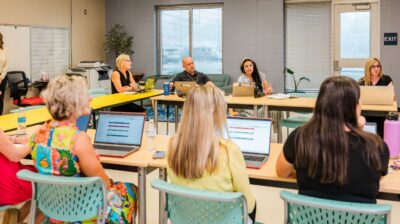
Attendees heard from several supporters of the challenge, including State Superintendent Maurice “Mo” Green, Book Harvest CEO Ginger Young, State Librarian Michelle Underhill from the Library of North Carolina, and CEO of PBS North Carolina David Crabtree.
“In 2027, North Carolina students will be challenged to read 10 million books in one year. That is 1.5 million students, 10 million books, one year,” said Green. “It is a statewide celebration of reading.”
 Sign up for the EdWeekly, a Friday roundup of the most important education news of the week.
According to an FAQ document about the challenge, no other state in the country has launched a “year-long, collective statewide reading challenge for all public school students from Pre-K through 12th grade, with a single shared numerical goal.”
Green emphasized the transformative power that reading can have for a student’s understanding of the world.
“A book can be where a child learns that the world is larger than their street and that they belong in that world,” Green said.
Every type of reading counts, from full-length novels and audiobooks, to e-readers and picture books, with texts in any language, including ASL.
“This Challenge isn’t about gatekeeping what ‘real’ reading looks like. Students are reading more than ever — just not always in the format we expect. It’s about encouraging joyful, sustained engagement with language, ideas, stories, and information — in whatever form excites each student,” said the FAQ.
Underhill highlighted the wide reach of the state’s library system, with over 400 locations across all 100 counties. She encouraged students and parents to sign up for a free library card to get books to read for the challenge.
“No matter who you are, no matter where you live, you are served by a public library with books, programs, services, and resources that are available even after school lets out, and even over fall, winter, spring, and summer breaks,” said Underhill.
Each district will set unique goals and have the ability to track their students’ progress. Students, caregivers, or teachers can log the number of books students read on the 10 Million Book Challenge Hub, which is a website managed by DPI. Throughout the challenge, reading will be measured by total books logged as well as a “Books Per Student metric.”
Read more
Loving to read
Green said that the challenge is a part of the state’s focus on improving literacy proficiency for its public school students, thanking educators for their contributions in teaching students to read.
“Thank you to all of the educators throughout North Carolina for making that happen. We’re not declaring victory. About 45 percent of our third graders are not yet reading on grade, so we know that there is more work to be done, and we will do it,” said Green.
According to previous reporting by EdNC, literacy is improving for early-grade students. At the end of the school year, 71% of first graders and 67% of second graders performed at or above benchmark on the statewide formative diagnostic reading assessment, DIBELS 8 (Dynamic Indicators of Basic Early Literacy Skills, 8th Edition), according to data presented to the State Board of Education in October. Both grades increased by one percentage point from 2024-25.
Longer-term literacy trends are also encouraging in the state. First grade results have increased from 39% in 2020-21 to 71% in 2025-26, while second grade results have increased from 43% to 67% over the same period.
Green continued to say that this challenge is not just about encouraging the act of reading but promoting a love of reading, helping students across North Carolina find stories that excite them.
“We want to be sure that they learn to love to read. You see, learning to read opens doors. Loving to read opens the universe,” said Green.
Crabtree also spoke to the importance of fostering learning and imagination in students through this initiative.
“I love the figure of 10 million, but I think it’s very important to realize it’s not just about the numbers: It’s about the learning,” said Crabtree. “In every book read is the potential of a seed of imagination that’s being planted that can change the lives of children all across the state.”
But to love to read, students must have access to books. Young spoke to the importance of making books accessible, describing Book Harvest’s commitment to building home libraries for children across the state.
“Let’s give every child in North Carolina the chance to ask, ‘Can I go get another book?’ And let’s make sure the answer is always yes,” said Young.
Investing in reading
During the question period of the event, Green explained that the challenge is supported by substantial financial investments from groups and individuals across the state. Several sponsors spoke at the event, describing the reasoning in partnering with DPI for this challenge.
“An extension of our financial services is the community impact work that we do to make a positive difference for our members and the communities that we serve,” said Leatrice Caldwell, senior vice president of outreach at the State Employee’s Credit Union, a sponsor of the challenge. “Education is a key component of that work, and we are thrilled to support their literacy support and the project that our sponsorship and other complementary efforts.
At the end of his remarks, Green encouraged the entire state to get excited and involved with the challenge.
“If you are a business, a congregation, a civic group, call your local school or the Department of Public Instruction, and ask how you can be of service in this initiative,” said Green. “If you are a student in our public schools, find and read a book, then find and read another book, and then find and read another book and another book. Find your stories by falling in love with reading.”
To get involved in the challenge and see all its sponsors, check out this website for more information.