
Charter Review Board approves 4 remote academies, Pender County’s first charter school

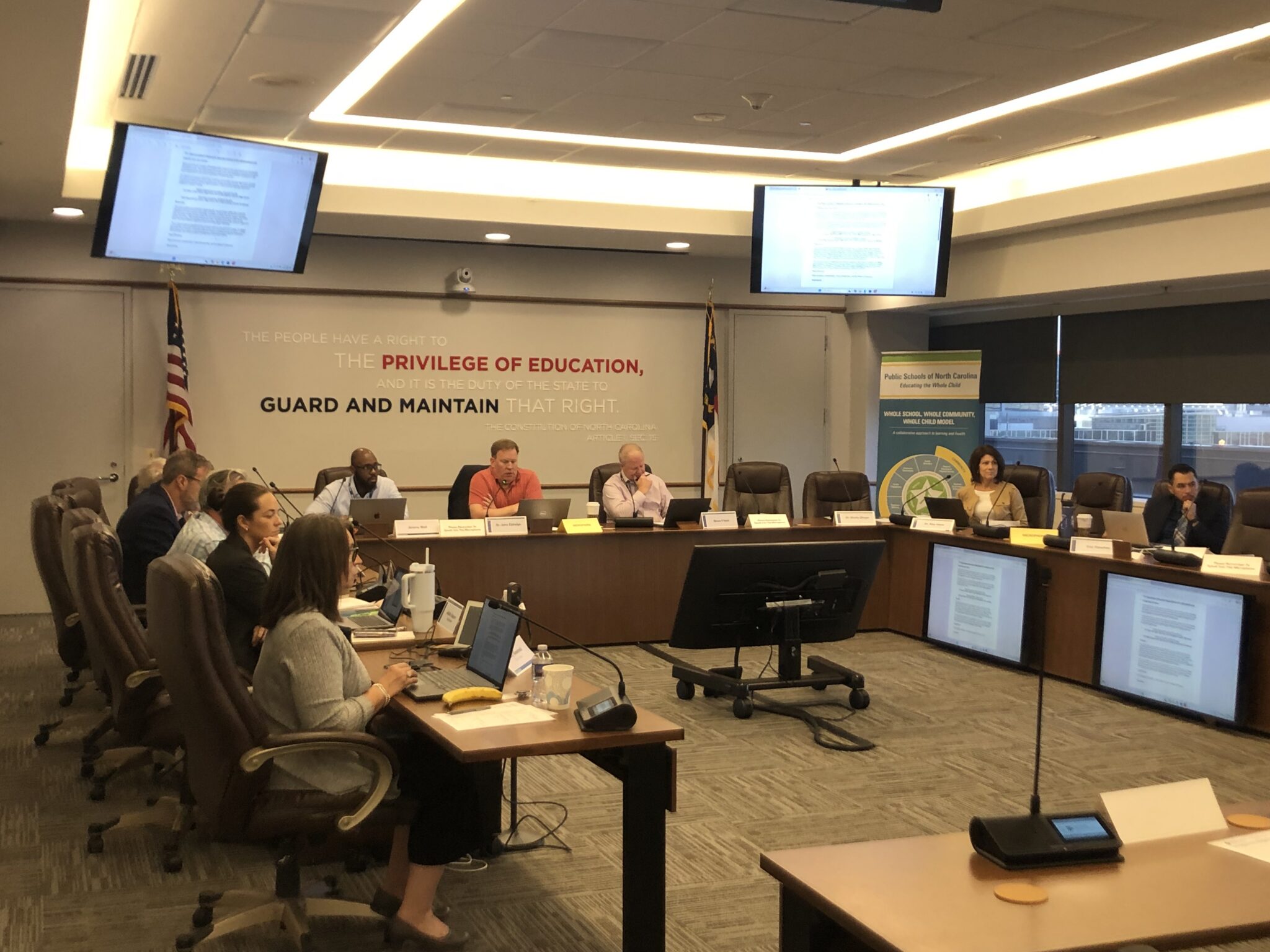
The state’s Charter Schools Review Board (CSRB) approved four new remote charter academies at its meeting on Monday, March 9, along with Pender County’s first charter school, Cape View Leadership Academy (CVLA).
Central Wake High School, Triangle Math and Science Academy, Jackson Day School, and Phoenix Academy will now move forward with remote academy plans, and soon. All four are slated to open in time for the upcoming 2026-27 school year.
Remote academies are a relatively recent addition to the state’s shifting charter landscape, made possible through a 2023 law. Since the law’s passage, charter leaders have embraced the academies as a way to meet family demands for flexibility and divergent student needs. To date, the CSRB has approved 21 remote academies, according to the Office of Charter Schools (OCS).
 Sign up for the EdDaily to start each weekday with the top education news.
Still, CSRB members were divided about the perks and perils of virtual learning.
“I don’t believe in the remote schools,” CSRB member Stephen Gay said. “And let’s just call it what it is. I see it as a money grab for a lot of schools that are doing it.”
“I’m saying let’s pump the brakes on (it) a little bit,” he said, while noting he remained open-minded about cases where there are great plans or legitimate need.
“If it’s a money grab, then we need to weed that out from the get-go,” CSRB Chair Bruce Friend responded, “not make a generic comment that applies to those involved in this learning environment.”
Friend is the superintendent of Pine Springs Preparatory Academy (PSPA), which operates one of the state’s largest remote academies. Last month, the CSRB converted PSPA’s remote charter into a stand-alone school. That conversion, the first of its kind, takes effect in the fall.
In another first this month, CSRB approval of CVLA will open up charter access in Pender County.
The decision also marks a reversal of fortune for CVLA: In December, the CSRB denied the school’s application. CVLA quickly appealed that decision to the State Board of Education, which remanded the matter back to the CSRB to allow the education management organization (EMO) to answer questions.
CSRB members remarked on the precedent-setting nature of the decision, along with the value of county expansion.
“This would be the first charter school in Pender County,” CSRB member Lindalyn Kakadelis said. “That’s important to me.”
Remote academy plans
Eight remote charter academies approved through the CSRB’s amendment process are operating this year, according to OCS.
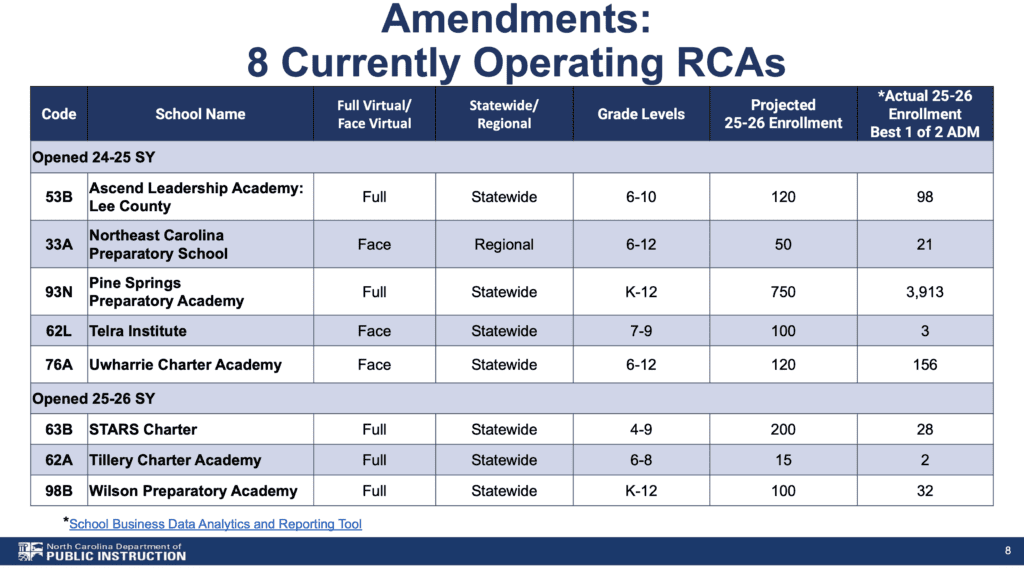
Screenshot from the OCS presentation.
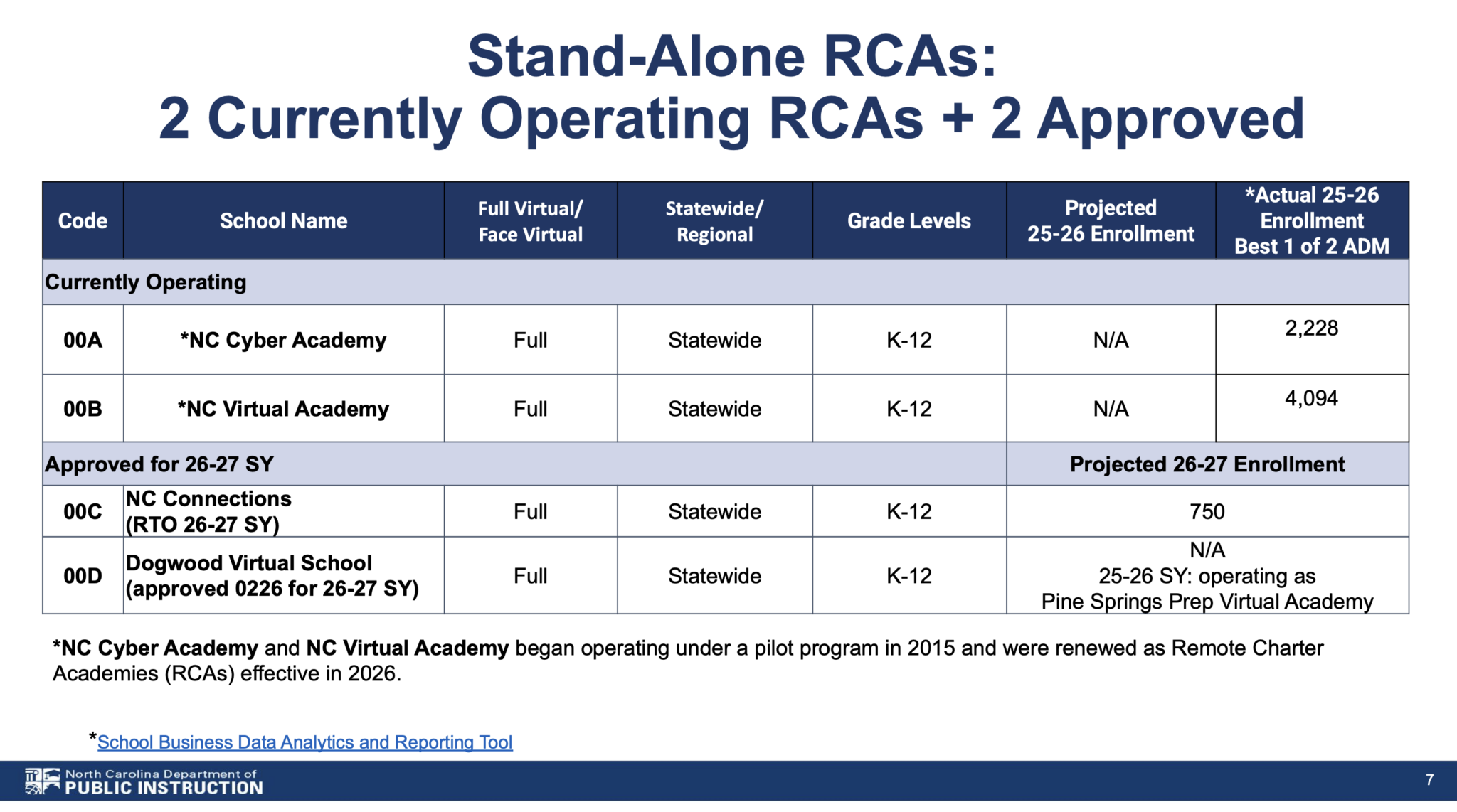
In addition, two virtual charters, NC Cyber Academy and NC Virtual Academy, are operating as stand-alone schools. These two schools, which launched under the state’s virtual charter pilot, were renewed by the CSRB in January as remote academies, a process authorized by a 2023 law. Another stand-alone school, NC Connections Academy, is on track to open this fall.
CSRB members also heard from leaders of the four new remote charter academies approved this week.
In their presentation to the CSRB, Central Wake leaders positioned their remote academy as a critical route to opportunity and access for at-risk students.
An alternative charter school, Central Wake is one of three North Carolina schools managed by EMO Second Mile Education.
According to Tom Hanley, the executive principal, students come to Central Wake from eight counties, and arrive well below grade level. Half of students are working, he said, while 69% are pregnant, parenting, or caring for another family member.
“We really need another vehicle in order to be able to serve these students,” he said.
The regional remote academy builds on Central Wake’s established commitment to flexibility. The academy will blend virtual instruction with at least four hours weekly of in-person instruction or interventions. Leaders expect to enroll 225 students by the academy’s third year.
During discussion, CSRB members commended Central Wake’s work with students, but expressed varying views about the viability and novelty of remote instruction.
“It’s not new. I feel like we have this debate every month, and I listen to the State Board. The first statewide virtual school opened in 1998,” said Friend, a veteran of online learning. “School districts and charters and privates have been offering online learning for nearly 30 years now.”
“Where it’s different than it was in 1998 is the preponderance of screens … all the tech. It’s everywhere,” CSRB member Eric Guckian said. “Yes, virtual schools aren’t different, but the world sure is.”
CSRB members also commented on the growing need for guardrails and best practices around remote learning. Guckian said there is an absence of reliable success metrics.
“I would like to know what good looks like, and I don’t,” he said.
Related reads
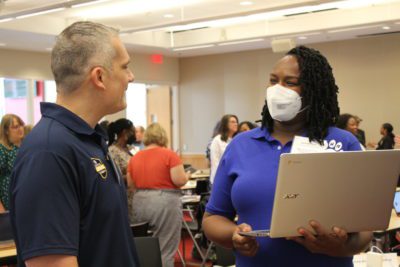
TMSA Triangle, part of the TMSA Public Charter Schools network, will serve 250 students in grades 7-12 when its remote academy is at capacity. Need for the academy comes from medically fragile students, rural families, accelerated learners, and students needing flexibility, the school’s presentation said.
TMSA’s regional remote academy will launch as “a virtual school with a face-to-face feel,” said Bryan Setser, TMSA’s director of innovation and strategic leadership.
Setser sought to alleviate the philosophical concerns he had heard about virtual learning.
“We take this work seriously. We believe in do no harm,” he said. “We have a mission to educate and give students opportunities, and we’re going to do it in a thoughtful way.”
Tammy Winstead, dean of operations at Jackson Day, highlighted “tremendous demand” for virtual and hybrid options in her remote academy presentation.
“I have been approached by families for years now, after coming back from COVID, about a hybrid program,” she said.
Jackson Day’s regional remote academy will blend two days of in-person learning with three days of virtual instruction. By year five, the academy expects to enroll over 870 K-12 students.
Phoenix Academy, managed by EMO National Heritage Academies, will operate a statewide K-12 remote academy, school leaders said. The remote academy plans to serve over 1,100 students by its fifth year.
NHA already operates a successful virtual academy in Michigan, said Brian Kuppelweiser, Phoenix Academy’s board vice president.
“This partnership ensures we have the proven infrastructure and systems necessary for immediate success,” he said.
In fact, the program replicates the “virtual infrastructure” at NHA’s remote partner school, PrepNet Virtual Academy, Phoenix Academy’s presentation noted.
According to the school’s remote academy application, the model will be blended, even with its statewide reach, with Phoenix Academy’s building in High Point serving as “the designated location for in-person meetings and instructional activities.” NHA’s statewide network of 16 schools would help with testing and services, according to other application materials.
However, Phoenix Academy’s CSRB approval came with a caveat: Leaders must verify that their existing budget includes legislatively mandated positions for a remote charter academy. Those positions were not sufficiently clear, according to the CSRB.
Three schools managed by EMO CSUSA withdrew their applications for remote charter academies, OCS said. Last month, the CSRB had asked the schools — Cardinal Charter Academy, Cardinal Charter Academy at Wendell Falls, and West Lake Preparatory Academy — to return for a second interview.
A reversal for Cape View Leadership Academy
A representative from CVLA’s EMO, ACCEL Schools, appeared before the CSRB to provide information and answer questions. This was part of the school’s appeal of the CSRB’s December denial of their application, which the State Board of Education remanded back to the CSRB last month.
In her letter and comments, Mary Gifford, ACCEL’s executive vice president for business development and new initiatives, addressed earlier CSRB concerns about the EMO contract, experience, and the EMO’s background with CTE (career and technical education).
The contract, Gifford said, was a draft, with both sides “amenable” to changes. Contract updates will give the school greater flexibility.
ACCEL’s experience includes managing about 100 schools in 19 states, Gifford said. The EMO also operates 13 early childhood centers in North Carolina.
However, CVLA will be ACCEL’s first North Carolina school. According to its OCS profile, CVLA plans to serve over 400 students in grades 6-12 at capacity.
Currently, 22 brick-and-mortar and 12 online charter schools are implementing ACCEL’s CTE program, Gifford said.
She also defended ACCEL’s record in Ohio, which has involved extensive work with under-performing schools.
“While we still have a long way to go, we are definitely making improvements with those schools,” she said.
Though they approved CVLA’s application, CSRB members warned school leaders to ensure they fully understood their budget and EMO contract.
The school plans to open in August 2027.
Ready to Open (RTO) updates and amendments
CSRB members also heard an OCS report on seven schools in the 2026 RTO cohort. Enrollment figures in the report are based largely on applications submitted by families.
As of this month, only one school has surpassed projected enrollment. Figures for NC Connections Academy show 1,046 students — 146% of projected enrollment, and more than double the school’s break-even figure.
BH2 STREAM, Carolina Collegiate, and Warren YES have each enrolled at least 70% of projected enrollment.
However, three schools — Focus Academy, IDYL Wake, and RYZE Academy — are at or below 55% of projected enrollment.
Those three show a “caution flag,” Friend said.
Schools deemed at-risk will appear before the CSRB virtually in May, according to OCS. In June, the CSRB will vote on whether to allow schools to exit RTO status.
The CSRB also approved this week a mission statement revision from Sallie B. Howard School, intended to be more concise.
In addition, the CSRB granted RYZE Academy, one of the RTO schools, permission to relocate to a different county. The school is moving five miles away, from Forsyth to Guilford County.
The original location, according to OCS, was no longer viable. In an interesting twist, RYZE Academy will colocate with another charter school, Liberty Charter Academy.
A new school, Liberty has fallen far short of its enrollment targets.
Mary Catherine Sauer, the executive director from Liberty Charter’s EMO American Traditional Academies (ATA), said the arrangement would benefit Liberty financially, especially since enrollment there came in under expectations.
While the CSRB approved RYZE’s request, members expressed concern about the school’s readiness to open.
As an accelerated applicant, RYZE should have had its facility “locked down,” CSRB Vice Chair John Eldridge said.
“You’ve got to hit these numbers,” Friend said. He warned leaders that June approval would be contingent on an enrollment uptick.
Low-performing schools and new grant funding
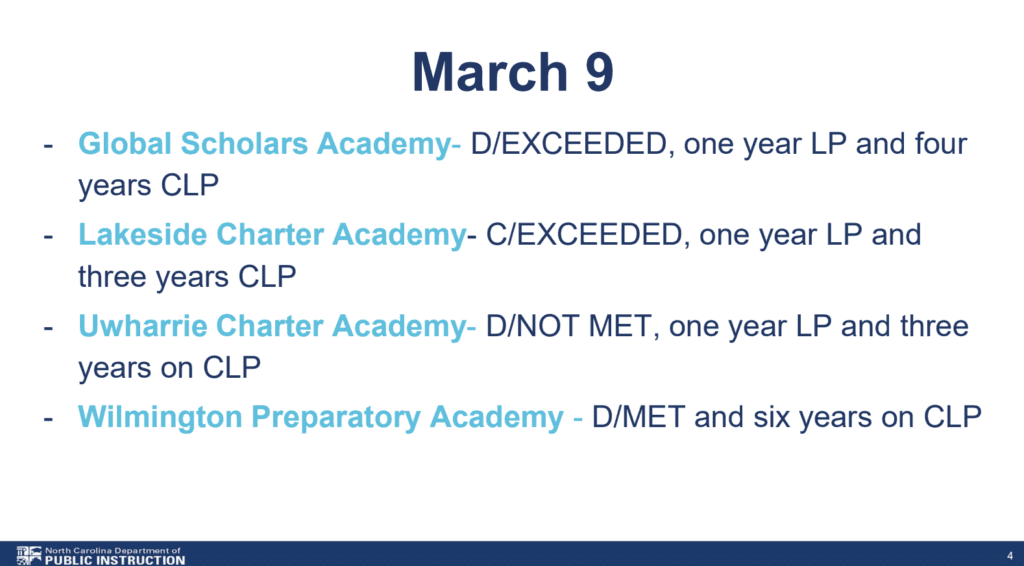
Four low-performing schools also shared presentations this month with the CSRB.
Screenshot from the OCS presentation.
In their update, leaders from Global Scholars Academy (GSA) highlighted improvements along with enrollment challenges.
“We’re very proud of our growth progress,” Trixie Brooks, the head of school, said.
“The growth is awesome,” CSRB member Eric Sanchez said. He noted that since 2014, GSA had met or exceeded growth every year, except for one.
However, the school is struggling with a transient student population due to a move.
“We are concerned about our (enrollment) numbers,” Brooks said, with current enrollment below break-even numbers.
Lakeside Charter Academy leaders shared performance improvements in their school presentation. Lakeside jumped two letter grades in one year, earning a public shout-out last fall from State Superintendent Mo Green for 2024-25 progress. The school earned a C grade, improving from F the year before.
Lakeside has also been removed from financial disciplinary status, according to Sauer, who serves as the school’s board chair in addition to her role at ATA.
Leaders from Uwharrie Charter Academy emphasized trends and innovative programming in their update. Uwharrie offers “multiple paths of interests” for students, including game design, culinary, and pottery, said Sharon Castelli, the school’s superintendent. The school also features a Career Academy and has a new manufacturing lab coming in.
However, the CSRB noted that the school hadn’t met growth since 2014.
Uwharrie has been working to cut the growth deficit, Castelli said, with leaders “hyperfocused” on math.
Kevin Johnson, the principal of Wilmington Preparatory Academy, also shared a progress update, noting that the school improved from an F in 2022-23 to a D in 2024-25. Wilmington Prep has met growth the past three years.
Last year, the school also exceeded growth in math.
“This is a testament that some of the things that we are doing (are) working, but we are cognizant that there’s a lot of work that we have to do,” Johnson said.
Finally, representatives from the North Carolina Association for Public Charter Schools outlined plans to distribute $52.9 million in federal Charter Schools Program (CSP) grant funding their organization was awarded by the U.S. Department of Education. The grant program is called NC GROW Charter Schools.
According to the association’s website, “This is a competitive grant program that enables State entities, including charter support organizations, to award subgrants to eligible applicants in their State to open and prepare for the operation of new charter schools and to replicate and expand high-quality charter schools.”
In her presentation, Rhonda Dillingham, the association’s executive director, said her organization applied for the CSP grant to build on the legacy of NC ACCESS — an earlier CSP grant — and grow high quality charter schools.
Six state entities received awards this cycle, Dillingham said.
“It’s the first time in North Carolina history that the CSP has been awarded to a nonprofit organization,” she said.
The association expects to award 42 subgrants to help fund 28 new schools, along with school expansions and replications emphasizing CTE/STEM programming, according to Dillingham’s presentation. Grant funds will also target board governance and leadership, among other things, as well as remote academy support. Those plans include publishing a remote academy implementation guide and quality indicators rubric.
The CSRB meets next on April 6.
Editor’s note: EdNC has retained Kristen Blair to cover the monthly meetings of the Charter Schools Review Board. Kristen currently serves as the communications director for the North Carolina Coalition for Charter Schools. She has written for EdNC since 2015, and EdNC retains editorial control of the content.