
Perspective | North Carolina’s Virtual Schools Network takes flight

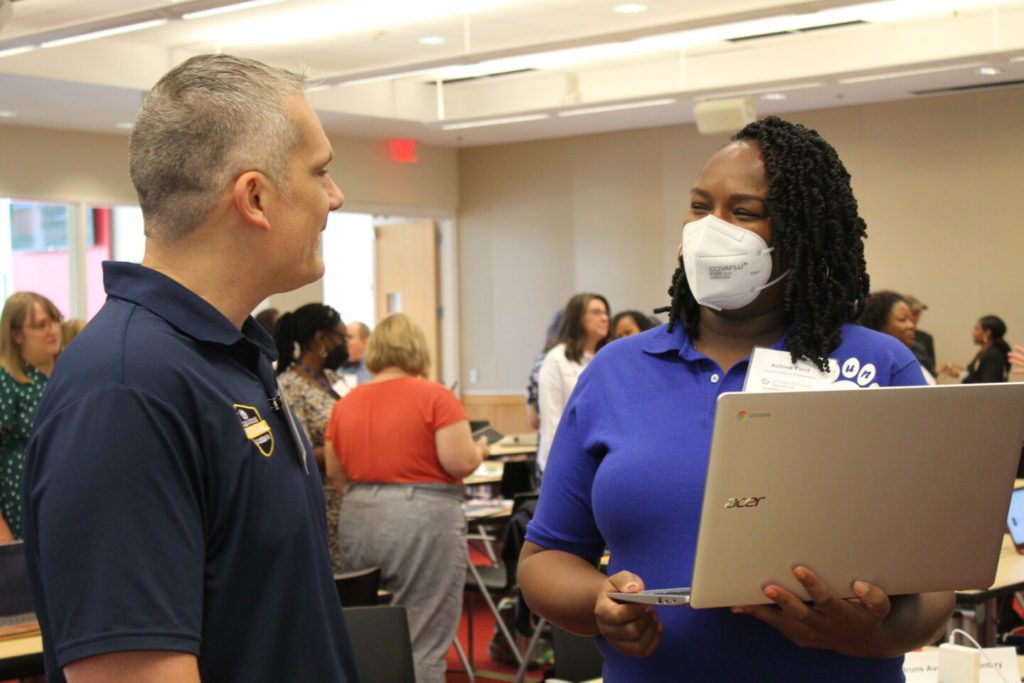
As an administrator at the only 6-12 virtual academy in her district, Estella Johnson and her colleagues felt alone at times, whether through the challenges or successes they faced.
When she heard about the Virtual Schools Network (VSN), a partnership between the Friday Institute for Educational Innovation and North Carolina Virtual Public School (NCVirtual) that supports and connects traditional virtual public schools, she was comforted by the idea of the network and attended their first Summer Institute June 28-29 with her colleagues.
“I was very ecstatic, as well as relieved, when I found out about the Virtual Schools Network because it let me know that my school was not alone,” said Johnson, assistant principal at Cumberland Academy 6-12 Virtual School. “A lot of the challenges that I face as a brand-new administrator, part of a brand-new school, an identity, some innovation, being a part of a virtual school, other schools are facing that. Things as far as getting students to engage, numbers, pandemics, ups, downs, variants, etc., these teachers, these administrators, were feeling the same pressures and same stress, and it gave me a place to get ideas on how to overcome barriers and work with somebody else.”
The VSN team designed the Summer Institute to support and inspire K-12 educators playing leading roles as innovators in the design, development, and implementation of their virtual school learning environments. Throughout the two-day in-person event, educator teams had time to connect, collaborate, reflect, learn, and plan for the future of their schools.
“The Summer Institute allows educators across the state to have their voices heard,” said LaShaundon Perkins, school support consultant at NCVirtual and co-lead for the VSN. “It provides them with a safe place to communicate obstacles, successes, commonalities, and much more when it comes to the virtual schools’ world. The institute allows educators to see that they indeed are not alone. It provides educators with opportunities and tools to assist them with enhancing or improving current practices within their virtual school structures.”
As the VSN grew before the network could be formally established, the VSN team embraced the saying “building the plane while flying it” and used it as their theme for the first Summer Institute. Everything during the program related to this theme, from the flight plan digital handbook to workshops titled “Small Classroom Shifts that Make a Huge Difference in Flight,” “Avoid Missed Connections: Working with Virtual School Families,” and “Chart Your Course.”
The institute kicked off with a keynote speech titled “The Wright Brothers, the 4Cs and Me” from Mickey Revenaugh, co-founder of Connections Academy and vice president of Pearson Virtual Schools.
“There might be something special in the air here in North Carolina because the way you guys do things here around online learning is just a little bit different,” said Revenaugh. “I will confess that my very first experience trying to conceptualize a virtual school happened here in this state and a couple of miles of where we’re standing right now … The place that we’re sitting now is really the launchpad for online learning as we know it in the 21st century.”
After the keynote, attendees joined sessions that addressed immediate and longer-term challenges to quality virtual school learning environments, such as human resources, personalized learning, parent and community engagement, technology and spaces, and curriculum/instruction/assessment.
“The fact that we can get all these people in one room to talk about the successes, the barriers that we have, what they did in response to those things, how they got to where they were is very important,” said Ken Simeone, principal at Cabarrus County Schools Virtual Academy. “Just being able to understand that we’re all in the same boat, we’re rowing in the same direction for the intention of helping kids and knowing that there are other people out there, that support is huge.”
Now, the VSN is looking for traditional virtual public schools to become a part of its network. All VSN schools will receive access to online professional learning sessions based on the unique needs and feedback of participating schools; personalized consultation; virtual and in-person job-alike networking; access to curated resources, archived webinars and tools; and more.
“Similar to early colleges, these virtual schools differ from traditional learning environments,” said Blake Wiggs, a research scholar at the Friday Institute and co-lead for the VSN. “To that point, they have a unique set of needs and challenges. I hope this network will serve as an intermediary of sorts — one that advocates for their unique needs, provides shared design principles and language for meaningful collaboration, and ensures that teachers and administrators do not feel alone — rather, part of something much bigger.”
To learn more about becoming a school partner in the VSN, visit its website here.