
State leaders talk AI and employer engagement at education and workforce conference

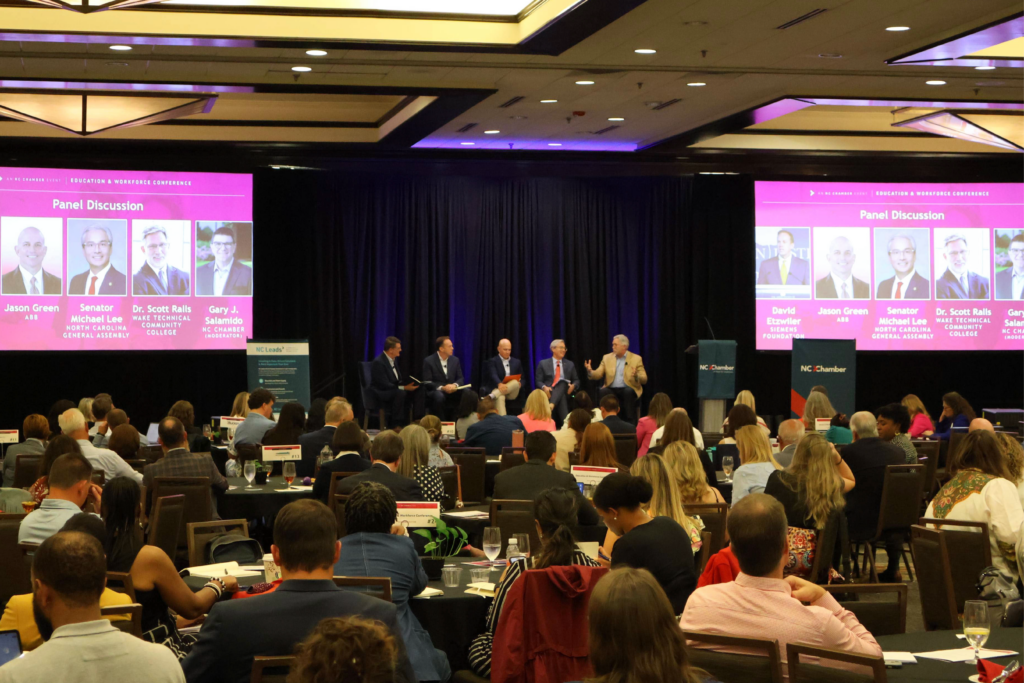
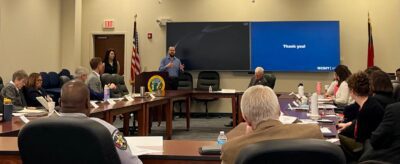
Education and business leaders gathered in Raleigh on Aug. 3 at the NC Chamber’s Education and Workforce Conference.
Held annually, this year’s conference asked business, higher education, community college, K-12, and government leaders to acknowledge the role they each play in owning a piece of the state’s workforce development efforts.
The day’s conversations came at a time when emerging technology, including artificial intelligence (AI), is changing the types and prevalence of jobs available, and as North Carolina’s economic output grows alongside its poverty rate.
 Sign up for the EdDaily to start each weekday with the top education news.
At last year’s conference, Vincent Ginski, senior director of workforce competitiveness at the NC Chamber, described the “absence of an underlying framework” that could turn employers’ and educators’ otherwise siloed workforce development efforts into one coordinated pipeline. By developing a “north star goal” that quantifies specific labor force needs within a geographic region, he said, those same organizations could instead each own and work toward a piece of a solution.
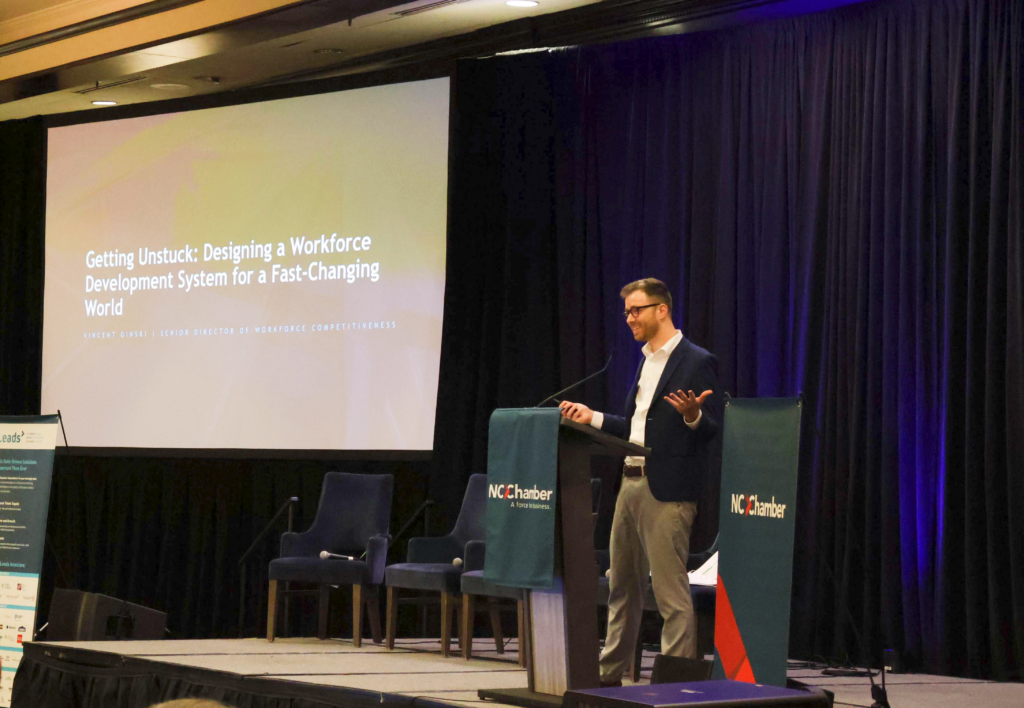
This year, Ginski’s conference remarks followed up on that diagnosis, reinforcing the idea that education partners should co-design efforts to more effectively develop the state’s workforce.
But as educators and employers consider how to redesign their approach to talent pipelines, AI is actively changing the types of skills employers seek out and the way students learn.
Education systems ‘have to keep up’ with AI’s changes to the labor market
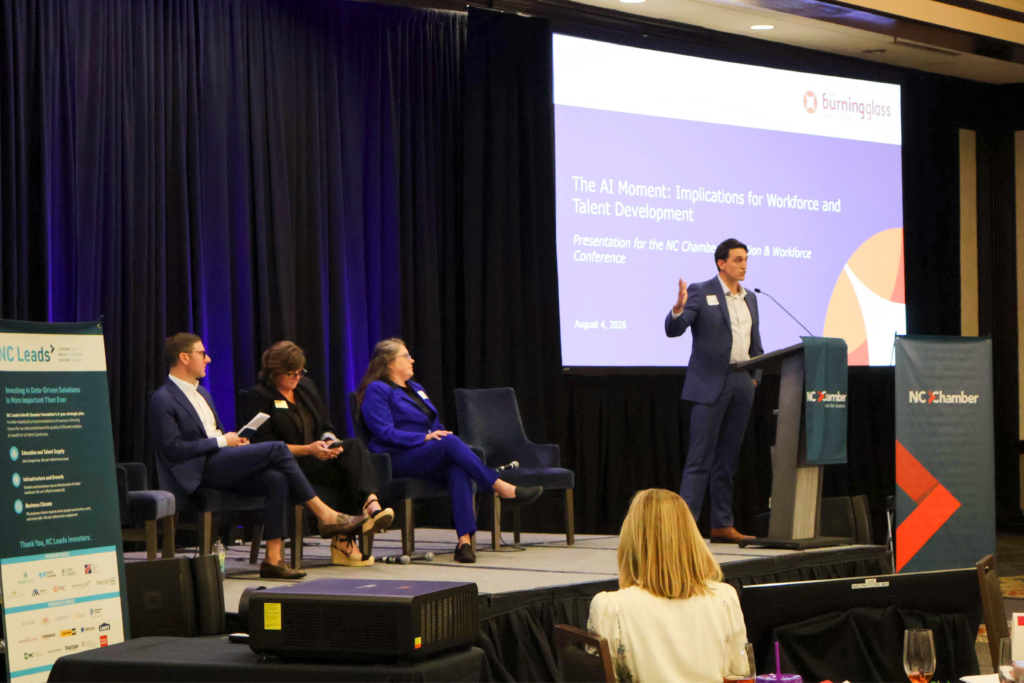
Erik Leiden, managing director of workforce strategy at The Burning Glass Institute, told attendees that one way to conceptualize AI’s impact on the labor market is whether the technology is augmenting the worker or automating the work itself.
According to Leiden’s presentation, there has been a 7.6% increase in demand among job postings for augmented skills, such as decision-making and leadership, after ChatGPT’s introduction to the general public. In contrast, there has been a 16.4% decrease in demand for automated skills, such as data entry and customer service.
Another way to conceptualize AI’s effect on industries is the concept of “the human floor,” according to Leiden. That is, the minimum level of human involvement a type of work actually requires.
Data from The Burning Glass Institute reports that fewer entry level roles are available in jobs that have high exposure to AI’s impact. Leiden noted growth in demand for skilled trades roles, however, as these human-driven positions are not as exposed to AI.
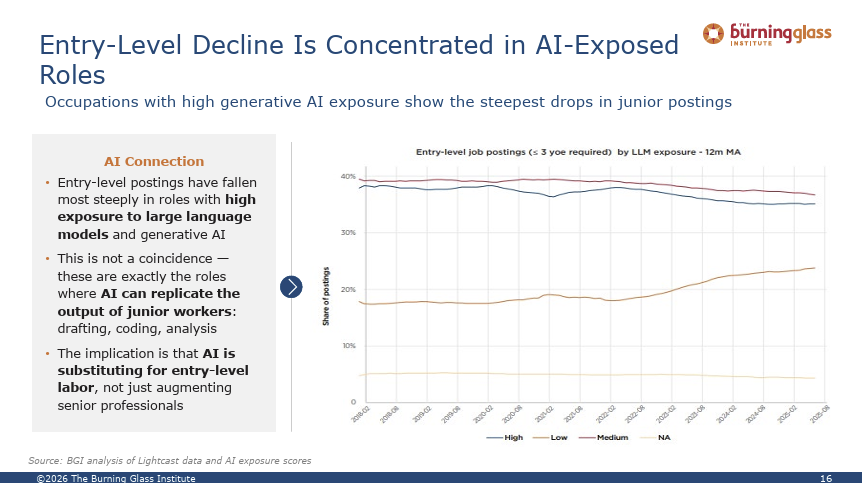
Leiden said the data means that education must be prepared to teach students durable skills, such as problem-solving, critical thinking, oral and written communication, and leadership.
“The entire frontier of this work is changing, and so education systems are going to have to keep up,” he said.
Vera Cubero, the former emerging technologies consultant at the North Carolina Department of Public Instruction (DPI) and a member of North Carolina’s AI Leadership Council, said that K-12 schools have not historically measured the skills that employers now increasingly value.
If schools continue to teach and test skills that can be “automated away,” she said, then students will not be able to “go out into the workforce and augment, which is what they need to be doing.”
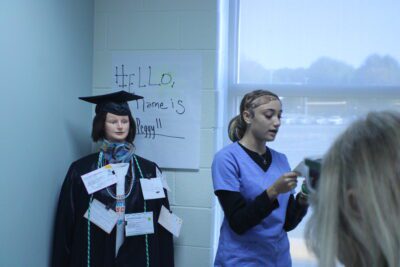
Work-based learning and project-based learning are tools that can help students translate their classroom education into workplace skills, according to Andrea Crowley, the executive director of the N.C. Student Success Center at the North Carolina Community College System (NCCCS).
DPI released a living document of guidelines for incorporating AI into classrooms two years ago, and the state budget signed by Gov. Josh Stein in July directs the State Board of Education to adopt age-appropriate standards for instruction on AI literacy for grades K-12.
The NCCCS also released an AI Guidance Handbook last year to act as a “practical roadmap for responsibly integrating AI into teaching, learning, and operations.”
Read more about AI

Employers and community colleges work together to build North Carolina’s healthcare workforce
While employer engagement takes time to organize and cultivate, efforts to address North Carolina’s healthcare workforce shortage prove that it’s possible.
Niki DaSilva, executive director of workforce at the U.S. Chamber of Commerce Foundation and the moderator of a panel on employer engagement strategies, said that employers should be leaders and co-designers of their own talent supply chain. Yet, DaSilva said that a common challenge employers face is not having a clear way to articulate their labor force needs to educational partners.
Amy Akers, the vice president of nursing and regional chief nursing officer at Novant Health New Hanover Regional Medical Center, described a siloed system among her healthcare peers as employers worked independently to find answers to their own workforce challenges.
Akers said this changed when Steven Hill, vice president of talent pipeline at the North Carolina Health Talent Alliance (NC HTA), “wrangled” her and her employer peers together through the initiative that is managed by the NC Center on the Workforce for Health.
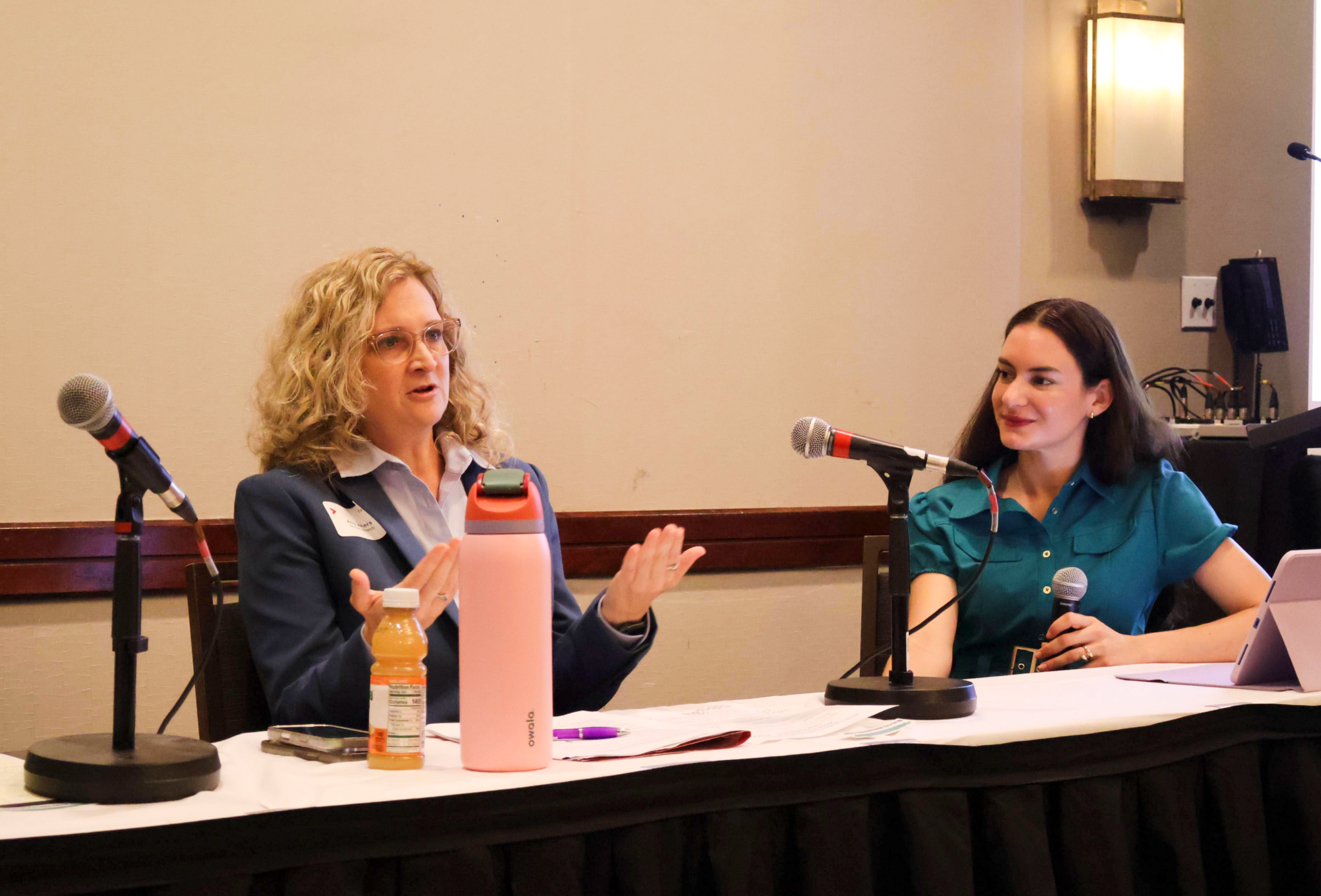

Through NC HTA, Akers and other healthcare employers met multiple times over several months to discuss regional needs and build relationships with one another. Hill said the group’s goal was to surface individual employer needs in order to identify common challenges to then bring to educational partners.
“When we formed ourselves and came together as one group, I think that’s made us go a lot further, a lot quicker,” said Akers.
From there, Hill said, it was crucial to build trust among employers so that they would be willing to share the timely labor market data necessary to systematically diagnose and evaluate progress on labor market needs.
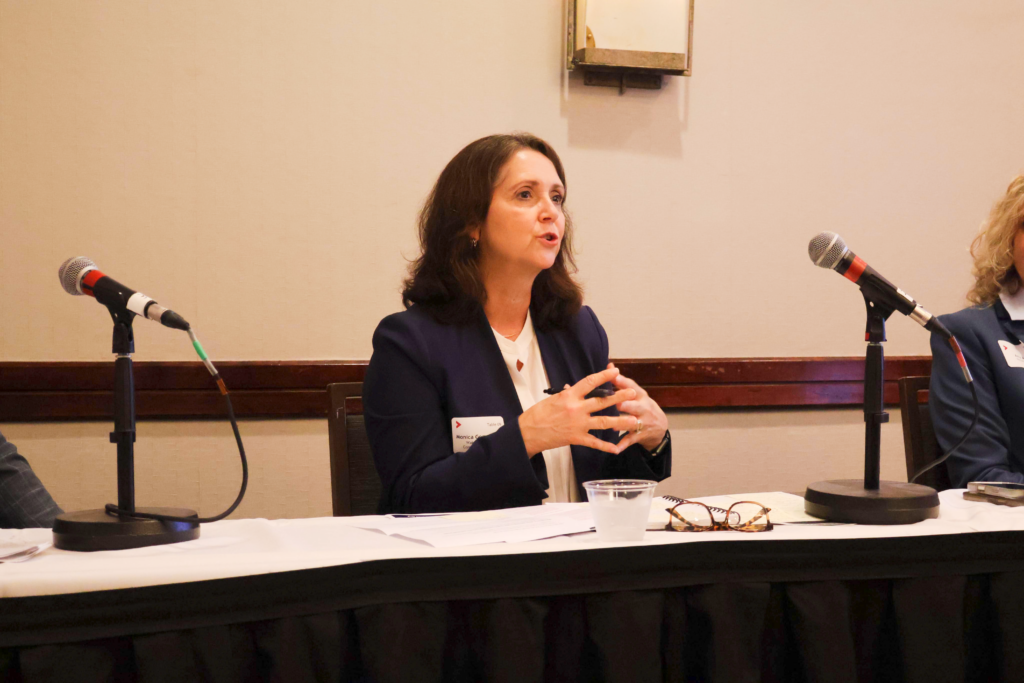
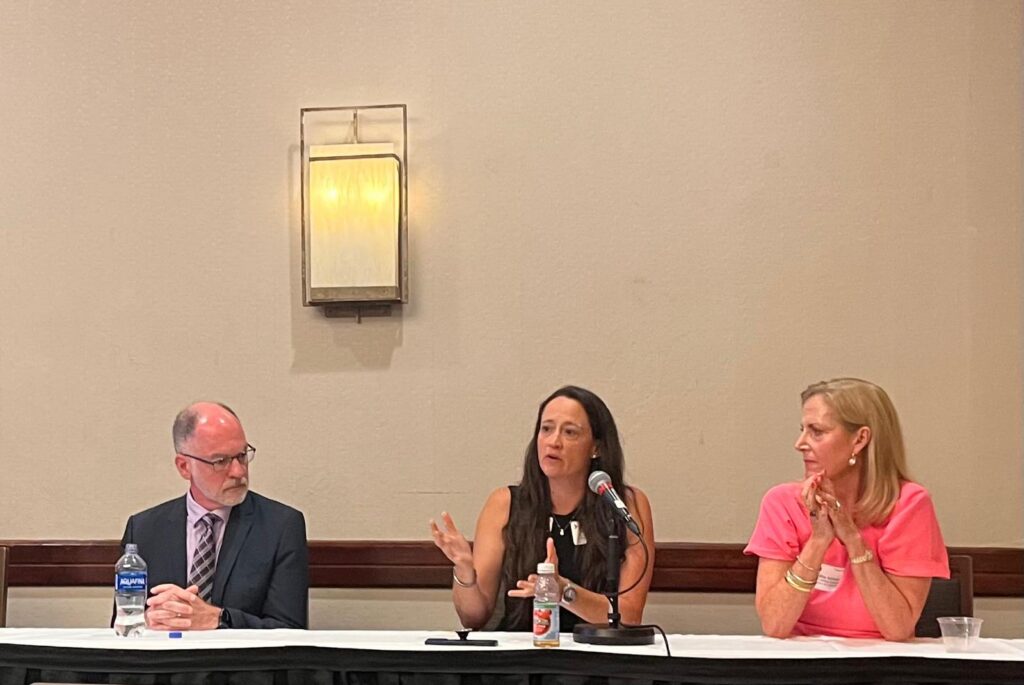
Monica P. Gemperlein, the associate vice president of workforce development and chief continuing education officer at Wake Technical Community College (Wake Tech), said that trust between education providers and employers is also important.
One way to build trust is through acknowledging that navigating community college systems can be challenging, she said. Wake Tech leadership restructured the college’s institutional structure to place one provost over each career field. The goal, Gemperlein said, is to make it easier for outside employers to engage with the college by having a go-to contact.
At Davidson-Davie Community College, partnerships with the college’s regional healthcare providers is another example of how co-designed workforce development strategies can strengthen talent pipelines.
Holly Myers, the college’s dean of health sciences, led the college’s creation of the state’s first nursing apprenticeship with Atrium Health Wake Forest Baptist. Since the apprenticeship became available to Davidson-Davie students in 2020, the college has expanded the earn-and-learn model into all of the college’s health sciences programs.
In addition to helping healthcare providers overcome the administrative burden of creating registered apprenticeship programs, Myers said that articulating the return on investment for employers has been key in building out the college’s work-based learning programs. The college has seen 100% retention of nursing apprentices with their local hospital employer, she said, saving employers the time and cost of recruiting and hiring new nurses.
The North Carolina Business Committee for Education (NCBCE), a nonprofit operated out of the Office of the Governor that acts as a link between business and education leaders and leads over a dozen statewide work-based learning initiatives, has helped shape the state’s work-based learning system.
Caroline Sullivan, executive director for the NCBCE and a panelist alongside Myers, added that work-based learning must be equally beneficial for students and employers. Wraparound support services and paid work experiences, she said, are two precursors to students’ actually thriving in and beyond their program.
“Employers need to be developers of talent, not consumers of it,” said Sullivan.
NCBCE has also helped lead the launch of the Careers Electric™ Training Network, a workforce program primarily funded by the Siemens Foundation that is designed to create accessible pathways into electrical careers.
This summer, 12 North Carolina community colleges hosted summer academies that provided 220 high school students with hands-on experience in the electrical trade while receiving college credit, a $2,000 completion stipend, and the tools, supplies, and transportation needed to complete the training.
Summer academy participants also explored pathways to becoming registered apprentices.
While some workforce development efforts focus on engaging with large industry employers, the Careers Electric™ summer academies are an example of how smaller employers can build and benefit from “homegrown” talent in their own communities.
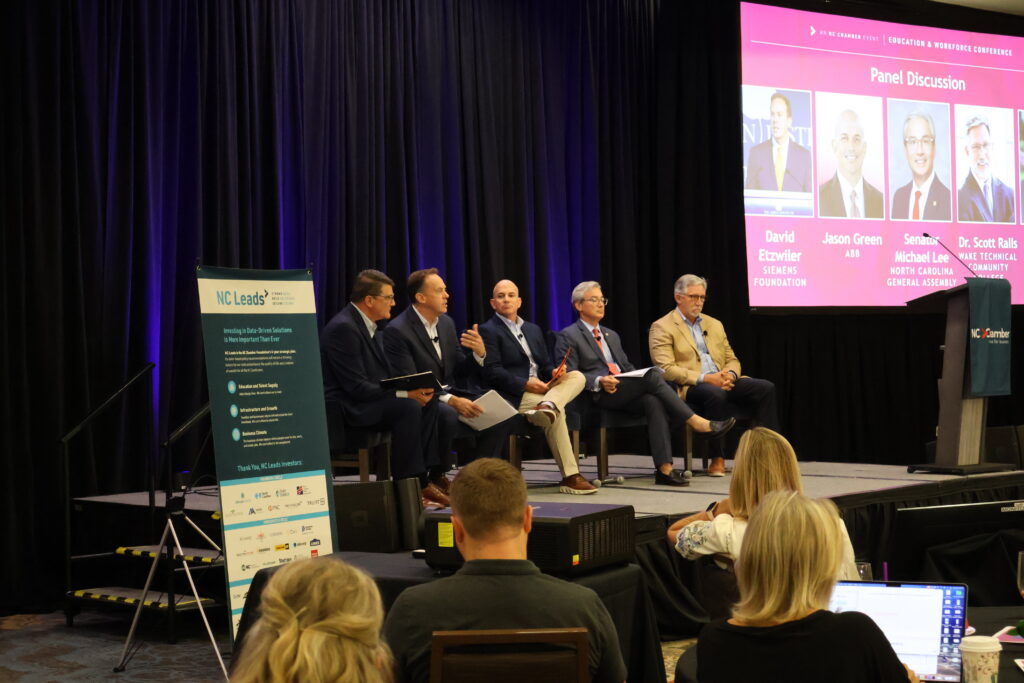
“Local employers made that happen,” said David Etzwiler, chief executive officer of the Siemens Foundation. “Without the local employers, without the apprenticeship program, this work does not happen.”