
New strategic roadmap from governor’s AI Leadership Council calls for more partnerships with education systems

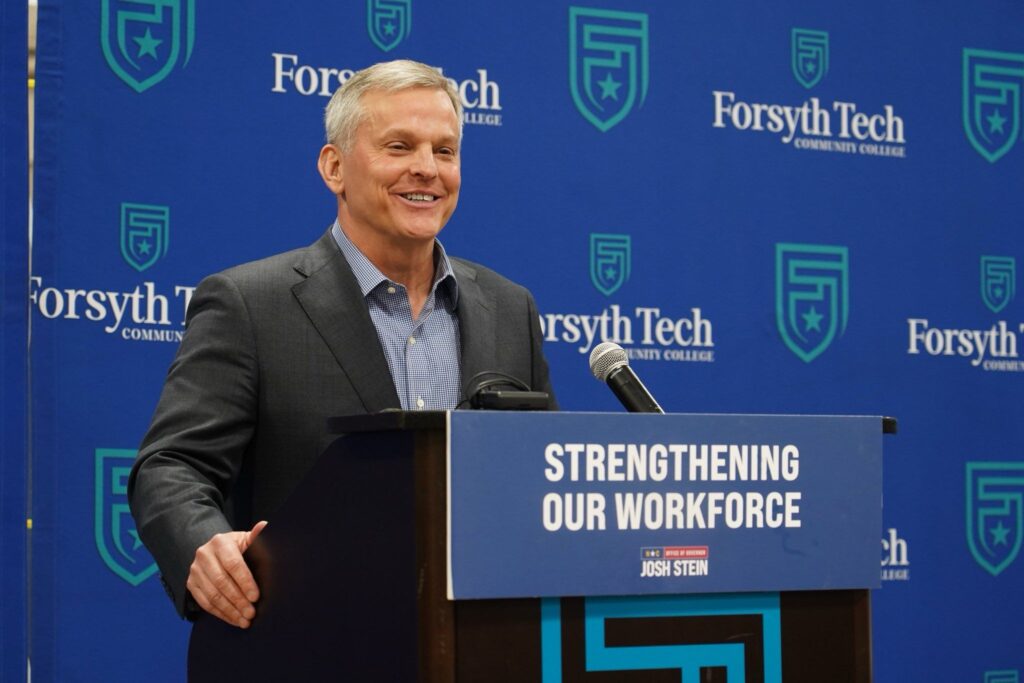
Gov. Josh Stein’s AI Leadership Council has released a strategic roadmap for addressing the potential impacts artificial intelligence (AI) will have on how North Carolinians live and work.
The council was formed in September 2025 from an executive order. Its role has been supporting the governor and state agencies on AI strategy, policy, and training.
Stakeholders from both the public and private sector sat on the council. Together, they drafted a roadmap that was released on July 1 with 17 “strategic goals” laid out in three categories: protect, prepare, and transform.
“Artificial intelligence is already changing how we work, learn, and serve the people of our state, and North Carolina must lead with urgency and care,” Stein said in a press release. “This roadmap gives our state a strategy to protect people from harm, prepare our workforce for opportunity, and transform how government serves the public. Together, we can make North Carolina a place where innovation and trust move forward together.”
 Sign up for the EdWeekly, a Friday roundup of the most important education news of the week.
In the roadmap, the council says implementation of the goals will require state agencies to collaborate with institutions of higher education, private employers, nonprofits, and workforce partners.
The council relied on the seven following principles to inform the recommendations made in the roadmap:
- Leadership in Trustworthy AI
- AI Literacy
- Workforce Empowerment
- Explainability, Interpretability, Accountability, and Transparency
- Security and Resilience
- Privacy and Governance
- Fairness and Protection of Civil Liberties
Recommendations for reaching each goal include a timeline and implementation plan. Many of the recommendations under the “prepare” category of the roadmap include partnerships with K-12 schools, higher education institutions, and workforce development programs.
One such goal is a statewide upskilling and reskilling initiative. According to the roadmap, it is estimated that by 2029, over half of the jobs in the country will be impacted by AI. The recommendation is to identify the roles most vulnerable to automation and provide an accessible reskilling program to those jobholders. Collaborations between the private and public sectors with institutions of higher education could then provide a path for workers into new jobs with their newly acquired skill set. The timeline for this career transition program to be formed is December 2028.
Advocating for legislation that mitigates the effects of AI-driven worker displacement is another recommendation given in the roadmap. For example, the council recommends legislation permitting workers to receive partial unemployment benefits if their hours get reduced.
The council also recommends that state leaders update the N.C. Worker Adjustment and Retraining Notification (WARN) data collection processes to monitor the amount of people who are losing jobs due to AI displacement and subsequently signing up for reskilling programs. The roadmap recommends these steps be taken by March 2027.
In 2024, the North Carolina Community College System partnered with Google to provide all 58 community colleges with free AI training programs. The roadmap included several examples of the role the system has played so far in developing the AI workforce.
Tracy Schmeltzer, dean of the Business and Computer Technologies Division at Wayne Community College, said that they are proud to support the state’s efforts of expanding AI literacy and strengthening the workforce.
“Community colleges play an important role in making AI education accessible to the public. Our commitment extends beyond technical instruction,” Schmeltezer said. “We are fostering AI literacy across disciplines so that graduates in health care, advanced manufacturing, business, public service, and information technology understand how to evaluate, apply, and govern AI responsibly.”
The “Prepare” section of the roadmap outlines state goals involving the education system from kindergarten all the way up to higher education and vocational programs. This section includes five recommendations:
- Launching a statewide AI literacy initiative in partnership with community anchor institutions to deliver free, foundational AI training to residents in all 100 counties by June 2028.
- Establishing an official education-workforce coalition with 10 employers from a variety of sectors. The coalition will decide on the key skillsets needed for entry level jobs and will pass that information on to higher education institutions so that they can adjust their curriculum by June 2028.
- Creating more pathways for workers into AI-enabled roles in state government by December 2027. Examples include apprenticeships, hands-on training, and AI-specific experience within entry level roles.
- Partner with N.C. Department of Public Instruction to encourage each public school units to adopt an AI policy, AI guidelines, and an AI-focused professional learning plan by March 2027.
- Forming a statewide AI fluency microcredentialing program with higher education institutions and the NCWorks Career Centers by September 2028.
The full roadmap can be found here, and minutes from previous meetings held by the AI council can be found here.