
State Board discusses legislative agenda, updates on CMS, EPP accountability, and more

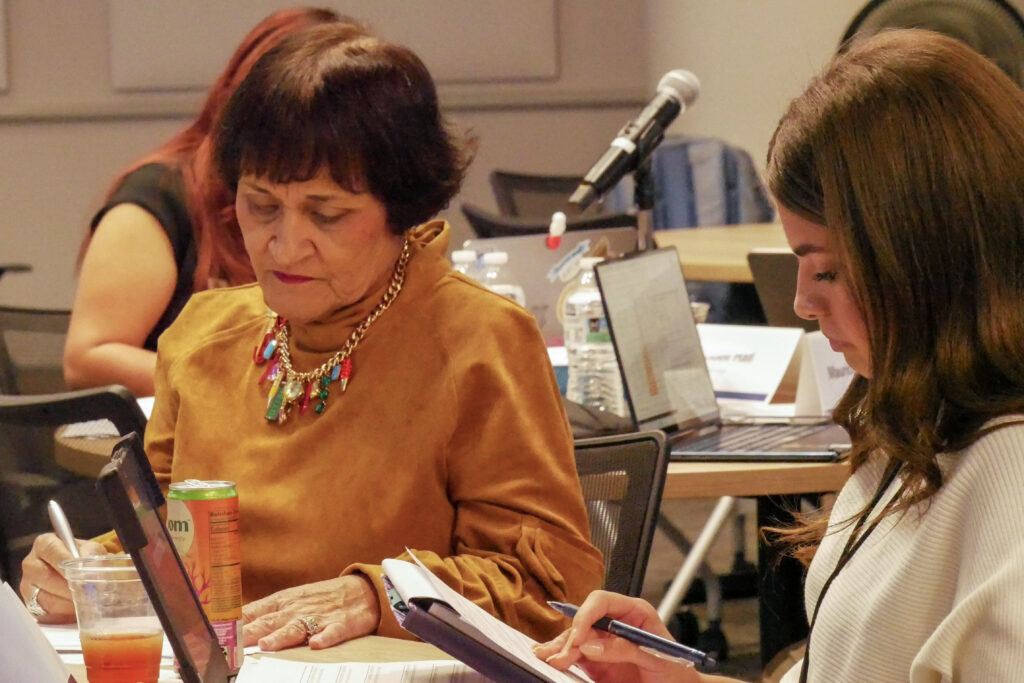
The State Board of Education met this week for its biannual planning and work session, discussing potential items to add to a legislative agenda for the upcoming long session of the General Assembly, which starts in January 2027.
“Today, we’ll turn our attention to our strategic plan and begin shaping our legislative agenda for the upcoming long session. We have some important momentum to build on, including the historic achievements and gains in recent years by our students and their teachers,” said Board chair Eric Davis on Tuesday. “And our work today is about how we can sustain that progress, build on their efforts, support them in greater ways, and create even more and greater opportunities for North Carolina students.”
Geoff Coltrane, senior director of Government Affairs and Strategy at the Department of Public Instruction (DPI), reviewed the timeline for drafting the Board’s official legislative priorities. Following the Board’s discussion, along with input from DPI leadership, Coltrane said DPI will begin to craft recommended legislative requests for the Board to consider at its November meeting.
He went on to explain that the Office of State Budget Management (OBSM), which puts together the governor’s recommended budget, has requested that all budget requests for the governor’s budget be submitted by early January 2027. In keeping with that timeline, the Board’s goal is to approve the legislative agenda at the December meeting so their requests may be submitted to OBSM, which Coltrane said would be “in time for the governor’s consideration.”
In order to identify their priorities for the upcoming long session as well as their long-term goals, Lizzie Yelverton, legislative liaison at DPI, provided an overview of the requests the Board made the previous year and the actions taken by the General Assembly regarding those requests.
One of the major requests by the Board from last year, “an investment in raising pay for all public school employees,” according to Yelverton, was partially met, with the state budget including an 8% average raise for teachers and a 3% raise for principals and other staff.
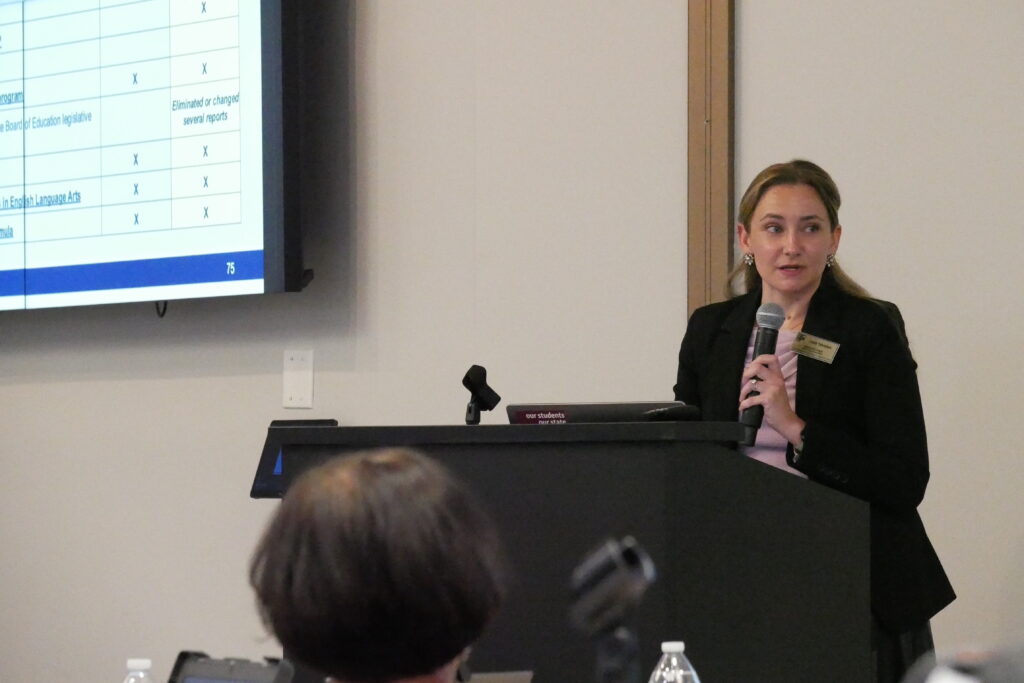
“I would be remiss if I didn’t note (the pay raise) was much higher for our beginning teachers as part of a recruitment method,” said Yelverton. “It was not as high for our veteran teachers — those with at least 15 years of experience. They are looking at the low end of that pay raise. We know that we have a lot of work to do when it comes to veteran teacher pay and retaining our excellent veteran teachers.”
Yelverton said the new state budget failed to restore master’s pay, reform the principal pay plan, address the nearly $13 billion in school construction needs, or place a moratorium on the Opportunity Scholarship program, which were all items included in the Board’s last legislative request.
Here is a list of the other K-12-related items in the 2026 budget from the General Assembly, created by DPI. You can also view a list of K-12 study mandates for the NC Collaboratory in the budget here.
Related reads
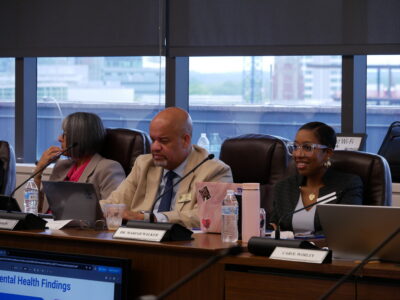
DPI leadership put forward possible major legislative priorities, which are listed below:
- Teacher and public school employee pay, including master’s pay
- Exceptional Children weighted student funding model
- Funding for school capital
- School accountability reform, including changing the definition of low-performing schools
- Educator preparation program accountability model changes
- High-quality instructional materials
- Beginning teacher support
- Math instruction
- Licensure reform
Board members were broken up into small groups to discuss and reflect on the presentation. Based on the recap provided by DPI, the strategic plan, and their personal experiences, members of the Board shared a few items they believed should be prioritized in the 2027 legislative agenda. For example, several Board members noted calendar flexibility for schools was something they wanted to see on the agenda.
“The first one is with calendar flexibility… that’s something important,” said Board student adviser Daniela Mojica-Uriostegui.
She went on to explain that with the new push across the country to reduce screen time for students, it’s important to ensure that physical instructional materials are “up-to-date” and useable.
“Just restoring (funding for high-quality instruction materials) to what it was previously, adjusted for inflation, would probably quadruple it,” said Board member Catty Moore. “Because it’s still less than half of what it was 20 years ago.”
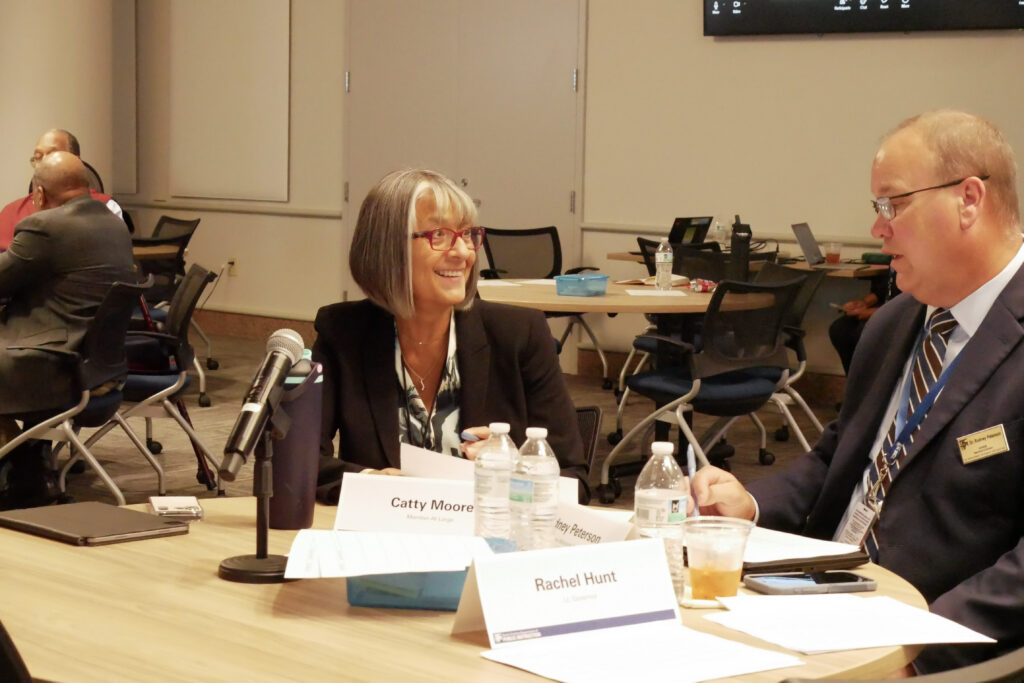
Another table agreed about the importance of funding high-quality instruction material, adding that school facilities need to be high quality, too.
“Our buildings need to be much more modernized,” said Board member Jason Johnson, 2025 Wells Fargo Principal of the Year.
Johnson several other priorities that his table identified: “High dosage tutoring, beginning teacher support, advanced teaching roles… health personnel… and flexibility around budget and allotments.”
Board member Cason Justice, 2026 Burroughs Wellcome Fund N.C. Teacher of the Year, said his table’s No. 1 priority was increasing pay for school staff.
“We had our first one as personnel pay — teacher, educator pay. I would lump in reforming the principal pay plan, too,” said Justice. “The second one was moratorium on the Opportunity Scholarships, no-cost breakfast and lunch was third.”
Moore said that, “even though it’s ambitious,” her table “wasn’t comfortable taking anything off the existing list” of potential legislative requests. She explained they believed that adding specificity to their request, though, might be beneficial.
“Perhaps it’s time for our legislative ask to be explicit in our ‘increasing teacher pay ask’ to address the veteran teacher concerns… instead of just talking about increasing teacher pay,” she said.
The Board will go over the initial full draft of its legislative agenda at its next meeting in November. To listen to the Board’s entire discussion of upcoming legislative priorities during the October planning and work session, click here.
 Sign up for the EdWeekly, a Friday roundup of the most important education news of the week.
Update on Charlotte-Mecklenburg Schools
At the beginning of the Board’s regular meeting on Thursday, Superintendent Maurice “Mo” Green read a joint statement from himself and Davis regarding the “alleged financial irregularities within transactions involving Charlotte-Mecklenburg Schools (CMS).”
In September, Mecklenburg County District Attorney Spencer Merriweather requested that the N.C. State Bureau of Investigation (SBI) launch a formal criminal investigation into the financial irregularities of the district. The Board will also be performing their own investigation into the matter.
“The State Board of Education has both a constitutional responsibility and a statutory obligation… to ensure that public education funds are managed lawfully and responsibly,” Green read. “We expect full cooperation from local officials as this review proceeds. If the facts establish violations of state fiscal requirements, the State Board will take whatever actions are authorized and necessary to protect public funds and uphold public confidence in North Carolina’s public schools.”
Last week, the CMS Board of Education voted 5-4 to terminate CMS Superintendent Dr. Crystal Hill, and several other leaders in the system have left their positions or announced their intent to leave. In the joint statement, Green and Davis said the Board understood that “recent changes in CMS leadership may create challenges for the district and its school communities.”
“Our foremost concern is ensuring continuity of educational services for students,” they said. You can read their full joint statement here.
On Friday, CMS issued a media statement, along with the CMS Board of Education, regarding the joint statement from DPI and the Board.
“As one CMS team, the Board of Education, district leadership, educators, school leaders, and staff remain committed to providing the information, documentation and access necessary to support these processes. We will continue to engage openly and professionally with NC DPI, the State Auditor’s Office, and SBI,” the statement said.
“We appreciate our state partners for carrying out their respective responsibilities with diligence and professionalism. Most importantly, the entire CMS team remains united in serving our students and families and ensuring every student has the opportunity to experience Endless Possibilities,” continued the CMS statement, which you can read in full here.
A new model for Educator Preparation Programs
The Board is now legislatively required — in consultation with DPI, the UNC System, the N.C. Community College System, and North Carolina Independent Colleges & Universities — to create a report to the Joint Legislative Education Oversight committee on their “recommendations for an educator preparation program (EPP) accountability model.”
Coltrane, along with Dr. Ann Bullock, chair of the Professional Educator Preparation and Standards Commission (PEPSC), presented the timeline for creating an EPP accountability model, the current law, and the recommendations for a new model.
According to their presentation, in February 2025, the State Board directed PEPSC to review the 2020 proposed EPP accountability model. PEPSC presented its revised weighted EPP performance model for consideration to the Board later that year, and the new state budget, which was signed into law in July 2026, mandated that the Board submit recommendations on a revised EPP accountability model to the General Assembly.
Related reads
Coltrane explained the current model has “three performance measures identified:”
- Performance based on the standards and criteria for annual
evaluations of licensed employees
- Proficiency and growth of students taught by educators holding an
initial professional license, to the extent practicable (when available,
EVAAS data shall be used to measure student growth)- Results from an educator satisfaction survey, developed by the State
Board with stakeholder input, performed at the end of the educator’s
first year of teaching after receiving an initial professional license
He said that failing to meet these performance measures in some way bring on three different “sanction statuses,” which are laid out in state law — warned, probation, and revoked. The law also identifies four instances when an EPP would be sanctioned with those statuses:
- EPP fails to meet overall student performance standard for at least one measure
- EPP fails to meet the performance standards for at least one measure for one student group
- EPP fails to meet the performance standards for at least one measure for two student subgroups
- EPP fails to meet the performance standards for at least one measure for three student subgroups
Bullock highlighted several issues that PEPSC has identified with the current EPP accountability model. She said the model doesn’t include performance measures the EPP can effectively collect data on and that are directly connected to the instruction that occurs in the EPP. She added that the “timeline for sanctions is aggressive.”
“It doesn’t allow EPPs to focus on continuous improvement, which is what we want for everyone in all the programs that we have,” said Bullock.
The model also does’t differentiate between type of licensures, meaning that if an EPP that offers both a residency program and a traditional program, both programs would be sanctioned if one is performing inadequately.
The proposed EPP accountability model, which was brought to the Board for consideration, is meant to address those issues. You can view how the proposed model differs from the current law in the slide below.
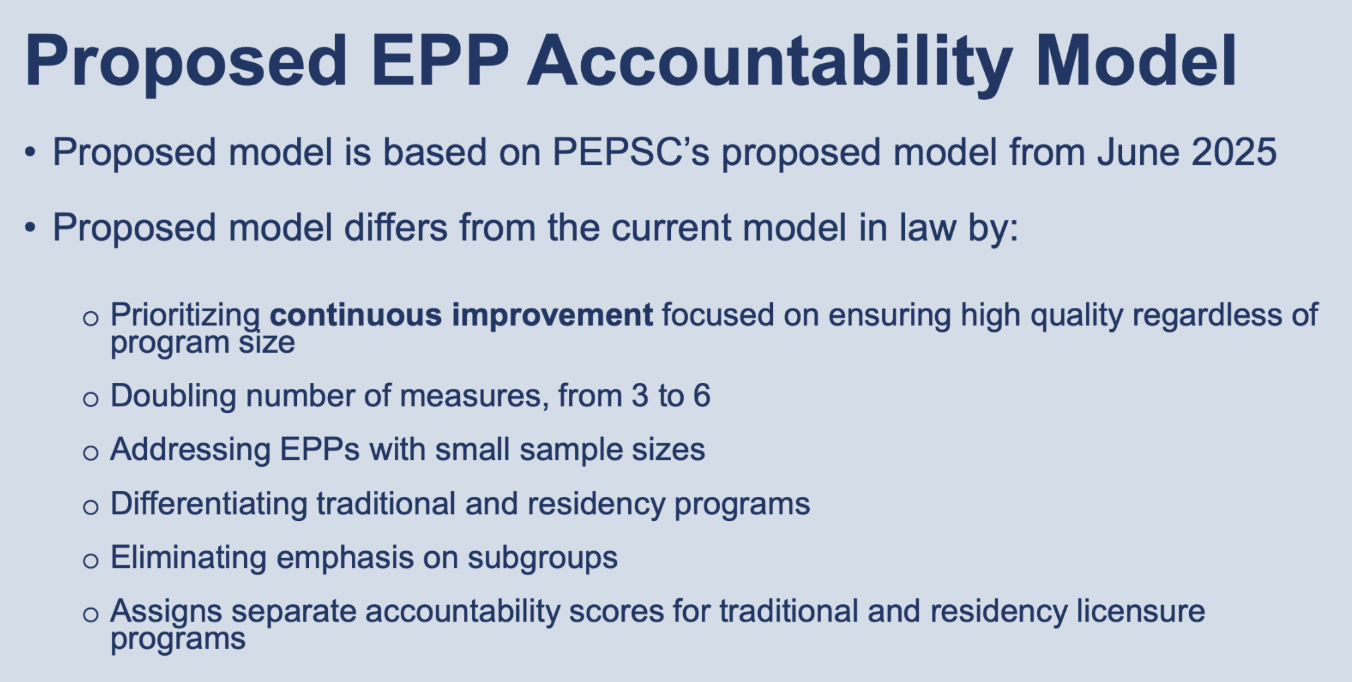
The current model considers results from the recent graduate survey, student growth data from the Education Value-Added Assessment System (EVAAS), and data from the NC Educator Effectiveness System (NCEES). The proposed model would remove NCEES from consideration while adding four additional measures: an employer survey, the edTPA performance-based assessment, the Foundations of Reading exam, as well as the Praxis II and other content exams.
Bullock noted the lack of interrater reliability as one of the main reasons that they are recommending removing NCEES from consideration.
Board members discussed what they saw as important in measuring the success of EPPs.
Board member Dr. Mariah Walker, 2026 Wells Fargo Principal of the Year, said one thing her table kept coming back to “is moving policy and practice to what the reality is of the people and what’s the reality in what we are seeing in performance.” She said student growth is the most important thing in measuring educator preparedness, explaining that many soft skills taught and used in the classroom cannot be measured by one of these tests.
Justice also noted that edTPA is one of the biggest items that prepares teachers before they come into the classroom. He said his small group thought that it might be beneficial to differentiate how educator preparedness is measured depending on the different grade levels they may be serving.
He also said he had concerns about the validity and consistency of many of the measures. Agreeing with Justice, Bullock said PEPSC believed that the accountability measures should be examined to ensure consistency across results.
“If they’re going to be an accountability measure, we need to look at them,” she said.
Coltrane told the Board that it is within their scope of power to align any performance measure with what they think is necessary to determine educator preparedness.
Report on Advanced Teacher Roles Programs
On Thursday, the Board heard a presentation on Advanced Teaching Roles (ATR) Program’s impact on classrooms and teacher retention from a research team at the Friday Institute. The report is statutorily mandated by the General Assembly.
According to DPI, the ATR program “offers school districts an annual opportunity to apply for grants to design and implement new organizational and compensation models that extend the reach of highly effective teachers to more students and/or teams of teachers.”
In the 2025-26 school year, there were 32 Local Education Agency (LEAs) fully implementing implementing ATR programs through grant funding, representing 476 schools, with 1,736 advanced teacher supporting 4,719 teachers.
The analysis focused on schools that were performing similarly before ATR programs were implemented in order to “isolate the effect of ATR,” according to Dr. Alicia Fischer, research scholar at the Friday Institute. The below graph compares five years of data before ATR implementation and eight years of data after implementation.
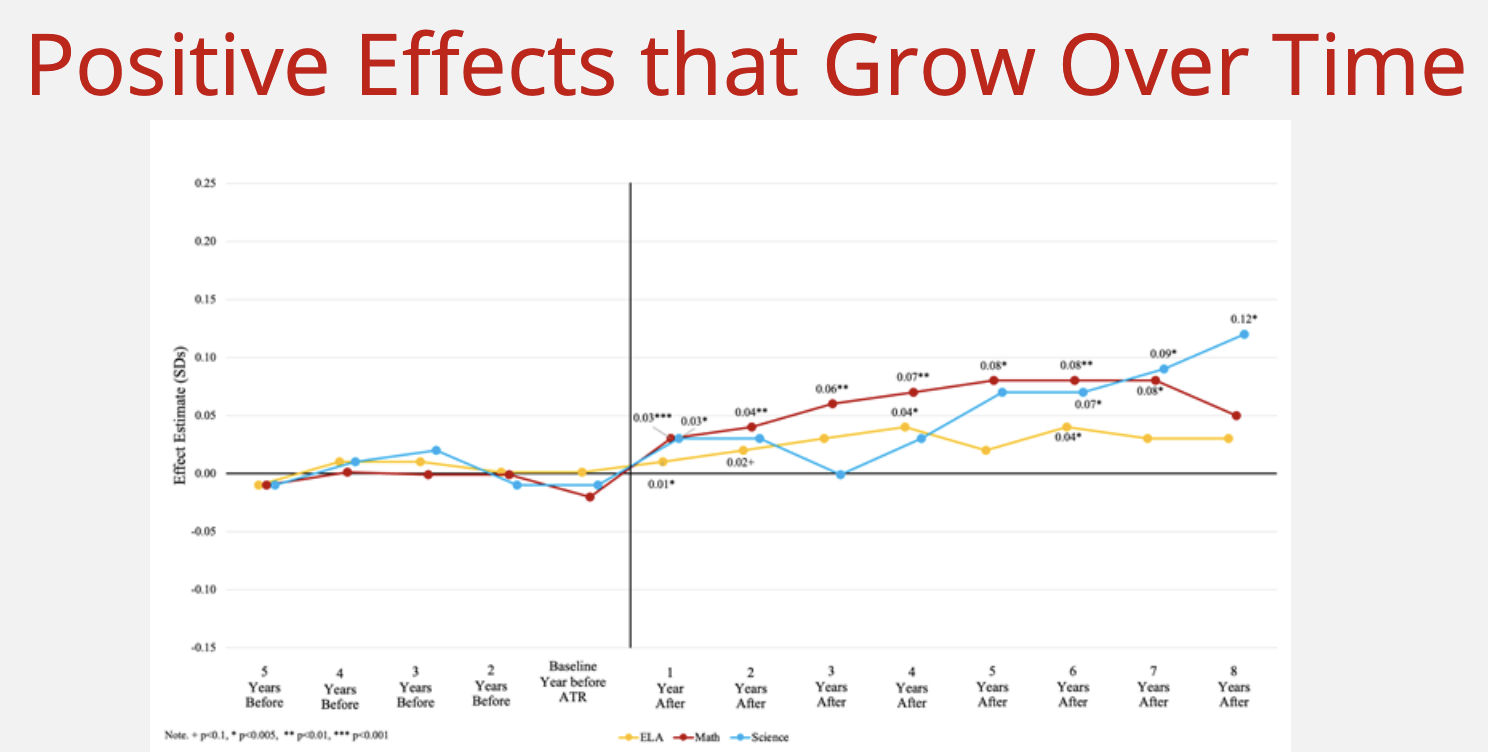
“When we break down looking at the impact of ATR across all subject areas, ATR is showing sustained positive effects in all subject areas — in ELA, math, and science,” said Fischer.
The report shows the strongest effect in math, comparable to nearly one month of additional learning between third and fourth grade math, according to a press release from the Friday Institute.
The presentation went on to explain that ATR results do not “vary systematically by grade level served,” meaning that ATR has positive benefits across elementary, middle, and high schools.
Furthermore, Fischer told the Board that teachers in ATR schools are “less likely to be alternatively licensed, tend to have higher than average EVAAS scores, are less likely to be beginning teachers, and have, on average, more experience.”
DPI, alongside reviewers across institutes of higher education and local school administrative units, also approved proposals to receive the ATR Program Grant. There was $2 million in ATR funding to support new district’s planning costs in fiscal year 2026-27.
One proposal was already approved by statute, and DPI recommended that the 10 highest scoring proposals, as determined by the reviewers, were also approved.
Updates to student performance data
Last month, the Board heard a presentation on school performance grades, which showed record numbers for cohort graduation rates, standardized test scores, and more. This week, Curtis Sonneman, director of DPI Office of Accountability, presented updated numbers in light of a few data corrections.
Notably, data corrections found that the four-year cohort graduation rate for NC public schools is actually 89.0% for the 2025-26 school year, which represents a 0.2 percentage point increase from the statistic presented last month.
There were several other changes in school status as reported by the performance grades:
- Two schools were removed from Low-Performing School identification
- One school was removed from Continually Low-Performing School identification
- Four schools had a School Performance Grade change
- Three schools had Subgroup Letter Grade changes
- Thirteen schools had Cohort Graduation Rate long-term goal target status changes
- Three schools had participation rate status changes
- One school was added to the Alternative School’s Modified Accountability System
Recommendations on grants and reimbursements
The Board heard several reports on grants and reimbursement programs. The Teacher Assistant Tuition Reimbursement Program “provides tuition assistance to eligible part-time and full-time teacher assistants employed by local school administrative units who are pursuing a college degree that leads to teacher licensure,” according to the Board.
The General Assembly appropriated $575,000 for the program, with applicants being eligible for up to $4,600. There were 652 applications for funding, and 202 received an allocation for the Teacher Assistant Tuition Reimbursement Program.
Additionally, the General Assembly allocated $250,000 (nonrecurring) for public school units (PSUs) to submit grant applications for schools serving students in grades 9-12 to “develop, maintain, or expand educational and competitive speech and debate teams and participate in speech and debate competitions for the 2026-2027 school year,” according to the Board. PSUs could apply for up to $10,000 per team that their program served or would serve.
There were 35 applications from PSUs, with $734,893 in requests across 28 school districts and five charter schools, reflecting 79 teams. The Board approved DPI’s recommendation of funding 16 programs, totaling $248,349 in funding. All state regions were represented in the schools recommended for funding.
“This will enhance academics in so many other ways,” said Board member Dr. Olivia Oxendine regarding the speech and debate grant program.
During COVID-19, the General Assembly also funded after-school robotics programs. In the new state budget, the General Assembly provided “$2,000,000 in funding for Public School Units to submit grant applications for schools serving students in grades 9-12 to establish an After-school Robotics Program for the 2026-2027 school year.”
Grant requests were capped at $15,000 per team. There were 72 applications received, totaling $1.7 million in funding dispersed. Board member John Blackburn said that “we should celebrate” this program.
Read more

Device refresh, new math standards, paid parental leave, and more
- During the 2025-26 school year, PSUs reported “approximately $6.62 million in technology device repair expenditures.” Of the PSUs who contributed data to the report, 53.9%, and nearly 75% of districts, reported that “local funding alone is insufficient to support their ongoing device refresh needs.” Read more about the funding issues that affect school’s ability to replace and fix student devices.
- The Board also “adopted the proposed 2026 K-12 Mathematics Standard Course of Study.” These newly adopted standards will be officially implemented beginning with the start of the 2028-29 school year, according to DPI.
- The Board discussed new literacy data, which shows increases in proficiency for first, second, and third graders. Read EdNC’s analysis of the data here.
- Updates to paid leave policy by state law have expanded paid parental leave for all state employees, including teachers, who become parents to 12 weeks. The statute also added one additional day of annual leave for all teachers.
- The 2026 application for charter schools has begun, and there are 11 charter school applications that will come forward to the Board for approval.
October is National Principals Month, and Davis said that, on behalf of the Board, he wanted to express his sincere appreciation to principals, who he called the “heart of a school.” Furthermore, Oct. 2 is National Custodian Day, and Davis said the Board wanted to recognize “every one of our dedicated custodians who serve our schools and facilities every day.”
He said their work is “essential to creating clean, safe, welcoming, and well-maintained environments where our students can learn and our staff can do our best work.”
The State Board of Education will meet for its next meeting on Nov. 4-5. You can view the livestream here.