
NC high school students report increased safety and mental health, decrease in risk behaviors

Editor’s note: This article discusses mental health and suicide. If you or someone you know needs help, reach out to the National Suicide and Crisis Lifeline by calling 988.
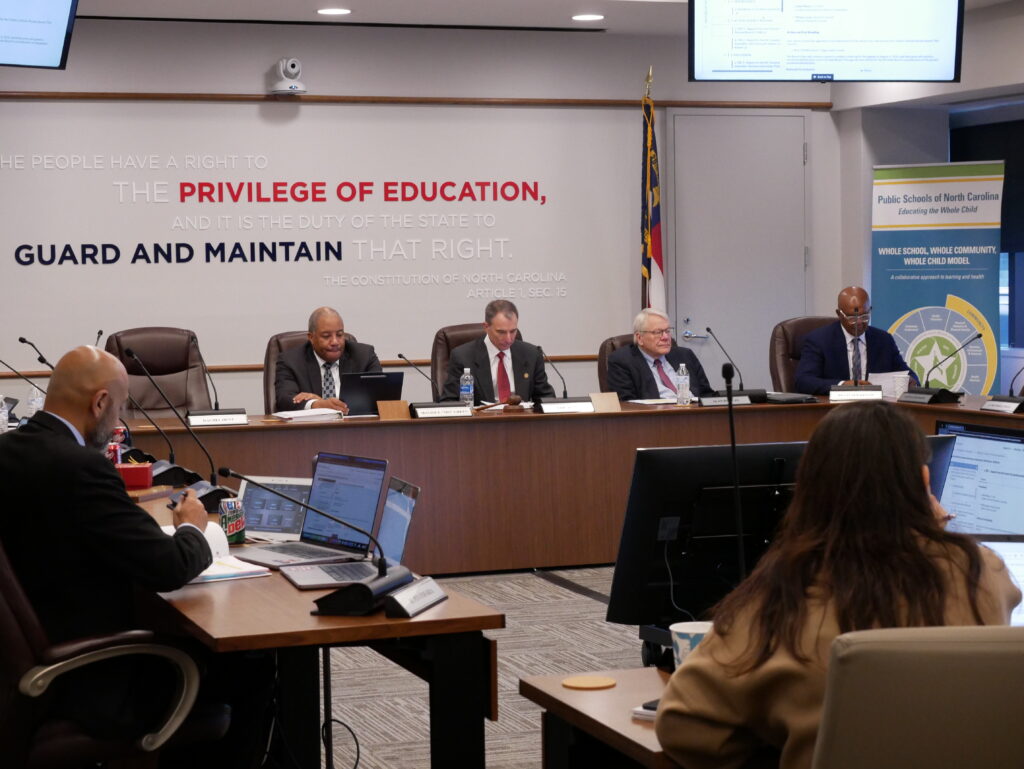
The State Board of Education convened for its monthly meeting last week, discussing youth well-being, the anniversary of the Department of Public Instruction (DPI) and Board’s strategic plan, remote learning, new educator salary schedules, and more.
“The start of the school year is always a season of optimism,” said Board Chair Eric Davis. “New students, new teachers, new opportunities, and another chance to help every child achieve their potential.”
A large portion of the meeting was devoted to the results of the 2025 Youth Risk Behavior Survey, an anonymous survey administered online once every other year to a “representative sample of middle and high school students.” The survey assesses student behaviors that “have immediate and long-term implications for health and academic success.”
A DPI press release says the data shows North Carolina “has returned to and exceeded pre-pandemic levels across nearly all reported measures.”
“The 2025 Youth Risk Behavior Survey reflects meaningful progress, particularly in improving student safety and reducing several risky behaviors,” Superintendent Maurice “Mo” Green said in the release. “At the same time, the findings reinforce the need to help every student feel safe, connected and prepared to learn. In order to become the best public schools in the nation by 2030, we must continue to uplift progress while responding to the continued needs of students in our schools.”
Explore more on youth well-being survey
Highlights from youth risk behavior survey
The survey topics include mental health, physical activity, substance use, safety, violence, nutrition, and social behaviors. Ellen Essick, section chief for DPI’s NC Healthy Schools, led the presentation on the 2025 survey results, highlighting that this survey is the only of its kind in North Carolina that relies on student voice.
“It allows students to tell us what they need, and then we can use that data,” Essick said of the survey.
She also explained that the data was composed only of the responses from high school students, as the middle school data is still not available. According to the available survey results, derived from 1,692 total usable survey responses, many indicators of student well-being are back to pre-pandemic levels, and several more are at record bests for the state. This year’s survey has 573 fewer total usable
student surveys than in 2023, per DPI’s presentation.
“So, what do we see? Progress in several areas. It’s real, and I’m excited,” said Essick. “This is the first time I get to tell you good things here in a long time, and I’m really excited about that.”
Areas that saw improvement
Reported social media use has dropped, with 75.9% of students using social media “more than once an hour,” “about once an hour,” or “several times a day;” down from 80.5% in 2023.
The report also found 20-year lows in alcohol and drug use among students. Sixteen percent of students reported current alcohol use, which is down from 42.3% in 2005. Approximately 10.6% of students reported current marijauna use, which is down from 21.4% in 2005.
Current use was defined as at least one drink or cigarette in the last 30 days. Prescription pain medication misuse was at 9.8%, which is down from 15% in 2017.
Tobacco and vape product use were also lower than previous years. Approximately 3.5% of students reported current cigarette use, 12.6% reported current e-vapor product use, and 4.2% reported current marijuana vape use. Regrading cigarette use, Essick said, “3.5% is still a pretty decent percentage of our students in North Carolina, but it’s as low as it’s ever been.”
Indicators of safety were better than past years as well. Approximately 1.1% of students reported carrying a weapon to school in the last year, 16.4% of students reported having been in a physical fight, and 9.9% of students said they missed school in the last year due to feeling unsafe. While all of these numbers were down from 2023, DPI leaders emphasized that any lack of a feeling of safety has adverse effects on students and school attendance. Essick said these are areas DPI is still looking to improve.
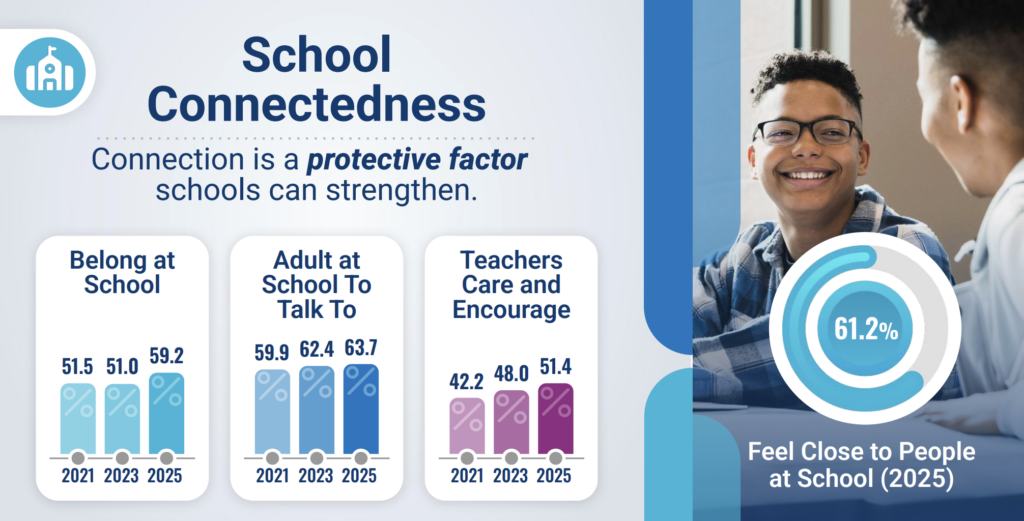
The survey results also showed an increase in students’ feelings of connectedness at school, and the presentation states that “connection is a protective factor.” About 59% of students reported feeling like they belong at school, nearly 64% felt like they had an adult at school who they could talk to, and 51% felt their teachers cared for them.
Overall, 61.2% of students felt close to people at school; all of these factors have improved in the last four years.
Continued areas for concern
There were a few data points that Essick described as “areas of concern” — namely student mental health and adverse childhood experiences. Indicators of student mental health have improved in the last several years, she said; however, they are still of concern.
According to the survey results, 29.7% of high school students felt sad or hopeless all the time, which is down from the state high of 43.4% in 2021. Nearly 20% of respondents reported experiencing poor mental health “most or all of the time,” which is a decrease from nearly 34% in 2021.
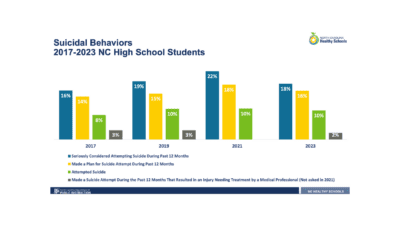
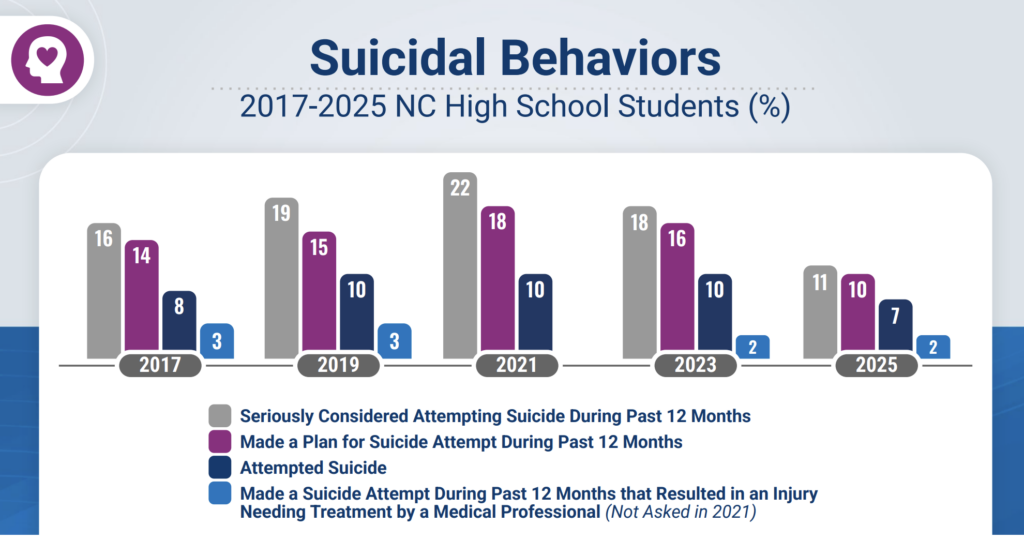
Approximately 11.4% of respondents said they seriously considered attempting suicide, which is down from the 22.3% high in 2021. About 15% of students reported harming themselves without the intent to attempt suicide, which is down from 21.5% in 2021 and 2023.
Other suicidal behaviors also decreased among high school students, which can be seen in the chart below.
“If we can get those students and address some of their needs before they get to a place of considering and contemplating suicide, then I think that totally helps us in terms of how we support students,” said Essick. “And it gives us more resources, then, to help some of the students who have those really significant mental health needs at school.”
New this year, the survey included questions designed to measure adverse childhood experiences.
“Those are those things, not student behavior, but things that happen in students’ lives that influence their school readiness, their attendance, their learning, their behavior,” said Essick.
The results showed that 20.8% of respondents lived in households with substance use. Approximately 21.5% lived in households with mental illness or suicidal behaviors present, 15.9% experienced food insecurity, and 4.1% experienced unstable housing, “meaning they didn’t sleep in the same place for several nights in a row,” Essick said.
According to the DPI release, “hours of sleep and physical activity were also concerning.” Only 21.7% of students reported receiving at least eight hours of sleep on an average school night, while 43.1% reported being physically active for at least 60 minutes on five or more days during the previous week.
 Sign up for the EdWeekly, a Friday roundup of the most important education news of the week.
Outliers in experience
Essick added that the results of the survey “aren’t evenly distributed.” Among the identity subgroups noted in the survey, some groups showed different trends.
“Of the students who made D’s and F’s, they were more likely to feel unsafe at school,” she said. “More of them felt sad or hopeless, and more of them felt like they did not belong, as compared to their counterparts who made mostly A’s.”
Students who identified as a part of the LGBTQ+ community also had different results from their heterosexual, cisgender peers.
“Our gay, lesbian, bisexual students felt more unsafe at school. They felt more sad or hopeless, and less like they belong at school,” said Essick. “The disparities aren’t as great as they’ve been in the past. So even though they’re still significantly more than their heterosexual peers, those disparities… (are) coming down a bit.”
Explore more about youth well-being

Recommendations
In light of these survey results and other data, DPI presented several recommendations to prioritize in the future.
- Strengthen grade 6-9 transition supports, particularly for attendance, behavior, belonging, academic performance, and early warning indicators.
- Coordinate mental health, basic needs, and substance-use supports through clear referral pathways, community partnerships, and student services teams.
- Improve schoolwide safety and conduct systems.
- Use integrated data for targeted prevention.
Essick highlighted several pillars of DPI’s strategic plan that aid in responding to these survey results.
She also discussed a few ongoing projects the department is working on that contribute to youth well-being in the state. These include four federal grants, Project AWARE, the Regulated Classroom pilot, the statewide Specialized Instructional Support Conference in December 2026, and partnerships with the Department of Health and Human Services.
Explore more on DPI’s recommendations in the full presentation here.
One year of DPI’s strategic plan
At its meeting last August, the State Board of Education approved a five-year strategic plan that calls for North Carolina public schools to be the best in the nation. The following goals were identified to help DPI measure the plan’s success:
- 92% four-year graduation rate (86.9% at time of plan approval)
- ACT composite score of 20 (18.5 at time of plan approval)
- 30% AP participation among 10th-12th graders (21.5% at time of plan approval)
- 41% Career Technical Education (CTE) participation among all K-12 students (36.1% at time of plan approval)
- 89% of school-aged children enrolled in public schools
- Lead the Southeast in educator compensation, and National leadership in National Association for Educational Preparedness (NAEP) reading and math scores
The plan also includes eight pillars to categorize action items: Prepare Each Student for Their Next Phase in Life; Revere Public School Educators; Enhance Parent, Caregiver, and Community Support; Ensure Healthy, Safe, and Secure Learning Environments; Optimize Operational Excellence; Lead Transformative Change; Celebrate the Excellence in Public Education; and Galvanize Champions to Fully invest in and Support Public Education.
Last week’s meeting marked the one-year anniversary of the plan’s approval, and DPI’s Geoff Coltrane and Dr. Maria Pitre-Martin provided updates on the current status of the plan’s goals. They walked the Board through the successes within each pillar, identifying several points where the state could grow in the future, and reviewing the existing accountability measures for the plan throughout its implementation.
The state saw improvements in many of the areas of interest to the strategic plan, which Coltrane and Pitre-Martin credited to the many initiatives done as a part of the plan. When the plan was announced, DPI identified 110 actions to be taken to move the state towards having the best public schools in the nation. As of this year, 41 actions have launched, and 53 actions are expect to launch in the next 12 months.
“This plan challenges us to do more to measure outcomes, it calls on us to focus on the actions that produce those outcomes,” Davis said. “Strengthening literacy, supporting excellent instruction, continually seeking operational efficiency, and expanding opportunities for every student, ensuring that every public school has the tools necessary to continue improvement.”
DPI also launched a public dashboard detailing the progress of the plan so far and calling for North Carolinians to become involved in making our state’s public schools the best in the nation. You can explore the state’s progress on different indicators here.
“A year ago, we made a promise to the students, families and educators of this state: that we would hold ourselves accountable, in the open, for building the best public school system in America,” Green said in a press release. “This dashboard is one way we are satisfying that promise. It shows what we said we would do, what we have done and what comes next. It also serves as an invitation for every North Carolinian to celebrate the successes of our public schools and to support us as needed.”
Read more about DPI’s strategic plan
Updates on remote learning plans and remote academies
DPI Director of Digital Teaching and Learning Matthew Mayo provided an update on remote instruction plans submitted to DPI by public schools. These plans are developed by schools under DPI’s guidance for scenarios when they might need to use remote learning in emergency situations to prioritize learning continuity.
“Remote instruction plans allow our PSUs to have that continuity of learning during any type of emergency closure, whether severe weather, power outages, or any other disaster that may happen, without losing that instructional time, and of course without having to extend the school calendar,” said Mayo.
Mayo said 303 public schools submitted a plan, 30 opted out, and seven did not respond with a plan. You can see the plans that school submitted here. Currently, the statute authorizing remote learning caps the number of remote days for public schools at five days or 30 hours. According to the report to the General Assembly, several schools are requesting additional flexibility in having remote days.
The report said there were four main strengths for public schools opting for remote learning: planning and readiness, effective communication, continuity of learning, and resource distribution. However, there were still several issues across the state with remote learning, including inconsistent internet.
“One-third of my county is still not connected (to the internet),” said Board member John Blackburn. “So (remote learning is) a real problem for a lot of parents and a lot of districts… I’m not sure it’s quite as effective as it should be, particularly with the lack of resources that so many of our students do not have in the west and the northwest parts of the state.”
Mayo also presented on changes to remote academies in North Carolina. There is one new remote academy, Carteret Virtual Academy, and there is one remote academy that closed, Nash Everywhere Digital Academy.
Explore more on remote academies
Other meeting business
Twenty-five charter schools and 446 traditional public schools are participants in the Name, Image, and Likeness (NIL) program, according to a presentation given to the Board last week.
Currently, there are no NIL agreements for charter school students, per the presentation, and the North Carolina High School Athletic Association (NCHSAA) had 24 NIL agreements. Brad Alford, the director of the Office of Athletics at DPI, said that typical NIL agreements range from $200-$700 and there were no NIL violations for last year.
The Board also welcomed three new advisers during this meeting.
- Dr. Rodney Peterson, Burroughs Wellcome Fund 2026 A. Craig Philips Superintendent of the Year.
- Dr. Mariah Walker, 2026 Wells Fargo Principal of the Year.
- Cason Justice, 2026 Burroughs Wellcome Fund NC Teacher of the Year.
“It’s truly humbling to witness the great work that takes place in schools across our state,” Walker said.
“It is unbelievable what (teachers) do every day,” said Justice. “I hope that we can get everybody else in our state on board because when you get better opportunities for teachers, you get better outcomes for students, and it’s that simple.”
Superintendent Green also appointed Keely Deal, a rising 11th grader from Purnell Swett High School in Robeson County, as the new junior student adviser to the State Board of Education.
The Board meets next Sept. 2-3, and you can watch the livestream here.