
State Board of Education discusses remote academies ahead of approval vote for new schools

Editor’s note: This article was updated on Thursday, May 7 following the State Board of Education’s meeting, where the Board voted to approve the six new remote academies.
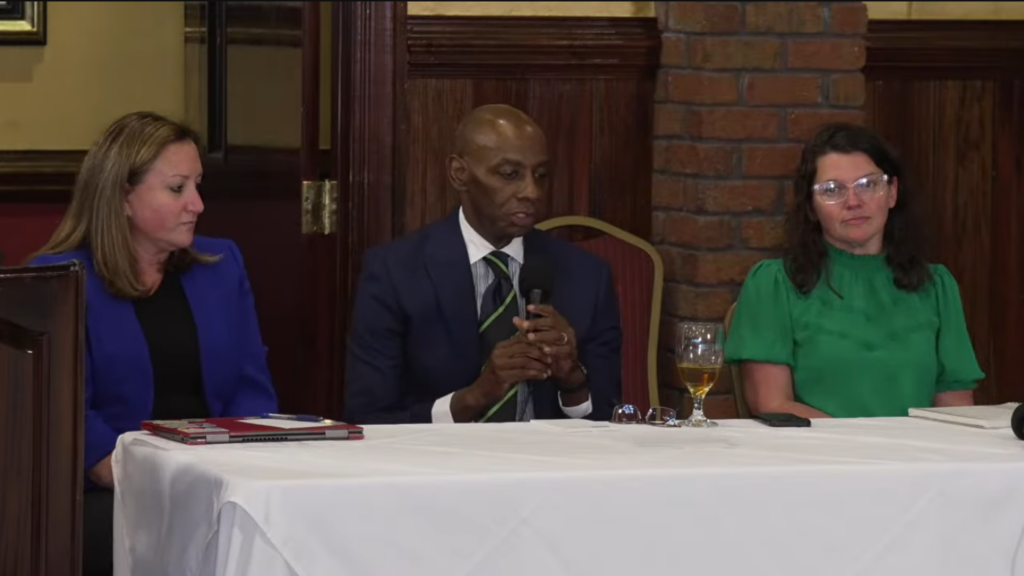
As part of the State Board of Education’s May planning and work session, the Board hosted three administrators on Tuesday to talk about North Carolina’s remote academies, public schools “whose instruction is provided primarily online through a combination of synchronous and asynchronous instruction delivered to students in a remote location outside of the school facility.”
That definition comes from a state law ratified in 2022, which authorized each school district to offer instruction through a remote academy after the academy is approved by the Board for a period of five years, which can be renewed.
Remote academies are different from traditional public schools that offer North Carolina Virtual Public School courses and other online courses to students — they operate as stand-alone schools. They are also different from remote charter academies, which are approved by the Charter Schools Review Board (CSRB).
You can see a map of North Carolina’s 38 remote academies on the Department of Public Instruction’s (DPI) website.
 Sign up for the EdDaily to start each weekday with the top education news.
Ashley McBride, Digital Learning Initiative section chief at DPI, introduced the virtual academy representatives by dispelling the potential misconception that virtual academies are unaccountable.
“These are not unregulated virtual programs,” McBride said. “Something to make sure we all understand is that they follow and fall under all the same laws that our other schools fall under.”
That includes things like teacher licensure requirements and attendance tracking. In fact, she said, the law is stricter on remote academies in some ways: they are legislated to require a media coordinator position, an instructional tech facilitator, a data manager, and technical support staff.
According to McBride, over 5,000 North Carolina students are enrolled in remote academies.
On Thursday, the Board voted to approve the applications of six new remote academies. The Board was originally scheduled to vote on four of those schools at its meeting last month, but delayed the vote after Board Chair Eric Davis and Vice Chair Alan Duncan raised concerns about the effectiveness of fully virtual learning and the purpose of remote academies. Members of the CSRB have also raised questions about the perks and perils of virtual learning in recent months.
“We do have evidence that virtual instruction, if used very carefully within a very constructive strategy as a complement to traditional education, is a good option for students. I think the data also supports that when it’s all virtual instruction, our students don’t get the education that we need to deliver,” Davis said last month. “Our job is to make sure that the program we’re offering will deliver. And I’m just not convinced that it will.”
Below, you can find highlights from each of the administrator’s presentations to the Board.
Wake County’s Crossroads FLEX High School
Christie Nottingham, the principal of Crossroads FLEX High School in Wake County, presented to the Board first.
Nottingham said that unlike many remote academies in North Carolina that were a response to the COVID pandemic, Crossroads FLEX has been around for nearly a decade. The student population that the school serves, Nottingham said, is one that otherwise wouldn’t be able to attend traditional public school.
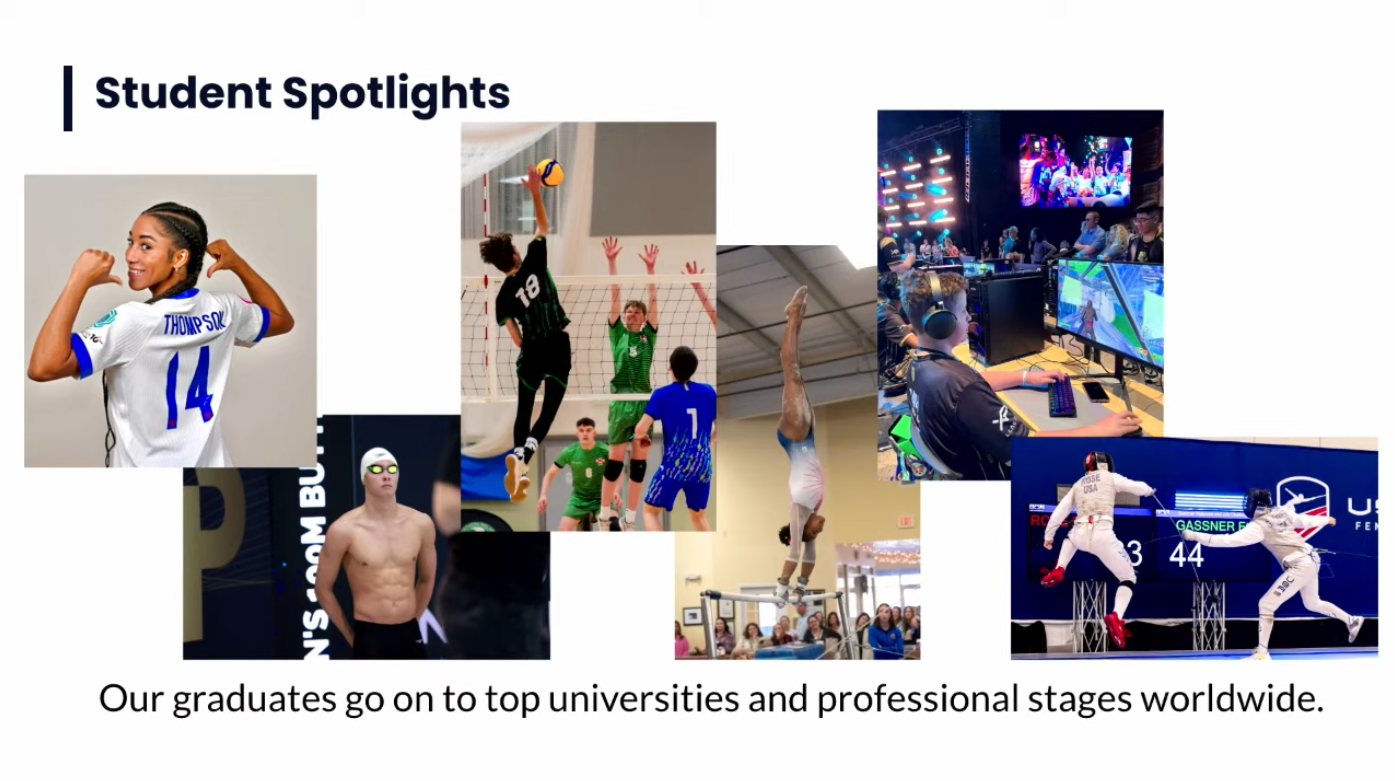
“Our students are all involved in something outside of school, which we call pursuits,” Nottingham said. “So they are athletes and artists. They are competing and performing at such a high level that they need a flexible schedule.”
Crossroads FLEX students include a swimmer who competed in the Olympic trials, an eSports professional, and a high-level fencer.
Classes meet two days a week and students complete work asynchronously on the other three days of the week, Nottingham said. Classes are virtual, but there is a physical space where students can gather and meet with staff, which Nottingham likened to a student union at a college.
The school boasts a 100% graduation rate since the school opened, Nottingham said. It graduated 42 seniors last year.
“Without the flexibility that Crossroads FLEX provides, I think Wake County Public Schools would lose these kids,” Nottingham said. “I think they would seek charter or private or homeschool.”
ONE Academy in Chatham County
The motto of ONE Academy, the remote academy in Chatham County, mirrors Crossroads FLEX: “Different is not deficient. It’s just different.”
“Our flexible academy in Chatham County was born out of a need to ensure that every student had a pathway — that every student had a pathway to the diploma,” said Anthony Jackson, superintendent of Chatham County Schools.
Jackson said that despite being a high-performing school district, some students were slipping through the cracks, and that typical school just didn’t work for them. Social workers in the district were asked to find those kids who had “fallen out of love with school,” to give them an opportunity through the remote academy, he said.
Jackson called ONE Academy, which serves around 80 students in grades 9-12, a “superpower” because it opened the door for these families and kids.
He said some students at ONE Academy manage complex external responsibilities; some are parents; some work to support their families; some have medical issues that prevent them from attending traditional school.
The remote academy keeps individual student needs in mind, Jackson said, and allows them to move from fully virtual instruction, to hybrid learning, to fully in-person, as needs change.
He said the sole goal of ONE Academy is to help students and parents realize their hopes and dreams.
“We don’t throw away, or let any child in Chatham County slip through the cracks any longer,” Jackson told the Board. “We have opportunities for them, and we’re very intentional about it, and unapologetic about it.”
Hyde County superintendent asks for flexibility
Hyde County Schools does not have a remote academy — it is one of the smallest districts in the state, with just three schools.
Melanie Shaver, the superintendent of the district, is seeking remote academy designations for Mattamuskeet School and Ocracoke School to accommodate the difficult geography of coastal Hyde County, which includes remote areas of the Outer Banks.
Hyde County’s geographical isolation creates barriers, Shaver said. Those barriers impact student attendance because it takes a long time to travel to essential services like medical care.
So far in the 2025-26 school year, the district has seen over 1,400 absences due to medical appointments. And those absences lower average daily membership (ADM), which affects the funding the district receives.
Shaver said there are 551 students enrolled in Hyde County Schools, but its ADM as of May 1 was only 501.
Students aren’t always losing instructional time during absences, Shaver said. Often, they’re calling in virtually from the car, or the bus (when traveling to a sporting event, for example), or from the ferry that transports students to and from the mainland.
However, right now, teachers must mark those students absent. If schools were designated as remote academies, that would allow them to be credited for their learning time, Shaver said.
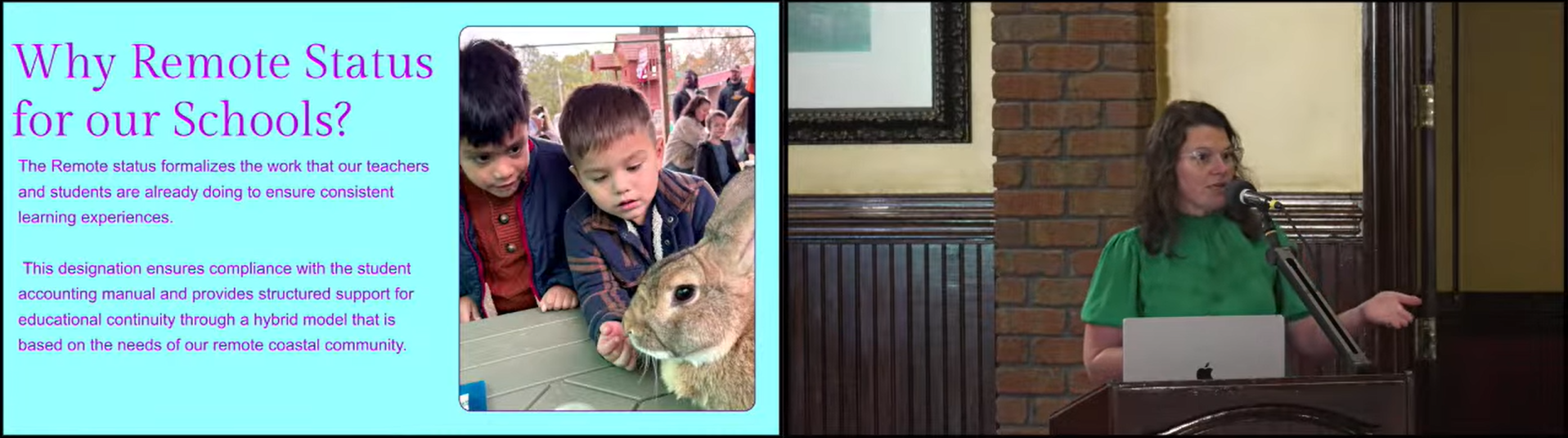
Shaver said she is seeking the designation for existing brick-and-mortar schools because there isn’t demand in her small district for a new school.
“We want our students to have success no matter where they live, no matter what the geographical conditions are. We want them to have the best access that they can to education, and this is one of the ways that we think that we can make that happen,” she said. “So, embedding this hybrid option into our schools, it reflects the commitment to ensure geography doesn’t define opportunity. It also maximizes that impact and ensures that we have compliance as our students are meeting the realities of rural, coastal life.”
Board to vote on new remote academy applications
The Board voted to approve new remote academy applications, including the applications for the schools in Hyde County, on Thursday.
The full list of applicants is as follows:
- Brunswick Virtual Academy — Brunswick County Schools
- Northampton Virtual Academy — Northampton County Schools
- Wayne Middle High Academy — Wayne County Schools
- Blue Comet Global Academy — Asheboro City Schools
- Mattamuskeet School — Hyde County Schools
- Ocracoke School — Hyde County Schools
According to meeting materials, the key purposes for the schools are to expand school choice, retain and reengage students, address various barriers, and provide flexible, high-quality pathways.
The Board also approved revisions to two school applications on Thursday, and two school closures due to no or declining enrollment. You can read DPI’s full presentation on remote academies here.