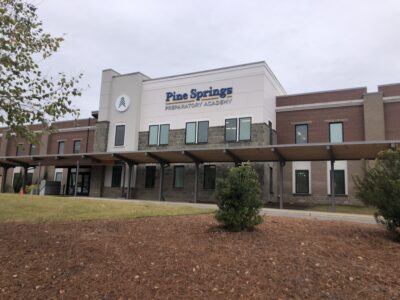
In a first-of-its-kind decision, the state’s Charter Schools Review Board (CSRB) authorized Pine Springs Preparatory Virtual Academy (PSPVA) to operate as a stand-alone school, separate from its parent charter school, Pine Springs Preparatory Academy. The CSRB approved the remote charter academy’s conversion unanimously at its meeting on Monday, Feb. 9.
A rapid route to remote charter expansion, the move is allowed by a new state law, which permits schools with larger remote academies to request a separate charter under an expedited process. No lengthy application is required. Pine Springs Prep submitted a simple amendment to its original remote charter application.
 Sign up for the EdDaily to start each weekday with the top education news.
Currently, PSPVA is one of the state’s largest remote charter options, serving 3,685 students from all 115 school districts this year, school leaders said.
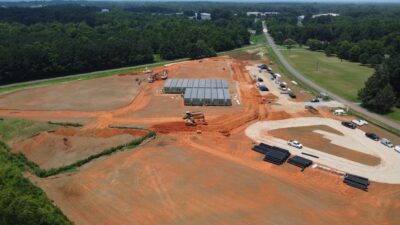
Since its 2024 launch, PSPVA has operated under Pine Springs Prep, offering fully virtual as well as blended instruction. Pine Springs Prep serves 1,425 K-8 students at two brick-and-mortar campuses in Holly Springs, according to school leaders, and is set to open a third campus for high schoolers this fall.
Demand is surging for online options, CSRB members noted during discussion.
“This is school choice,” CSRB Vice Chair John Eldridge said. “People are choosing all kinds of different things. … The virtual option is not going away. If anything, it’s grown exponentially.”
Pine Springs Prep has paved the way on policy before. It was the first North Carolina charter school to secure state approval for three distinct learning models — traditional, fully virtual, and blended.
Bruce Friend, chair of the CSRB, is also the superintendent at Pine Springs Prep and oversees all three models. He recused himself from voting and deliberations on his school’s remote academy amendment.
The CSRB also approved remote charter academies for The Franklin School of Innovation and The Mountain Community School on Monday. However, the CSRB denied a remote charter application from Alamance Community School and asked three schools managed by Charter Schools USA (CSUSA) to return for another interview regarding their remote charter proposals.
Even as the CSRB moved to expand remote learning options, some members expressed broader reservations about school quality and the impacts of screens. According to state data, remote charter academies have generally performed poorly compared to in-person options.
“I’m concerned that we’re going to take the already deep research … regarding issues with this specific generation and being behind screens and being away from collaborative environments, and we are going to call it choice and we’re going to expand it significantly,” CSRB member Eric Sanchez said.
“I have huge concerns about these virtual schools in general,” CSRB member Eric Guckian said, specifically highlighting the need for better ways to track success.
Two remaining schools in the 2026 renewal cohort also secured charter renewals on Monday, with Old Main STREAM Academy receiving a 10-year term and Rocky Mount Preparatory Academy earning a three-year term.
More on remote charter academies
Moving forward, PSPVA will operate under a new name: Dogwood Virtual School. It will be the state’s third stand-alone remote charter academy, according to Ashley Logue, the executive director of the Office of Charter Schools (OCS).
NC Cyber Academy and NC Virtual Academy, the two original virtual charters, each received renewals as remote academies last month, a process authorized by a 2023 law. However, both schools have operated under the state’s virtual charter pilot since 2015 — and unlike PSPVA, were not under the umbrella of a brick-and-mortar charter school.
Another stand-alone virtual charter school, NC Connections Academy, is expected to open in the fall.
During discussion, CSRB members highlighted the precedent-setting nature of Pine Springs Prep’s request.
“I believe this is the first time we’re separating the charters. … For most purposes, (it) is going to be for administration purposes because you’re going to have the same board overseeing both charters,” CSRB Counsel Steven Walker said. “We’ve seen a lot of confusion with the remote charters because you’ve got separate school numbers, and then sometimes the audits are getting conflated.”
The legislature’s intent, he said, was that larger remote academies should become stand-alone schools for greater administrative clarity.
The law thus limits eligibility to apply for a separate charter to those schools that enroll or plan to enroll at least 250 students in their remote charter academies.
Erin Fisher, the board chair at Pine Springs Prep, led the presentation to the CSRB, providing context for the school’s request. The remote academy meets legislative criteria, is twice as large as Pine Springs Prep, and serves a very different population, she said.
Students and families choose the remote learning option for a range of reasons, she said, such as medical conditions, athletics, or outside obligations. Some students are behind in credits.
In terms of impacts, the shift to a separate charter would lessen confusion for parents, the Department of Public Instruction (DPI), and others, Fisher said — and would foster clearer and greater accountability.
“This totally makes sense,” Eldridge said. “If we added up the two North Carolina virtual public schools and this school, that should tell you something about the public’s demand (for online schooling).”
Together, NC Virtual and NC Cyber enroll over 6,300 students, according to 2026 data from DPI. Including PSPVA, the three remote charter schools serve more than 10,000 students.
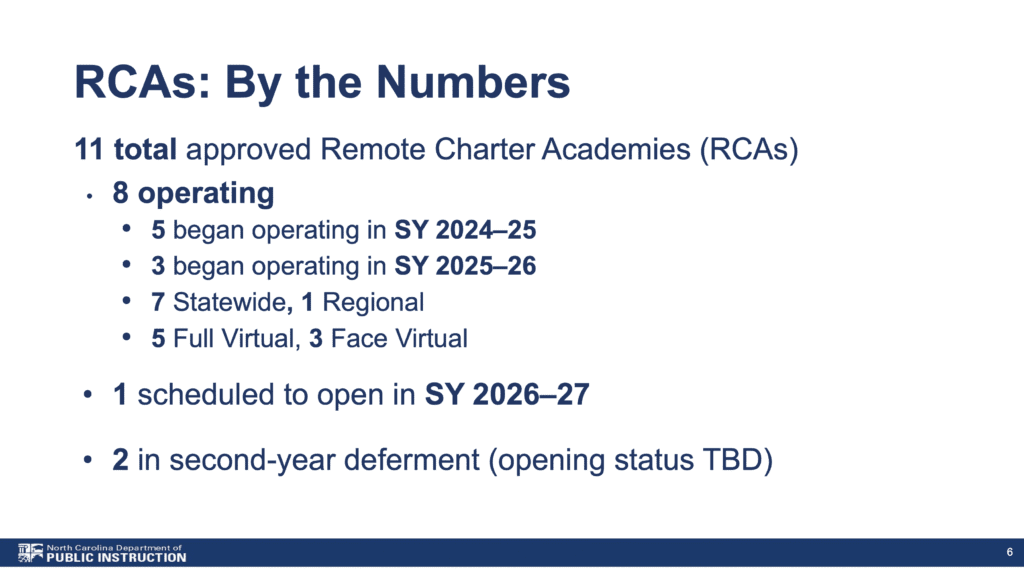
Six other charter schools came before the CSRB this month with standard remote charter academy applications. According to a presentation from OCS, eight remote charter academies are operating during the current school year.
Following CSRB approval of its remote charter academy request, The Franklin School of Innovation (FSI) in Asheville will move forward with its Innovation Career Academy. A regional, blended academy, Innovation will emphasize career readiness and CTE (career and technical education) with “wrap-around in-person services,” according to the presentation from FSI Executive Director Michelle Vruwink.
The impetus for the academy, Vruwink said, is to meet the needs of students who are not thriving in a traditional school setting.
“There are some students, particularly post-COVID, who have really struggled to be in our high school program,” she said.
FSI plans to contract with Edmentum, serving 44 students in grades 9-12 the first year and growing to 87 students by year five, according to Vruwink.
The Mountain Community School (TMCS) in Hendersonville will also launch a remote charter academy in western North Carolina, serving students in grades 4-8, according to its request. The academy will be fully remote, Jeff Morris, the executive director, said in his presentation. Although the plan is for statewide operation, the academy plans to target nearby counties initially.
Families are looking at other options, Morris said, which served as a catalyst for launching the remote academy.
Like FSI, TMCS will partner with Edmentum. TMCS hopes to enroll 125 students in its remote academy during the first year, eventually growing to 375.
Alamance Community School had hoped to open a fully virtual, statewide remote academy, but failed to win over a majority of CSRB members with its request.
Leslie Paynter, the managing director, said the remote academy could counter attrition from families seeking an online environment.
However, CSRB members expressed concern about the school’s capacity to handle a remote academy right now, given its continually low-performing status.
In North Carolina, low-performing (LP) schools have received either D or F performance grades and a growth status of met or not met, according to state guidelines. Continually low-performing (CLP) schools have been low-performing for two of the past three years.
A CSRB motion to approve the Alamance application resulted in a tied vote, meaning it would not move forward.
Three schools managed by CSUSA, an education management organization (EMO), shared a joint presentation proposing remote academies for high schoolers. The schools are Cardinal Charter Academy in Cary, Cardinal Charter Academy at Wendell Falls, and West Lake Preparatory Academy in Denver.
CSRB members expressed some confusion about the combined presentation and questioned how the blended component could be implemented statewide.
In addition, technical difficulties precluded the CSRB from speaking with school board members attending online. As a result, the CSRB asked the schools to return individually for second interviews.
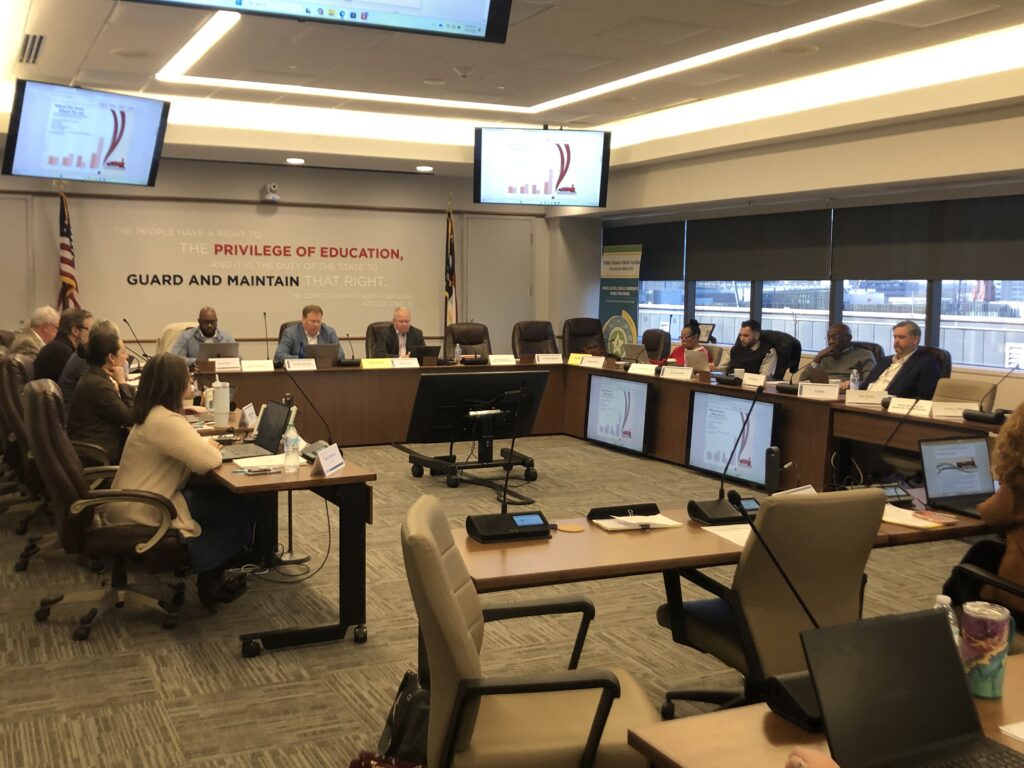
Final 2026 renewals
Old Main STREAM Academy’s renewal vote was straightforward, with the school meeting statutory criteria for a 10-year renewal in the areas of compliance, financial audits, and academics.
The CSRB last month delayed Old Main STREAM’s vote because its financial audit was late. The school turned in the audit last week, and it was removed from financial noncompliance on Monday morning, according to Amanda Fratrik, the director of the Office of School Business at DPI.
Renewal for Rocky Mount Prep (RMP), however, involved extended discussion and admonitions. Multiple board members and school leaders appeared in person to address CSRB concerns.
RMP is not academically “comparable” to the district, which is defined in state policy as having a proficiency score within five points of the district’s composite score on end-of-grade or end-of-course tests. The school did exceed academic growth benchmarks one out of the last three years — but fell short of a stipulation placed on its last renewal requiring two years of growth.
In addition, RMP is designated as a continually low-performing school and its audit revealed compliance issues.
However, in her renewals presentation, Logue said audit findings had been resolved, and the school is progressing in areas related to compliance.
RMP’s Board Chair Keen Gravely highlighted last year’s academic growth in his remarks. The school has the leadership, staff, and systems to make this growth “repeatable and sustainable,” he said.
Heather Collins, the head of school, said leaders planned to implement a year-round model and strengthen their Multi-Tiered Systems of Support (MTSS) to sustain growth. MTSS is an integrated school improvement framework emphasizing academics, behavior, and more, according to DPI.
“These two models, I feel, will sustain Prep in its forward movement,” Collins said.
CSRB members also asked about enrollment, which has declined substantially since 2023 to 820 students. Collins said the looming threat of closure a couple of years ago fueled the downturn.
Friend challenged that claim.
“I have a hard time accepting responsibility that we’re the reason for lower enrollment over the last few years,” he said, citing the school’s poor performance, insufficient academic growth, and short renewal terms.
“I have to think parents pay attention to that more than they pay attention to what I’m saying right here and now,” he said.
“Fear traveled faster than the faith we were building in the team,” Collins replied. “You are absolutely correct: Rocky Mount Prep owns all of where we are, and where we have been, and where we are going.”
“I don’t say this often, but I have full confidence in this leader,” CSRB member Shelly Shope said.
But Shope had a warning to school leaders, too: “These three-year renewals have to stop. … Make it happen.”
Relocation requests, updates from low-performing schools, and more
The CSRB approved a relocation request from the Institute for the Development of Young Leaders (IDYL), an accelerated applicant currently in its Ready to Open (RTO) planning year. The school’s original and new location are in Raleigh.
Another accelerated school scheduled to open this fall, BH2 STREAM, requested a relocation 19 miles away, in Rocky Mount, rather than Tarboro. The CSRB tabled that vote until no later than April to learn more about the facility.
Four low-performing schools also shared updates with the CSRB, following a presentation from OCS.
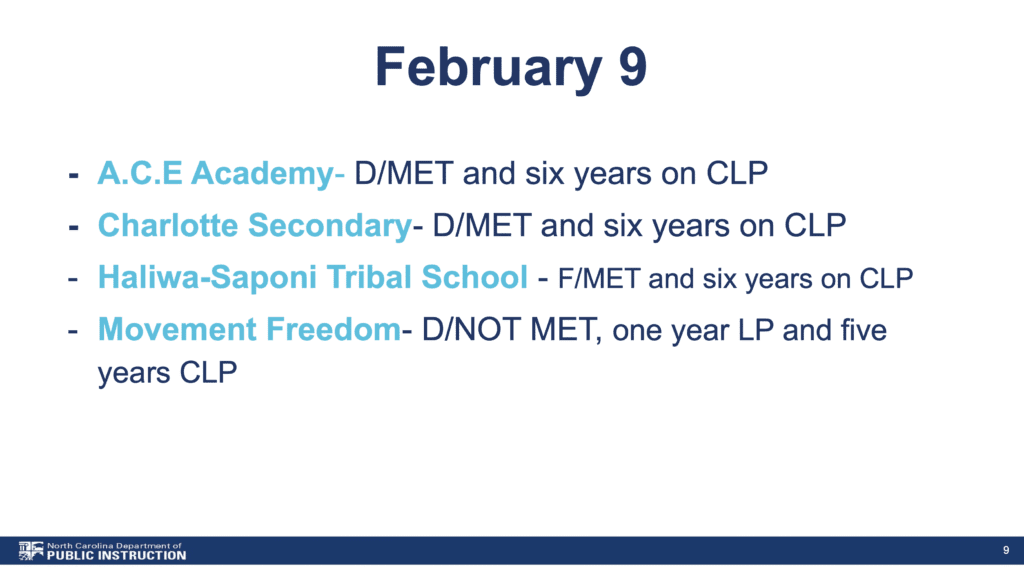
In her update, Laila Minott, the executive director of A.C.E. Academy, highlighted increased proficiency and noted that the school met academic growth in 2024 and 2025.
The head of school at Charlotte Secondary School, JoHannah Miller, shared academic trends in her presentation, along with successes and challenges. As an improvement strategy, Charlotte Secondary has extended the school day with a morning “power hour” for interventions, she said.
School leaders from Haliwa-Saponi Tribal School outlined their goals and referenced substantial restructuring. Data from their presentation revealed rising but still extremely low proficiency rates.
Asia Parks, the executive principal at Movement School Freedom Elementary, said math and English Language Arts proficiency data lag behind the district, but the school is “moving urgently” to change results, with new leadership and other changes.
Finally, Logue shared a director’s update, noting that Cape View Leadership Academy — which appealed the CSRB denial of its charter application to the State Board of Education (SBE) — would come back before the CSRB in March.
On Feb. 5, the State Board of Education voted to remand the matter back to the CSRB for the “limited purpose” of allowing ACCEL, the EMO, to present and answer questions about the application.
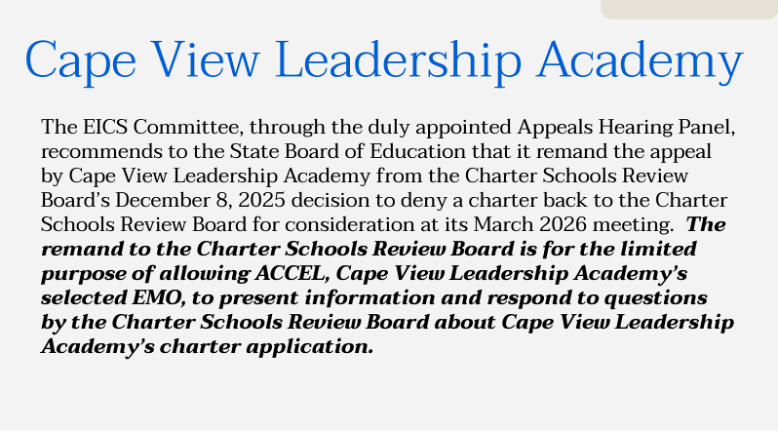
The CSRB meets next March 9-10.
Editor’s note: EdNC has retained Kristen Blair to cover the monthly meetings of the Charter Schools Review Board. Kristen currently serves as the communications director for the North Carolina Coalition for Charter Schools. She has written for EdNC since 2015, and EdNC retains editorial control of the content.

Recommended reading