
Governor’s advisory council discusses Youth Risk Behavior Survey ahead of final policy recommendations

Editor’s note: This article mentions suicide and mental health. If you or someone you know is experiencing a mental health crisis, call or text 988 or chat with the 988 Suicide & Crisis Lifeline at 988lifeline.org.
Gov. Josh Stein’s Advisory Council for Student Safety and Well-being met on Sept. 28 to hear updates on 2025 Youth Risk Behavior Survey data and continue discussion on statewide recommendations to improve student well-being, safety, and physical health.
This was the council’s first meeting after North Carolina Attorney General Jeff Jackson’s office announced in August that the state would receive at least $451 million in settlement funds from social media company Meta.
The lawsuit alleged that Meta, which owns Instagram and Facebook, had knowingly caused harm to young people through its apps’ features. Stein said that the recovery settlement will be used to expand mental health support for children across the state.
North Carolina legislators will ultimately decide on how to disperse the settlement funds.
In response to the settlement news, the council announced that it will now release its final recommendations in January 2027. The council had previously planned to do so in March 2027.
“This gives us the best chance for our recommendations to actually get implemented in the upcoming legislative session,” said council co-chair William “Billy” Lassiter of the updated timeline.
 Sign up for the EdDaily to start each weekday with the top education news.
Highlights from the 2025 Youth Risk Behavior Survey
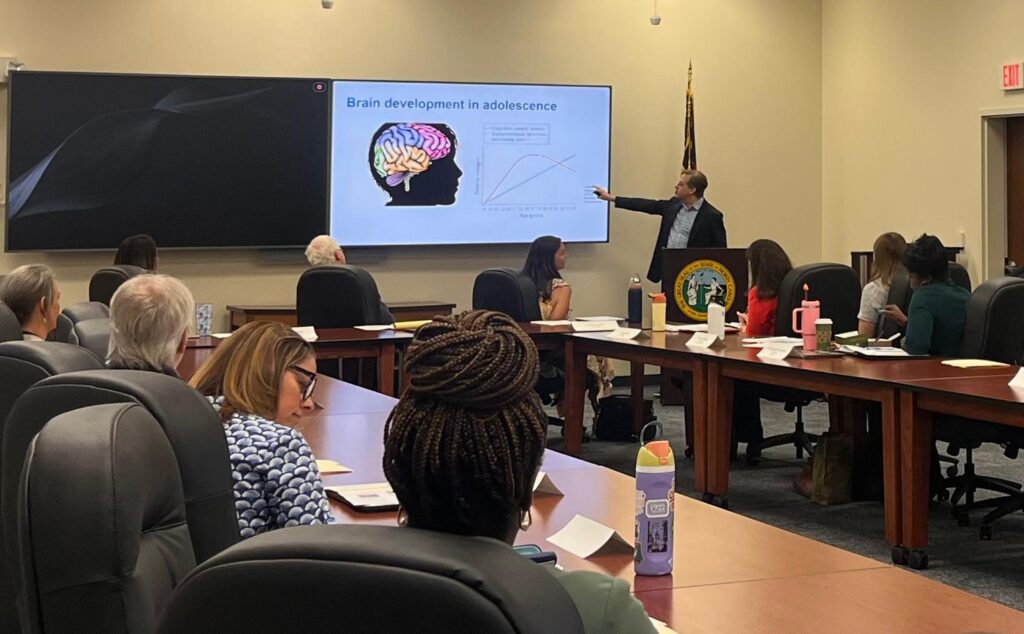
The council received a presentation from NC Healthy Schools Section Chief Dr. Ellen Essick on highlights from the 2025 Youth Risk Behavior Survey.
Survey topics included mental health, physical activity, substance use, safety, violence, nutrition, and social behaviors.
Essick, who is also a member of the advisory council, said the survey is the only of its kind in North Carolina that relies entirely on student voice. She also said the data is a representative sample of the state’s high school population and provides reliable data.
“Students don’t lie,” said Essick. “Students want to tell us about their health behaviors.”
She noted that the presented data only included high school student responses. Middle school data will be available in the coming weeks.
Essick’s presentation showed improvement in students’ substance use behaviors, including 20-year lows in alcohol and drug use.
The survey also showed a decrease in the percent of students who reported carrying a weapon at school (1.1% in 2025) and who were in a physical fight (16.4% in 2025).
Roughly 10% of surveyed high school students said they missed school in the past year because they felt unsafe on the way to, from, or at school. That measure is down from 14.6% in 2023.
About 59% of high school students reported feeling like they belong at school, nearly 64% felt like they had an adult at school who they could talk to, 51% felt their teachers cared for them, and 61.2% of students felt close to people at school. All of these factors have improved in the last four years.
“Those are all things that are getting better, but we still have some work to do, especially around mental health,” said Essick.
Essick said the survey’s mental health results are generally back to pre-COVID-19 pandemic levels. The decrease in the percent of high schoolers who feel sad or helpless between 2021 and 2025, she said, reflects the work accomplished statewide to support young people’s well-being in the wake of the pandemic.
“I hope you don’t lose that momentum for that mental health work, because 29%, almost 30% of our students having signs and symptoms of depression is still a lot of students,” she said.
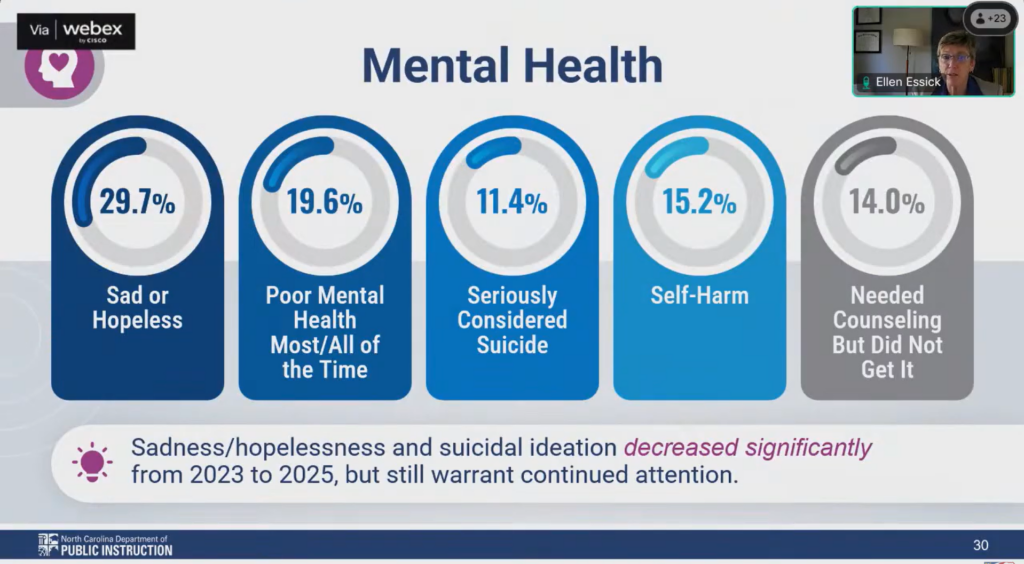
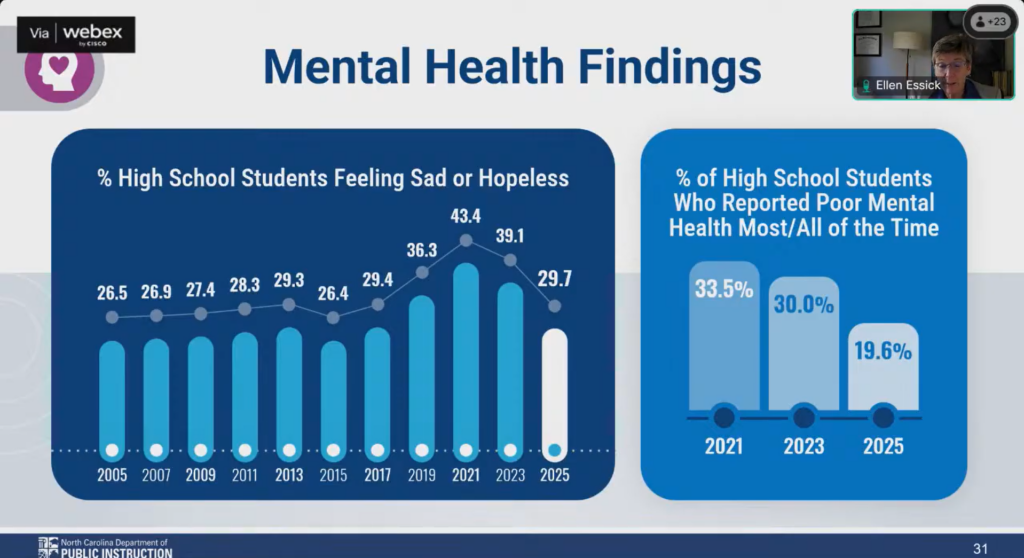
The percentage of students who said they seriously considered attempting suicide is 11.4%, a 20-year low. Essick said she believes this decrease in the number of students experiencing a mental health crisis is evidence of the important role schools play in providing preventative support.
You can read EdNC’s full coverage of the 2025 survey data here.
Student well-being subcommittee discusses cellphones and NC’s school health personnel shortage
One of the draft recommendations from the council’s subcommittee on student well-being is to amend the state’s cellphone-free classroom policy to restrict students’ access from the beginning of the school day to the end (sometimes referred to as “bell-to-bell” bans) rather than just during instructional time.
Subcommittee members said a more explicitly strict version of this policy might limit some of the variation in students’ experience. The council heard from five high school students and recent graduates in August who said their schools have implemented the policy with varying degrees of success.
Members also suggested recommending additional support and guidance on the policy for schools and teachers.
“It didn’t sound like it was a policy difference, it sounded more like it was a practice difference,” said Wilkesboro Elementary School principal Beckie Spears of the students’ August remarks.
The subcommittee also discussed a recommendation to require schools to adopt a digital learning policy that incorporates the guidance set out by the North Carolina Department of Public Instruction’s guidance for purposeful screen use in schools.
Read more about cellphones and schools


The subcommittee also discussed a recommendation to launch a statewide chronic absenteeism campaign and ensure schools have access to AttendNC.
Annie Goldberg, a school counselor for Alamance-Burlington Schools, added that increasing funding for social workers, the school health personnel who monitor students’ attendance patterns, is an important part of addressing chronic absenteeism.
“If you have one social worker serving seven schools, chronic absenteeism will be a problem because they can’t effectively serve their schools,” she said.
Meeting national standards for school health personnel is another of the council’s draft recommendations and has been an ongoing part of the council’s discussions over the past year.
Without sufficient state funding, school districts struggle to create additional school health personnel positions. High case loads and noncompetitive pay make it difficult for schools to fill these positions.
The draft recommendation would establish a goal of “fully funding the national school health personnel staffing recommendations by 2037.”
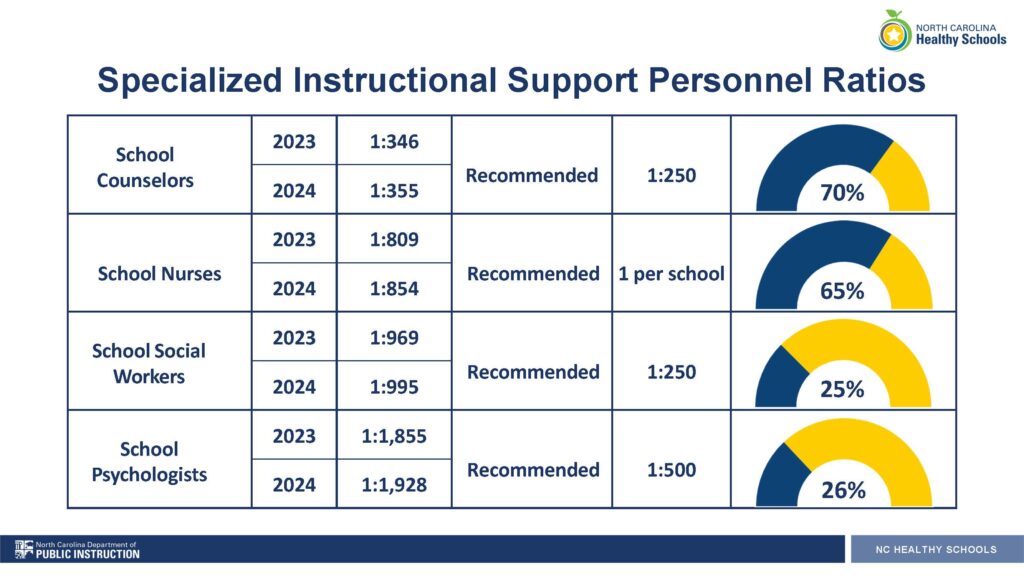
Subcommittee member and school psychologist Mary Katherine Stiles said that sign-on and retention bonuses have helped Cumberland County Schools attract eight school psychology interns, additions that she says have “tremendously helped” meet the schools’ needs.
Goldberg added that state support shouldn’t stop at incentives to recruit school health professionals.
“We need them to stay in the field, too,” she said.
Essick said she believes if a school district received enough funding to fully staff school health personnel positions, the outcomes would speak for themselves.
“It’s hard to say what would happen, but it’d be great to show what does happen when you have the people in place that you need to have,” she said.
Subcommittee members discussed the fact that school health personnel shortages are also a workforce pipeline problem, noting that even if the state were to fund school health personnel positions to meet national recommendations, the state currently does have enough people to fill the positions.
Direct grants or tuition remissions that go directly to students might be an effective incentive to grow the number of students training for these professions, said Paul Smokowski, executive director of the North Carolina Youth Violence Prevention Center.
The subcommittee also discussed the potential to strengthen the workforce pipeline by educating middle and high school students about behavioral health professions. As an example, Goldberg highlighted Kentucky’s CLIMB 2.0 program, which allows high school students to earn certifications that then enable them to work in the behavioral health field after graduation.
Smokowski suggested nonmaster’s degree professionals, such as qualified professionals or certified peer support specialists, are other potential avenues for for schools to support students’ mental health.
“These are other ways that the school district could enhance mental health professionals,” said Smokowski. “I think that there might be a place for those who have a beginning in the profession, but aren’t at the master’s level.”
The subcommittee also briefly discussed recommendations to expand the number of counties with school-based telebehavioral health services.
The advisory council will meet again on Nov. 16 to finalize their recommendations.
Meetings are open to the public, and you can use this form to submit public comments.