
What are NC schools doing to combat chronic absenteeism?


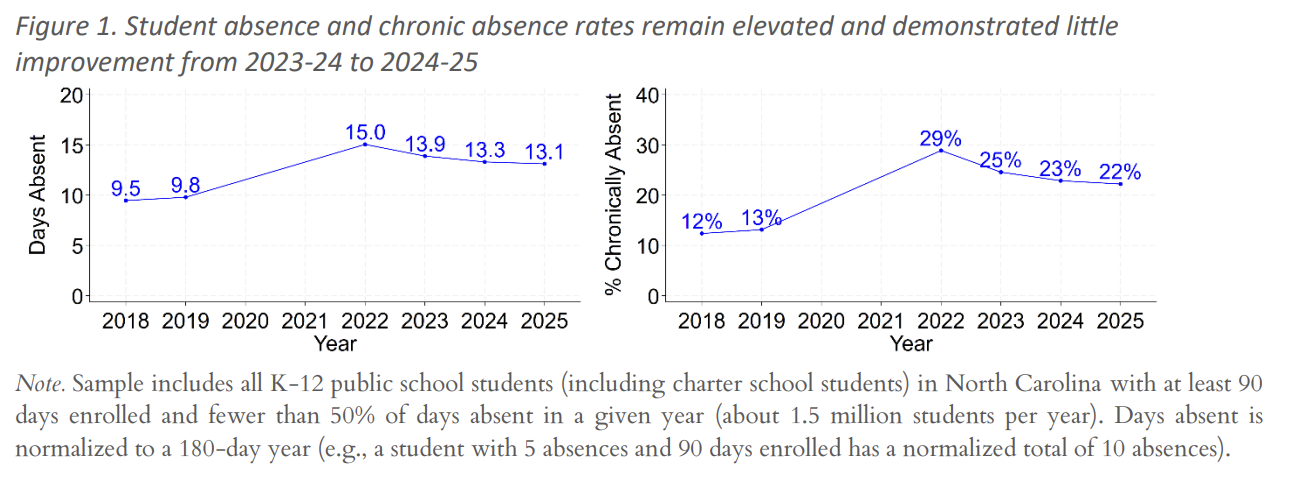
The COVID-19 pandemic exacerbated the problem of chronic absenteeism for many North Carolina schools. The Education Policy Initiative at Carolina (EPIC) released a March report showing that while chronic absence rates have decreased since they peaked during the 2021-2022 school year, chronic absenteeism is still high, and the rate of improvement is slowing.
In North Carolina, chronic absenteeism is defined as missing 10% or more days of school — including both excused and unexcused absences. Currently, rates of chronic absenteeism have not returned to pre-pandemic norms, as described in the EPIC report. The average North Carolina student missed 13.1 days of instruction in the 2024-2025 school year, compared to an average of 9.8 days pre-pandemic.
According to state data, chronic absenteeism peaked in the state during the pandemic at 31% and was around 24% in the 2024-25 school year. According to the report from EPIC, in 2025 “many educators felt current attendance practices did not meet the needs of students facing the most severe attendance barriers.”
Nonprofit Attendance Works put forward a national challenge to reduce chronic absenteeism by 50% by 2030, and in North Carolina, the Department of Public Instruction (DPI) took up that goal by launching the statewide initiative, AttendNC Counts.
“That’s about 380,000 students in North Carolina that have missed roughly a month or more of school. So it’s a lot of kids that are missing school,” Dr. Shaun Kellogg, senior director of the DPI Office of Research and Promising Practices, told EdNC. “We’re kind of plateauing. So (DPI has) been working over this past year to identify ways that we might help schools better reduce chronic absenteeism in their own context.”
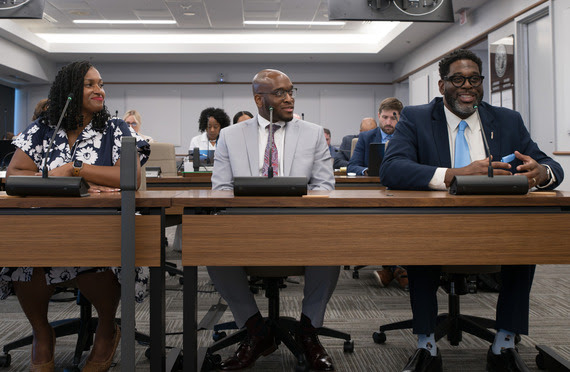
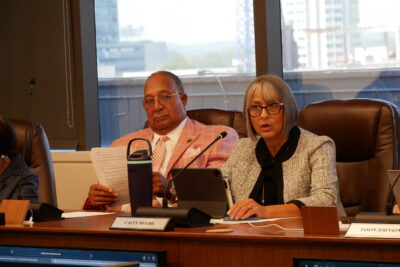
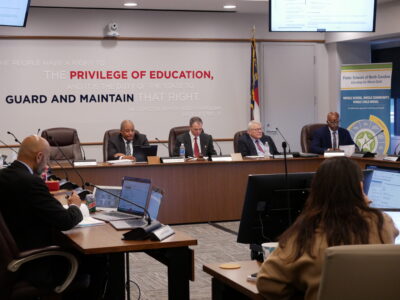
At the State Board of Education’s September meeting, the Board heard from three principals of Bright Spot schools, which are schools identified by DPI as having reduced chronic absenteeism significantly in the last few years.
Overall, DPI researchers identified about 300 Bright Spot schools statewide. Seven of those schools, in northeastern North Carolina, were interviewed by DPI to develop an understanding of effective strategies in practice currently.
According to previous reporting by EdNC, the principals told the Board about the importance of strong relationships, flexibility, creative attendance incentives, and working to understand individual student situations.
Elenia Riddick, principal of Hertford County Middle School, described how her school has utilized daily check-ins for chronically absent students and students trending toward being chronically absent, which has encouraged students to be at school.
“We have to create the environment for them where they want to come, feel connected, and they have their voice when they come in the building,” said Riddick. “And they’re excited to come to school when they know that someone is there looking for them.”
Washington County High School Principal Torrey Hines said his school believes in “leading with love” when it comes to encouraging attendance, making sure that they directly check-in with students and parents when a student is absent.
The principals also emphasized the importance of relationships — both for incentivizing attendance and responding to situations of chronic absenteeism.
For example, Northwest Elementary School Principal Taimak Willis said that when he has relationships with students, he’s “able to respond with love and care and try to figure out the next steps to keep them at school consistently.”
Overall, each school took a different approach to ensuring their students and families understood that attendance was a priority.
“There’s really no single attendance intervention represented here or at the seven schools,” said Kellogg at the meeting. “Each school’s been responding uniquely to their unique circumstances.”
Explore more on attendance


What’s worked for other schools?
EdNC spoke with two principals at Bright Spot schools about clear communication, engaging both parents and students, using positive reinforcements, and more. Below, find major takeaways on how their schools are working to mitigate chronic absenteeism.
Attendance as a team sport: Inside ECU Community School
According to a report by DPI, ECU Community School, a laboratory elementary school that operates through East Carolina University in Greenville, saw a decline in their chronic absenteeism rate from approximately 39.5% in 2021-22 to 14.8% in 2024-25, a reduction of nearly 25 percentage points.
“We are an environment of love and support,” Dr. Tracy L. Cole, the executive director of ECU Community School, told EdNC.
Cole described how, in an elementary school, connecting with families early on is crucial to approaching each child’s education like a team sport.
Before students even arrive on campus, Cole requires that teachers reach out to their guardians to introduce themselves, establish a relationship, and outline expectations for the child and guardian early on. She emphasized the importance of a positive first interaction between teachers and parents.
“It is a lot asking for staff members,” said Cole. “But what they found is when they build these relationships with families early on, that when we do come across some hard conversations, it makes it easier to approach the family.”
At the community school, the attendance team is primarily made up of three staff members — Cole, the school social worker, and the data manager. According to Cole, the team meets weekly to discuss which students were absent and why.
These meetings are especially crucial to their model because families may gravitate more toward one leader more than the others, which helps the school address barriers to a child’s attendance one-on-one. Speaking all together allows the team to make sure nothing and no one falls through the cracks.
Cole said the hardest barriers to attendance to address are when a family prioritizes other things over school.
However, when issues with transportation, morning routines, or even food access arises, the school works to help families address it. From coordinating carpools, encouraging parents to place backpacks by the door the night before, or connecting them with local food pantries, the team works to help families be ready to come to school each morning.
Read more
ECU Community School leaders also incentivize students to want to show up. Below are a few strategies used by the school to reward students for their attendance:
- Every day, the number of students who were on time and the homerooms with perfect attendance are announced.
- Every Friday, the homeroom with the strongest attendance receives the Pirate Homeroom Attendance Award, which is displayed outside their door.
- Students who were present and on time all week are entered into a prize drawing, and each Friday, a few students win small prizes.
- At the end of each quarter, students with perfect or near-perfect attendance are recognized at a school ceremony.
“The children love to hear their class names announced at the end of the day,” said Cole. “And if somebody happens to be out, I can guarantee, I’ve heard it for myself, they will say, ‘Were you sick? Why were you out?'”
At the quarterly ceremonies, parents are also recognized if their child has perfect attendance with a certificate and a photo. Cole said this gets parents excited, too.
Cole also emphasized the importance of having strong, dedicated staff who makes attendance a priority. The biggest piece of advice she had for other schools, she said, was to remember that “relationships matter.”
“To replicate what we’re doing is to build those strong relationships with your families and build those strong relationships with your team,” said Cole. “This is not a one-person effort. It takes a group of people having conversations, thinking outside the box to figure out how to meet children and families at their need so as to encourage student attendance.”
Boots-on-the ground attendance solutions at Farmville Middle School
Jeremiah Miller served at the principal of Farmville Middle School in Farmville for seven years. He recently became principal of Ayden Middle School, also in Pitt County, but he led Farmville during the period when they were recognized as a Bright Spot school.
“Attendance was crucial,” said Miller. “We realized, with my attendance committee, quickly when we were analyzing our attendance data that we needed kids to be at school. We needed to make sure they were consistently in school, so we really started digging into questions as a team — (like) why are certain students not coming to school consistently?”
Farmville’s standing attendance team began to examine the “why” behind absences. Miller said that without addressing the root cause of an issue, the cycle of absenteeism would continue.
They started with calling a child’s guardian, trying to get a better understanding of their situation. However, when those methods failed — maybe because the parent was unable to take phone calls during the school day due to their work schedule — the team had to get more creative.
“So there were times where the social worker and myself, we would come before school. We come after school. Maybe we would find out when mom’s shift was over,” said Miller.
If they couldn’t reach a parent, Miller and the school social worker would do a home visit or arrange a home meeting, using a “boots-on-the-ground” approach to meet families where they were at.
He emphasized the importance of “opening a line of communication” with families so that guardians can “be a part of the team” that helps with their student’s success. Once they were able to gather the student and their parent, they could outline the next steps for address the child’s absenteeism — both the incentives the child would receive for coming to school and the consequences that a continued pattern of absenteeism would bring.
Miller also wanted the community their school serves to understand the importance of being physically present at school. After the pandemic, and with the introduction of remote learning, many families began to view school has something that could be easily made up.
“We really needed to be at school, face to face. Being at school, there’s just no other — you cannot compete with it,” said Miller. “That interaction face-to-face at school is going to be the best education.”
Miller also spoke about the effect the pandemic had on student mental health, saying the school has resources to help with anxiety or other ailments. But students can only benefit from those resources if they are present.
More on youth well-being
To incentivize students to come to school, the staff at Miller’s school issued a survey to see what rewards would be particularly exciting to them. Some students were most incentivized through Takis or candy, which were an easy, low-cost way that the school could reward them for being present. But others simply wanted to spend time with a school staff member.
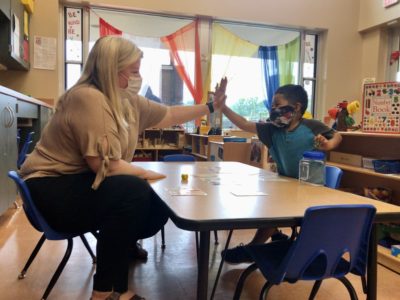
For each student identified as “high-risk” of being chronically absent, the attendance team assigned them an accountability partner, who is a member of the staff that checks in with them every single day.
“I would connect them with an adult, like I would figure out who they who they mesh with on campus,” said Miller. “It could be a custodian, could be a bus driver, it could be one of my teachers, it could be a teacher assistant. … A lot of times, they just wanted to spend time with them talking.”
The school also held raffles, when fundraising made it possible, to reward students for their attendance with bigger ticket items like AirPods.
Miller said that funds for prizes like that were are always available, but he said it was important to keep thinking of ways to encourage students despite budgetary restraints.
“We’re in education, so we always think outside the box,” said Miller. “We often get as creative with the limited amount of resources that we have, and then — just being grateful and really celebrating students when they have those small victories because it’s all about creating that momentum.”
One of the largest barriers to attendance that Miller noticed in the last several years is students avoiding school due to interpersonal drama that occurred on social media. To combat this, the school began having conversations with students about online behaviors and even hosted a parent night where they discussed how to communicate with your children about appropriate online communication.
“So we wanted to give those tools to our students, but then also keep our parents aware because our parents are trying to do the very best they can,” Miller said.
Improving their attendance rates wasn’t easy, according to Miller. But he said that his team really committed to the problem, and he is also thankful for the support from the community that the school received regarding attendance.
Finally, Miller emphasized the importance of “assuming positive intent.”
“Assume that mom and the parents, the guardians, are doing the very best that they can, and they are sending their best to school,” said Miller. “Every day, you assume a positive intent when you interact with the families and you’re addressing issues. Bring them on the team. This job gets much easier if we can all lift the weight together.”
To learn more about the state’s AttendNC Counts initiative, you can explore their landing page here, which has resources for parents, teachers, schools, and districts. You can read more about the work being done in Bright Spot schools here.