
Governor’s advisory council hears from students on NC’s cellphone-free classroom policy

Last year, North Carolina lawmakers passed a bill that required school districts to develop policies prohibiting students from “using, displaying, or having a wireless communication device turned on during instructional time.”
Gov. Josh Stein signed House Bill 959 into law on July 1, 2025, and the law took effect on Jan. 1, 2026. The Governor’s Advisory Council for Student Safety and Well-Being reported in December that every North Carolina school district had a plan in place for cellphone-free classrooms.
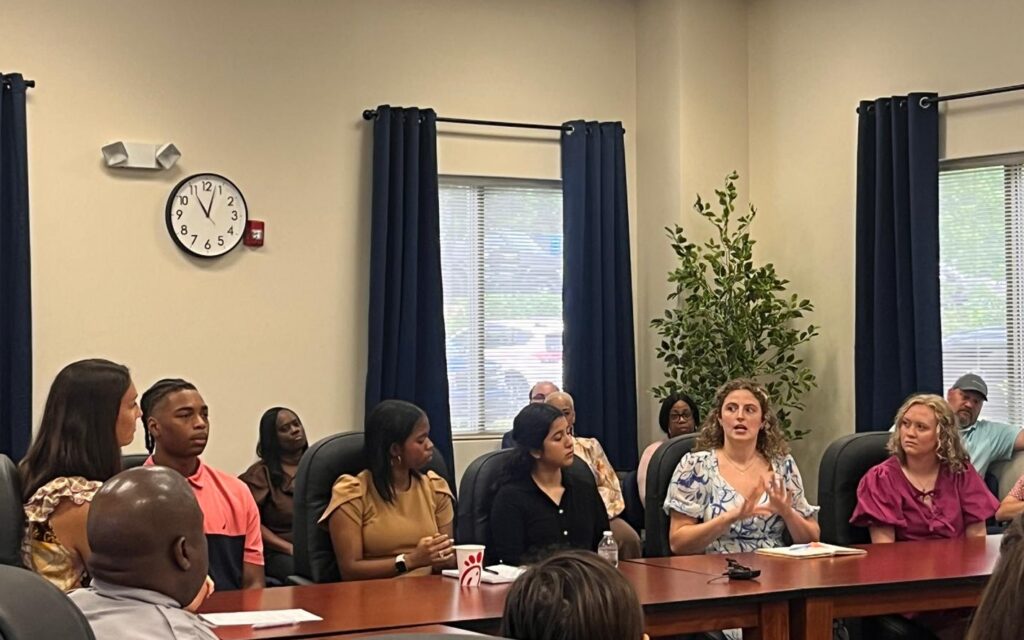
As students begin a new school year under the policy, a panel of five high school students shared their initial experiences with the rules their own schools put into place at the council’s Aug. 3 meeting.
Students told council members that, while individual schools have implemented and enforced the policy differently, they have each felt benefits from cellphone-free classrooms, such as socializing more with their classmates and being more productive at school.
“It feels like we are cared for,” said Edie Zeldin, a recent graduate from Laney High School in New Hanover County Schools.
High schoolers describe the policy in the field
At Edgecombe Early College High School in Tarboro, Jasmin Aparicio-Tobar said her principal implemented a policy limiting cellphones a year before the state requirement began. Aparicio-Tobar said that at her school, most students adhered to only using their cellphones between classes, during lunch, and before or after school.
Zeldin described a different scene at Laney High. There, she said, whether or not students had their phones out during instruction varied by classroom.
“It’s implemented in very different ways,” Zeldin said, adding that phones were typically stored in backpacks, designated cubbies, or not at all.
At Carver High School in Winston-Salem/Forsyth County Schools, senior Steven Beasley said cellphones must be facedown on students’ desk or stored away in backpacks. Ettalen Laws, who just graduated from Mitchell High in Mitchell County Schools, said teachers used a calculator caddy to store phones, but other factors such as whether or not the phone had to be turned off varied by classroom. Jala Fontenette said her school, Pine Forest High in Cumberland County Schools, uses a similar system, but with lockboxes in lieu of caddies.
Students’ experiences differ by classroom and school, reflecting the varying degrees to which school districts have implemented the policy. According to NC Local’s analysis of all 115 school district’s cellphone policies, most policies comply with the law’s minimum requirements, allowing cellphones to be used outside of instructional time, while 13 school districts implemented policies that ban phones during the entire school day, also called “bell-to-bell” policies.
 Sign up for the EdWeekly, a Friday roundup of the most important education news of the week.
While the requirements outlined in the law mean implementation varies by district, Mitch Prinstein, co-director of the Winston Center on Technology and Brain Development, said the fact that the rules students experience in class come from state law also means that teachers don’t have to necessarily bear sole responsibility for enforcing them.
“When there’s a top-down regulation, teachers don’t have to be the mean ones making policy just for their own classrooms,” said Prinstein, who gave a presentation at the August council meeting.
At the council’s November 2025 meeting, Lindley Andrew, a teacher at George Moses Horton Middle School, said the fact that she could rely on her principal to enforce the district’s policy if a student refused to magnetically seal their phone in a Yondr pouch made enforcing cellphone free classrooms “not even a battle.”
The top-down nature of the law also makes it important for schools to communicate the intention behind cellphone-free classrooms.
Students on the panel said that hearing the reason state leaders approved the policy — to support students’ well-being and learning — played a part in their willingness to follow the rule.
Aparicio-Tobar said her principal gathered students together to share research behind technology’s impact on student achievement and development and the benefits cellphone-free classrooms would have on their learning.
Hearing this research made it much easier to not use her phone during class.
“It made me feel like I was helping myself,” said Aparicio-Tobar.
Read more about NC’s cellphone policy


The science behind screen use and brain development
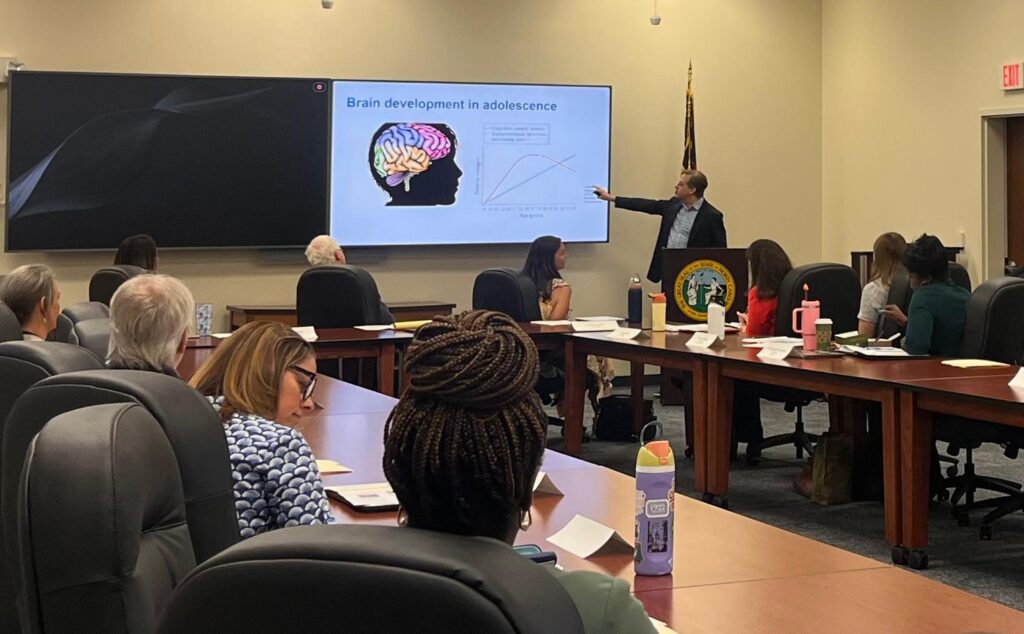
During a presentation to the council, Prinstein explained that the introduction of social media and mobile devices has created an “environmental and developmental mismatch” for young people.
The stage of brain development that adolescents are in during middle and high school, he said, makes them both hypersensitive to social signals from their peers and unable to fully control cognitive impulses as their pre-frontal cortex matures.
Paired with constant access to social media and the internet, “kids feel like they are constantly getting beeps and buzzes telling them: People are wanting you to respond, to notice, to comment, to be available to them at all points in time,” said Prinstein. “And that’s a lot.”
According to Prinstein’s presentation, a study of 680 students between 14 and 15 years old found that about 45% of students report experiencing digital stress that interferes with their daily routines, including sleep, physical movement, and relationships. A survey examining the state’s cellphone policy conducted by researchers at the Winston Center found that the students reported being more likely to use their cellphones when they felt bored, uncomfortable, or lonely.
Beasley said his school’s cellphone policy has helped students become more sociable with their classmates and teachers. Fontenette added that she thinks their classmates are more engaged and productive during class.
In response to how the cellphone policy could be improved, Zeldin and Fontenette suggested that schools could try to replace the social connection and engagement that students feel they lose when they don’t have their phones. Some of the ideas they suggested were to bring peer-to-peer debates, project-based learning, or outdoor activities into the school day.
“I think that there’s still this balance of understanding that we’ve got to have a little more consistency across the board, but it does seem that some expectations were set,” said Heather Smith, council co-chair and teacher at Haywood County Schools, in response to students’ reflections on the new policy.
At the end of August’s meeting, the council broke into subcommittees to discuss final recommendations that will appear in a March 2027 report.
Draft recommendations, introduced at May’s council meeting, aim to address challenges around student safety, well-being, and physical health.
Meetings are open to the public, and the council’s next meeting will be held virtually on Sept. 28. You can use this form to submit public comments.