
Governor’s advisory council hears updates on proposed budget, disciplinary data to inform recommendations on student safety and well-being

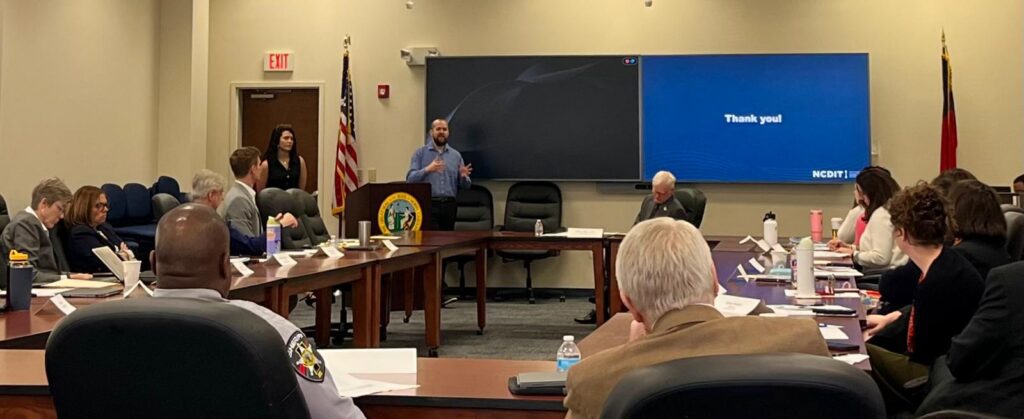
The Governor’s Advisory Council for Student Safety and Well-being met virtually on May 18 to hear highlights from Gov. Josh Stein’s proposed budget and data trends from the 2024-25 discipline in schools report.
Council members also discussed draft policy recommendations on student safety, well-being, and physical health. The council’s final recommendations to the governor are due in March 2027.
 Sign up for the EdWeekly, a Friday roundup of the most important education news of the week.
Highlights on student safety and well-being from the governor’s budget proposal
Amber Harris, deputy legislative director for the governor’s office, provided council members with highlights from Stein’s proposed budget that address student safety and well-being.
These highlights included:
- An 11% increase in average teacher pay and the restoration of master’s pay to support recruitment and retention. “Teachers are core to what happens in the school, and keeping them is critical to a successful education system, critical to student success in schools,” said Harris.
- $32.1 million in recurring funding that would fund 360 additional positions for school health personnel, including school psychologists, nurses, counselors, and social workers. In North Carolina, all four positions exceed national recommended ratios.
- $85.3 million in recurring funding to provide universal free school breakfast for students, plus an additional $5 million commitment in state funding to unlock federal funding for SUN Bucks, a USDA-sponsored summer nutrition program.
- An increase in the number of school resource officers (SROs) and required training in child development, behavioral health, and trauma-informed practices. The budget proposal would fund an SRO for every middle school. “We want to be sure that SROs that are entering schools have some knowledge, some understanding, about children’s mental health,” said Harris.
- $500,000 in nonrecurring funding for the Behavioral Threat Assessment Management System through the Center for Safer Schools (CFSS). The investment would bolster schools’ work to monitor threat assessments by funding a case management platform, according to Harris.
- $115 million in nonrecurring funding for the Public School Building Repair and Renovation Fund, and $20 million in nonrecurring funding for the School Safety Grant through CFSS. Harris said these funds are intended for public school units to use at their discretion in order to make their school buildings safer.
William Lassiter, council co-chair and deputy secretary of the Department of Public Safety, said last week’s announcement of a bipartisan budget framework revealed “the big things” that lawmakers have agreed on, including teacher pay and state employee salaries.
“There’s a lot of little details to still figure out,” Lassiter said.
Harris said the governor’s office is hoping to see some of Stein’s budget items appear in the legislature’s final budget.
Read more
DPI’s annual report on student behavior shows a decrease in crimes and suspensions
The council then heard from Dr. Rob Dietrich, the Department of Public Instruction’s (DPI) senior director of enterprise data and reporting, and Dr. Michael Maher, DPI’s chief accountability officer, for an update on the state’s 2024-25 annual report on discipline, alternative learning, and dropout.
The report, mandated by state law, collects data from public schools on discipline, alternative learning, and dropouts across the state.
You can read EdNC’s in-depth analysis of the state data here.
According to Maher, fewer than 1% of the state’s 1.5 million students have committed acts of violent crime. This means more than 99% of students were not involved in any violent or reportable offense during the school year, he said.
“When we look at these data together, it’s not a system in disorder,” said Maher. “It’s a picture of concentration, and it’s concentrated in specific grades, key transition years, and among students who are already facing multiple overlapping challenges.”
The data also show that severe violence is rare, with a statewide rate of 0.196 acts of violent crime per 1,000 students. Most schools, Maher said, report five or fewer acts of violent crimes, and the majority of reported acts are related to possession of a controlled substance.
According to the report, 62% of all acts reported included possession of a controlled substance, which Dietrich noted are defined by state law.
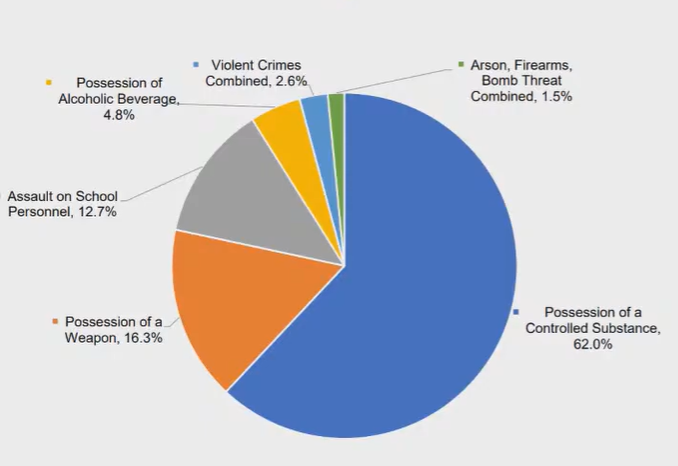
While every incident matters, Maher said, the most common incidents in schools are behavioral and substance related, not those that cause wide-spread physical harm.
“So any policy or procedure or programmatic recommendation that’s made should be proportional to that evidence,” he said.
The data also reveal consistent trends among student subgroups. Students in middle grades (sixth, seventh, and eighth) have higher rates of in-school, short, and long-term suspensions than most other grade levels.
Ninth grade remains a “primary risk point,” Maher said, where students have higher rates or numbers of suspension, dropouts, and acts of crime and violence.
Maher also noted that subgroup trends identify descriptive patterns, meaning that discipline is not a stand-alone issue but rather one that must be understood alongside attendance, academic support, and student services.
The data also show declining rates, many in double digits, over the last two years for many subgroups in suspensions, dropouts, and placements in alternative learning programs.
The presentation concluded with DPI’s recommendations based on the data:
- Establish a targeted middle-to-high school transition initiative.
- Expand annual reporting to include advanced analyses and continuous monitoring. This would allow the state to better collect data, improve reporting, and identify targeted interventions.
- Continue training school districts on discipline, alternative learning, and dropout data.
Draft recommendations on student safety, well-being, and physical health
The council’s small group sessions included discussion of draft policy recommendations to the governor.
The draft recommendations, which are still under review, have taken into consideration information presented to the council over the course of their last several meetings. That includes presentations in March on the appropriate use of artificial intelligence in schools and in September on challenges schools face in providing school-based health services.
Student safety recommendations include:
- Strengthen the threat assessment and school violence prevention infrastructure.
- Pilot a substance use and prevention response framework.
Student well-being recommendations include:
- Develop a statewide student well-being survey that could supplement the biennial Youth Risk Behavior Survey.
- Meet national standards for school health personnel ratios.
- Create a best practice guide for public school units around screen time for instructional use.
Student physical health recommendations include:
- Align school structures with student health needs, such as changing school start times to align with children’s sleep schedules and providing universal school breakfast.
- Strengthen K-12 health and physical education standards.
- Launch a chronic absenteeism awareness campaign at the statewide level.
The council’s next meeting will be held on Aug. 3, 2026 at the Juvenile Justice Center in Raleigh. Meetings are open to the public, and you can use this form to submit public comments.