
State Board’s accountability task force reaches consensus on indicators for new model
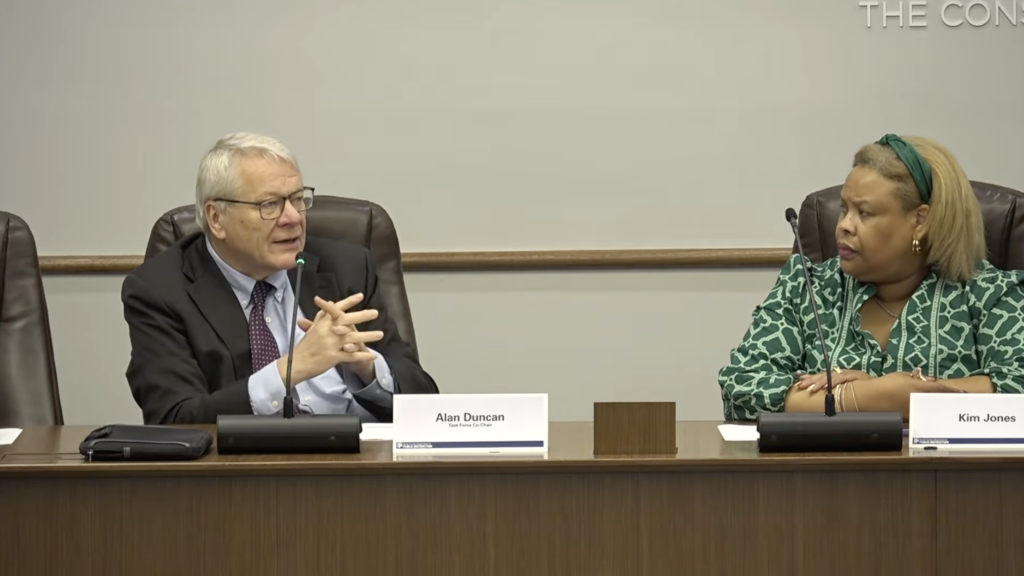
The State Board of Education’s Task Force on Accountability for Public School Units continued its work to redesign North Carolina’s school accountability system on Monday, Sept. 21, discussing the indicators that should be included in the proposal for a new model.
During the meeting, task force members discussed what to include under eight potential indicators: growth, achievement, postsecondary readiness, student engagement, school climate, nonacademic supports for students, English Learner progress, and cohort graduation rate.
The Center for Assessment, a nonprofit supporting districts and states through the design, implementation, and evaluation of school accountability systems, will now work on drafting an initial report based on the points of consensus task force members reached last week. The task force is currently set to review an initial report in December.
State Board of Education Vice-Chair Alan Duncan, cochair of the task force, said they have an “ambitious goal” to have the report done and to the full Board in January, in order to be ready for the long session. He noted the importance of the task force’s work, and said the state’s Blue Ribbon Commission on Public Education is also very interested in school accountability.
“We are delving much more deeply than they are able to because they’re delving deeply into several subject matter areas,” Duncan said. “It’s important we get our work done and provide our input and thoughts … to assist in their work.”
 Sign up for the EdWeekly, a Friday roundup of the most important education news of the week.
In North Carolina, under state law, schools are assigned letter grades based on student achievement scores (including standardized test grades), weighted 80%, and on students’ academic growth, weighted 20%. Education leaders have long said that formula does not capture the full picture of the work happening in the state’s public schools.
Over the last few years, and under the leadership of former state Superintendent Catherine Truitt, the Department of Public Instruction (DPI) advocated for state lawmakers to change how school performance grades are calculated to account for more factors than achievement and growth.
While lawmakers initially showed interest in DPI and Truitt’s plan, they never passed legislation changing the formula. Even before Truitt’s plan, lawmakers and the Board had discussed how to change the state’s school accountability model.
The creation of this task force in October 2025 reflects another attempt by DPI to reform school performance grades. The task force’s purpose is to design a new theory of action and design principles for the accountability system.
Since the task force’s last meeting on Aug. 20, DPI and the Board released and reviewed school performance grades for the 2025-26 school year, which showed progress among North Carolina students and schools. At the Board’s September meeting, Chair Eric Davis said “these results tell only part of the story about the education that our students are receiving and the performance of their schools.”
Davis said that is why the Board launched the task force, which he said “is hard at work developing a system that is less reliant on standardized tests and that will provide a more complete and accurate assessment of educating the whole child in every student.”
Below, find a quick summary of the task force’s work up to now, along with highlights from the discussion on eight potential indicators.
Read more
The work of the task force so far
The State Board of Education first proposed the task force to develop a new school-level accountability system last October. You can view all the task force participants here.
During the task force’s first meeting in February, the group discussed the new model’s theory of action, meant to define how the task force would move from the current system to a new proposal. You can read a summary of the first meeting from the Center for Assessment here.
At its second meeting in April, the group discussed a draft of its theory of action, “articulat(ing) a coherent set of priorities for what the accountability system should accomplish and how it should function.” The April meeting also included discussion of design principles and priorities for the working group, along with review of a framework from the National Academy of Science, Engineering, and Medicine outlining 16 possible indicators of school quality.
Ahead of the task force’s June meeting, a working group made up of DPI staff met twice to review the task force’s discussion and discuss indicators from the first cluster: achievement, growth, and extended graduation rate.
In June, the task force discussed those initial recommendations on the first cluster of proposed indicators. You can also review the executive summary and recommendations document task force members reviewed ahead of the meeting here.
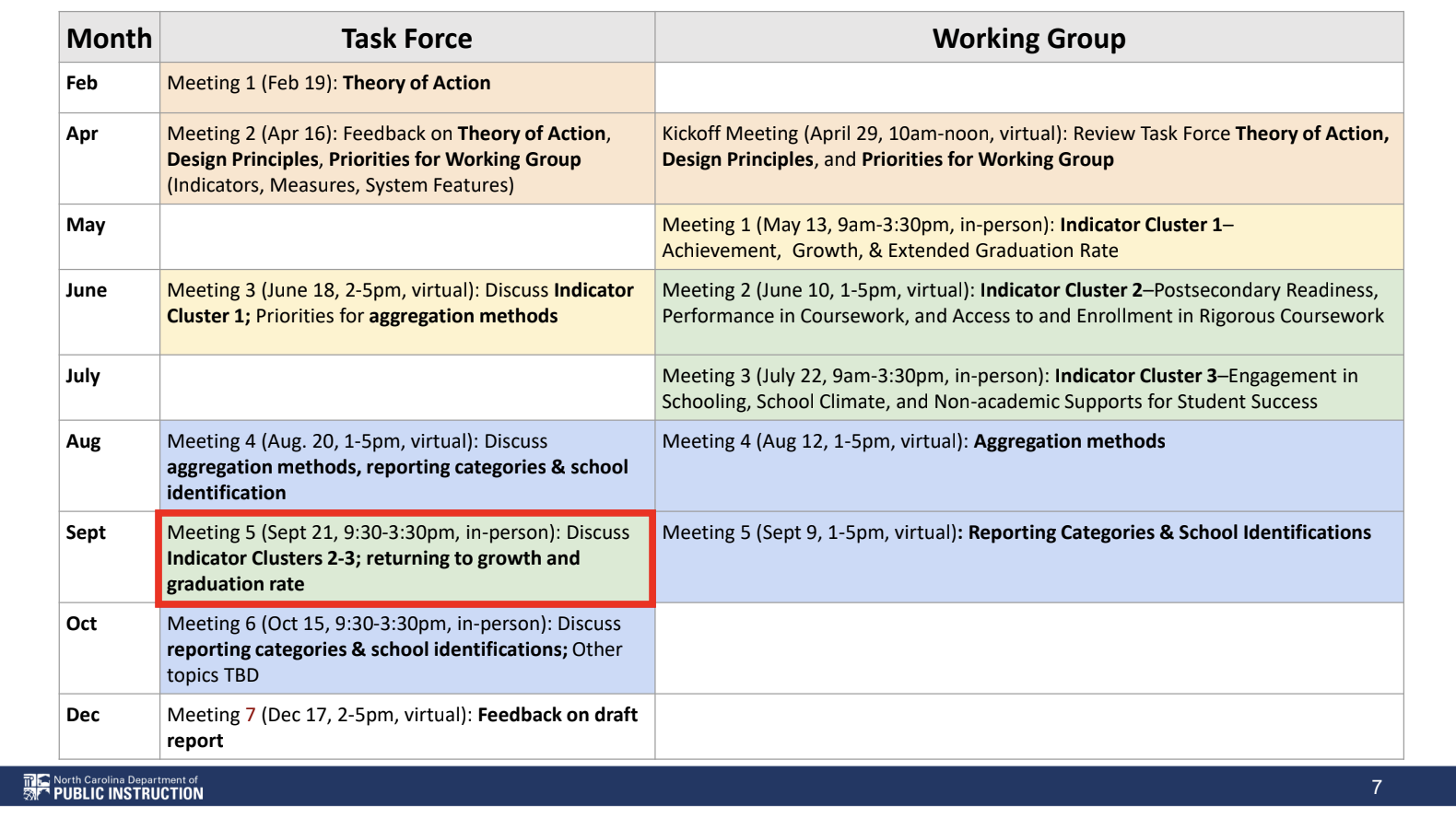
In August, the task force discussed how the state identifies and supports low-performing schools and districts. Members also discussed aggregation, “the process of combining indicator-level results into a single summative score or grade.”
“Meeting 4 raised broader questions, including how the accountability system and the state’s support for schools work together, and members spent more time surfacing those questions than settling them,” a summary document from the Center for Assessment says.
North Carolina currently uses a compensatory approach where all indicators are combined to produce a single score. That score is then used to assign a single letter grade (A-F) to the school.
In August, the group expressed concerns about the unintended consequences of the compensatory index, largely because it reduces schools to a single grade, which can have a negative effect on the school, district, teachers, and students. There was support among members for using a profile system, which would present multiple indicators of success. Some members, however, believed that would be confusing and that parents would have significant pushback.
“Using the letter grade as its currently calculated is fraught with peril, yet… it’s widely used,” said member John Hood, president of the John William Pope Foundation and board member of the John Locke Foundation. “I think taking away anything that’s relatively simple that parents might use as some sort of guide would be very unpopular.”
More on indicators
Last week’s meeting largely focused on reaching consensus around eight potential indicators, listed below. You can also review the executive summary and recommendations document task force members reviewed ahead of the meeting here.
Rupen Fofaria, director of Board operations and policy, said that task force members will review a draft report from the Center for Assessment before it is finalized.
Achievement
Currently, a school’s achievement score is largely based on standardized test scores, including end-of-grade and end-of-course assessments in reading, math, and science.
Ahead of the meeting, task force members requested the DPI working group explore additional assessments for inclusion in the academic achievement indicator, including: K-2 early literacy, additional science and history courses in grades 4-8, AI literacy, along with high school arts and music, civics exam, financial literacy, and other sciences.
The working group recommended not including additional K-2 assessments in a new model, and the task force agreed.
For high school, Fofaria said there “is emerging consensus on expanding the assessments and content areas included.”
Regarding reporting of the achievement indicator, the task force agreed on using an achievement index, which would assign points to each achievement level rather than only using the percent of students proficient, as is the case in the current model.
While the proposed new accountability system would use an index across scores, members said DPI should continue “to publicly report percent proficient for clarity and transparency.”
Growth
North Carolina currently uses a value-added growth model through their agreement with EVAAS (Education Value-Added Assessment System). The model essentially measures relative performance against a statewide prediction model, rather than year-over-year changes in proficiency.
In June, task force members presented a spectrum of opinions about the current EVAAS system, with some liking it and others not. Some members said the current model is helpful for individual teachers, but not as helpful for schools, who cannot replicate the data locally.
Currently, EVAAS is named in statute for calculating the overall growth score. Ahead of last week’s meeting, DPI began discussions of other growth models that the EVAAS team at the SAS Institute could provide.
John White, EVAAS vice president, shared with the task force about student growth models, most widely used across the country. He said SAS already collects the data for the state to adopt this model, which measures a student’s growth against students who performed similarly the year prior.
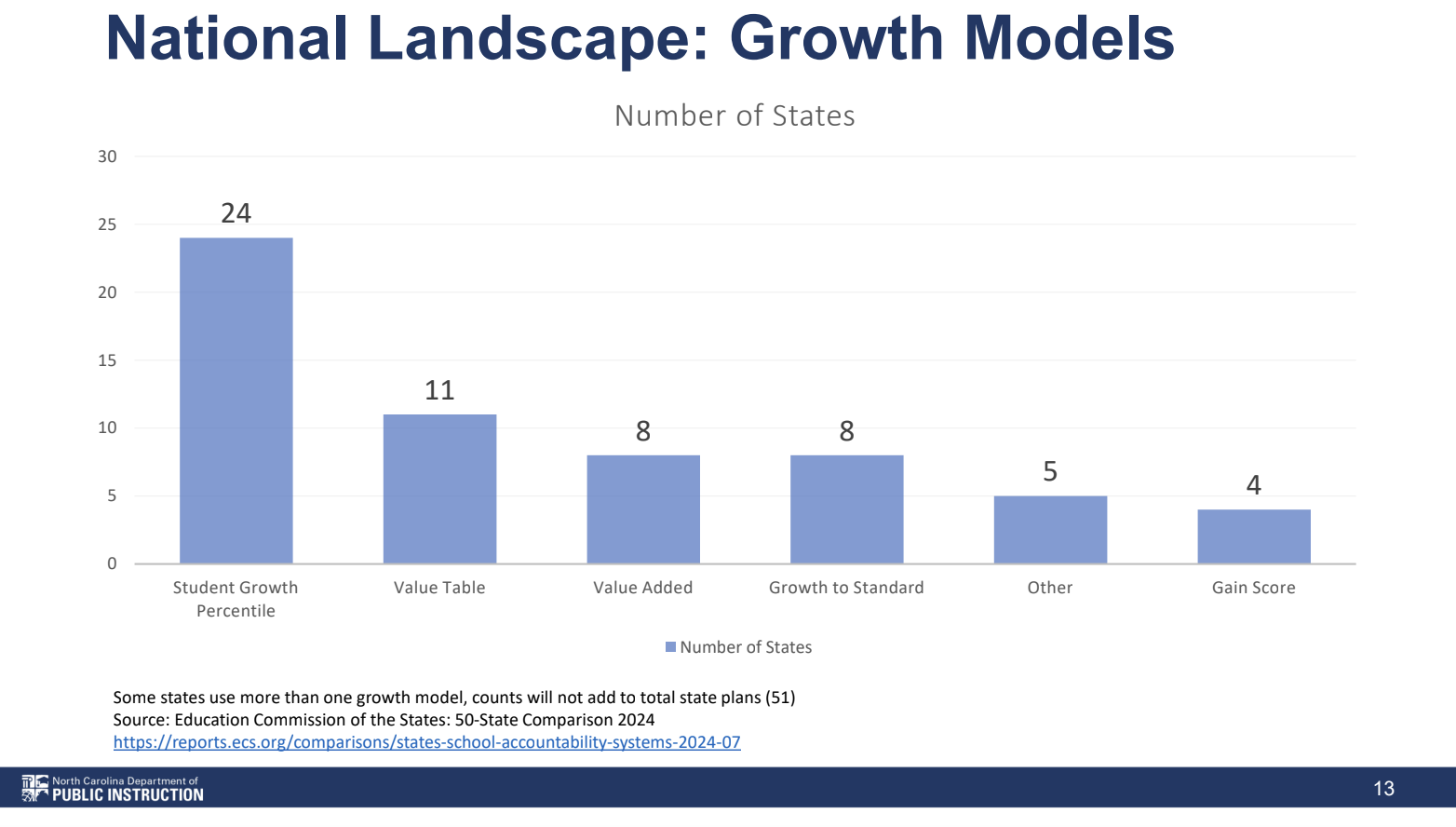
At the end of last week’s meeting, Fofaria said there was consensus in moving away from the statewide relative predictive model “toward a student-level projection approach that measures each student’s performance against a prediction based on that student’s own prior achievement.”
Members also agreed that the growth indicators should include as many assessments used for achievement as possible, and that growth should count for more than its current 20% in the school performance grade formula.
If the task force uses a compensatory aggregation approach for school performance grades, the DPI working group recommended using at least 50% for growth for elementary and middle schools, with less weight applied to growth for high schools.
The task force will formally address the relative weighting of growth and achievement during October’s aggregation discussion.
Postsecondary readiness
Postsecondary readiness currently consists of two measures: students passing the NC Math 3 course, and students scoring a composite 17-plus on the ACT.
At the second meeting, “a postsecondary readiness indicator was rated the highest priority of the Task Force when surveyed,” per DPI’s presentation.
Last week, the task force reached consensus that postsecondary readiness should be broadened beyond the current ACT WorkKeys measures, represented through multiple measures rather than a single indicator or index score.
Members favored a “menu-based” approach that would include college, career, and military/civic pathways, with an emphasis on externally validated outcomes rather than just participation.
“Members also suggested further consideration of apprenticeships, military enlistment, service learning, and whether on track to graduate should be measured later than ninth grade,” Fofaria said.
Cohort graduation rate
At earlier task force meetings, there was consensus that DPI should include both the four-year and five-year cohort graduation rate as part of the new accountability system.
Using an extended-year graduation rate may incentivize and reward schools and districts to keep students on a pathway to graduation and to earning a high school diploma, even if it takes an extra year, which could lead to better long-term life and future outcomes for North Carolina’s students.
Working group executive summary document
DPI recommended the four-year cohort graduation rate have more weight.
Last week, the task group agreed the new model should include both rates, with consensus around a 1.0 weight for the four-year graduation rate and 0.5 weight for the five-year graduation rate.
“Members noted that this would align with the index approach being considered for achievement, while emphasizing that the four-year graduation rate should continue to be reported publicly as a distinct measure,” Fofaria said.
English Learner progress
Currently, students are identified as English Learners (ELs) through a standard process. Once identified, students must test annually on the English language proficiency assessment, until meeting the English Language Proficiency Standard set by the State Board of Education.
Task force members expressed concern about the time and burden associated with administering the current test, the WIDA assessment, and interest in exploring alternative assessments.
According to DPI, “to be federally compliant, the accountability system must include an English learner progress indicator.” However, states have options regarding methodology, weight, and where to include the measure (as an achievement, growth, or stand-alone indicator).
Last week, the task force reached consensus on moving English language proficiency out of the achievement indicator, to potentially treat it as a stand-alone indicator. Some task members also expressed interest in exploring whether federal flexibility or a waiver could provide additional options.
Student engagement
According to DPI’s presentation, the task force “rated student engagement as a priority topic for the Working Group to explore.” The DPI working group explored two types of engagement: extracurricular activities and chronic absenteeism. Ultimately, the task force decided not to include either measure as a formal accountability measure.
Regarding extracurricular activities, there were concerns raised about data availability, consistent definitions, measurement, and unequal access to opportunities across schools and districts.
“Members nevertheless emphasized the value of extracurricular engagement and supported including information about these opportunities in the school performance profile,” Fofaria said.
While members agreed that attendance is an important issue that schools should monitor, members said “that absenteeism is not itself an outcome, may be redundant with outcomes already measured, and is influenced by factors and resource constraints outside schools’ control,” per Fofaria.
According to the DPI working group, 38 states currently include chronic absenteeism in their accountability systems.
School climate
The task force also agreed with the working group’s guidance not to include school climate surveys as a formal accountability indicator.
The DPI working group said that state law “may prohibit collecting surveys of this type from students,” and the “teacher working conditions survey is not an annual administration.” Additionally, the group said using the working conditions survey as part of a school climate measure may have unintended consequences on survey responses.
Task force members did support strengthening the collection and reporting of school climate data outside of the formal accountability model.
Nonacademic supports for student
The task force agreed that nonacademic supports — like social-emotional learning, counseling, and medical care — should not be included in the formal accountability model, but could be included in a school performance profile.
The DPI working group found that few states include nonacademic supports in accountability models, and that tracking the supports would require new data collections.
“Members strongly supported the importance of these services, but emphasized that unequal funding, access, and workforce availability would make it unfair to hold schools and districts accountable for supports they may not have the capacity to provide,” Fofaria said.
What’s next?
The task force is currently scheduled to meet two more times — on Oct. 15 to discuss aggregation methods, reporting categories, and school identification, and on Dec. 17 to review a draft summary report.
Curtis Sonneman, DPI’s accountability director, said the recommendations and report should reach the State Board in early 2027. If the plan receives necessary legislative approval, statewide implementation of the new model would begin sometime in fall 2027.
You can find all meeting resources on this DPI website, and all of EdNC’s reporting on school performance grades here.