
State Board approves updated educator salary schedules following new budget

The new state budget, which became law on July 7, included 8% average teacher raises, effective on July 1, 2026, the first day of the new fiscal year.
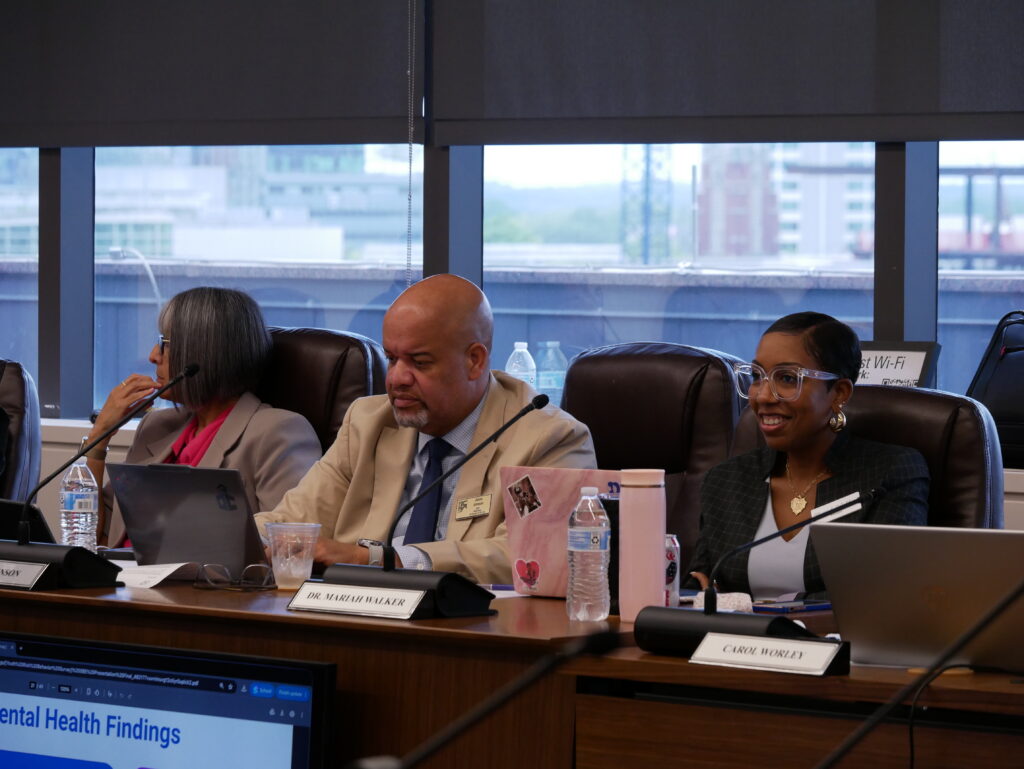
During the State Board of Education’s August meeting, members discussed the budget’s investment for teacher pay, voting to approve DPI’s updated public school personnel employee salary schedule, which now reflects pay increases from the budget. According to the Department of Public Instruction’s (DPI) Chief Financial Officer Alexis Schauss, DPI expects that “school districts will be able to implement the increases for the August payroll.”
The Board expressed gratitude for the budget’s salary increases, while also raising concerns about a few items within the budget, particularly the new principal pay structure, and the impact that salary increases have for districts and their locally paid education professionals.
“The budget enacted this summer includes meaningful investments, and we appreciate the legislators who supported educator pay increases,” said Board Chair Eric Davis. “Those raises will make a difference, particularly for many beginning teachers, but they do not fully address the challenges facing our educators.”
Most other school employees received an across-the-board 3% raise and a bonus based on their salary — $1,750 for employees making under $65,000 annually, or $1,000 for those making more.
You can view the updated salary schedules here, which includes updated salary schedules for teachers, instructional support, school counselors and psychologists, principals and assistant principals, and more.
More on NC teacher pay
Updates on teacher pay
The updated salary schedule reflects the changes to teacher pay made in the budget, with first-year teacher pay starting at $4,800 a month. DPI’s charts also include summaries of annual salary for each year of service, with first-year teachers being paid at $48,000 across their 10-month pay period.
The budget also included funding for bonuses for educators: $500 for teachers with 15 or fewer years of experience and $1,000 for those with 16 or more. Teachers can also qualify for various pay supplements, including local district supplements, which vary widely district to district. See the new base salary schedule below.
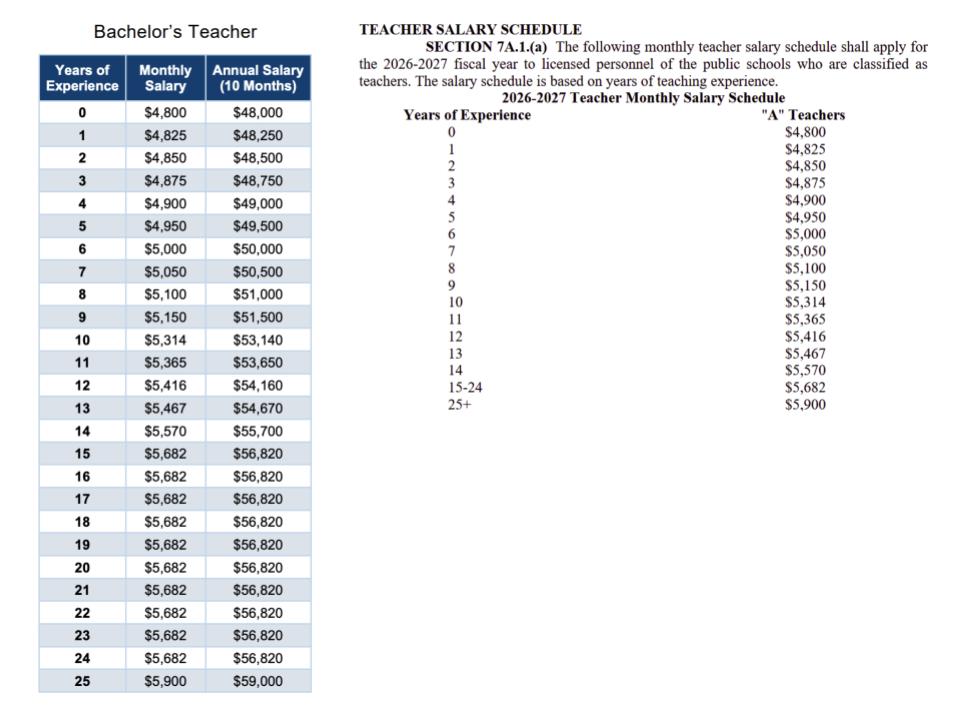
The state budget did not eliminate the pay plateau for teachers with between 15 and 24 years of service. During this period, teachers do not receive pay raises in base pay, which is now $56,820 annually, up from $53,880. Only once they reach 25 years of service does their salary increase to $59,000.
Teachers who get a certification from the National Board for Professional Teacher Standards (NBPTS) can also boost their base pay by 12%. The DPI salary schedule includes pay for NBPTS teachers and educators.
The state budget did not restore master’s pay, which is higher pay for teachers who have obtained a master’s degree. According to EdNC’s previous reporting, the governor and the House proposed eliminating the pay plateau and restoring master’s pay in their respective funding proposals.
“We urge restoration of master’s pay to recognize educators who continue to deepen their own expertise and strengthen classroom instruction,” said Davis.
 Sign up for the EdDaily to start each weekday with the top education news.
In April, before a new budget was passed, average teacher pay in North Carolina ranked 43rd in the nation for the second year in a row, according to data from the National Education Association (NEA) for the 2024-25 school year. The state also ranked 38th in the nation for beginning teachers’ average salary last school year, up from 39th the year prior.
Under the new budget, starting teacher pay increased from $41,000 to $48,000. This increase is the largest raise in nearly 50 years, according to a statement by Gov. Josh Stein when he signed the budget into law.
“The $48,000 beginning teacher pay that the new state budget provides still leaves North Carolina below the national average,” Davis said. “That’s unacceptable for an educator workforce that, despite enduring low pay for nearly two decades, continues to show up and stand up for our students, delivering the promising results that we celebrate today.”
The Board also discussed how the raises, while a good thing for teachers, could have a negative financial impact on local districts because of budgeting. Board member Catty Moore explained that most districts only anticipate a 3% annual raise.
“It’s a good thing that it’s average 8%,” said Moore. “But the impactful piece is [districts] are now reworking all of their budgets to identify the additional funds that are necessary for those that are locally paid employees to manage that more than 3% that they built into their budget.”
Read EdNC’s budget coverage
Updates on principal pay
As a result of the new state budget, the way principals are paid is set to change starting Jan. 1, 2027. Currently, the state’s principal salary schedule is tied to Average Daily Membership (ADM) and school growth. Principals earn a base salary, which increases according to ADM, and earn more if their school has met or exceeded growth.
However, the budget changes that structure, only paying principals a base salary tied to ADM, starting in January. Then, DPI would pay a salary supplement to principals accounting for their school’s growth status.
All principals will be paid the base pay on a monthly basis, and then principals will receive half the difference of the base pay and growth status supplement, depending on what they are eligible for. A breakdown of the pay schedule for principals starting in January is included below.
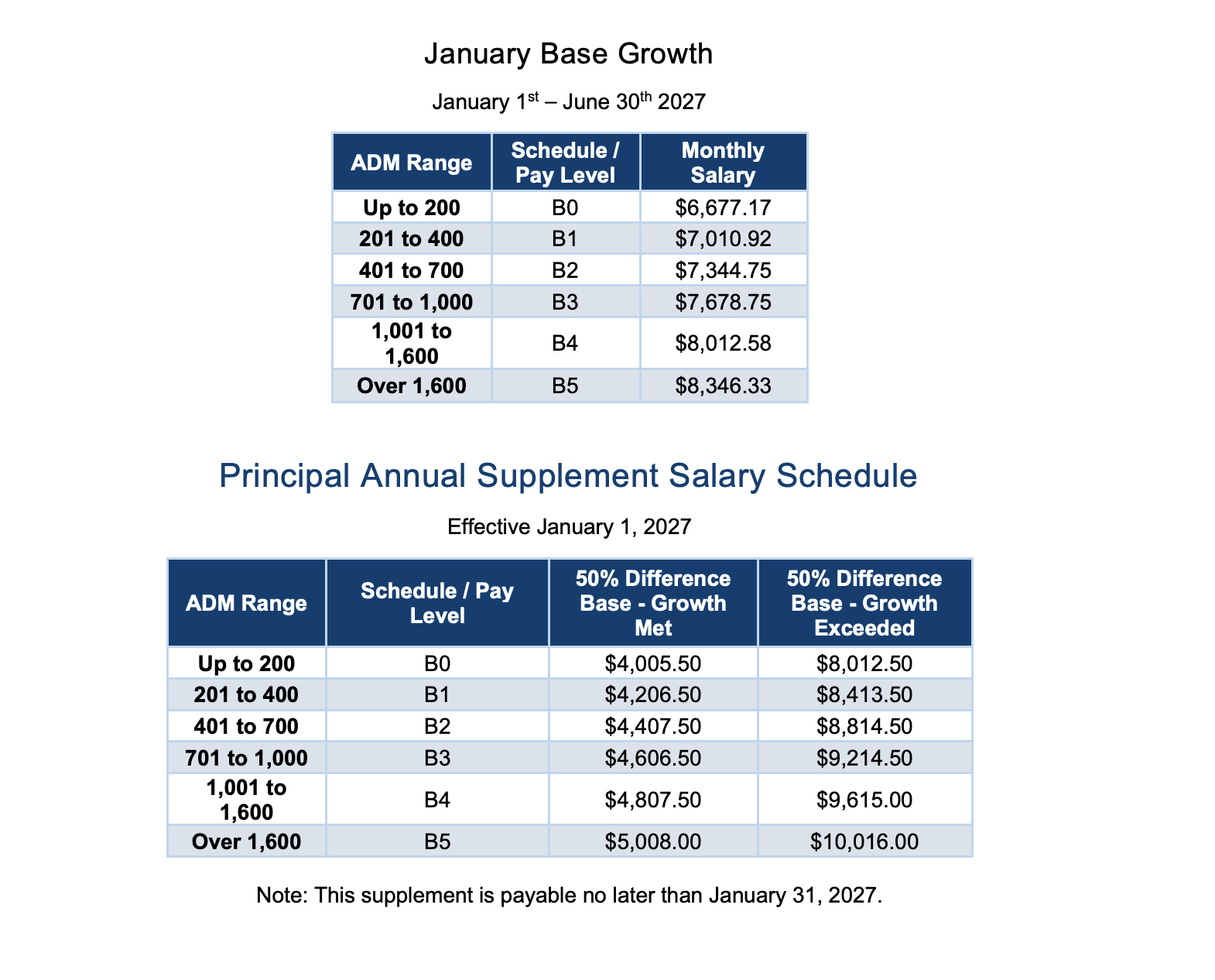
Several members of the Board raised concerns that the new salary method for principals actually results in a monthly pay decrease for many principals, even if annual pay remains the same.
Jason Johnson, the 2025 Wells Fargo Principal of the Year and member of the Board, said that starting in January, the new structure “is going to have an impact on monthly bring-home pay for many of our principals across the state.”
Read more about principal pay changes
Originally, the budget would have implemented this pay structure starting in July. Following a request from the NC Principal of the Year (NCPOY) Network, lawmakers passed a technical corrections bill, along with the budget, which delayed the principal pay changes until January 2027.
Schauss said that DPI will present a recommendation for further modifications to the text of the salary policies in next month’s State Board of Education meeting.