
With a new president soon to be announced and funding for Propel NC, community college system poised to lead the nation

The State Board of Community Colleges met last week and considered in closed session four finalists for president and CEO of the North Carolina Community College System (NCCCS). The four candidates were ranked by the search committee and previously met with the executive committee of the Board.
Board Chair Tom Looney said, “The State Board has voted to elect a new system president and CEO pending contract and General Assembly approval. An official announcement will be made at a later date.”
Looney said the top opportunities for the next president and CEO include:
- Leading bold transformation — modernizing systems, unifying 58 colleges, removing barriers to completion;
- Securing sustainable funding and winning legislative confidence;
- Strengthening workforce and employer alignment;
- Building trust through transparency and measurable outcomes; and
- Building a high-performing system office.
The Board delegated authority to approve the contract of the new president and CEO to the executive committee. The legislature convenes on Monday, July 27, 2026.
 Sign up for Awake58, our newsletter on all things community college.
Celebrating ‘a new business model’ for community colleges in North Carolina
The July State Board meeting was the first since the legislature passed the state budget, which included significant increases in funding for community colleges.
“We have a new business model,” said Dr. Amanda Lee, president of Bladen Community College and president of the N.C. Association of Community College Presidents. “And let me tell you the excitement that generates back on our campuses to take what has been approved by the General Assembly and start applying it differently and creatively. This is a wonderful, exciting time for us.”
The legislature passed the state budget on July 2, 2026, and the budget was signed by Gov. Josh Stein on July 7, 2026.
“The conference budget makes significant investments in our Community College System, including Propel NC and our System’s approved 2026-27 Legislative Agenda. These investments show strong support for our System, and System-wide advocacy efforts over the recent years,” says a legislative update for the Board.
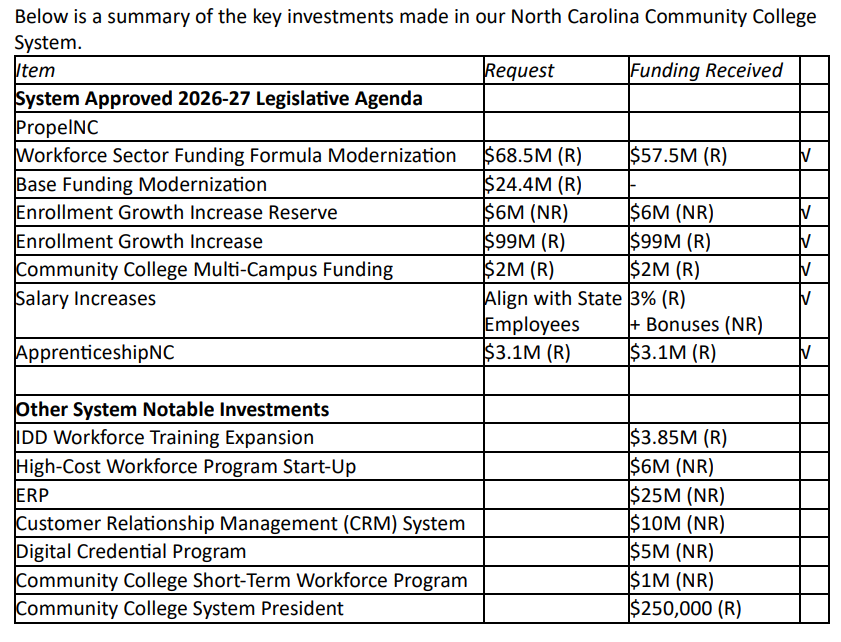
The system’s legislative request focused on recurring funding for Propel NC, which will transform and modernize the system’s funding model. Already seen as a national model, the goal is to move the system toward a labor market-driven model of community college programs by prioritizing funding for high-wage, high-demand sectors.
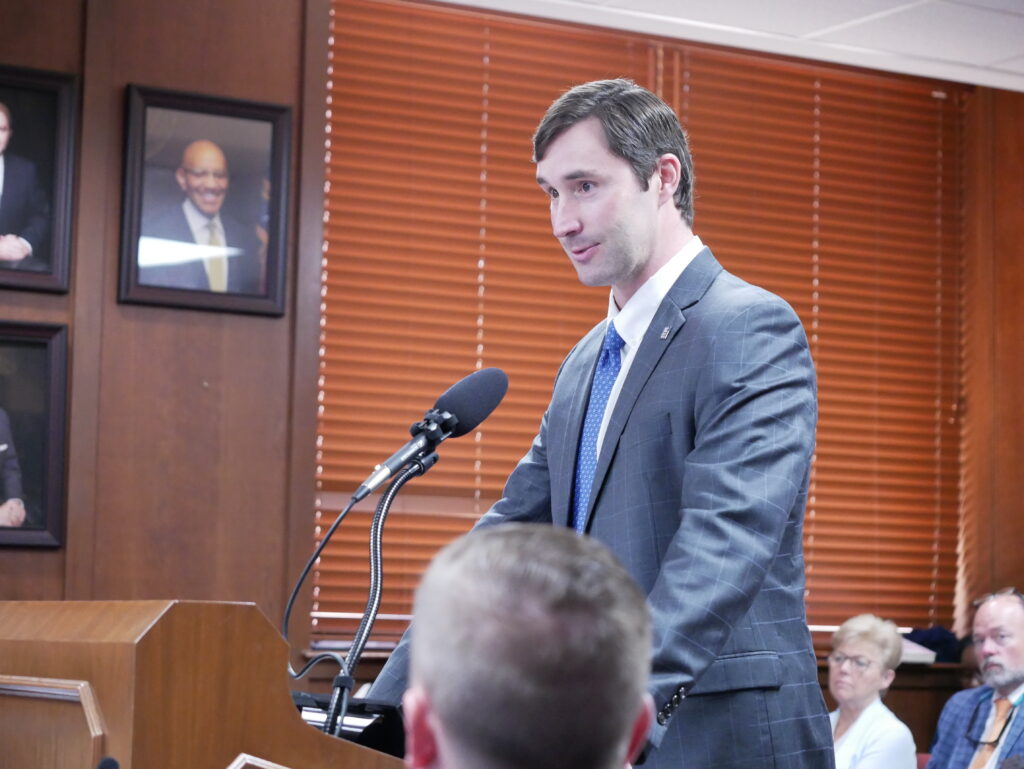
It took the system 35 months of determined advocacy to get the innovative model funded. Securing these investments from the legislature was a career-defining accomplishment for Alex Fagg, the system’s vice president of government and external relations.
At the Board meeting, Fagg generously credited others for what he called “a massive, massive win,” noting the importance of everyone involved sharing a “unified voice.”
He said the next step is to operationalize Propel NC. “It is important to get that foundation right,” he said.
“We’ve got a great story to tell here in North Carolina,” Fagg said. You’d be hard pressed, he noted, to find another state in the nation that is a top state for business and workforce with the strategic assets of Propel NC, Workforce Pell, and apprenticeships.
Related reading


Spotlight on student success
“There is no community college system without students,” said the new NC Comprehensive Community College Student Government Association (N4CSGA ) President Stephanie Pano, a student at Johnston Community College.
She presented the association’s organizational goals for 2026-27, which focus on student experience and supports that lead to student success, including:
- Student mental health and wellness;
- Childcare access and support; and
- Workforce development.
Order of the Long Leaf Pine Society Scholarship Program
Bill McBrayer, a member of the Board and a recipient of North Carolina’s Order of the Long Leaf Pine, announced a newly established fund at the N.C. Community Colleges Foundation.
Community colleges, McBrayer said, “develop more than skilled workforce, they also help develop leaders. We believe the students our colleges serve go on to strengthen their communities by serving their neighbors.”
For the first time, McBrayer said, the Order Of The Long Leaf Pine Society has decided to focus its philanthropic efforts by investing in community college students with strong leadership potential.
“Supporting community colleges and college students was a natural fit,” said Philip Fisher, the founder and president of the society.
The fund will annually 1) recognize ethical leaders serving with integrity, a strong commitment to community and service, and a positive influence on their peers, and 2) invest in the system’s student leadership development program (SLDP).
Citlaly Garcia Guijon, a student at Alamance Community College, shared with the Board the impact of her experience with the SLDP and a recent leadership retreat.
The importance of serving veteran students
Alex Cooke, a student at Isothermal Community College and veteran who served in the Army, offered the Pledge of Allegiance and then shared the experience of veterans with the Board.
“We have a lot of trouble reintegrating into society after long stints of deployment, PTSD, and all the other things veterans suffer,” Cooke said. At Isothermal, he said he was met, supported, and encouraged as both an adult learner and veteran, helping him find what he called a “foothold in the future.”
“Community college really is about community and community helping others,” said Cooke.
“Our support of our veterans and their families extends far beyond the classroom,” said Margaret Annunziata, the president of Isothermal Community College. “We really are intentional about how we engage with our veterans and their families.”
“As we engage,” she said, “I think the most important thing for us to remember is the incredible impact that these individuals have in our community.”
Related reading

Bright spots from around the system
Workforce Pell
Established by the federal budget reconciliation bill in 2025, Workforce Pell is a historic expansion of federal Pell Grants for certain short-term workforce training programs that meet rigorous standards, including strong completion and job placement rates.
On June 23, 2026, North Carolina was one of the first states to open Workforce Pell applications.
Dr. Brian Merritt, the system’s senior vice president and chief academic officer, said 29 of 58 community colleges already have submitted applications.
As part of the state’s policy, the NCWorks Commission released a list of 364 Workforce Pell-eligible occupations that meet the state’s threshold for high-skill, high-wage, or in-demand, including those in healthcare, the skilled trades, engineering, and more.
Other states, Merritt said, are taking a much more limited approach to eligibility, but he said for this first iteration of implementation the North Carolina approach is warranted given the diversity across the 58 community colleges, including urban and rural colleges as well as small, medium, and larger campuses.
“This is a true partnership in North Carolina,” he said. At a recent national conference, he said North Carolina, Iowa, and Ohio were the shining stars.
Politico reported today, “North Carolina is also vying to be among the first to get its programs approved. The state has been touted as an early leader with an aggressive workforce agenda, thanks to a March executive order from Gov. Josh Stein (D), which launched the process of building the state’s new workforce education system.”
On Aug. 12, the NCWorks Commission will review Workforce Pell applications that were submitted by July 15. Additional application reviews will be held quarterly.
Read more about Workforce Pell


Regional adult high school consortium
Prior to 2025, three community colleges in northeastern North Carolina — Halifax, Martin, and Roanoke-Chowan — did not offer the Adult High School (AHS) program. To address this gap, the system established a regional adult high school pilot project in fall 2025 that launched in January 2026.
Halifax Community College, which serves four local school districts, is the lead college for this initiative.
To date, 21 students between the ages of 16-45 have enrolled in the online program, and three students already have earned diplomas.

The Board approved $225,000 for year two of this pilot, which is designed to “foster long-term economic resilience in some of North Carolina’s most economically distressed communities.”
“Your support changed their trajectory,” Dr. Patrena Benton Elliott, the president of Halifax Community College, said in remarks to the Board. One student, one diploma, one new beginning at a time, she said, “you changed their lives, their families, our community.”
NC College Connect
This year the NC College Connect Direct Access Letter will be sent to every North Carolina public high school senior, inviting them to apply to their local community college. Previously the letter was not sent to all seniors. The Board approved $70,000 in funding for this expansion ensuring every senior will receive a letter.
“The proposed letter raises NCCCS visibility and affirms to all North Carolina public high school students and their families that they are college-eligible by extending a clear invitation to enroll at their local community college after high school graduation,” said Board materials.
Competency-based education
“Competency-Based Education (CBE) is an instructional approach that measures student progress through demonstrated mastery of clearly defined competencies rather than elapsed instructional time,” according to Board materials.
This nationally recognized nontraditional approach to learning has been important for adult learners “who require flexible scheduling due to work, family, or other responsibilities.”
Wilkes Community College has been pioneering this work since January 2025.
“Wilkes has partnered with national experts through the Competency-Based Education Network (C-BEN) to design competency-based certificate programs and aligned student support structures, ensuring academic and operational systems are ready prior to implementation,” according to the materials presented to the Board.
The Board approved a waiver for the pilot providing “limited flexibility from seat-time and attendance requirements to allow approved pilot colleges to implement and evaluate CBE instruction.”
The pilot is anticipated to expand to a small number of other community colleges.
What’s new and notable from the Board meeting
Child care grant program
The Board approved $3,038,215 to support the Child Care Grant program. To ensure the complete utilization of funds going forward, the system is changing how it administers the state appropriation.
Each community college participating in the Child Care Grant program will receive an award based on its program expenditures from the previous year. Institutions that did not expend any Child Care Grant funds during the prior year will receive a base allocation of $5,000. The System Office will retain a balance of $447,703 to reallocate to colleges upon request once the college has expended its allocated funding. If a college does not participate in the program or projects unexpended funds, their available funds will be redistributed to participating colleges. The System President will have the authority to reallocate funds as needed during the program year to ensure full utilization of funds.
— Board materials
Here you can see the recommended child care grant allocations by college for 2026-27.
System issues two RFPs
After the new state budget passed, the system quickly rolled out two requests for proposals (RFPs) from the community colleges, according to Merritt.
The new state budget includes a number of workforce investments, including $6 million to assist community colleges in starting high-cost workforce programs to meet workforce demands. The grant program requires community colleges to match a percentage of the total cash cost of the program with non-state funds based on a college’s total FTE, ranging from 5-15%.
The state budget also expands training programs for students with intellectual and developmental disabilities (IDD) to 10 more community college campuses through a $3.85 million recurring investment. The revised net appropriation is now $7.8 million in FY 2026-27.
A new financial aid directors training program
The Board approved $21,375 to support the development and delivery of the inaugural New Financial Aid Directors Training Program.
According to Board materials, “The training will provide foundational leadership, compliance, operational, and strategic enrollment management training for Financial Aid Directors who have served in their roles for two years or less across North Carolina’s 58 community colleges. The training will be held during the fall semester of 2026 and will serve approximately 25-35 new financial aid leaders statewide.”
Issues to keep an eye on
Federal funding
According to a presentation to the Board, “there continues to be uncertainty at the federal level related to these grants being funded at the same level as previous years.”
The system is assessing how critical each federal grant is, the likelihood of renewal, and the risk of the loss of funding for colleges and the system. You can see the framework here.
Faculty and staff recruitment and retention
Dr. Kim Gold, the system’s chief of staff, provided an update to the Board’s planning committee on faculty and staff recruitment and retention, finding:
- Even with recent salary increases, pay still falls below national and southern state averages;
- On average, 88% of college budgets are spent on personnel;
- Local funding is important in recruiting and retaining presidents of the 58 community colleges:
- Enrollment growth has been largely supported by part-time faculty; and
- Full-time faculty (93%) and staff (89%) are retained at consistently high rates, but they represent less than half of the instructional workforce at the community colleges.
Gold said recruitment and retention continues to matter because 1) faculty salaries have ranked near the bottom nationally for the past five years despite salary increases; 2) student enrollment has increased by 10% over the past five years while full-time faculty numbers have remained flat; and 3) growing student-to-faculty ratios require each faculty and staff member to support more students, limiting the individual attention students receive.
Diversity, equity, and inclusion
Bills banning diversity, equity, and inclusion (DEI) in public schools, community colleges, and universities are now law after the Republican-led legislature overrode vetoes of the bills this legislative session. Gov. Josh Stein, a Democrat, had vetoed the bills last July.
The Board adopted policies to “mirror the expectation of the new session law,” according to Board member Lisa Estep, who chairs the policy and governance committee that presented the policies to the Board.
Here are the regulations on purpose, definitions, dignity and discrimination, and campus free speech.
Board members David Price and Sarah West abstained from the votes, and Board member Ray Trapp voted against the policies.
Price explained that the legislation mandates that the Board implement the policies. You can hear his concerns at 1:44:18.
Other items from the State Board meeting
Chaz Beasley resigned from the State Board effective July 1, 2026.
Here is the agenda, materials, and video from the Board meeting.
Editor’s Note: Margaret Annunziata serves on the board of EdNC.