
Who will be the next leader of the NC Community College System? Here’s what the State Board is looking for

The State Board of Community Colleges approved on Friday a profile for the next president and CEO of the N.C. Community College System (NCCCS) during its monthly meeting.
The search process, which kicked off in the fall following current system President Jeff Cox’s retirement announcement, now enters the next phase of candidate recruitment.
In early April, the NCCCS launched a website for the search, dubbing the role “the most important job in North Carolina.” For the first time, CEO has been added to the president’s title, which Board Chair Tom Looney said reflects that the position’s roles and responsibilities are aligned with those of a chief executive officer.
“This is not a traditional presidency,” Looney said during the Board meeting. “We must continue to hold a high bar as we go through the process, and we must bring forward a leader who can meet this moment. This decision will shape the future of the system, and it will also impact North Carolina for many years to come.”
The most recent version of the profile, available here, was approved with minor revisions.
How did we get here, and what comes next?
In October, the Board created a six-person presidential search committee, composed of existing Board members. That committee is the voting body leading the search and will conduct finalist interviews before submitting a ranking of three finalists to the State Board.
The committee includes:
- Tom Looney, co-chair
- John Kane, co-chair
- Chaz Beasley
- State Treasurer Brad Briner
- Lisa Estep
- Chris Lumsden
The Board also established a non-voting search advisory council of seven leaders across business, government, and higher education, including:
- Amanda Lee, president, N.C. Association of Community College Presidents;
- Gene Rees, board chair, N.C. Association of Community College Trustees;
- Chris Chung, CEO, Economic Development Partnership of N.C.;
- Ward Nye, chair & CEO, Martin Marietta;
- Sen. Michael Lee, R-New Hanover, North Carolina Senate;
- Rep. David Willis, R-Union, North Carolina House; and
- Seth Dearmin, chief of staff for the North Carolina Governor’s Office.
Then, in January, the Board selected Buffkin Baker as the firm to lead the national search for the next president and CEO.
Since then, the presidential search committee and advisory council has met periodically, largely focused on an extensive stakeholder engagement process that informed the creation of the presidential profile.
In February and March, more than 1,300 stakeholders were asked to participate in interviews, surveys, and group sessions to share their priorities for the next president and CEO. Participants included former system presidents, state and legislative leaders, philanthropic partners, and business stakeholders. The system also launched a short survey where members of the public could share priorities.
With the launch of the profile, candidate recruitment will begin, and interviews will take place throughout May and June.
“We are also working on contingency plans in the event the candidates of the quality we want are not in the first round of candidates we receive,” Looney said during the Board meeting.
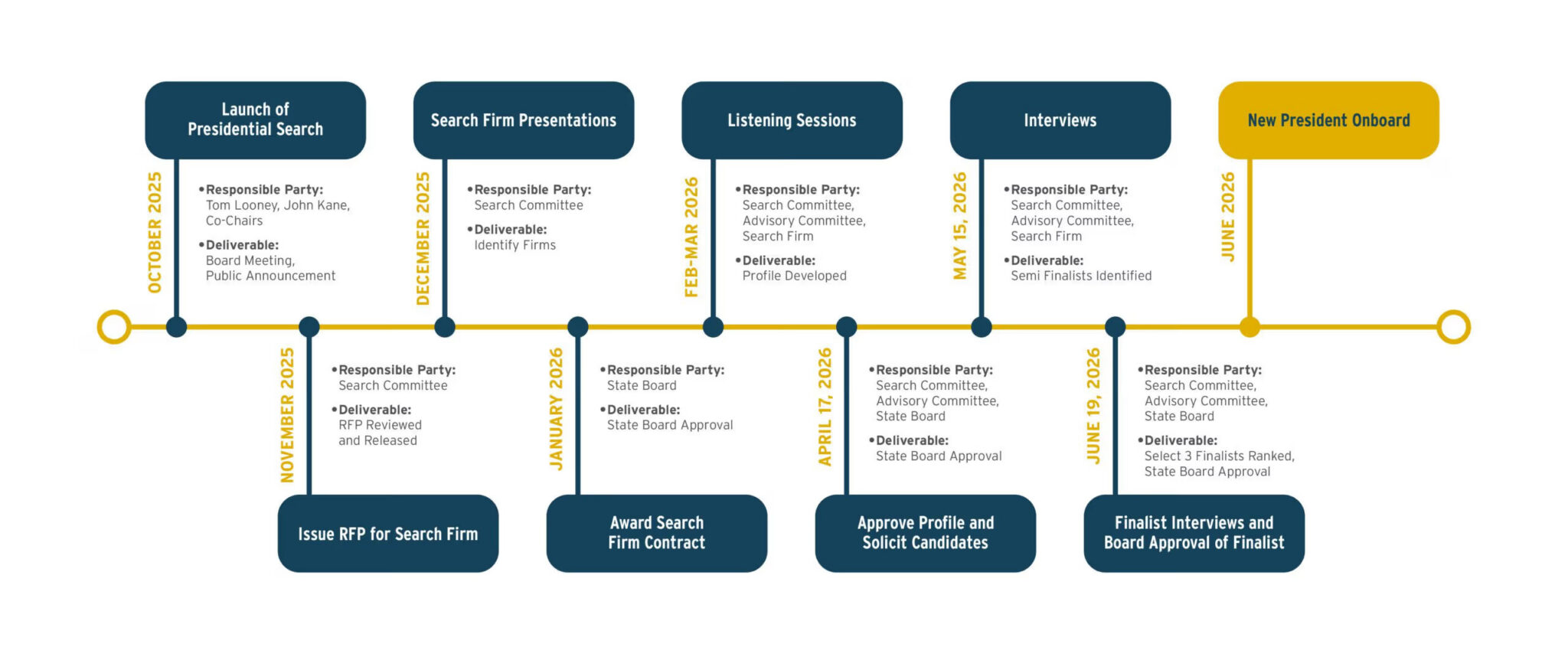
Throughout the search process, the timeline for hiring and onboarding the next system president and CEO has shifted back.
When the Board launched its search in the fall, Looney said it hoped to hire a new president and CEO by April. Now, the Board plans to approve the selected candidate during its meeting on June 19, with onboarding to take place between July and October. Given that Cox’s retirement is effective June 30, the Board anticipates that an interim president will be named.
Further complicating the timeline is the fact that this is the first system presidential candidate that will require confirmation by the General Assembly. That change, which became law in fall 2023, allows the person selected by the Board to serve as interim president until the General Assembly adopts a joint resolution confirming the selection.
The 2026 legislative short session starts on April 21, and while there is no set adjournment date, the end of the state’s fiscal year is June 30, and the legislature often aims to adjourn soon after that once a new budget is passed.
“Speed can kill, and I want to make sure we get this right,” Looney said during the Board meeting. “So while this will depend upon the legislature approving the final person, we are looking at avenues to make sure that if we need additional time, we’ll have that time to make sure we make the right decision for the state of North Carolina.”
 Sign up for Awake58, our newsletter on all things community college.
What does the profile contain?
“This is not a job description,” Looney said during the Board meeting.
The 14-page profile serves as an introduction to the role, the state, and the system for potential candidates, providing context on North Carolina’s changing economy, statistics on the community college system and its foundation’s fundraising campaign, and other key information.
The profile also features quotes of support from leaders across the state, including Mo Green, state superintendent; MC Belk Pilon, president and Board chair of the John M. Belk Endowment; and Peter Hans, current UNC System president and previous NCCCS president. Full statements are available here.
The charge for the next president and CEO, outlined in the profile, reads: “This role carries a clear mandate: Accelerate the System’s impact on workforce and economic growth.”
Rather than prescribe specific qualifications for candidates, the search committee said the profile was intentionally designed to be broad, allowing the search to cast a wide net.
To that end, the profile includes a list of desired attributes, informed by input from the stakeholder engagement process:
- Act with urgency and drive results.
- Build trust across sectors.
- Decide with conviction.
- Lead with confidence and humility.
- Think and lead at the enterprise level.
- Champion workforce outcomes.
- Use data and technology to drive performance.
- Communicate with clarity and purpose.
- Navigate complex environments.
- Build and lead high-performing teams.
- Lead change with discipline.
- Represent the system with credibility.
During a presidential search committee meeting on Friday, ahead of the Board meeting, Lumsden expressed a need to ensure the committee, Board, and search firm understood what experiences and qualifications they are looking for, even if not defined in the profile. For example, Briner said experience managing a decentralized organization would be relevant to the role, and Looney said experience leading an organization through transformation is also important.
Additionally, both Lumsden and Looney expressed that candidates do not have to have a background in education. Looney himself does not have a background in education, “and I’ve been involved in three major institutions now,” he said.
Ultimately, the presidential search committee decided not to define any required qualifications or experiences in the profile, and instead is directing interested candidates to contact the search firm to discuss their qualifications directly. At that point, the search firm will identify the strongest candidates.
Another point of discussion in previous presidential search committee meetings centered on whether or not the candidate needs to be from North Carolina. Looney has repeatedly emphasized that the search is national.
During a presidential search committee meeting on April 2, he shared that the Board hired a public relations firm to support national distribution of the opportunity.
“We’re moving at the speed of business here, we’re going to make quick decisions, and I think maybe in the past we haven’t got out as broadly, and this firm is going to give us national recognition on day one,” Looney said.
During Friday’s Board meeting, the profile was approved with only minor revisions. After Board members Sarah West and David Price expressed concern that the profile did not adequately highlight the system’s educational mission, a motion was passed to add mention of advancing education goals, in addition to workforce and economic goals, under desired attributes.
Price also introduced a motion to change the phrase “regardless of industry” to “regardless of sector” in a letter penned by Looney and Kane to potential candidates. The word industry, Price said, implied that the Board is only seeking corporate leaders.
“We may of course have corporate leaders that we want to consider,” Price said. “But I believe if taking this quite literally, I’m not sure that many of our most successful presidents in the past … would have made the cut, because they didn’t come to us as corporate executives.” That motion also passed.
That section of the letter now reads:
We are seeking a proven executive, regardless of sector, who has led at scale, built high-performing teams, and delivered results with clear return on investment. Someone who operates with urgency, uses data to drive decisions, and understands that students and employers must be treated as valued customers.
The profile concludes with a call to action for interested candidates to send their resume, cover letter, and any questions to Buffkin Baker, the search firm.
The next State Board meeting is scheduled for May 14-15.
Editor’s note: The John M. Belk Endowment supports the work of EdNC.