
How Rowan-Salisbury School System built the conditions for literacy success


School improvement often begins with the search for a new program or initiative. Rowan-Salisbury School System chose a different path. Long before adopting a coherent literacy curriculum, district leaders invested in educator expertise, instructional systems, and coherent practices that would make lasting improvement possible.
Yet one question remained: If students were mastering foundational reading skills, why weren’t those skills transferring to increasingly complex text?
“We realized data outcomes did not show evidence that foundational skills were transferring into the upper grades,” said Stephanie Ward, K-12 district literacy director. Feedback from the district’s Literacy Intervention Plan pointed to the same conclusion.
The district had strengthened foundational reading instruction, but students needed greater support developing the language, knowledge, and comprehension required to tackle increasingly complex texts.
“We had a phonics curriculum,” Ward said. “But we did not have a comprehensive curriculum.”
 Sign up for the EdWeekly, a Friday roundup of the most important education news of the week.
Building the foundation before curriculum
Like many districts across North Carolina, Rowan-Salisbury School System had spent years transitioning from balanced literacy to the Science of Reading. Before beginning Language Essentials for Teachers of Reading and Spelling (LETRS), every kindergarten through third grade classroom teacher, exceptional children’s teacher, English learner (EL) teacher, instructional coach, and certified reading teacher completed IMSE Orton-Gillingham Plus training.
LETRS validated much of the district’s instructional work while helping educators recognize that strong foundational skills alone were not enough. Students also needed consistent opportunities to build knowledge, vocabulary, comprehension, and writing through a coherent, knowledge-rich literacy curriculum. Recognizing this gap caused district leaders to revisit earlier conversations about the need for curriculum and instructional materials that intentionally developed the language comprehension side of Scarborough’s Reading Rope.

Curriculum as the missing piece
District leaders resisted the temptation to assume one purchase would solve the problem. Instead, they examined the conditions surrounding instruction. Over several years, the district revised its literacy framework, strengthened instructional coaching, redesigned local unit guides, developed classroom walkthrough tools, and expanded support for principals and reading coaches.
Those efforts built educator knowledge and established a shared vision for literacy instruction, but leaders ultimately recognized one critical piece was still missing. They came to view curriculum not as a scripted program that replaced teacher expertise, but as the tool that connected years of professional learning with consistent classroom practice centered on rich texts, knowledge building, vocabulary, writing, and comprehension.
Heather Alexander, early literacy specialist, remembers the realization clearly.
“We put numerous structures in place,” she said. “But we still did not have what we needed for kids. Without the structured curriculum, we realized we would always continue to fall short of meeting the intended outcome.”
That need ultimately led the district to adopt Benchmark Advance as its comprehensive literacy curriculum.
Mt. Ulla Elementary School principal Brenda Sokolowski, with more than 30 years of experience, saw the same progression.
“Our trajectory began to change in the LETRS training,” she said. “It laid the groundwork for us to provide, in a very comprehensive way, best practices for teaching reading. Then, with the addition of the curriculum, we were given the proper tools to implement some of those best practices.”
But translating that knowledge into consistent classroom practice required far more than simply opening a new set of instructional materials.
For Shive Elementary instructional coach Stacy Rosenbaum, the years leading up to curriculum adoption were not years of waiting, they were years of preparation.
“The systems the district literacy team established created the conditions for teachers to shift both mindset and instructional practice,” Rosenbaum said. “Once we added the curriculum, it pulled things together nicely.”
Teachers had already developed a deeper understanding of structured literacy. When the comprehensive curriculum arrived, they were prepared to approach instruction differently, not simply implement another program. The curriculum became the vehicle for applying the knowledge and practices they had spent years building.
Preparing teachers for a different kind of instruction
Zachary McClary, a third grade teacher at Shive Elementary with 17 years of experience, recalls sitting down with his grade-level team the summer before implementation to work through the new curriculum. At first glance, the lessons appeared straightforward.
“Then the students came back,” McClary said. “That’s when we realized how rigorous and complex it was going to be for both teachers and students.”
The challenge wasn’t following a script. It was understanding the instructional purpose behind each lesson and knowing how to respond to student thinking in the moment.
Students engaged with richer vocabulary, more complex questions, and grade-level texts from the start, requiring teachers to rethink long-standing instructional habits while providing support without lowering expectations.
“It stretched teachers so that we didn’t unintentionally water down language or expectations for our students,” McClary said.
That adjustment reshaped weekly planning. Instead of deciding what to teach, teachers studied how lessons unfolded, anticipated where students might struggle, and determined when to provide support and when to step back.
“The repeated reads took a lot of the strain off the kids,” McClary said. “They were able to focus on constructed responses with oral and written responses.”
The impact soon became visible in classrooms. Alexander recalls visiting McClary’s third grade classroom during a unit on the Industrial Revolution, where a student with a disability who had previously struggled academically was fully engaged in discussion alongside classmates.
“They were talking about things I’m not sure I knew,” Alexander said. “It’s great to see that every student is included in the core lessons, learning about what their peers are learning about.”
Implementation became shared learning
District leaders anticipated that learning curve.
“We realized that while this tool provided support for teachers, it would still require a lot of new learning and planning for effective implementation,” Ward said.
Rather than introducing new materials and stepping back, district leaders chose to remain deeply involved throughout the process. Coaches, curriculum leaders, and administrators spent time in classrooms conducting demonstration lessons, observing instruction, and participating in learning walks alongside teachers.
“We were learning too,” Ward said.
That simple statement reflects one of the most important decisions Rowan-Salisbury School System made. Implementation was never treated as something teachers were expected to figure out alone. It became a shared learning experience, with district leaders seeking to understand what was working, where teachers were struggling, and what support was needed next.
Professional learning communities reflected that same philosophy. Rather than focusing on pacing guides or simply planning upcoming lessons, teachers studied the instructional design together, discussing where students might struggle, when to provide support, and when to gradually release responsibility. Conversations centered on helping students do more of the reading, writing, speaking, and thinking themselves.
Those conversations soon extended beyond individual schools as teachers visited one another’s classrooms, shared effective practices, and learned from colleagues across the district.
“Our teachers were really the front line of this work,” Rosenbaum said. “Our teachers trusted us, and it really paid off.”
Related reading

Changing classroom practice
The district’s commitment to learning also challenged assumptions about what was happening inside classrooms. Prior to the new curriculum, Sokolowski wondered whether students were actually spending as much time reading as adults believed.
Working with her leadership team and district staff, she observed randomly selected students throughout an entire 60-minute literacy block, documenting every minute they spent actively engaged in reading.
The findings surprised nearly everyone. Students averaged only five to seven minutes of active reading during the lesson.
“It made a lot of adults really uncomfortable,” Sokolowski said.
The observations prompted honest conversations about classroom practice. Teachers recognized that, despite the best of intentions, adults were often doing too much of the cognitive work. In an effort to help students succeed, they sometimes have limited opportunities for productive struggle.
That realization continues to shape classroom observations across the district today.
“When the lesson states to release students to partner-read or complete an independent task, it is important to do this for students,” Ward said. “Teachers tend to over-scaffold because they don’t want to see their students struggle.”
The question district leaders now ask during classroom visits is deceptively simple: Who’s doing the reading, writing, speaking, and listening? Who’s doing the doing?
The shared instructional framework changed more than classroom instruction. It changed the way educators talked about teaching.
Building a literacy culture
Knollwood Elementary principal Kimberly Martin said the changes have extended far beyond a single lesson. With 65% of the school’s students coming from Spanish-speaking homes, she said the new curriculum has brought greater coherence to instruction while giving teachers the confidence to meet the needs of diverse learners.
“Prior to this curriculum, teachers were pulling in a hodgepodge of resources,” Martin said. “It’s all they had, but now it’s all in one nice package for them.”
Martin said the impact is evident not only in classrooms but throughout the school.
“It has changed our school culture, specifically our literacy culture, because children are starting to love to read again,” she said. “Kids are approaching me all the time, excited to share what they are reading.”
This year, Rowan-Salisbury School System is expanding implementation into kindergarten and first grade while continuing to strengthen instruction in grades two through five. Professional learning is shifting more deeply into writing and word study, and district leaders are helping families understand how learning develops through a spiral curriculum, where students revisit concepts over time to build deeper understanding.
That long-term perspective has defined the district’s approach from the beginning. Rather than expecting immediate results, Rowan-Salisbury School System has focused on building the knowledge, systems, and shared instructional practices that support lasting literacy improvement. The work continues, but district leaders view implementation as an ongoing process of continuous improvement rather than a completed initiative.
A parent’s perspective
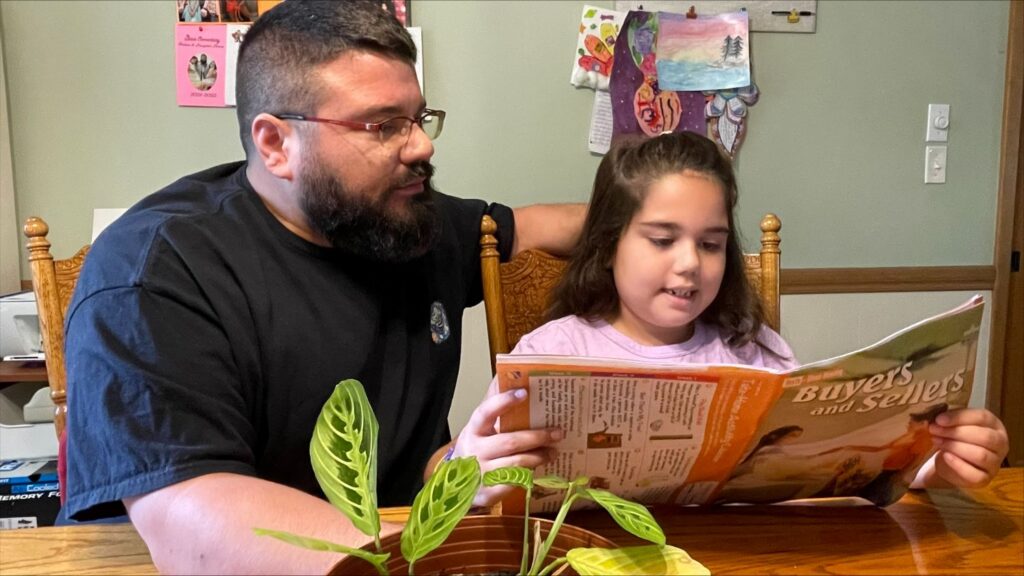
Zachary McClary’s daughter was a second grader during the district’s first year of implementation. As her materials came home from school, he found himself looking beyond completed assignments. He could see her annotations, her written responses, and the questions she worked through as she engaged with increasingly complex texts.
“It was her actual little brain work,” he said.
Seeing that work gave him a different perspective, not only as a father, but as a teacher. It helped him better understand what families were experiencing at home and gave him confidence in the students who would soon enter his own classroom.
“We know what they were taught,” he said. “They will come well prepared to jump straight into third grade content.”
Literacy improvement in Rowan-Salisbury School System has never been about a single curriculum or one year of assessment results.
Those outcomes reflect years of building educator knowledge, strengthening instructional coaching, fostering trust, and creating coherent systems. Student achievement followed because the system changed first.