
Inside North Carolina’s ELA standards revision and implementation process

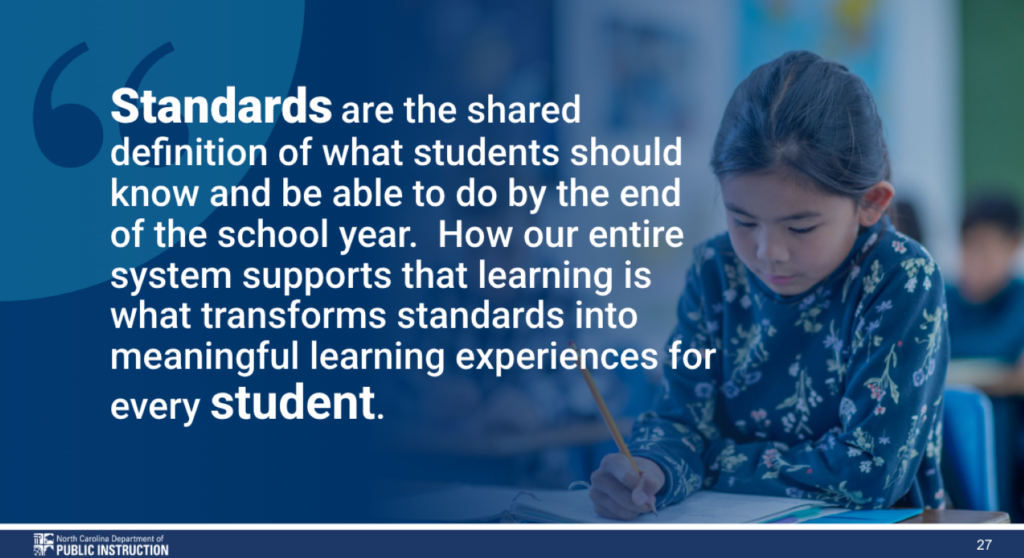
When North Carolina educators open a new Standard Course of Study, they see a polished document that outlines what students should know and be able to do. What they don’t see are the years of collaboration, research, revision, and planning that made those standards possible.
The recently revised North Carolina English Language Arts (ELA) Standards, scheduled for implementation in the 2027-28 school year, are the result of an intentional, multiyear process that extends far beyond drafting standards. The work brings together classroom teachers, district leaders, higher education representatives, parents, business leaders, literacy experts, and North Carolina Department of Public Instruction (DPI) staff to ensure the standards reflect current research, classroom realities, and the evolving needs of North Carolina students.
 Sign up for the EdWeekly, a Friday roundup of the most important education news of the week.
Equally important, the work does not end when the State Board of Education adopts the standards. Recognizing that rigorous standards improve student outcomes only when they are implemented effectively, DPI has devoted just as much attention to preparing educators through comprehensive professional learning, instructional resources, communication tools, and statewide collaboration designed to support successful classroom implementation.
As Dr. Kristi Day, director of DPI’s Office of Teaching and Learning, explained, standards development is intentionally deliberate.
“They don’t write standards in a month or a weekend,” Day said. “From the time we begin reviewing standards until teachers are teaching them, the process takes about four years.”

Listening before writing
Rather than beginning with a blank page, the process starts by gathering extensive feedback from educators across North Carolina. Educators identify standards that are working well, those that may need clarification, and concepts that may be better placed at different grade levels. Families and community members provide another important perspective, sharing how well the standards prepare students beyond the classroom.
Research is equally important. Throughout the review process, DPI examines current literacy research, analyzes revisions completed by comparable states, and collects both quantitative and qualitative data through surveys, interviews, and focus groups.
The information is then placed in the hands of a volunteer Data Review Committee (DRC) composed of educators from across North Carolina. Committee members carefully examine every strand, standard, objective, and piece of feedback before identifying areas that warrant revision. These educators volunteer their time because they believe in strengthening instruction for students statewide. Their recommendations become the foundation for the next phase of the work.
Once the DRC completes its analysis, DPI presents the findings to the State Board of Education. Only after receiving approval does the formal revision process begin.

Writing standards through collaboration
Standards writing is a highly collaborative endeavor. Volunteer educators representing multiple grade levels, regions, and educational roles serve on the Standards Writing Team (SWT). Using recommendations from the DRC alongside research findings, they begin drafting revisions that reflect both evidence-based literacy practices and classroom experience.
The writing process is intentionally cyclical. Drafts are developed, shared with stakeholders, revised, and refined through multiple rounds of feedback. For the ELA standards, that process extended through four complete drafts before the final version was approved.
One significant change that educators will notice is a shift in the standards structure. This structure mirrors other content areas across North Carolina, creating greater consistency for educators who teach multiple subjects while providing additional clarity for instruction.
Throughout each revision cycle, feedback shaped the work. Representatives from multiple DPI offices, including Early Learning and Exceptional Children, collaborated with the SWT to ensure the standards reflected diverse perspectives and supported all learners.

Grounded in research and coherence
While educator voice drives the revision process, research provides the foundation for every decision. According to Dr. Stacy Daniel, section chief for ELA and Languages at DPI, research was not confined to the beginning of the process. Instead, it informed every stage of standards development. Throughout the revision process, the team relied on current, relevant, peer-reviewed, and comprehensive research to evaluate proposed revisions and ensure the standards reflected the strongest available evidence on literacy teaching and learning.
The revised ELA Standards also reflect North Carolina’s broader commitment to the Science of Reading. Rather than viewing standards and evidence-based literacy instruction as separate initiatives, DPI intentionally designed the revisions to complement the state’s Excellent Public Schools Act of 2021 legislation and professional learning.
The standards identify what students should know and be able to do, while science of reading research informs how educators help students reach those expectations. It is the “genius of and” rather than the “tyranny of or.” High-quality academic standards and evidence-based instructional practices must work together to improve literacy outcomes for every student.
Beyond examining other state standards, the revision team also focused on ensuring that they were aligned with other statewide expectations, including, but not limited to, North Carolina’s Digital Learning Standards, English Language Development Standards, and Literacy Instruction Standards. This cross-disciplinary review ensured educators would receive consistent guidance rather than competing expectations.
“We worked really hard with all of the offices in our agency and educators in the field to make sure we were singing from the same sheet of music without sending mixed signals,” Daniel said.
Rather than developing standards in isolation, DPI sought to create a unified framework that supports educators across content areas and instructional settings while remaining grounded in both practitioner expertise and high-quality research.


Three foundational principles
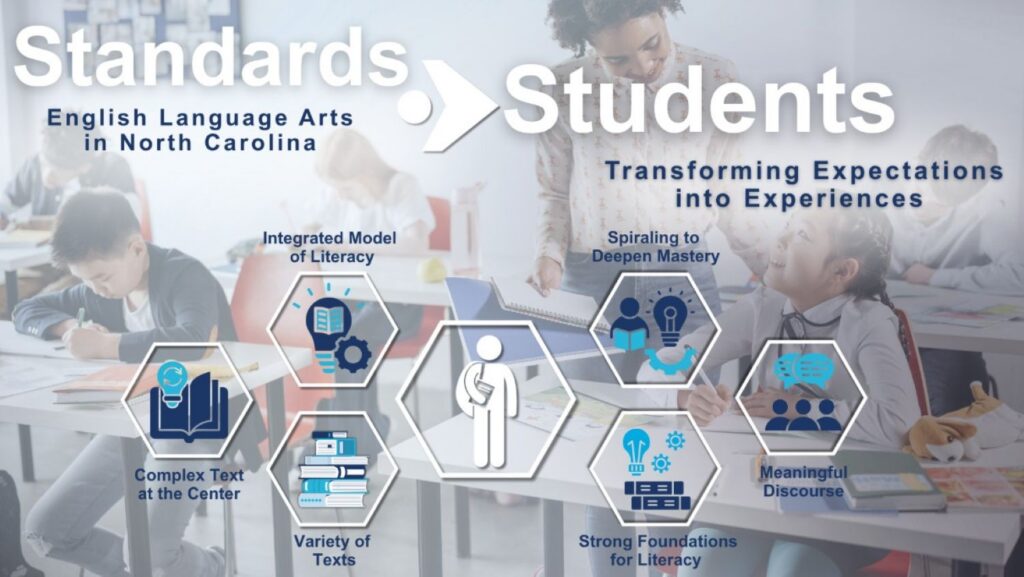
While many standards remain familiar, the revised ELA Standards reinforce three fundamental principles intentionally designed to strengthen literacy instruction:
- Text at the center
- Integrated model of literacy and spiraling
- Variety of texts
The first major principle places grade-level complex text at the heart of literacy instruction. Rather than treating text complexity as one standard among many, the revised structure places it as the foundation that supports every strand of literacy learning.
This emphasis also addresses a common misconception that text complexity can be determined solely by Lexile measures. Instead, educators should consider these measures alongside qualitative features, as well as reader and task considerations when selecting instructional materials.
The principles also reinforce the essential message that access to grade-level instruction is an equity issue. When all students engage with appropriately complex texts supported by effective instruction and scaffolding, they have greater opportunities to develop the knowledge, vocabulary, and higher level thinking necessary for long-term success.
A second foundational principle emphasizes that literacy learning does not occur in isolation by simply reading texts. Students should also have opportunities to discuss, analyze, write about, and respond to what they read. The standards reflect an integrated model in which reading, writing, speaking, listening, and language continuously and seamlessly reinforce one another.
This structure also supports a spiraled approach to learning. Rather than teaching individual standards once before moving on, educators revisit concepts throughout the year, using increasingly more complex texts and tasks. This structure provides a more authentic model of literacy instruction that reflects how students gradually and naturally build understanding over time.
The third principle recognizes the expansion of text in today’s world. While traditional literature remains essential, students must also learn how to navigate informational texts, multimedia resources, and multimodal communication that increasingly prepare them for college, careers, and civic life. The revisions encourage students to engage with a wide variety of genres and formats while continuing to value sustained reading experiences, including novels and longer reading material that build knowledge, vocabulary, and stamina.
From standards to students
For Day, developing strong standards represents only part of the work.
“While we appreciate that the board approves the process and standards,” she explained, “our main priority is making sure these standards have a positive impact on the students. Student experiences with the standards is the most important part of the entire process and at the core of why we do what we do.”
That philosophy shaped the Office of Teaching and Learning’s implementation plan. Recognizing that successful implementation requires more than distributing documents, the ELA team has invested significant effort in preparing educators before the standards become fully operational in classrooms.

Building capacity across the state
Once the standards are approved, the Office of Teaching and Learning creates a communication plan, as well as detailed plans for installation and implementation.
During the installation period, DPI creates resources and supports, while public school units (PSUs) begin teacher training and resource updates.
Implementation begins with extensive planning for professional learning throughout the department. More than 260 DPI employees were organized into a three-tiered framework based on how the standards relate to their work.
The awareness level provides a basic understanding of the revised standards and available resources. The working level offers more detailed learning for staff who regularly interact with the standards but may not directly support ELA instruction in the field. The expert level prepares staff members who work directly with districts and schools to provide turnkey professional learning and ongoing implementation support.
Designed as a model for future standards revisions across all content areas, the framework ensures that DPI staff develop a shared understanding of the standards, communicate consistent messages, and provide coherent support to educators throughout North Carolina.
The same intentional planning has extended to the eight regional professional development sessions, with all 115 North Carolina school districts registering to participate. Each district was invited to send a four-member team to engage in turnkey training designed to build local capacity for implementation.
The sessions bring together district ELA leaders, instructional coaches, classroom teachers, and other instructional leaders to develop a shared understanding of the revised standards, the rationale behind the revisions, and their instructional implications. Teacher leaders who served on the Standards Writing Team are serving as co-presenters alongside the DPI ELA team, providing participants with the unique opportunity to learn directly from educators who played an integral role in the revision process.
This collaborative model not only promotes statewide consistency in implementation but also reinforces the practitioner-driven nature of the standards revision process, ensuring that the revisions remain grounded in classroom expertise while building confidence and readiness across districts.

Resources designed for educators
Professional learning is supported by an extensive collection of implementation resources designed to help districts transition to the standards with confidence. One of the most valuable tools is the crosswalk, which highlights standards that have changed, identifies updates, and notes those that remain unchanged. Rather than requiring districts to redesign curriculum unnecessarily, the Crosswalk allows educators to focus their efforts on revisions that truly require instructional adjustments.
The vertical progression illustrates how knowledge and skills develop across grade levels, helping educators understand how individual standards contribute to students’ long-term literacy development. A revised glossary provides consistent terminology across standards and supporting documents, promoting a shared understanding of key concepts.
Among the most comprehensive supports are the unpacking documents, developed for every grade level. These resources bring together standard clarifications, instructional considerations, question stems, sentence frames, classroom supports, and supplemental resources into a single, user-friendly reference. Glossary terms are embedded alongside the standards, while appendices organize additional resources by strand for easy navigation.
To support district implementation and stakeholder communication, the department has also developed communication toolkits that include customizable presentations, talking points, newsletters, social media content, implementation timelines, and frequently asked questions.
The revised standards are also available in Spanish, expanding accessibility and strengthening communication with families and communities across North Carolina. Parent guides, available in both English and Spanish, will be released soon to further support families in understanding the standards and what students are expected to know and be able to do at each grade level.

Looking ahead
Recognizing the importance of thoughtful implementation, the State Board of Education recently revised its standards policy to extend the implementation timeline from one year to two years. The additional time allows districts to deepen their understanding of the standards, build educator capacity, and prepare instructional resources before students are assessed on the revised expectations.
State assessments will remain aligned to the 2017 ELA Standards during the 2026-27 school year, reflecting the standards currently being taught in classrooms. Beginning in the 2027-28 school year, when teachers begin implementing the revised ELA Standards, state assessments will transition to align with those new standards, ensuring that what is taught, learned, and assessed remains fully aligned.
The work, however, is far from complete. As professional learning continues and additional resources are released, the focus remains the same as it was when the revision process first began: listening to educators, supporting implementation, and improving outcomes for students.
