
EdExplainer | How North Carolina schools support student mental health, and the challenges that remain

Highlights
- North Carolina takes a comprehensive approach to student mental health. Students receive support in schools through the promotion of emotional, social, and mental well-being, direct support from school health personnel, and referrals to external providers.
- School health personnel — school psychologists, counselors, nurses, and social workers — are trained to collaboratively promote student well-being and are key to supporting student mental health. However, funding and workforce pipeline challenges have created shortages in these positions statewide. As a result, school health personnel often have to prioritize supporting students in crisis rather than working on up-stream, preventative solutions.
- In the absence of sufficient state funding for school health personnel, federal grants help fill the gap in providing school-based mental health care.
Students don’t learn in a vacuum. Researchers agree that students’ social, emotional, and mental well-being is a precursor to their ability to engage in learning, develop character, and, ultimately, thrive in adulthood.
The state’s public schools are a key entry point for youth mental health services, and educational leaders have long sought to support students’ overall well-being. But recent data on students’ mental and emotional well-being reveal a youth mental health crisis that has prompted conversations on how to best support the 1.5 million young people enrolled in the state’s public schools.
NC Child’s 2025 Child Health Report Card gave the state an “F” in mental health. This failing grade is based on increases in the percent of young people who reported experiencing a major depressive episode and who reported difficulties accessing mental health treatment that they needed. In the 2025 KIDS COUNT Data Book from the Annie E. Casey Foundation, North Carolina ranks 34th in the nation on youth well-being across education, health, and economic indicators.
Insufficient funding from the state for key health personnel in schools, coupled with workforce shortages, have complicated students’ access to consistent and quality mental health care. At the same time, a variety of state-led policies and initiatives are working to address student needs and fill critical workforce shortages for school staff who support student mental health.
This Mental Health Awareness Month, take a look at how North Carolina’s public schools support students’ well-being and the challenges that remain.
State-led frameworks and policy
The Whole School, Whole Community, Whole Child (WSCC) model and Multi-Tiered System of Supports (MTSS) framework guide the state’s student mental health policy goals. Additionally, under the state’s School Mental Health Policy, public school units are required to adopt and implement a a school-based mental health plan.
Whole School, Whole Community, Whole Child
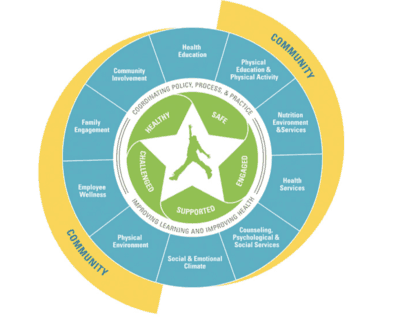
Originally developed by the Centers for Disease Control and Prevention (CDC) in 2014 and adopted in North Carolina in 2015, the WSCC model is a student-centered approach to education, identifying 10 components that, together, contribute to students’ holistic well-being.
As EdNC reported in 2019, the model “shifts away from an exclusive focus on academic achievement and towards the idea that a student’s success at school is tied to comprehensive health and well-being.”
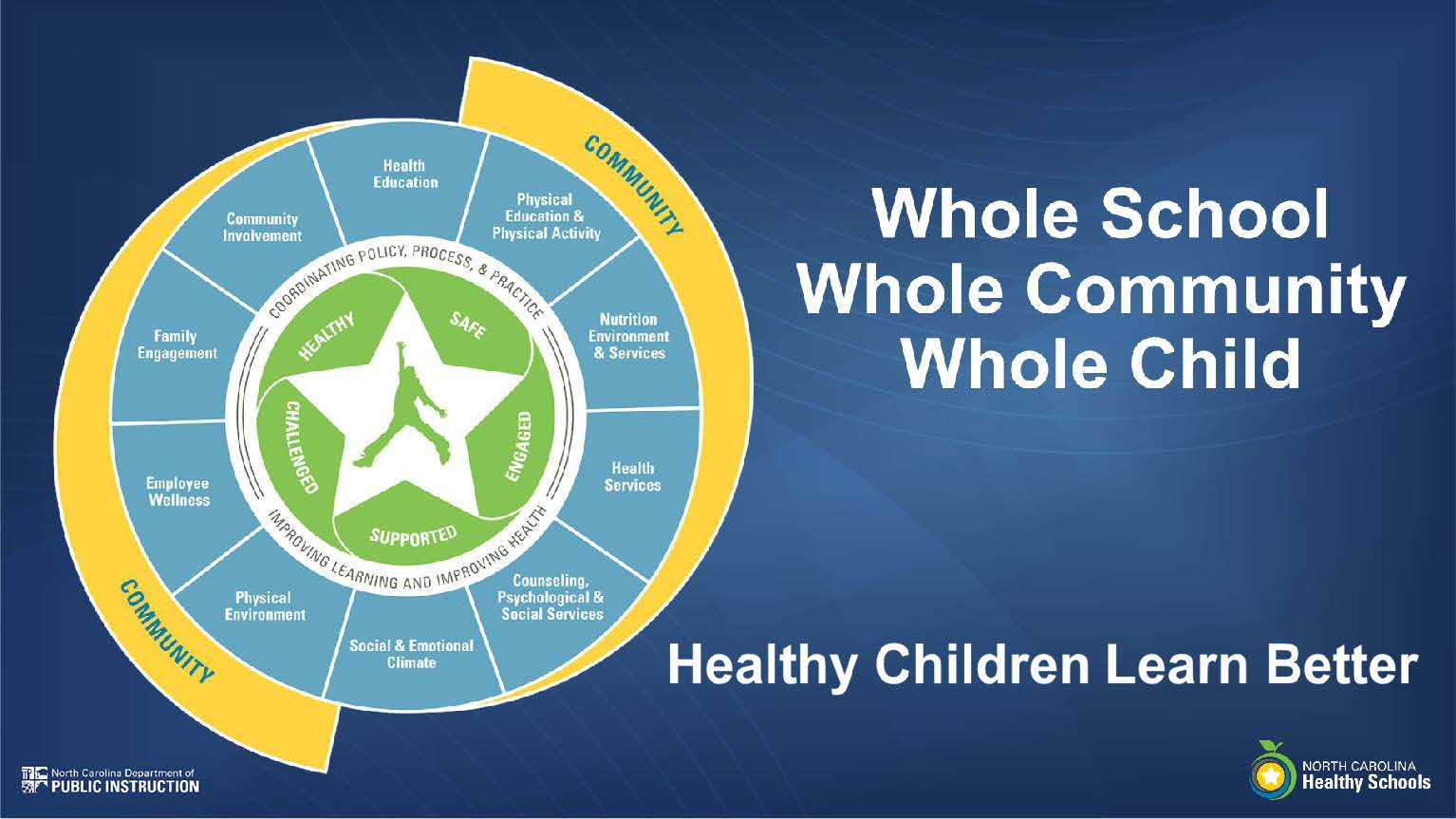
Branded as Whole Child NC in North Carolina, the State Board of Education created an internal committee that then became an interagency advisory committee to examine non-academic barriers to success for students.
In addition to the Whole Child NC Advisory Committee’s annual recommendations to the State Board, the North Carolina Department of Instruction’s (DPI) NC Healthy Schools team uses each component of the model to guide their work, according to Section Chief for NC Healthy Schools Dr. Ellen Essick.
Read more about Whole Child NC
Multi-Tiered System of Supports
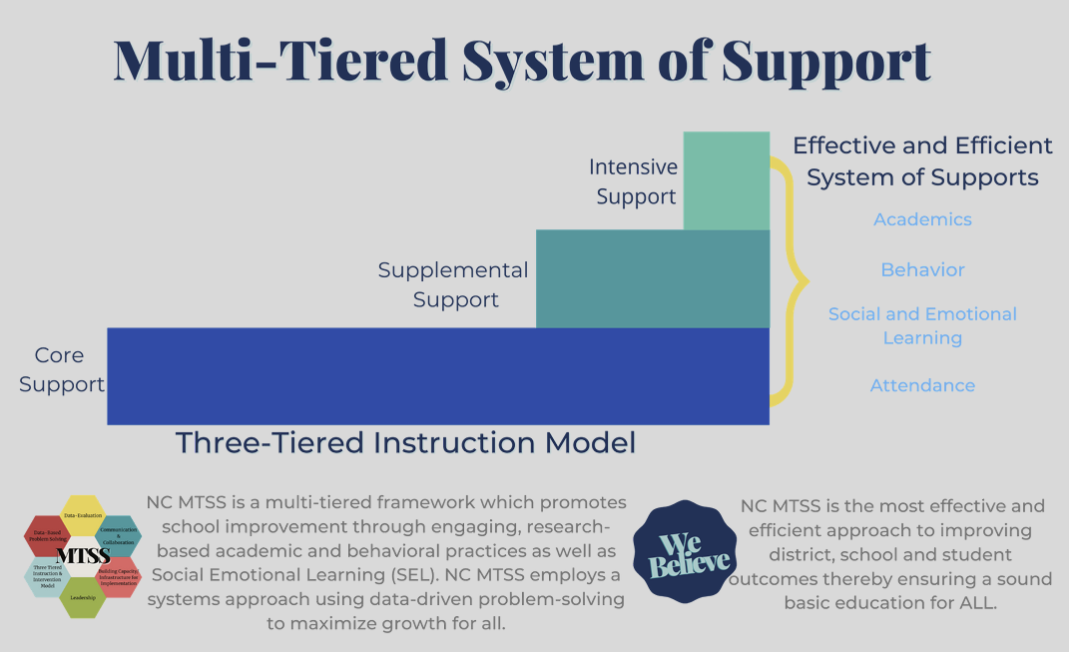
Working alongside WSCC is the Multi-Tiered System of Supports (MTSS) framework, a school improvement framework that encompasses academic, behavioral, social, and emotional instruction and support.
The Integrated Academic & Behavior Systems (IABS) team, housed within DPI, helps districts implement the MTSS framework. According to IABS, six critical components make up the MTSS framework, and four essential elements make it unique from other school improvement models.
According to the IABS website:
In a typical system, Core (Tier 1) includes the instruction all students receive. Supplemental (Tier 2) includes additional instruction or intervention provided to students not meeting benchmarks; and Intensive (Tier 3) includes intense, small group or individual interventions for students showing significant barriers to learning the skills required for school success.
The MTSS framework is one way to conceptualize the types of well-being support a typical student might encounter during the school day.
In 2024, NC Child held focus groups with school support personnel across the state. The group’s findings were published in a March 2026 report that found school-based mental and behavioral health care is typically provided through the MTSS framework.
At Tier 1, students are exposed to universal programming. Examples in the NC Child report include setting daily social-emotional goals, incorporating positive behavioral intervention and support content into curriculum, and conducting screen time checks. The focus groups NC Child conducted reported the most success with providing Tier 1 support.
At Tier 2, services address students with more serious or ongoing mental and emotional needs. This might include services school health personnel are licensed to provide, such as conducting learning assessments alongside teachers or facilitating support groups.
Finally, Tier 3 services encompass the most intensive intervention students might need, such as suicide risk assessments, mobile crisis care, or referral and reentry meetings if a student needs to attend an intensive outpatient program. NC Child’s research found that school district officials report an increasing number of students in need of intensive Tier 3 services, “but schools lack the capacity to provide this level of care, leading to less success providing services in this tier.”
One way to think about how the WSCC model and MTSS framework work together, said Essick, is to imagine the MTSS model at the center of the WSCC model with the student.
“And when that student needs more support, we go to the next level, but everybody else who’s around that framework can help that student, depending on what their needs are,” Essick said.
 Sign up for the EdWeekly, a Friday roundup of the most important education news of the week.
School-based mental health plans
The NC Healthy Schools team also oversees the implementation of the state’s School Mental Health Policy, required by Senate Bill 476 and adopted by the State Board of Education in November 2020 through SHLT-003.
The policy requires public school units to adopt and implement a school-based mental health plan that details plans to promote student mental health and well-being, as well as six legislated training requirements.
According to DPI’s School Social Work Consultant Pachovia Lovett, the fact that the School Mental Health Policy established more explicit protocols around school-based mental health proved an important tool in the years following the height of the COVID-19 pandemic.
While districts’ unique demographics and the local providers available cause plans to vary slightly, a benefit of the policy has been its role in standardizing the continuum of care public school students receive, Lovett said.
“So if a student moves from one place to another, the expectation around those mental health services and protocols are pretty similar,” Lovett said.
As districts enter the sixth year of reporting on their plans to DPI, Lovett said the plan’s submission requirements have become part of districts’ standard procedures.
“And so that’s what we’re seeing now, is that everybody has that pretty strong foundation,” she said. “And now we start to work on the climb, and what that looks like.”
School health personnel play a key role in mental health service delivery
NC Child’s March 2026 report also found that school health personnel — the state’s school counselors, school psychologists, school social workers, and school nurses — are essential to delivering mental health services in schools.
Each professional discipline, referred to as specialized instructional support personnel (SISP) by DPI and as school health personnel by state law, adheres to standards set forth by their respective national associations and holds specific school-based roles.
You can read more about the specific roles each SISP has, including the unique academic, career, and social-emotional, behavioral, and mental health supports they provide, in this document created by DPI.
According to that document:
- School psychologists assist in developing effective school-wide practices/policies, assess student needs and growth in learning and behavior, intervene with students, and collaborate with staff to coordinate services.
- School counselors provide a broad array of comprehensive services to all students with a focus on academic achievement, career development, social-emotional development and mental wellness.
- School social workers integrate the school, community and family context into comprehensive support services, interventions and resource referrals to remove barriers to student success.
- School nurses assess health-related needs, develop health care plans, remove health related barriers to learning, and collaborate with school personnel and healthcare providers to promote student wellness.
Ideally, the unique services school health personnel provide work together to support students’ well-being.
For example, Annie Goldberg, the government relations representative for the North Carolina School Counselor Association (NCSCA) and a 2026 National School Counselor of the Year Finalist, explained that school counselors’ primary role in schools is to implement comprehensive programming that improves life readiness and academic success.
This comprehensive programming, Goldberg explained, includes using school data to create preventative and responsive programming for students. In practice, this might look like facilitating individual or small group counseling sessions, helping students explore career options, or providing crisis intervention. The MTSS model also guides school counselors’ work, Goldberg said.
As a school counselor, Goldberg said collaboration between each of the four school health personnel is a key part of making sure interventions aren’t being duplicated and all student needs are addressed.
“It benefits us, it benefits the students, and just being able to triage all of that is really important,” she said of collaboration between school health personnel.
How the state funds school health personnel
In the 2023 state budget, a School Health Personnel Allotment was created to fund salaries for all school health personnel. “The revised total requirements for this allotment, including technical adjustments, are $347.4 million in each year of the biennium,” reads the 2023 state budget committee report.
Per DPI’s 2026 state budget highlights report, the state’s initial allotment formula for school health personnel is one position per local education agency (LEA), with additional positions funded per 440.48 average daily membership (ADM).
In the absence of additional state funding, the Public School Forum of North Carolina writes that “counties have had to take on an increasing role in funding instructional expenses.” According to DPI data, in the 2025-26 school year, local funding supported 22.4% of full-time professional instructional support personnel, which includes school health personnel, among other positions. In the 1994-95 school year, the first year for which the data are available, that number was 12.4%.
School health personnel ratios
Professional associations set national recommended ratios of students to school health personnel in order for the people working in these positions to effectively provide students with services.
In North Carolina, all four school health personnel positions exceed national ratio standards.
| School health personnel position | Recommended ratio per position | North Carolina’s average ratio per position |
| School psychologists | 500 students | 1,928 students |
| School counselors | 250 students | 355 students |
| School social workers | 250 students | 995 students |
| School nurses | 750 students | 834 students |
Per the School Mental Health Plan’s 2025 legislative report, an annual report put together by DPI using information submitted by school districts, school health personnel workforce challenges are often more pronounced in small and rural districts. Data gathered by NC Child confirms that rural school districts have higher school health personnel ratios than urban and suburban districts.
The maps below, created by DPI, illustrate the uneven geographic distribution of school health personnel.
Funding, workforce pipeline challenges contribute to school health personnel shortages
Inadequate funding is a key reason public school units report being unable to improve their school health personnel staffing ratios according to the School Mental Health Plan’s 2025 legislative report.
More specifically, “persistent budget constraints at the state and local levels prevent hiring additional licensed support staff,” and “state allotment formulas do not align with national ratio recommendations, leaving districts under-resourced,” according to the report.
Workforce shortages also complicate hiring school health personnel, as strong workforce pipelines that train and retain qualified professionals are a necessary precursor to filling school health personnel positions. As NC Child’s report summarizes: “Schools also face challenges actually filling positions they are funded for.”
According to the School Mental Health Plan’s 2025 legislative report, districts report difficulty finding qualified candidates and face competition with the private sector and community agencies that offer higher pay reduces applicant pools.
The result is a strained system that requires school health personnel to disproportionately focus on students in crisis rather than promote preventative care.
According to the report, 60% of public school units either “did not” or “somewhat” addressed their SISP staffing ratios during the 24-25 school year. Lovett explained that her team expects this number to be high because, without higher state allotments, districts don’t have many other financial options for hiring additional school health personnel.
In practice, districts may utilize local funding to supplement school health personnel positions. However, when a district experiences financial hardship, those locally-funded positions are typically the first to be eliminated. According to the report, reliance on grants or temporary funding for school-based mental health services creates sustainability concerns.
“Persistent budget constraints at the state and local levels prevent hiring additional licensed support staff,” and “State allotment formulas do not align with national ratio recommendations, leaving districts under-resourced.”
— DPI’s School Mental Health Plan 2025 legislative report
One way to make school health personnel salaries more competitive, in addition to increasing base salaries, is reinstating master’s pay. A 10% salary increase for teachers holding a master’s degree was funded by the state until 2013.
According to Goldberg, there’s a desire among school health personnel to be paid for the advanced degrees required by their professions.
“We need to pay people what they should be making for master’s level professionals in a building,” said Goldberg.
At the state level, reinstating master’s level pay for school social workers, the school health personnel with the second highest student-to-staff ratio, was one of the Whole Child NC Advisory Committee’s recommendations to the state board in March 2025.
School psychologists face unique workforce pipeline challenges
The state’s school psychologists experience the highest average student-to-staff ratio, with an average of one psychologist for every 1,928 students.
Mike Thomas, president of the North Carolina Association of School Psychologists (NCSPA), explained that school psychologists are trained to provide services at the student and system level. For students, this might include conducting special education evaluations or developing and monitoring socioemotional interventions for students. At the system level, school psychologists serve as subject matter experts on the science behind learning.
When school psychologists’ training is fully utilized, Thomas said, “the level of impact is not just the kid level. You can improve a whole community.”
In practice, however, Thomas described the school psychologist workforce as spread thin across the state. As a result, their scope of work is often primarily focused on providing student assessments.
Lyndsay Greene Fotos, NCSPA’s president elect, explained that as the only school health personnel trained to provide cognitive assessments, school psychologists must prioritize compliance-related duties. Part of school psychologists’ training, according to DPI, includes evaluation and identification related to the federal Individuals with Disabilities Education Act (IDEA).
DPI estimates the state would need an additional 2,400 school psychologists to meet recommended ratios, but a combination of limited funding and workforce challenges have made it difficult for the state to fill this demand.
Many school psychologists are retiring, according to Thomas, and only five North Carolina universities have school psychology graduate programs. Collectively, those programs produce between 25 to 30 graduates each year.
Getting graduates to stay and work in the state’s schools is another challenge. North Carolina has one of the lowest school psychologist salaries in the Southeast, and graduates can make more working in neighboring states.
“If you could go just across the border and make significantly more, why wouldn’t you?” said Greene Fotos.
Previous state legislation has aimed to improve school psychologists ratios. In 2021, the state budget included legislation that directed the State Board of Education to create a funding allotment for school psychologists positions that would require each local school administrative unit to receive sufficient funding for at least one school psychologist position.
Despite that legislation, 2026 data from the NCSPA reports 23 districts with zero full-time school psychologists, and NC Child’s March 2026 report shows that nearly all of these shortages were in rural school districts.
The state’s small number of graduates from school psychology programs coupled with low pay and high workloads are some of the reasons why this legislation’s intended outcome has not yet happened, according to Thomas and Greene Fotos.
Read more about NC’s school psychologists
Efforts to strengthen mental health support for students
While school health personnel across the state work daily to make sure students are supported, proposed policy changes, community partnerships, and grant programs also aim to strengthen school-based mental health services.
Proposed policy changes
Gov. Josh Stein’s proposed budget, introduced in April, includes a $32.1 million recurring increase in the School Health Personnel Allotment. According to the budget proposal, this item would fund at least 360 additional school health positions.
The Governor’s Advisory Council on Student Safety & Well-being has also previously discussed school health personnel shortages. The council’s student well-being subgroup presented three draft recommendations at their May meeting, which included meeting national standards for school health personnel ratios.
Senate Bill 949, introduced on April 30, would increase the School Health Personnel Allotment to $359.3 million in recurring funds beginning in the 2026-27 fiscal year. This would be a roughly $12 million increase from the 2023 budget’s $347.4 million revised total allotment. The bill’s intent is to increase positions for school counselors and school psychologists so they are closer to recommended ratios.
While SB 949 is still in the early stages of this legislative session, according to school counselor Goldberg, it is the first time state legislation has been introduced that would ensure school counselors are within the occupation’s reccomended ratio.
“That was very exciting for us because that’s, first of all, a recognition that what we do is important and people are recognizing what not having us means,” she said.
The school psychologist omnibus bill, introduced in the 2025 legislative session as Senate Bill 259, aimed to address “critical workforce challenges through increased compensation, targeted recruitment and retention actions, and expanded training capacity,” according to the NCSPA’s legislative agenda. The bill included increasing school psychologists’ base salary, bolstering funding for the state’s training programs, and enacting the interstate compact for school psychologists to make it easier for school psychologists trained in other states to work in North Carolina.
That bill did not make it out of committee last session, but it is part of NCSPA’s 2026 legislative agenda.
“We are asking to be part of the solution,” said Thomas of school psychologists.
Community partners and mental health providers help lighten the load
NC Child’s research found that using community partners to deliver additional mental health services are one way schools have mitigated their school health personnel shortages.
Per the report, “schools need community partners to provide more targeted and intensive services for students and to fill in gaps in service delivery.”
As one example, NC Child’s focus groups surfaced Duplin County’s partnership with Tar Heel Human Services (THHS), a local mental health clinic based in Beulaville. According to the report, the partnership with THHS provides schools with licensed clinicians to provide mental health services and helps close the gap between clinical and school-based services.
Part of the state’s School Mental Health Policy includes a requirement for schools to offer to enter a memorandum of understanding (MOU) with their Local Management Entity/Managed Care Organization (LME/MCO) or a local mental health provider.
This requirement formalizes processes for referrals to outside care providers when a student needs support that school health personnel are not licensed, or don’t have the capacity, to provide.
According to Lovett and the School Mental Health Plan’s 2025 legislative report, most schools have an MOU in place with their local LME/MCO or a local mental health service provider. These agreements use a variety of configurations, as the services providers can offer to schools is vast. The key, Lovett said, is ensuring districts and LME/MCOs have a shared understanding of how the partnership will serve students.
Some districts, she said, have challenges establishing MOUs because of provider deserts. Without an actual mental health provider building nearby, schools don’t have many options for referrals. And in districts that do have a provider school personnel can make referrals to, per NC Child, the waitlist often can be several months long.
“That’s what makes the roles of those internal people so important,” said Lovett of school health personnel.
Federal grant programs
Grants administered by DPI are investing federal dollars in strategies to attract, train, and retain school health personnel.
In 2023, DPI announced the state’s receipt of two federal grants, totaling $17 million, designed to build the state’s school health personnel workforce. According to a DPI press release, Project Adding Direct Support (ADS), funded through the Mental Health Service Professional (MHSP) Demonstration Grant, partnered with three state universities that operate approved school counseling and school social work licensure programs to incentivize local generalist counselors and social workers to “respecialize,” completing additional work to become licensed to practice in a school setting.
Similarly, Project FAST, funded through the School-Based Mental Health (SBMH) grant program, has aided with recruitment, respecialization, and retention in six school districts.
Lovett, who helped secure the federal funds, said participating districts have been able to successfully hire school social workers and school counselors. That has had a district-wide impact, she said, on schools’ ability to provide mental health services. As the grants enter their final years of funding, Lovett said the work will turn to replicating and disseminating lessons learned across the state.
In February, DPI announced that the state received a new round of funding from both federal grants totaling $11 million. According to DPI’s press release, the MHSP Demonstration Grant will support the NC School Psychology Internship Program, or NC SPIn, by providing salary and housing stipends for school psychologist interns serving in high-need, primarily rural school districts.
Also focused on increasing the number of school psychologists in the state, the NC School Psychologists Supporting our Students (SoS) project, funded by the SBMH Grant Program, will increase the number of school psychologists serving high-need districts by providing recruitment and retention stipends, according to DPI.
Read more
Another key federally funded grant program is North Carolina’s Project AWARE.
Dr. Heidi Austin, the Director of Project AWARE at DPI, co-authored an April 2026 journal article on the grant program’s success since its implementation in 2018.
The Substance Abuse and Mental Health Services Administration (SAMHSA) awards Project AWARE (Advancing Wellness and Resiliency in Education) State Education Agency grants in five-year cohorts. According to the April article, North Carolina received two grants, one in 2018 and the second in 2021, through which six districts have served as “pilot transformation zones to develop scalable models for sustainable school-based mental health systems.”
The School Mental Health Initiative (SMHI), also led by Austin and DPI’s Healthy Schools team, is another ongoing statewide effort to promote successful school-based mental health efforts in local settings.
According to Austin, SMHI was formed in 2015 as a statewide, multidisciplinary partnership in response to concern that the state’s child and adolescent youth mental health system was fragmented. The SMHI brings together educators, families, mental health clinicians, advocates, university faculty, state agencies, and community partners.
Eight regional SMHI networks work together to:
- Develop a common statewide vision for school mental health.
- Improve coordination between schools and community providers.
- Increase equitable access to prevention, early intervention, and treatment services.
- Recommend policy and legislative changes.
- Build a sustainable continuum of supports within schools.
Proposed policy changes to the state’s school-based Medicaid program
Finally, schools’ ability to leverage Medicaid reimbursement for school-based services is a promising opportunity for providing mental health support. North Carolina is one of 16 states that, in 2019, expanded school-based Medicaid to cover services provided to any Medicaid-enrolled student who has an IEP, Individual Family Service Plan (IFSP), Individual Health Plan (IHP), Behavior Intervention Plan (BIP), or 504 plan.
In December 2025, EdNC reported on the Medicaid Learning Collaborative’s (MLC) work with the Rural Opportunity Institute (ROI) to provide technical assistance to school district leaders on how to leverage the school-based Medicaid program and receive federal reimbursement dollars for the school-based health services schools provide.

Sarah Broome, a national Medicaid policy expert, told EdNC that planned changes to the State Plan Amendment (SPA) — the state’s rulebook for how it operates Medicaid — will help increase the types of services schools can bill for by adding “any other written plan of care” to the umbrella of covered services.
That policy change, among others, was presented to Stein in February 2026. The SPA must be submitted to the Center for Medicaid Services by June, and, if approved, changes would go into effect in the fall, according to Essick.
The MLC is continuing to provide technical assistance to districts across the state, and Essick said she hopes DPI will provide education to districts on how to leverage the funding in the future.
“We have some pretty dedicated people in the state. We really do,” said Essick. “If we put the funding in place, the rest of it will follow.”
Appendix: Glossary
Statewide frameworks and policy
- NC MTSS: North Carolina’s Multi-Tiered System of Supports “is a school improvement framework that encompasses academic, behavioral, social, and emotional instruction and support. NC MTSS employs a systems approach using data-driven problem-solving to maximize growth for all,” per DPI’s website.
- Four essential elements comprise the framework: screening, progress monitoring, tiered instruction and intervention, and data-based decision-making.
- In a typical MTSS framework, Core (Tier 1) support includes instruction and curriculum all students receive. Supplemental (Tier 2) includes additional instruction or intervention for students who are not meeting benchmarks. Intensive (Tier 3) services include small group or individual interventions for students that are experiencing significant challenges.
- WSCC: The Whole School, Whole Community, Whole Child model was developed by the Centers for Disease Control to emphasize communities’ role in supporting schools and the connection between a student’s health and their academic achievement. The WSCC model was adopted in North Carolina in 2015 and branded as Whole Child NC. The State Board of Education created an internal committee that then became an interagency advisory committee — named the Whole Child NC Advisory Committee — to examine non-academic barriers to success for students.
- School Mental Health Policy: North Carolina’s School Mental Health Policy is required by Senate Bill 476 and was adopted by the State Board of Education in November 2020 through SHLT-003. The policy requires public school units to adopt and to implement a school-based mental health plan that includes six legislated training requirements as well as details regarding the school’s plan to promote student mental health and well-being.
State teams
- IABS: The Integrated Academic & Behavior Systems team within the N.C. Department of Public Instruction supports districts as they implement and sustain the MTSS framework.
- NC Healthy Schools: The NC Healthy Schools team is a division of the N.C. Department of Public Instruction that uses the WSCC framework to ensure North Carolina students, staff, faculty, and families are healthy, safe, supported, engaged, and prepared for future success. The NC Healthy Schools team also oversees data collection and reporting associated with the state’s School Mental Health Policy.
- NC SMHI: The North Carolina School Mental Health Initiative was established in 2015 as a statewide, multidisciplinary partnership focused on children’s access to school mental health services. The initiative includes educators, families, mental health clinicians, advocates, university faculty, state agencies, and community partners. The SMHI has helped inform the School Mental Health Policy, MTSS implementation, and NC Project AWARE. The SMHI has also established eight regional school mental health networks.
School health personnel
- School health personnel: School health personnel is the language used in North Carolina state law (G.S. 115C‑316.2(a)) to refer to school psychologists, school counselors, school nurses, and school social workers.
- Specialized Instructional Support Personnel (SISP): DPI refers to Specialized Instructional Support Personnel as “those affiliated with providing school-based physical, social, emotional and mental health prevention, intervention, transition and follow-up services for all students and families,” which includes school counselors, school social workers, school psychologists, and school nurses.
Grant programs
- SBMH Services Grant Program: The School-Based Mental Health Services Grant Program is a federal discretionary grant program administered by the Department of Education’s Office of Elementary and Secondary Education that provides funding to increase the number of credentialed school-based mental health providers in high-need local education agencies (LEAs). The N.C. Department of Public Instruction received SBMH Services Grants in FY 2022 and FY 2025:
- Project FAST: Announced in 2023, the Project Further Access to Support Teams (FAST) initiative aims to increase the number of licensed school-based mental health providers in six school districts and provide training on inclusive mental health intervention strategies. The grant total is approximately $12.3 million over five years.
- NC School Psychologists Supporting our Students (SoS) Project: Announced in 2026 and led by the NC Healthy Schools team, the SoS Project will provide hiring bonuses, tuition assistance, and stipends for LEA employees pursuing school psychology licensure as well as specialized training in early intervention, suicide prevention, and evidence-based mental health practices. The grant total is approximately $6.4 million over four years.
- MHSP Demonstration Grant: The Mental Health Service Professional Demonstration Grant Program is a federal discretionary grant program administered by the Department of Education’s Office of Elementary and Secondary Education that provides funding to support innovative partnerships that train school-based mental health providers to work in schools. North Carolina’s Department of Public Instruction received MHSP Demonstration Grants in FY 2022 and FY 2025:
- Project ADS: Announced in 2023, Project Adding Direct Support (ADS) created a partnership with The University of North Carolina-Charlotte, The University of North Carolina-Pembroke, and N.C. State University to “recruit, train and re-specialize school-based mental health providers, provide travel stipends for internships in identified LEAs, and provide stipends for internship supervisors,” according to DPI’s press release. The grant total is approximately $5.54 million over five years.
- NC SPIn: Announced in 2026, the NC School Psychology Internship Program will fund salary and housing stipends for school psychologist interns working in high-need, rural school districts. The grant will also support interns’ training and supervision. The grant total is approximately $4.8 million over four years.
- NC Project AWARE/ACTIVATE: The Substance Abuse and Mental Health Services Administration (SAMHSA) awards five-year Project AWARE (Advancing Wellness and Resiliency in Education) grants to state education agencies. North Carolina was a Project AWARE grantee in FY 2019 and FY 2021, with two cohorts spanning six school districts. In North Carolina, the AWARE grant is branded as NC Project AWARE/ACTIVATE (Advancing Coordinated and Timely InterVentions, Awareness, Training, and Education). North Carolina’s Department of Public Instruction and Department of Health and Human Services work together to implement NC Project AWARE.