The state’s teacher attrition and principal retention rate held steady during the 2024-25 school year, according to the Department of Public Instruction (DPI).
The teacher attrition rate in 2024-25 rose slightly to 10.11%, up from 9.88% the previous year. In total, 221 more teachers left the profession than in 2023-24, out of 9,107 full-time permanent teachers statewide, a DPI press release said.
“North Carolina continues to see a leveling off in attrition rates from the post-COVID high observed in the 2022-23 report,” the release said.
 Sign up for the EdWeekly, a Friday roundup of the most important education news of the week.
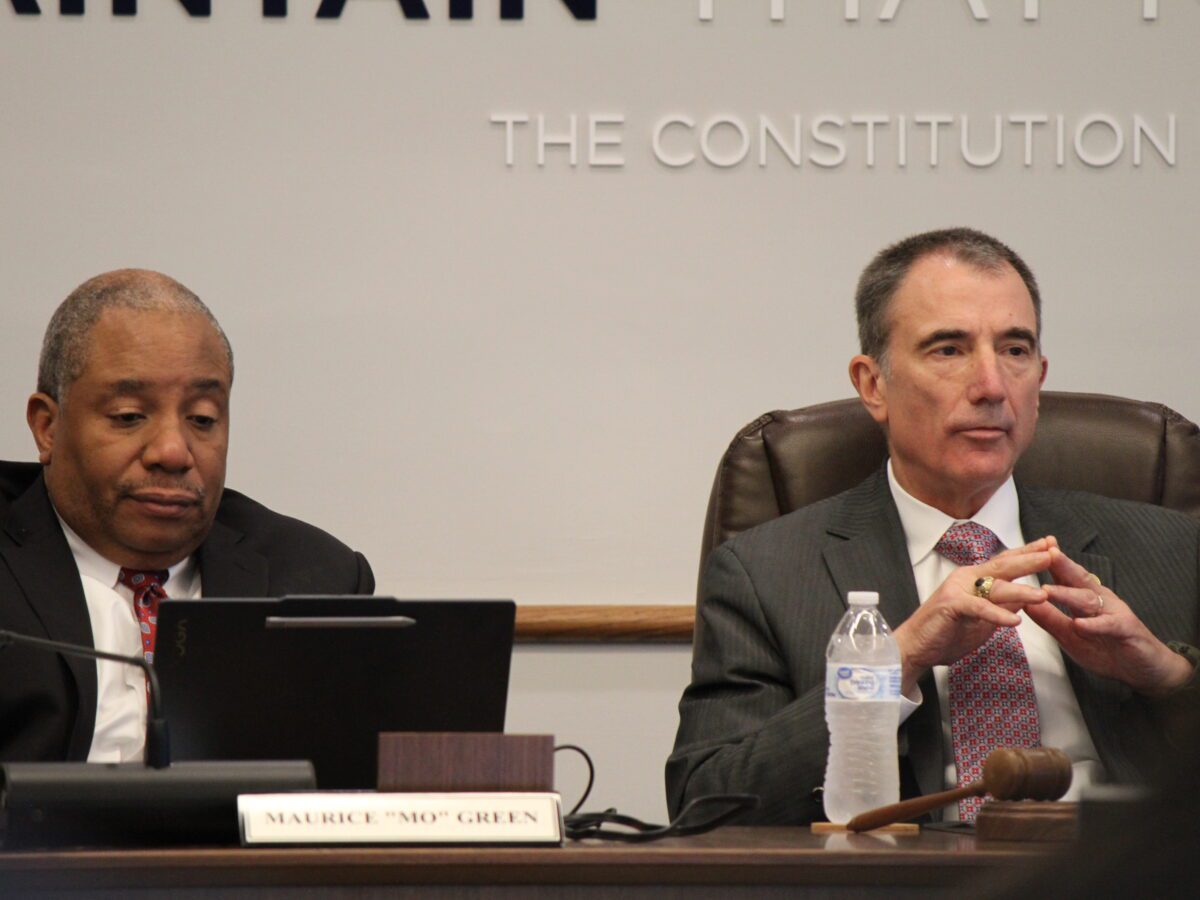
Dr. Thomas Tomberlin, senior director of DPI’s Office of Education Preparation and Teacher Licensure, presented the data at the State Board of Education’s March meeting on Wednesday.
“We do not consider this a large difference. It’s not substantive. It probably represents just the kind of wobble changes in the data from year to year,” Tomberlin said. “We don’t think anything positive or negative is happening in regard to attrition from the previous year.”
Attrition rates were highest among the newest and most experienced teachers. In 2024-25, between 14% and 18% of teachers with 5 years of experience or fewer left the profession, compared with 15.5% to 25% of teachers with 30 years in the field or more.
“This year’s report reinforces the importance of addressing the core issues that lead to teacher attrition,” Superintendent Maurice “Mo” Green said in the release. “Our public schools cannot be best in the nation if our teachers are not adequately compensated, trained and revered. It will take action from the North Carolina General Assembly, the North Carolina Department of Public Instruction and our schools to strengthen the education profession.”
The teacher vacancy rate for 2024-25 was 7.4%, a decrease from 7.6% in 2023-24. Tomberlin said that most of these vacant roles are being filled by educators with temporary licenses or by rehired retirees.
“Unfilled positions, positions that the districts have not yet been able to hire for, represents about 1,000 classrooms across the state, or 1.2% of our positions,” Tomberlin said.
During the 2024-25 school year, the attrition rate for principals was 6.1%, or 151 of the state’s 2,482 principals, according to the report. Nearly 60% of those who left the profession retired.
Of the remaining principals who did not leave employment in North Carolina public schools, the vast majority — 92.4% — remained employed as principals, DPI said. Another 4.3% moved to a district-level role.
Year after year, vacancies and attribution rates vary across regions, shaped by a range of factors, from the supply of teachers in a district to issues within a specific school. EdNC has reported extensively about the state’s teacher pipeline — and the context behind these numbers.
You can see DPI’s full presentation on the data here. You can read the full report to the General Assembly here.
Educator preparation programs
Officials from DPI’s Office of Licensure and Educator Preparation also presented a 2024-2025 report for the General Assembly on Educator Preparation Programs (EPP).
The report highlights the yearslong drop in the share of new teachers being trained through North Carolina’s EPPs, which stood at 35% in 2025 — down from nearly 60% in 2021.
Growing shares of teachers entered the profession through other routes, the report says, such as emergency licenses, out-of-state programs, or international recruitment.
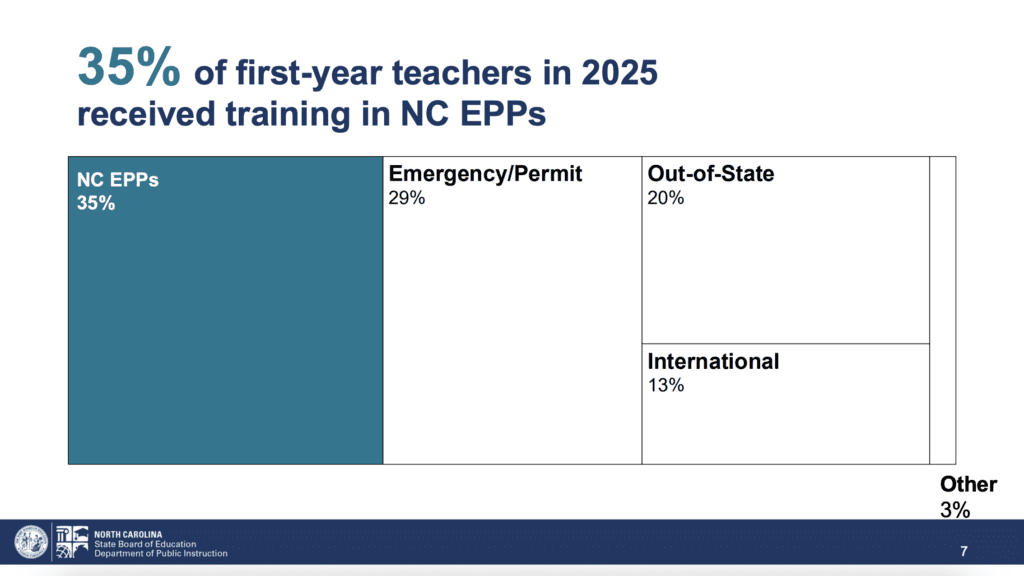
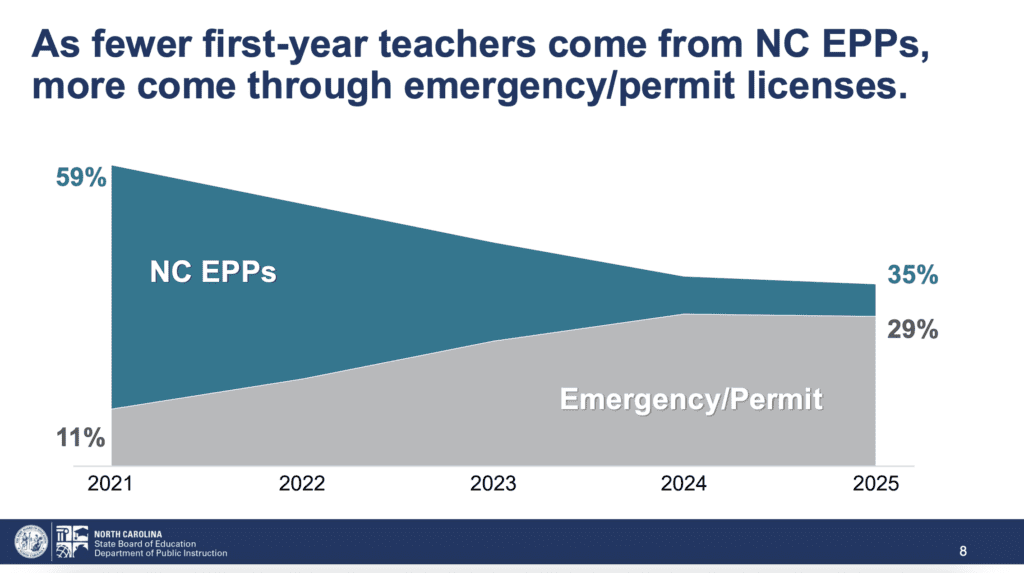
This trend is occurring while more North Carolinians are enrolling in the state’s EPPs — a 25% increase in the past decade, with 5,825 enrolling in 2024-25.
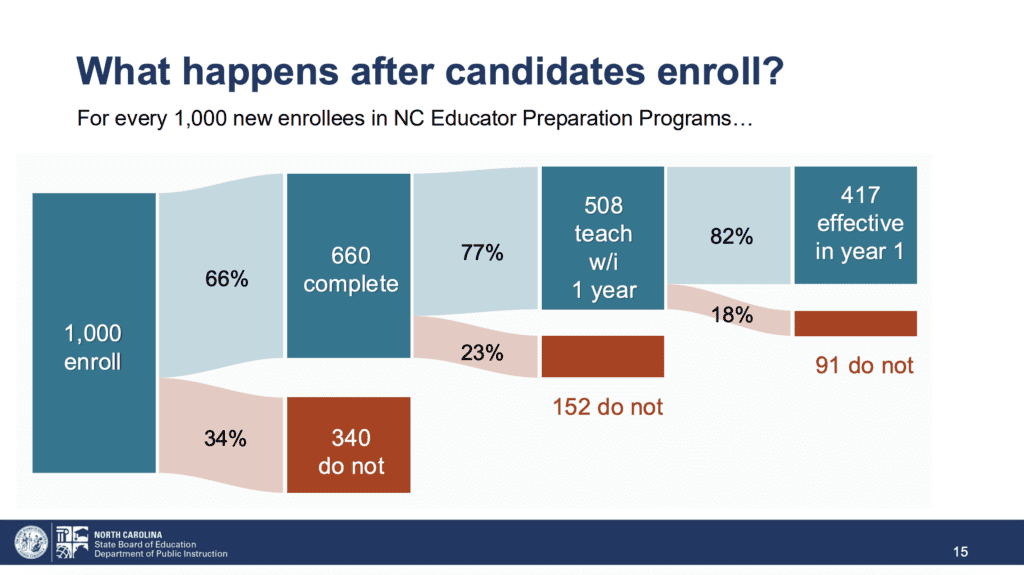
Using a cohort of 1,000 prospective teachers as an example, officials said that of the 660 who complete an EPP, only 417 of 1,000 become effective first-year teachers in North Carolina classrooms.
“Is our North Carolina educator preparation pipeline providing enough, freshly minted, brand new teachers to replace those who are leaving? The answer is no,” said Dr. Andy Baxter, an educator preparation data analyst at DPI.
Cooperative Innovative High Schools
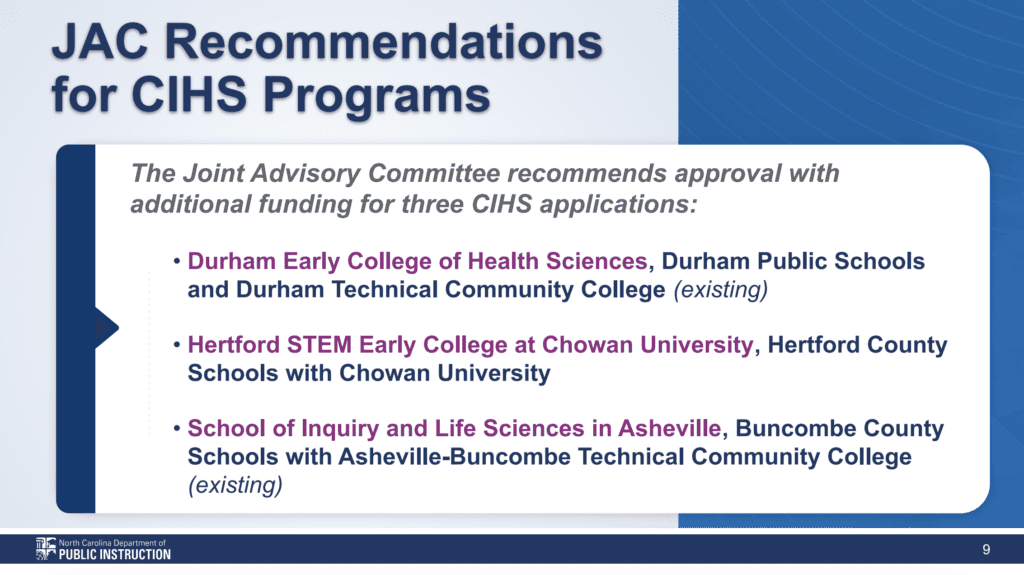
The Board heard three applications for approval regarding Cooperative Innovative High Schools (CIHS) in North Carolina.
- Durham Early College of Health Sciences, focused on nursing, allied health, surgical technology, and clinical research, applied to redesign its existing middle college model into an early college for grades 9-13.
- The creation of Hertford Early College at Chowan University, which would become the county’s second early college and focus on STEM pathways such as agribusiness, health care, advanced manufacturing, IT, and analytics.
- The School of Inquiry and Life Sciences, a long-standing early college, requested supplemental funding to expand programming, add another grade level, and hire a college liaison.
The Board will vote on the applications for approval next month, followed by a vote for approval by the State Board of Community Colleges and the Independent College Governing Board. Final authorization and funding will have to come from the General Assembly.
2026 legislative priorities
Geoff Coltrane, senior director of Government Affairs and Strategy, also presented updates to the Board’s legislative priorities approved last month.
The legislative priorities now reflect DPI’s goal to raise teacher pay by at least 8% — matching the state House of Representatives’ budget proposal.
Coltrane said that after collecting additional data, some requests’ budget estimates increased. He also said the Board’s short session budget priorities would include $655,000 in funding for the three new CIHS applications.
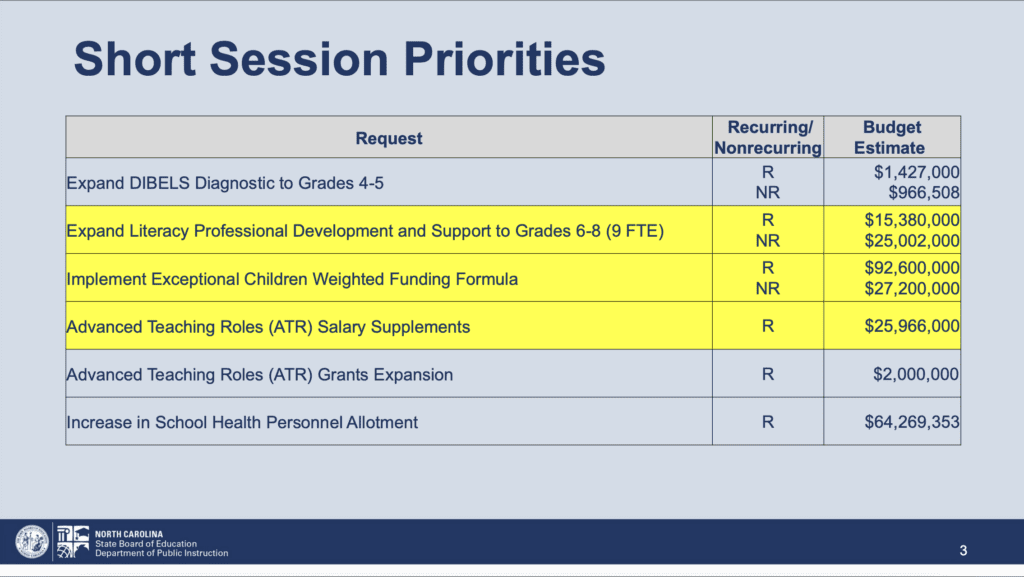
He also recommended the Board maintain its $150 million budget request to replace student devices and maintain a 1-to-1 device ratio. The Board had originally approved the request despite some members’ requests for additional data.
Coltrane said that after reviewing Digital Learning and Media Inventory (DLMI) survey data, DPI concluded that 384,000 devices would have to be replaced this school year. In that survey, districts reported having only enough funding to replace 13.5% of those devices.
Coltrane said his team had recommended an estimated $400 price for each device, chosen at the time the DLMI survey was produced. Since then, however, DPI officials say costs of devices have gone up around 30%.
You can read more about the Board and DPI’s legislative priorities here.
Charter transportation grant program
Board members approved a recommendation from DPI’s Office of Charter Schools to request additional funding for the Charter School Transportation Grant Program.
Created in 2021, the grant reimburses up to 65% of eligible transportation expenses for charter schools with at least half of their students coming from households eligible for free or reduced-price lunch.
Schools reported $8.8 million in eligible transportation expenses this school year — up from $8.1 million last year — far higher than the available $2.5 million in funding. Schools received about 31% of their eligible expenses, or less than half the 65% originally intended to be covered by the grant, according to DPI’s report.
DPI’s recommendation was to double the grant funding to $5 million and create an additional $2.5 million transportation grant for charter schools’ summer programs.
Teacher and principal supplement programs
The Board also approved a recommendation to expand eligibility for the Principal Recruitment Supplement Program, which provides a three-year $30,000 pay supplement to effective principals who move to lead low-performing schools.
Under current state law, participating principals have to move to one of the state’s 124 schools in the state’s bottom 5% of performance. Under DPI’s recommendation, principals would be able to move to any of the state’s low-performing schools, expanding the pool of eligible schools.
The Board also approved a report on the state’s Supplemental Funds for Teacher Compensation program, which provides salary supplements to educators in lower-wealth school districts. For the 2025-2026 school year, around $200 million was appropriated, with roughly $186.6 million distributed to public school units and the remainder allocated to charter schools.
According to the report, districts provided an average bonus of $2,125 per teacher. In a survey, 62% of districts said these bonuses have helped improve teacher recruitment and retention.
“Durham, Guilford, Mecklenburg, Wake, New Hanover, Forsyth, Asheville City, and Buncombe County Schools were not eligible for Supplemental Funds for Teacher Compensation under the legislation and, therefore, were not included in this report,” the report says.
Read more
Other business
- The Board heard a report on the Feminine Hygiene Products Grant Program, which helps schools fund menstrual products for students experiencing poverty. During the 2026 fiscal year, DPI used its $500,000 funding pool to award grants of $100-$5,000 to 138 districts, or around 40% of applicants.
- The Board approved 56 grants to districts using funds from the $3 million Homeless Extraordinary Transportation Grant for the 2025-2026 school year. The grant helps districts cover up to half of their transportation costs for students experiencing homelessness or living in foster care. Districts have previously reported using the funds to pay for fuel, bus driver salaries, and transportation contracts. Alex Charles, senior director of DPI’s Office of Federal Programs, said North Carolina had 39,248 homeless students in the previous school year, and that the federal government had recently notified DPI that the state has one of the highest numbers of homeless students in the nation.
The full Board meets next April 1-2.

Recommended reading