
EPIC study explores impact of high rates of absenteeism in NC schools on learning


A 2026 research paper from the Education Policy Initiative at Carolina (EPIC) at UNC-Chapel Hill examined how “student absences influence instructional practices, classroom environments, and measures of teacher performance and retention.”
According to previous reporting by EdNC, rates of absenteeism in North Carolina public schools have not returned to pre-pandemic levels. State data found that chronic absenteeism peaked during the pandemic at 31% and was around 24% in the 2024-25 school year.
In North Carolina, chronic absenteeism is defined as missing 10% or more days of school — including both excused and unexcused absences. The average North Carolina student missed 13.1 days of instruction in the 2024-2025 school year, compared to an average of 9.8 days pre-pandemic.
The EPIC study found that student absences significantly “disrupt” instruction, teaching working environments, and teacher performance. Their findings, which are detailed below, “signal a need for education officials to recognize the broader impacts of absences and take action to support educator well-being and success.”
“Absenteeism should be understood not only as a student outcome, but also, as a condition that shapes broader educational contexts and environments,” says the study. “Efforts to reduce absenteeism may therefore offer benefits — e.g. improved instructional practice, more manageable workloads for educators, stronger teaching and learning environments — that extend beyond individual students.”
 Sign up for the EdDaily to start each weekday with the top education news.
Examining the effect of absenteeism
The study was based on data from the North Carolina Department of Public Instruction (DPI) on information regarding students, educators, and schools. Researchers also conducted interviews with 22 educators, including teachers, principals, assistant principals, counselors, and social workers, from the 2025-26 school year, from five public schools and four districts.
Researchers examined the following questions:
- How have the average number of student absences experienced by teachers changed across the pre- and post-COVID periods?
- How have elevated student absences influenced instructional practices and classroom environments?
- How have elevated student absences influenced teacher performance and retention?
Related reads



Differences in student absence rates before and after COVID
Across the state, student absence rates remain high. However, the data presented in the study found differences in absenteeism rates across grade levels.
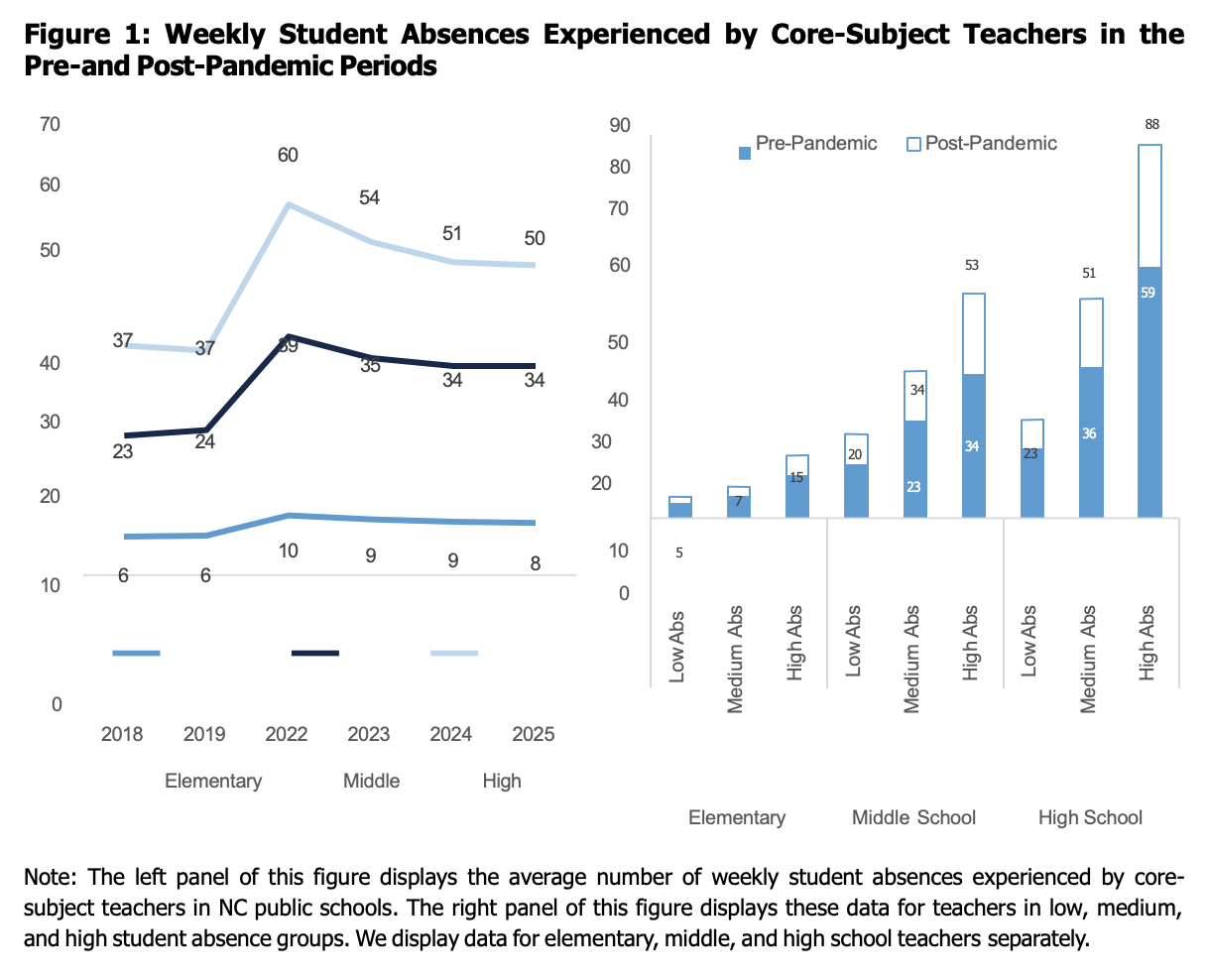
For instance, elementary school teachers are experiencing less of an increase in absence rates compared to pre-pandemic rates than their middle and high school counterparts. Elementary school teachers in the “low absence” category only had one more student absent on average each week.
Average absenteeism rates were much higher for middle and high school. The average middle school teacher experienced about 34 student absences each week, and the average high school teacher had about 50 student absences a week. That’s 11 more student absences now compared to the pre-pandemic data for middle school and 13 more for high school.
In the high absences category, however, the rates were more severe.
“Middle and high school teachers in the high absence category are experiencing 19 and 29 more absences per week. For high school teachers in this category, this is equivalent to approximately six more student absences each day and 1,000 more student absences across the school year,” says the study.
See the charts below for more on absence rate trends over the last few years:
How student absences affect the classroom
During interviews with educators, researchers found that these higher absence rates have a negative effect on the following classroom and teaching conditions:
- Instructional continuity
- The balance of tasks undertaken by teachers
- The emotional strain of teaching
When students are absent, instructions keeps going for their peers who are in class. When the students come back to class, teachers are tasked with helping the previously absent student catch up while simultaneously continuing the education of their peers, who are at a different point in the instruction.
When students were absent for a long time, interviewed teachers said they “struggled to balance the needs of students who were present with those who had missed substantial time.”
“(Educators are) actually putting out a lot more work because it’s time to move on as a whole, but they may find themselves backtracking or giving out more paperwork, printing more things and by the time they think that they’ve moved on, they still got to catch another student up,” said one of the interviewed counselors. “So, it’s like working two times extra to keep everyone up to par, or they may be staying later to do one on one with that student.”
Related reads


These disruptions, however, were not just limited to when students were absent for long periods of time.
“Educators reported that teachers frequently managed classrooms where different students missed instruction on different days, resulting in on-going cycles of instructional catch-up,” says the study.
Increased absences have also added to the workload of teachers in North Carolina. For instance, many interviewed educators explained they were now expected to “allocate more of their time towards encouraging student engagement, addressing attendance concerns, and attempting to communicate with families and coordinate supports.” They also had to spend their time tracking classroom absences, preparing make-up work, and adjusting instruction timelines and material deadlines.
Educators also reported that increased absences “reshape the emotional work of teaching.”
“Participants expressed frustration, discouragement, and emotional strain when students missed substantial instructional time,” says the report.
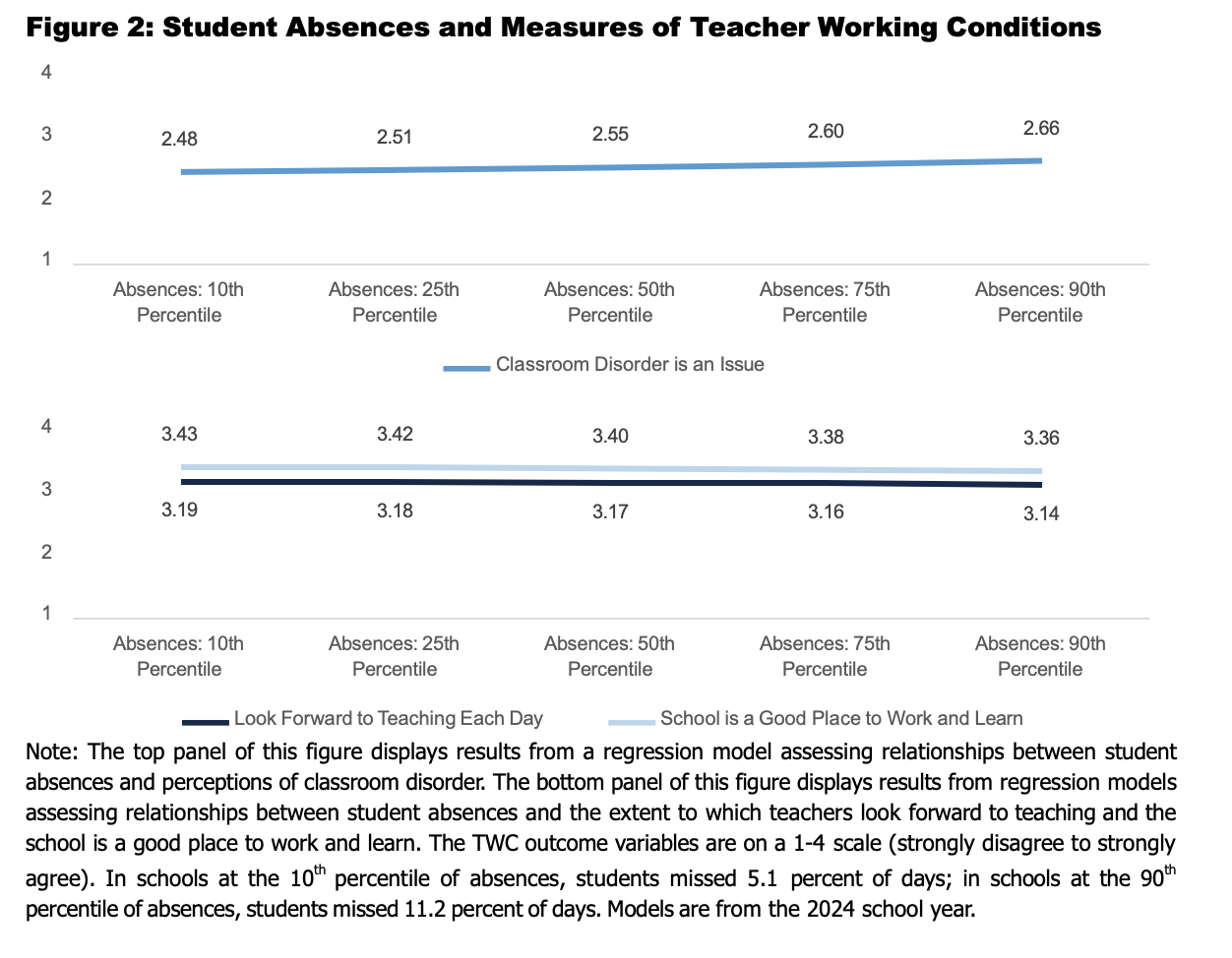
Teacher satisfaction, as measured by the 2024 NC Teacher Working Conditions survey, was found to be negatively influenced by student absences, as well — with perceptions of classroom disorder being higher when schools have higher absenteeism.
Educators were also less likely to describe their school as “a good place to work and learn” and less likely to “look forward to teaching each day” when they worked at a school with higher rates of absenteeism. Explore the charts below to learn more.
How student absences affect teacher performance and retention
Student absence rates were also found to have an impact on measures of teacher performance. Using data from the NC Educator Effectiveness System (NCEES) and Education Value-Added Assessment System (EVAAS), researchers estimated the relationship between student absenteeism and teacher value-added.
The study found a statistically significant, “but very modest relationship,” between the student absences experienced by teachers and their NCEES ratings.
Teachers who experienced low absenteeism levels (in the 10th percentile) had an average evaluation ratings of 3.75 on NCEES. For teachers who experienced high absenteeism level (in the 90th percentile), their NCEES rating dropped to 3.73.
However, the study found that student absence rates had a more obvious impact on teacher performance when EVAAS results were considered. For teachers in high-absence environments, their score, when compared to a teacher in a low-absence environment is similar to the difference in “value-added estimates between a first- and second-year teacher.”
The study found no relationship between the number of student absences experienced by a teacher and whether they would return to teaching at their school or another North Carolina public school.
Statewide efforts to reduce chronic absenteeism
The nonprofit Attendance Works put forward a national challenge to reduce chronic absenteeism by 50% by 2030, and in North Carolina, DPI took up that goal by launching the statewide initiative, AttendNC Counts.
Dr. Shaun Kellogg, senior director of the DPI Office of Research and Promising Practices, recently explained to the State Board of Education that DPI has conducted research on best practices across the state, providing “research-based planning guides, resources, reports for schools and districts.”
On the AttendNC Hub, DPI has assembled a number of tools for “districts, schools, and community partners” to implement as the state attempts to tackle the major issue of chronic absenteeism, including a list of practical tools, lessons from Bright Spot schools, data products, and communities of practice materials.
You can explore their tools here.