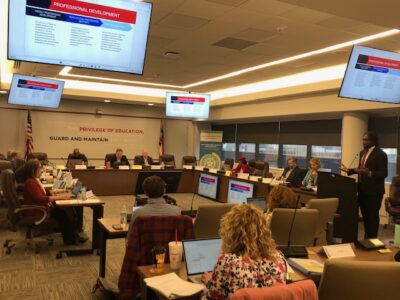
North Carolina’s Charter Schools Review Board (CSRB) approved renewals for 37 charter schools at its meeting on Monday, Jan. 12. The schools comprise nearly 18% of the state’s 211 charter schools and represent the “largest number of renewals” in recent years, according to Bruce Friend, the CSRB’s chair.
Twenty schools received 10-year renewals, the longest term available.
One of them, Paul R. Brown Leadership Academy, was lauded as a salient example of academic revival. “This was a school that was on life support a few years ago — and then (had a) miraculous turnaround,” Friend said.
 Sign up for the EdDaily to start each weekday with the top education news.
In addition to the 10-year renewals, three schools secured seven-year renewals, while nine earned five-year renewals. North Carolina’s two virtual charters, which together serve over 6,300 students, were among the five-year renewals.
Five schools earned three-year renewals, the shortest term.
Votes on two schools were delayed due to audit or compliance concerns.
The CSRB this month also approved tougher requirements for schools in their planning or “Ready to Open” (RTO) year. Concerns over faltering student enrollment at new schools, along with recent mid-year closures, fueled the changes.
“Our office’s goal is to have a program that is very effective, that creates strong schools,” Ashley Logue, the executive director of the Office of Charter Schools (OCS), said as she outlined the data-driven revisions.
CSRB member Todd Godbey commended the proposals. “Hope is a strategy” for a lot of charter boards, he said, but they also need data, policies, and structures.
“We want to nurture one without killing the other … The work that you guys are doing is getting us closer and closer to doing that,” he said.
Charter renewals and financial reviews
For some schools, the renewal vote was a mere formality. According to statute, the CSRB must renew a charter school for 10 years, unless one or more of the following conditions applies:
- The charter school has not provided financially sound audits for the immediately preceding three years.
- The charter school’s student academic outcomes for the immediately preceding three years have not been comparable to the academic outcomes of students in the local school administrative unit in which the charter school is located.
- The charter school is not, at the time of the request for renewal of the charter, substantially in compliance with state law, federal law, the school’s own bylaws, or the provisions set forth in its charter granted by the CSRB.
If one of the above conditions applies, the CSRB may decide on a shorter term or elect not to renew the charter.
The CSRB may also consider academic comparability between a charter school and the local district for various student subgroups. The State Board of Education’s charter renewal policy defines comparability as having a “proficiency score that is no less than 5 points of the local school administrative unit’s Composite score based on the EOG/EOC courses offered.”
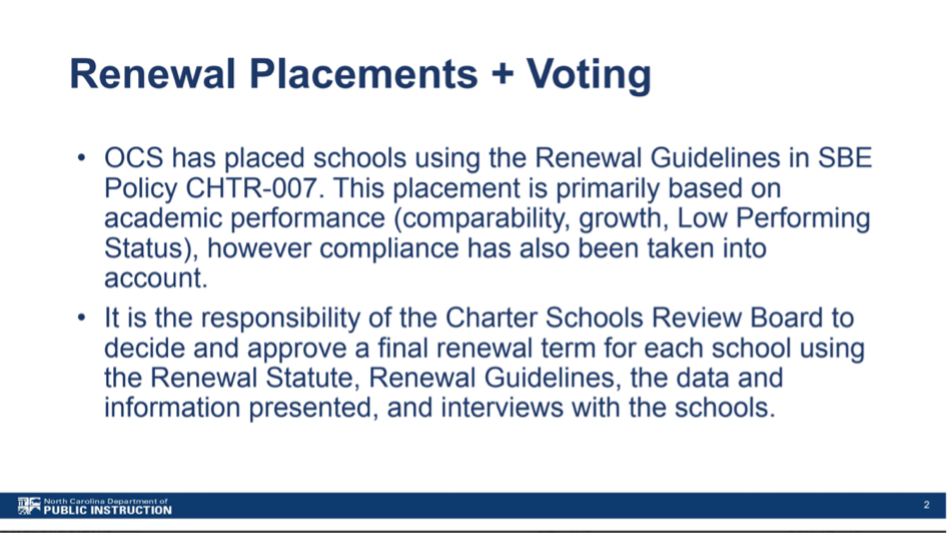
To guide voting, OCS recommends renewal terms based on State Board policy. But the CSRB retains final authority for renewal decisions.
Prior to voting, Amanda Fratrik, director of the Office of School Business at the Department of Public Instruction (DPI), provided a financial review of the 2026 renewal schools. Thirty-four schools had no financial compliance issues.
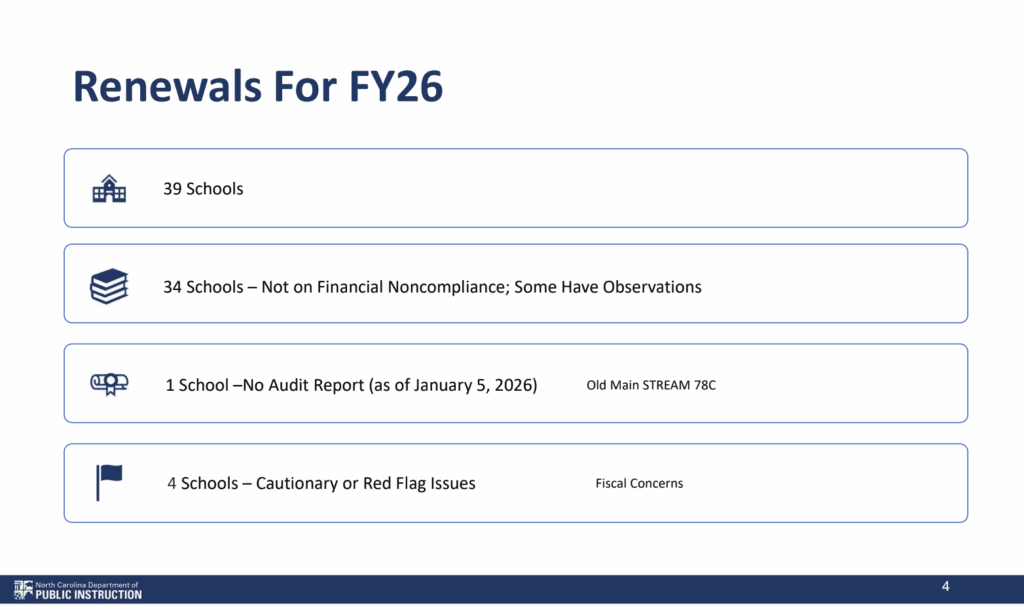
However, DPI had placed four charter schools on financial noncompliance status, Fratrik said.
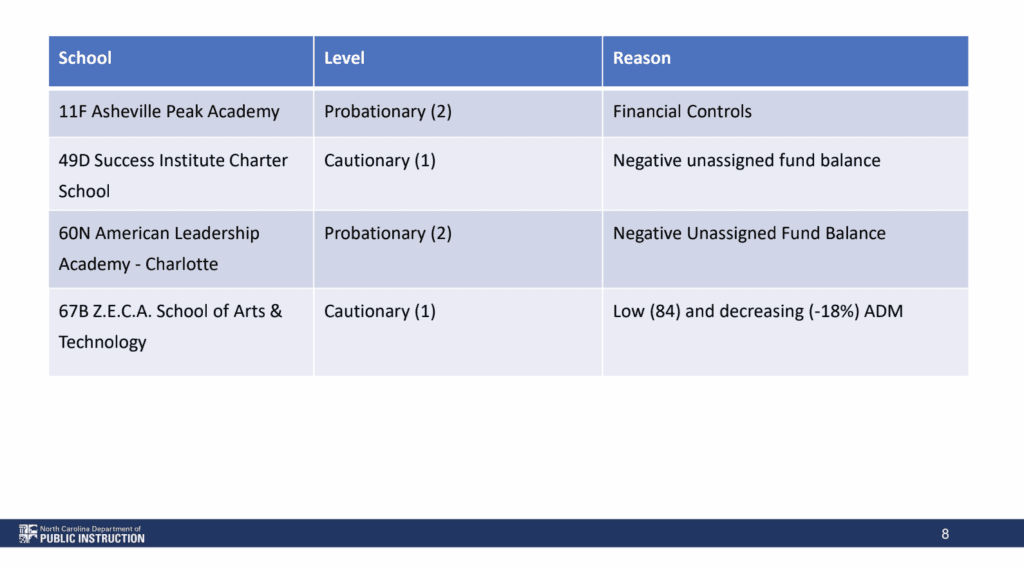
Asheville PEAK will likely be removed from financial noncompliance soon, she said. Success Institute has had a negative unassigned fund balance for two consecutive years, she noted, but the school is receiving growth funding due to its uptick in enrollment.
DPI’s concerns over Z.E.C.A.’s financial position are due to low enrollment, she said. With just 84 students, the school is worryingly close to the 80-student minimum required by statute.
About ALA-Charlotte, Fratrik noted, “If I had to say one I was most concerned about, it might be this one.”
The school has a “very large” unassigned negative fund balance, she added, which has “persisted last year and this year, and has grown significantly.”
Ten-year renewals
The CSRB granted these 14 charter schools automatic 10-year renewals, based on their alignment with statutory criteria:
- Clover Garden School
- New Dimensions School
- Davidson Charter Academy
- Wake Preparatory Academy
- FernLeaf Community Charter School
- Bradford Preparatory School
- Pioneer Springs Community School
- Unity Classical Charter School
- Telra Institute
- Moore Montessori Community School
- KIPP Pride College Preparatory
- Roxboro Community School
- Faith Academy Charter School
- Carolina Charter Academy
Old Main STREAM Academy also met 10-year renewal requirements, according to the OCS renewal presentation. However, the school had not submitted its Fiscal Year 2025 audit as of Jan. 12, according to Fratrik.
As a result, the CSRB delayed the school’s renewal vote until next month.
The CSRB also awarded these six charter schools a 10-year renewal, based largely on their academic performance:
- Institute for the Development of Young Leaders (IDYL)
- Girls Leadership Academy of Wilmington (GLOW)
- Paul R. Brown Leadership Academy
- Concord Lake STEAM Academy
- Commonwealth High School
- Stewart Creek High School
IDYL has exceeded growth for each of the past three years and was comparable to the district for two years.
“Truth be told, the only reason they’re not in the (legislative) criteria for a 10-year is three years ago, they were six points from their LEA (district), and the criteria we’ve been using is five,” Friend said.
GLOW “has exceeded or met growth each of the prior three years,” he noted, and has “very strong subgroup comparability to other schools in their area.”
Paul R. Brown Leadership Academy has met or exceeded growth for the past three years and has been comparable to the district for two years. The school also posted “outstanding” student subgroup data, CSRB member Rita Haire said.
“They have made wonderful strides and certainly have taken this school from … last in place in the county … to second of all schools in the county,” Godbey said.
Concord Lake STEAM Academy was comparable to the district for two of the past three years, CSRB members said — and came close another year. The school has met or exceeded growth all three years.
OCS had recommended each of the schools above for a seven-year renewal.
The two other schools earning 10-year renewals — Commonwealth High School and Stewart Creek High School — are alternative charters specializing in dropout prevention and recovery. They are evaluated according to an alternative accountability model.
“Our guidelines really aren’t set up for comparison when it comes to the alternative schools,” Friend said.
Both schools are rated “highly effective” under their accountability model, Haire said. “They’re actually in the business of rescuing students.”
“A big part of the charter movement ought to be addressing populations that maybe the traditional public schools can’t serve,” CSRB member Eric Guckian said. “This is a shining example of that, and I think we ought to support it.”
OCS had recommended both alternative schools for five-year renewals.
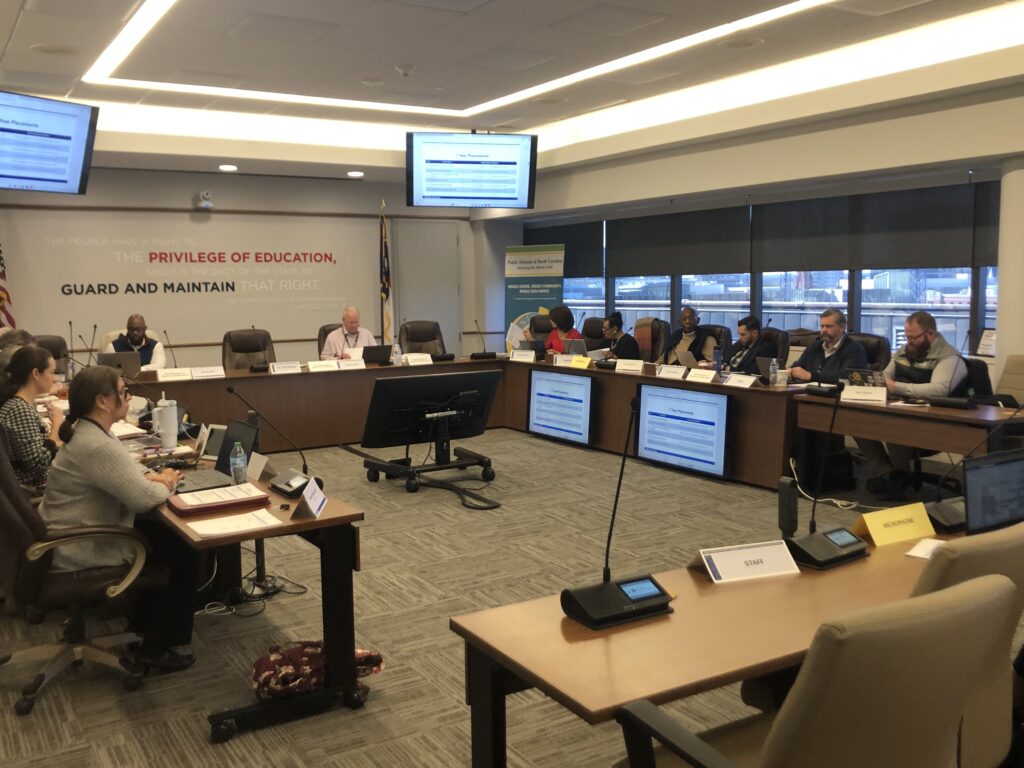
Other renewals
The CSRB approved seven-year renewals for three schools: Gate City Charter Academy, Success Institute Charter School, and Thomas Academy Charter School.
CSRB renewals for the first two schools were in line with OCS recommendations.
While OCS had recommended Thomas Academy for a three-year renewal, the CSRB believed the alternative charter school did not fit within guidelines around district comparability and warranted a significantly longer term. Thomas Academy serves students in foster care.
“They do meet a very, very specific need in the county,” CSRB member Lindalyn Kakadelis said.
Nine charters secured five-year renewals, including seven brick-and-mortar schools, listed below:
- Crosscreek Charter School
- ALA-Coastal
- Union Day School
- Raleigh Oak Charter School
- Next Generation Academy
- Summit Creek Academy
- Classical Charter Schools of Wilmington
Renewals for the first four were in line with OCS recommendations. However, OCS had recommended Next Generation Academy, Summit Creek Academy, and CCS-Wilmington for shorter, three-year renewals. Those schools are continually low-performing.
Low-performing (LP) schools have received either D or F performance grades and a growth status of met or not met, according to state guidelines. Continually low-performing (CLP) schools have been low-performing for two of the past three years.
In awarding the longer terms, CSRB members cited positive growth and enrollment trends for Next Generation Academy. Summit Creek Academy earned a five-year renewal based on academic growth and district comparability data.
CSRB members said CCS-Wilmington had met academic growth for each of the last three years and was serving its student population, most of whom are economically disadvantaged, well.
North Carolina’s two virtual charters, NC Cyber Academy and NC Virtual Academy, also earned five-year renewals. Both have operated under the state’s virtual charter school pilot since 2015, but that is slated to end this year.
Legislation allows the pilot schools to apply for renewal as remote charter academies, stipulating that renewal terms must be set at five years.
During discussion, CSRB members expressed a need for separate guidelines for the virtual charters. They also voiced concern about the schools’ performance and wished for more contextual data around the student population and achievement.
Both virtual charters are continually low-performing schools, according to OCS.
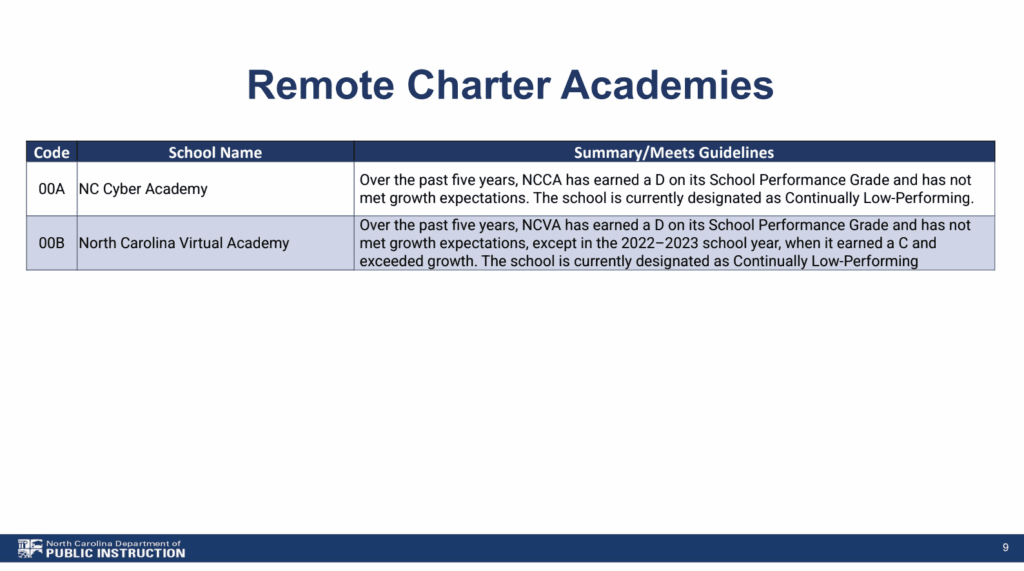
“If a brick and mortar school (was) in front of us with that kind of academic performance, we would pick them apart to understand all of those pieces and hold them accountable for it,” Godbey said.
A veteran of online education, Friend referenced the “high fluidity” of the virtual student population. “In some states, these schools are actually given alternative status because of the very nature of the students that they’re serving,” he said.
“That’s not an excuse,” he added, but noted “it is a different model than what you find at a traditional school.”
In a press release distributed after the CSRB’s vote, Martez Hill, the superintendent of NC Cyber Academy, said the school “has the largest CTE (Career and Technical Education) program of any charter school” in North Carolina. Hill served as the State Board of Education’s executive director from 2010 to 2017.
Read more
Five schools also earned three-year renewal terms:
- Asheville PEAK Academy
- The Experiential School of Greensboro
- Iredell Charter Academy of Arts & Science
- ALA-Charlotte
- Z.E.C.A. School of Arts and Technology
Renewal terms for each of these schools aligned with OCS recommendations. With the exception of Asheville PEAK, all of the schools are continually low-performing.
Several schools prompted extended discussion, however.
CSRB members also considered DPI feedback regarding Asheville PEAK’s service to EC (Exceptional Children) students. Asheville PEAK is still addressing noncompliance issues and has a fully virtual EC staff, which has posed challenges for the school, DPI leaders said.
CSRB members discussed ALA-Charlotte’s financial noncompliance status as well as its academic performance. However, they noted that the school met growth in each of the past three years and has moved its performance grade from an F to a D.
“They’re trending in the right direction as far as their proficiency data,” said Haire.
According to Jenna Cook of OCS, Rocky Mount Preparatory Academy met some stipulations placed on its prior renewal by the State Board of Education. However, the school did not meet its academic growth stipulation. In addition, she said, Rocky Mount Prep has some ongoing compliance concerns and “pretty significant” audit report findings that included paying employees at the incorrect rate. Over half of the school’s teachers are not licensed.
Ultimately, the CSRB chose to delay its vote on Rocky Mount Prep’s renewal until February, following an appearance from the school’s board.
“We’re not ready to vote for some type of closure, but we also don’t want to repeat the three-year (renewal) with stipulations that don’t get fulfilled,” Haire said.
RTO revisions
New schools will face more intensive review prior to opening, based on changes the CSRB approved this month.
Moving forward, OCS will provide the CSRB with detailed “readiness reports” in May and June, assessing facility and other factors. Best practice guidelines for break-even budgets will specify a minimum enrollment of 100 students. In addition, OCS will assess readiness based on three enrollment tiers.
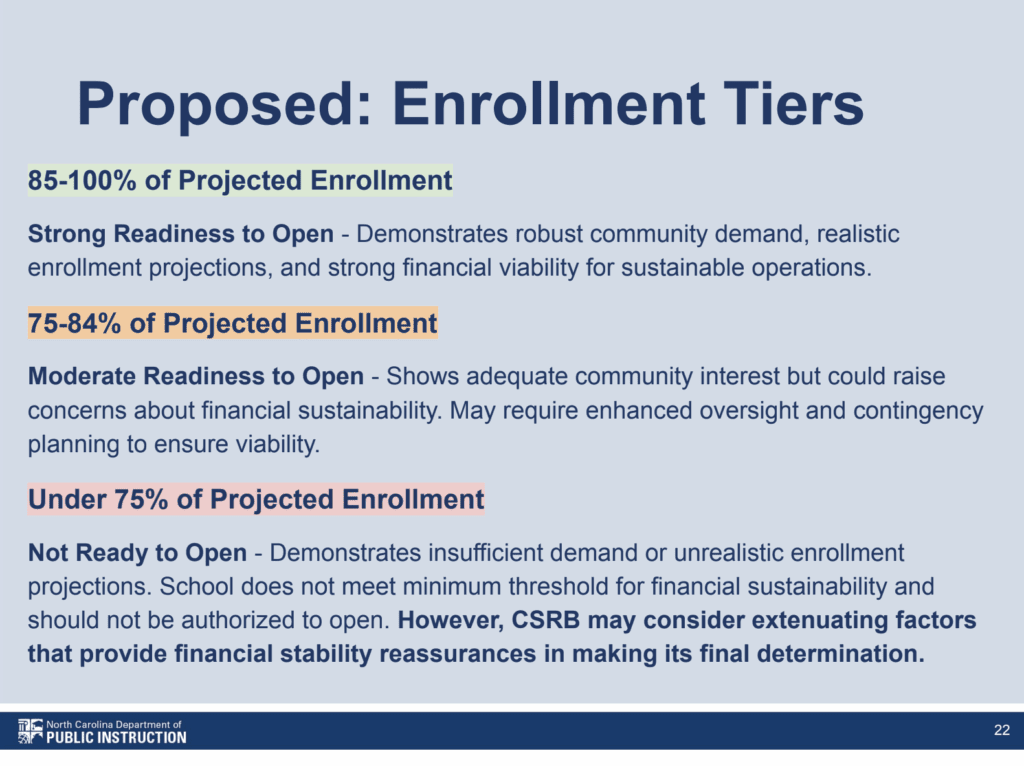
Schools below 75% of their projected enrollment will be deemed “not ready to open,” although the CSRB may evaluate “extenuating factors.”
At-risk schools will also be required to present virtually to the CSRB earlier, coming in May rather than June.
The CSRB supported the revisions but said even more needed to be done to optimize charter success.
“This is a starting point,” Friend said, suggesting the CSRB should look broadly at the pre-application through opening process.
A school that faced closure is back on track, and other business items
Leaders from Community School of Digital and Visual Arts (CSDVA) in Durham also provided an update on school improvements. The school’s prognosis last year was perilous: The CSRB voted in January 2025 to close it down, citing financial and noncompliance concerns. However, CSDVA appealed the decision to the State Board of Education, which remanded the matter back to the CSRB to consider additional information.
In April 2025, the CSRB granted CSDVA a three-year renewal with stipulations around board governance, reporting, and compliance.
Now, CSDVA is “on track completing or in progress with all of their stipulations,” Cook said in her introductory presentation.
School leaders outlined substantive leadership changes and said they were working to address a downturn in enrollment, which they attributed to the renewal process.
Finally, the CSRB this month approved HYPE Leadership Academy’s request for a second delay. School leaders said they were unable to secure a suitable facility.
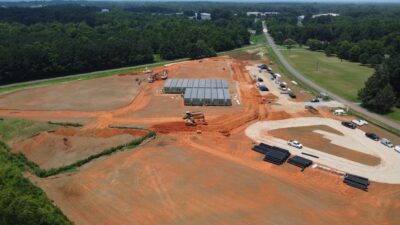
HYPE planned to open in Hoke County in 2025 but now is slated for a 2027 launch.
CSRB members discussed the implications of ongoing delays.
“I’d like … for us to articulate the fact that when we do these delays, it will be at least four years from the approval” to opening, Haire said.
That timeframe means shifts in numbers and budgets are inevitable.
“We need to give this some thought as to how many delays we allow … before we determine this is no longer the same application,” she said.
The CSRB meets next on Feb. 9-10.
Editor’s note: EdNC has retained Kristen Blair to cover the monthly meetings of the Charter Schools Review Board in 2025-26. Kristen currently serves as the communications director for the North Carolina Coalition for Charter Schools. She has written for EdNC since 2015, and EdNC retains editorial control of the content.

Recommended reading