
Perspective | What NC needs: A simple, compelling, and visionary model of teaching
During a routine observation of a student teacher, something stopped one of us cold — not a lesson plan or an approach to classroom management, but joy.
That afternoon, Robert Smith wrote to his colleagues: “In all my years of supervising interns, Matt Taylor is the first one that shows joy in teaching … And there is no teaching standard for teaching with joy.”
This observation raised a fundamental question: If we value students’ experience of joy in learning, why is joy absent from the standards that define good teaching?
As North Carolina works to attract and retain teachers, it needs a compelling vision of what teaching can be. In 2024-25, 44% of people hired as teachers in the state reportedly had no prior classroom experience or teacher licensure. Good teaching is both critically important and complex.
North Carolina’s Professional Teaching Standards provide the main reference for “what teachers need to know and be able to do in 21st-century schools.” Developed in 1998, with minor revisions in 2013, the standards identify important components of effective teaching and provide a useful basis for evaluating practice.
But standards alone do not answer two equally important questions: Why would someone want to become a teacher? And how does a person grow into the teacher they hope to be?
The standards describe good teaching largely from the outside looking in. They are important for evaluating practice, but they do not, by themselves, offer a compelling vision that invites people into the profession or illuminates the developmental journey of becoming a teacher.
North Carolina needs a model of teaching that invites and excites people to become teachers. The difference is like having a car manual that describes all of the car’s functioning parts without ever showing you the car. A model should help us see the whole — the beauty, grace, wonder, purpose, and pleasure of teaching.
Teacher recruitment messages often emphasize making a difference in students’ lives, sharing their love of content, finding purpose and meaning, getting to know students, and encouraging them. These are important reasons to consider becoming a teacher. But they are rarely connected to a coherent vision of teaching or to a model of how teachers develop. Instead, new teachers may encounter these ideas primarily as expectations against which their performance will eventually be evaluated, rather than as aspirations that can guide who they become.
 Sign up for the EdDaily to start each weekday with the top education news.
Discovering teaching with joy
Although we have worked in North Carolina for many years, we had not encountered a model of teaching that made joy an essential part of good teaching. Denise Ousley-Exum and Rbert Smith have worked in preservice teacher education preparing high school teachers. Jessica Harvey has taught high school students, hosted teaching interns and now serves as a Beginning Teacher (BT) Coach in Pender County Schools.
What do we mean by “teaching with joy?”
The answer begins with what Smith saw in Taylor’s classroom: joy in Taylor’s disposition, relaxed demeanor and smile; in his relationships with students; students’ engagement in learning; and in a classroom where students’ work was displayed and celebrated. Check out Creating the Teaching with Joy Network to learn more.
That observation led to a larger question: What if joy were understood not simply as a personal preference, but as part of professional practice?
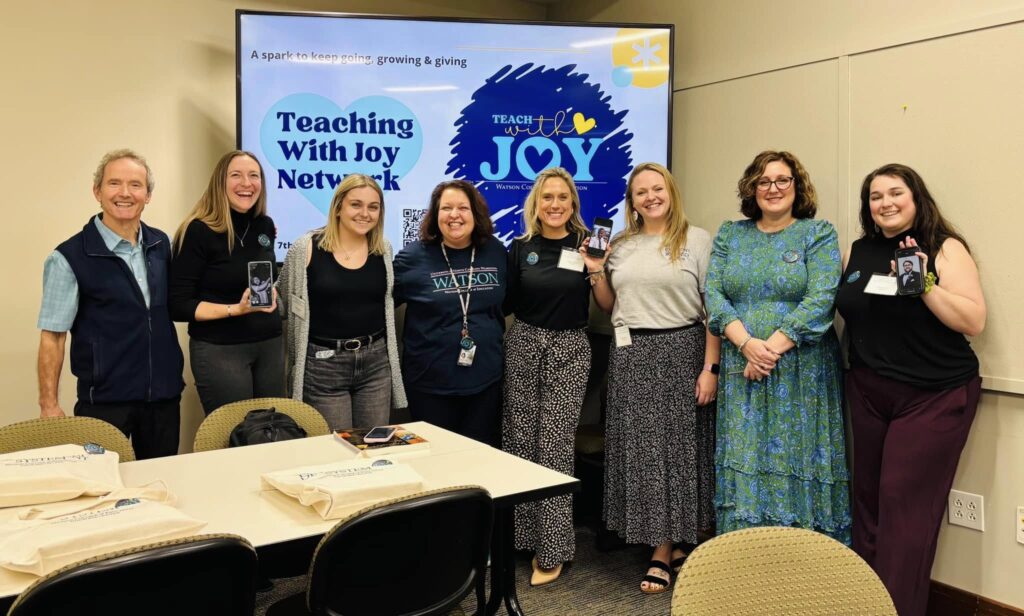
Over the next two years, Smith and Ousley-Exum explored this question and created the Teaching with Joy Network. Its founding members included seven high school teachers whom we recognized as teaching with joy. Through their experiences and conversations, the Teaching with Joy (TWJ) model emerged.
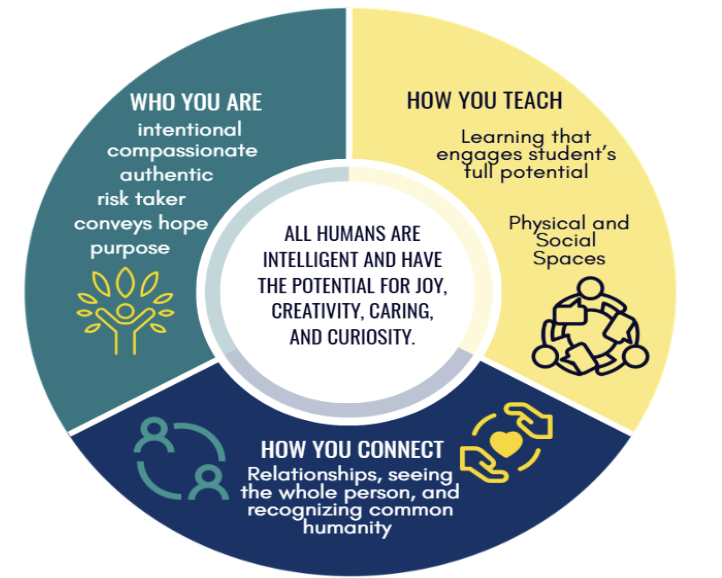
TWJ offers a simple, coherent, and memorable way to think about teaching through three interconnected questions grounded in core beliefs about our shared humanity.
- Who You Are — the teacher’s presence, mindset, purpose, and identity
- How You Connect — relationships, belonging, care, and community
- How You Teach — engagement, student voice, empowerment, and the learning environment
Rather than presenting teaching as a collection of techniques, TWJ offers a vision of the kind of teacher one can become. It is not a checklist to complete, but a model that can prompt deeper conversations and new perspectives throughout a teacher’s career.
Harvey has taken the lead in incorporating the TWJ model into beginning teacher (BT) support in Pender County Schools, working with the two other BT Coaches to support 135 BTs. Their experience offers insights into how a simple, coherent model can strengthen teacher development.
Read more



Why a model matters for beginning teachers
It gives teachers a lens, not just information.
Beginning teachers encounter an enormous amount of information, advice, strategies, and expectations. Often, what they need is not more information but a lens through which to organize it. Introduced early in their careers, TWJ can provide a common language for interpreting new ideas, connecting individual practices to larger purposes, and reflecting on their developing identities as teachers.
It can shift the emotional experience of professional growth.
Teacher development can feel like a continual search for deficiencies, especially when an observation or evaluation makes a beginning teacher feel exposed or inadequate. TWJ offers an aspirational alternative: Here is the kind of teacher you can become — not simply a list of things you need to fix.
That shift begins by recognizing what is already working. A teacher may worry about being too silly, too quiet, or different from the teacher next door. In the right context, those very qualities may be sources of connection and strength. Naming strengths does not mean overlooking areas for growth. It gives teachers a more confident place from which to grow, inviting questions such as: What is already strong here, and how can we build on it?
Repetition creates coherences and a shared language.
A shared model also helps make professional learning more coherent over time. Beginning teachers receive advice from many sources; revisiting a few enduring questions can help them connect that advice to a larger vision.
The model also gives coaches and mentors ideas they can return to with increasing depth as teachers gain experience. For example, “What does belonging look like in your classroom?” can open a meaningful conversation at many stages of a career.
The concept remains relevant even as a teacher’s understanding and practice become more sophisticated.
TWJ connects the why of teaching to the what.
Instead of simply advising a teacher to give students more choice, a coach can connect that practice to a larger belief: Students are capable, intelligent, and worthy of having a voice in their learning. The strategy then becomes more than a technique; it expresses a philosophy of teaching.
It supports professional identity, not just instructional technique.
Beginning teacher support often focuses on strategies: classroom management, lesson planning, assessment, differentiation, and engagement.
These are important, but TWJ adds another question: Who do I want to be as a teacher?
The answer to that question can serve as a north star — not only in the early years, but throughout a career. The three dimensions — Who You Are, How You Connect, and How You Teach — invite teachers to understand teaching as both a profession and a process of becoming.
It reduces the cognitive load of professional learning.
Beginning teachers can easily become overwhelmed by the sheer volume of good advice they receive. TWJ does not make teaching less complex, but it gives beginning teachers a few fundamental questions to return to: Who You Are. How You Connect. How You Teach.
Those questions can help teachers make sense of new strategies without losing sight of the larger purposes behind them.
Read more



A vision for North Carolina
The potential of TWJ extends beyond beginning teachers. A compelling model of teaching could provide a common language for recruitment, teacher preparation, mentoring, professional development, and ongoing growth.
North Carolina has standards for describing and evaluating teaching. What it needs alongside those standards is a vision of teaching that people want to join and that teachers want to grow into.
Teaching with Joy offers one possibility: a vision grounded in relationships, human connection, student empowerment, meaningful learning, and the joy of becoming a teacher who helps young people flourish.
North Carolina has an opportunity to place a compelling model of teaching at the center of the teacher journey — from why someone chooses to become a teacher, to how they learn to teach, to how they continue to grow and remain in the profession.
Recruitment, development, retention: A simple, coherent, and aspirational model of teaching could help connect all three.