
Perspective | What is TeachReadyNC? Inside the paid apprenticeship model


Last year, 3,000 new teachers started teaching in North Carolina schools on an Emergency or Permit to Teach license with no training requirements or experience as a teacher. These teachers leave the profession without obtaining a full license at a rate of 47%. TeachReadyNC seeks to break this cyclical dependence on unprepared teachers by giving them, instead, a paid apprenticeship with a supervising mentor teacher, a $5,000 stipend for training, and support from an Advanced Teaching Roles team.
TeachReadyNC is a new teacher apprenticeship model that is a partnership between the North Carolina Department of Public Instruction (DPI) and ApprenticeshipNC. It was recently established in the 2026 North Carolina state budget as Section 7.24 of the 2026 Appropriations Act (SB 257). TeachReadyNC is now in its design phase, with the first cohort of districts launching as early as this school year.
A pipeline caught in a cycle
In 2025, 44% of new North Carolina teachers — thousands of educators each year — entered the profession through alternative licensure pathways, doubling the rate from just 10 years ago. Many start as a Teacher of Record with no formal training and no classroom experience, and nearly half never go on to earn full licensure.
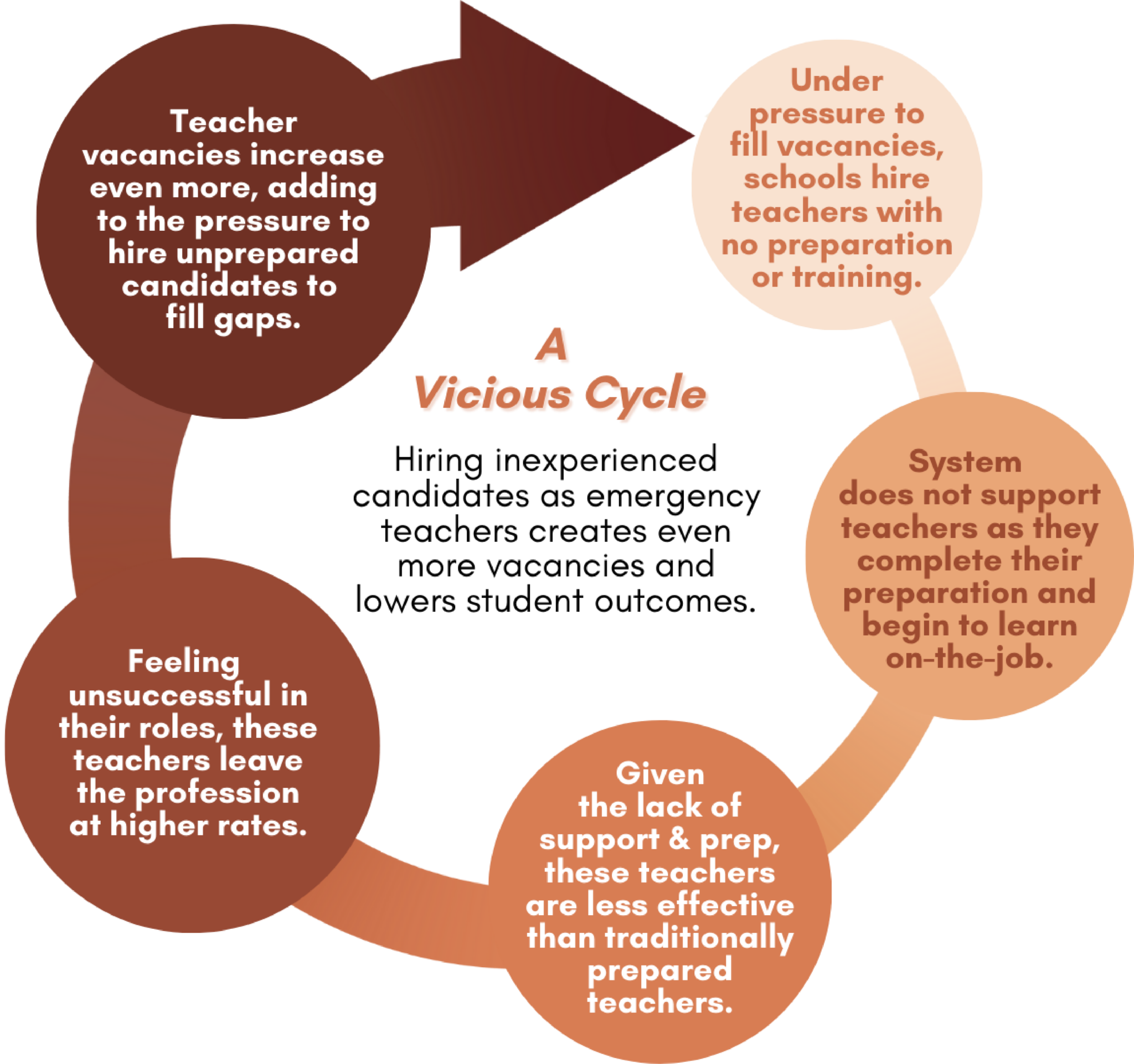
Teacher turnover has hovered around 10% statewide, with 18% of first-year teachers leaving after just one year, according to the most recent data. In fall 2025-26, districts reported more than 6,000 teacher vacancies. To fill them, many turn to Emergency Licenses and Permit to Teach placements — candidates who become a Teacher of Record with no required training, no classroom experience, and no enrollment in an Educator Preparation Program (EPP).
Those underprepared teachers leave at high rates and are often replaced by other underprepared candidates, resulting in a vicious cycle that ultimately harms our state’s publicly educated students. Research shows that two consecutive years with an underprepared teacher can have near-irreversible effects on a child’s academic trajectory.
How the TeachReadyNC apprenticeship works
TeachReadyNC targets that pool of alternative licensure candidates — typically college graduates entering the teaching profession without preparation or experience, who would otherwise land in an Emergency License or Permit to Teach role. Instead, a TeachReadyNC apprentice works as a full-time paid member of an Advanced Teaching Roles™ (ATR™) team, alongside a trained, compensated apprentice supervisor, while enrolled in a recognized EPP.
- Apprentice teachers are full-time, paid employees, earning a salary higher than a Teacher Assistant’s but lower than a beginning teacher’s — typically about $7,500 more than a TA position.
- Each apprentice is paired with a supervising mentor teacher, who is paid a $5,000 stipend for their role. The apprentice also benefits from the expertise of the ATR team’s Collaborative Impact Leader.
- Additionally, schools can provide another stipend of up to $5,000 to teachers who take on additional students during the apprenticeship year, since the apprentice would have otherwise become an Emergency licensed or Permit to Teach hire. This is also stackable with the supervising mentor teacher stipend.
- TeachReadyNC apprentices enrolled in an EPP can also receive up to $5,000 a year toward the cost of their preparation program.
Building the pilot
TeachReadyNC is the first of its kind in the United States and requires exemplary collaboration between local, state, and even national thought leaders for implementation. The planning phase is well underway and is organized around four core projects — competency frameworks, compliance and onboarding tools, mentor system redesign, and HR candidate triage — each with a designated lead, defined outcomes, and key partners.
DPI and ApprenticeshipNC are coordinating the project with support from BEST NC and other advisers including: RTI International (research, evaluation, and monitoring); The Innovation Project (district consortium and early adopter implementation); and Public Impact (ATR integration and team-based mentorship design).
ATR districts, UNC and private EPPs, the N.C. Community College System, prospective pilot districts, and legislative and gubernatorial advisers are all engaged in the work.
Educators need a clear, well-supported path into the classroom, especially the 44% coming in from other professions. By redirecting funding from an overlooked program to support TeachReadyNC, we’re investing in a model that acknowledges the changing teacher pipeline.
— Rep. David Willis, R-Union
What’s next
Beginning as early as the 2026-27 academic year, TeachReadyNC will launch its first cohort of district pilots in partnership with select schools that are implementing Advanced Teaching Roles. Those early districts will test the full model, including competitive selection of apprentices, placement on ATR teams, enrollment in a recognized EPP, and tracked progress toward full licensure.
TeachReadyNC traces back to the NC STRIDE recommendations, which charted a course for strengthening the state’s educator pipeline. Teacher apprenticeship was a key NC STRIDE priority, which led to the 2025 BEST NC report: “Teacher Apprenticeship in North Carolina: Exploring In-Classroom Preparation for the Next Generation of Teachers,” which was delivered to a broad set of education stakeholders at the BEST NC 2025 Education Innovation Lab.
While the Teacher Apprenticeship brief recognizes the more traditional uses of apprenticeship — like grow your own, TAs to teachers, and paid student teaching programs — it found that the greatest need and highest impact would be to leverage teacher apprenticeship to eliminate the need for Emergency and Permit to Teach licenses.
The goal for TeachReadyNC is straightforward: No teacher in North Carolina should enter a classroom without training, preparation, and support.
To learn more about TeachReadyNC, visit BEST NC’s website.