
With growing momentum after state investment, Advise NC charts its future

When Anamari Thomas-Carter visits classrooms at Franklinton High School, she uses a simple exercise to gauge where seniors are in their process of considering postsecondary plans. She asks questions like: How long do you see yourself in school? How much money do you want to make? And finally, how much money are you willing to invest in yourself or your education?
After that last question, Thomas-Carter said, many students don’t respond.
“They’ve never considered what life is like outside of Franklin County. They’ve never considered that you can go to a two-year (college) and still be successful,” Thomas-Carter said. “They’ve never considered that you can go to school nearly debt free if we do the FAFSA.”
 Sign up for Awake58, our newsletter on all things community college.
As a Next Step Adviser with Advise NC, Thomas-Carter supports nearly 300 seniors, helping them fill out the Free Application for Federal Student Aid (FAFSA), explore their interests and career pathways, and build their confidence in the postsecondary planning process. Last year, students she worked with secured nearly $9 million in scholarships, and 97% had concrete plans for after high school.
“Sometimes you just need to speak power into a student just as you would speak power into yourself because it is … incredibly overwhelming. And that is my favorite part of being an adviser,” said Thomas-Carter.
In more than 160 high schools across the state, 146 recent college graduates like Thomas-Carter are working one-on-one with seniors to help them plan for life after high school — whether that means enrolling in a university or a community college, taking a job or an apprenticeship, or enlisting in the military. In total, those Next Step Advisers serve more than 30,000 students.
“The reach is huge. The impact is there, and we want to keep building,” said Samantha Gutter, a consultant with the John M. Belk Endowment, one of the philanthropic supporters of Advise NC. “We don’t want to just rest on what’s been done in the past. We want to continue to innovate.”
Near-peer advising is not new to North Carolina. Recent college graduates have worked as advisers in the state’s high schools since the late 2000s. The programs began as affiliates of the national College Advising Corps, starting at the University of North Carolina at Chapel Hill in 2007. North Carolina State University and Duke University joined in 2014-15, Appalachian State University in 2019-20, and UNC Wilmington in 2021. In the 2025-26 school year, those programs relaunched together as Advise NC — a distinct, North Carolina-based network.
Now, momentum behind Advise NC is growing, supported by an influx of state dollars. In July, the General Assembly provided $5 million to the North Carolina State Education Assistance Authority (NCSEAA) to implement Advise NC, including $2.5 million recurring and $2.5 million nonrecurring. That funding is matched one-to-one with philanthropic support from the John M. Belk Endowment and Anonymous Trust.
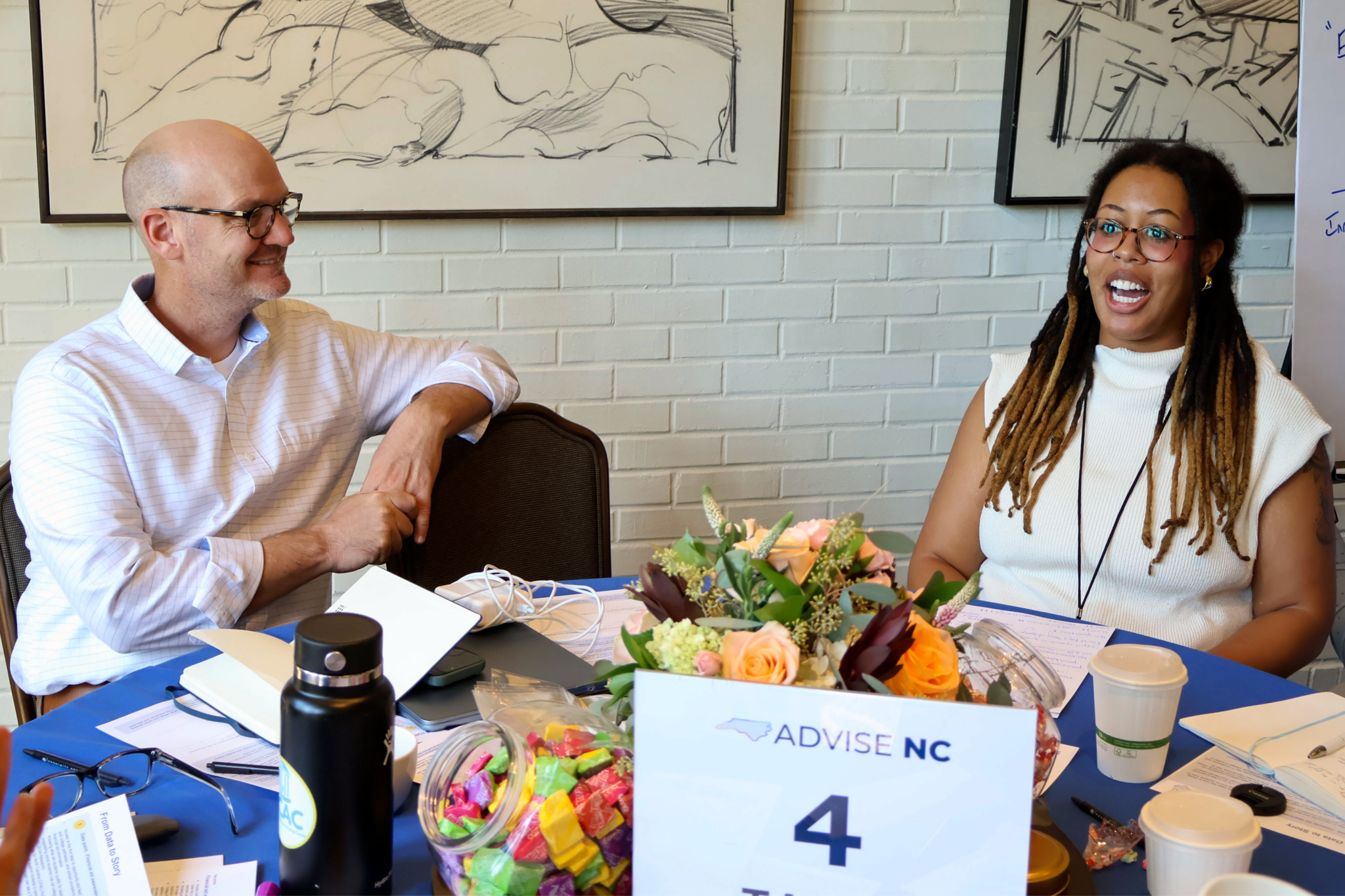
In early September, partners from universities, community colleges, school districts, philanthropies, state agencies, and community-based organizations convened in Greensboro to reflect on the current landscape of advising and discuss the future of Advise NC.
Mapping advising assets at the state and national level
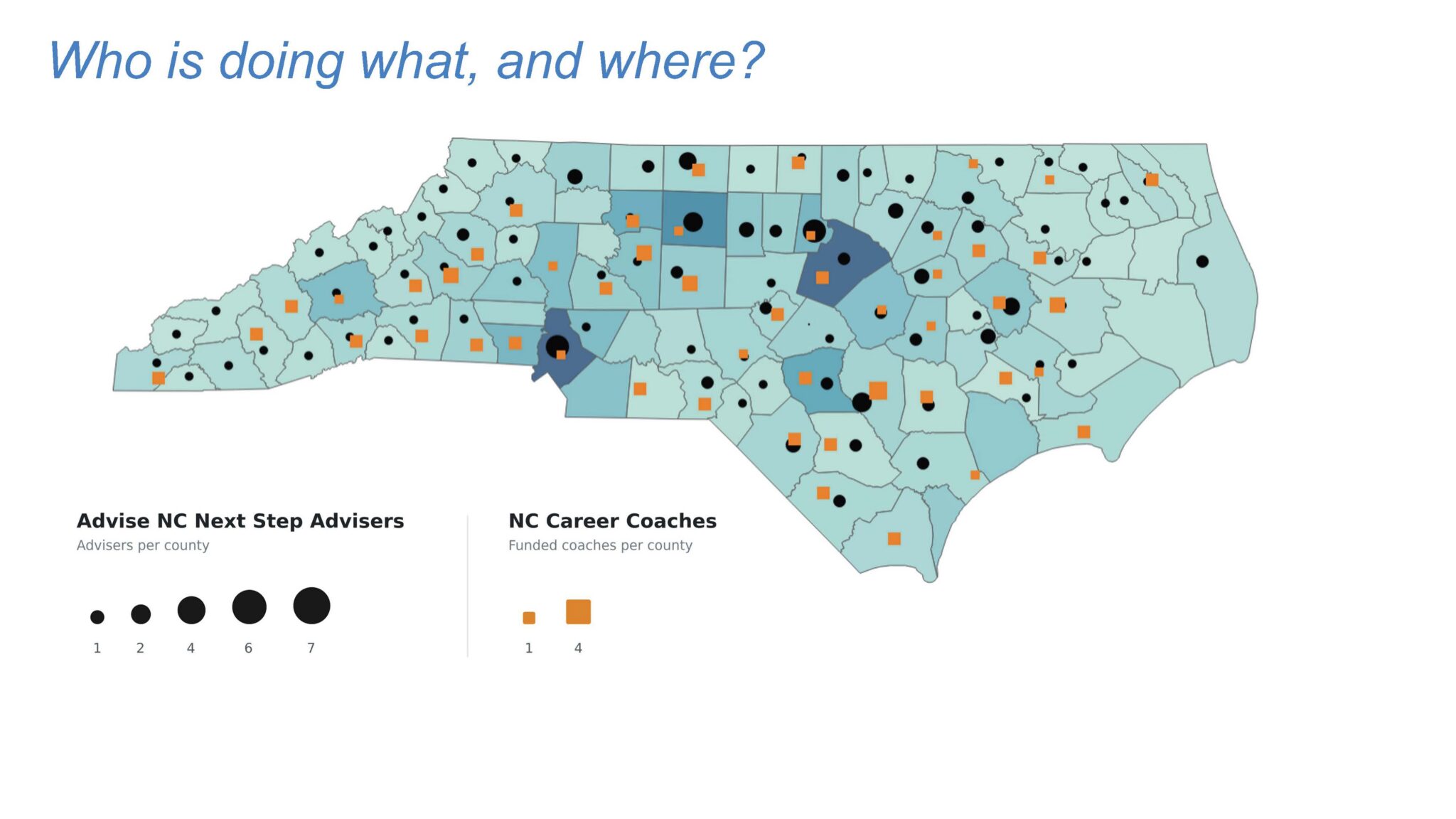
To ensure Advise NC works in coordination with existing efforts and resources, an asset mapping process took place to understand which schools and students have support and which could use more support.
Part of that process included mapping the locations of Advise NC’s Next Step Advisers side-by-side with the locations of NC Career Coaches, a state-funded program that places coaches in high schools. In the 2025-26 school year, 94 NC Career Coaches employed by 49 community colleges were placed in high schools to help students students identify career goals and connect them with educational pathways.
The asset mapping process found that 41% of public high schools have at least one dedicated Next Step Adviser or NC Career Coach, with roughly 60 NC Career Coaches serving high schools that also have a Next Step Adviser — but regional coverage varies widely across the state.
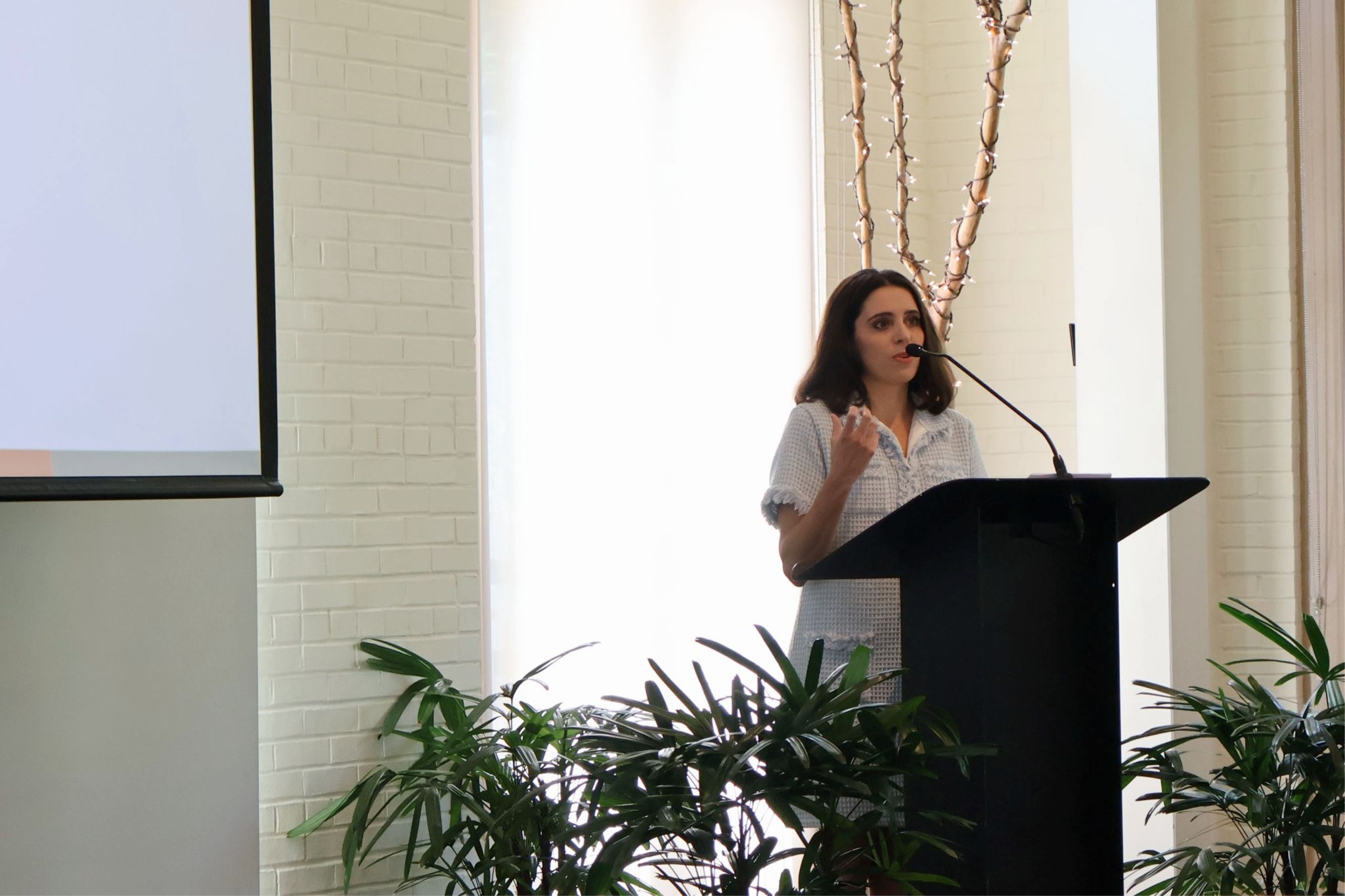
“The challenge is alignment — not scarcity,” said Kathy Hastings, director of outreach and communications at the NCSEAA, during the September convening. “North Carolina does not shy away from investing in our students … and so part of that is, how do we get greater alignment among our partnerships?”
Gutter also discussed the results of a recent survey of 92 school district leaders to understand the state of college and career advising. The survey found that districts primarily rely on school counselors to provide college and career advising, and that they are working with a growing network of external partners — including advisers and career coaches — to connect students to opportunity.
Advise NC is also receiving support from national organizations, including the Strada Education Foundation. During the September meeting, Craig Robinson, a senior vice president at Strada, shared insights on the national landscape of what the foundation calls “quality coaching” — or effective education-to-career coaching that includes clear guidance, timely labor market information, and support.
Through its State Opportunity Index, Strada categorizes states as either foundational, developing, advanced, or leading across five key areas, including quality coaching. In North Carolina, quality coaching is indexed as developing at four-year institutions and advanced at two-year institutions.
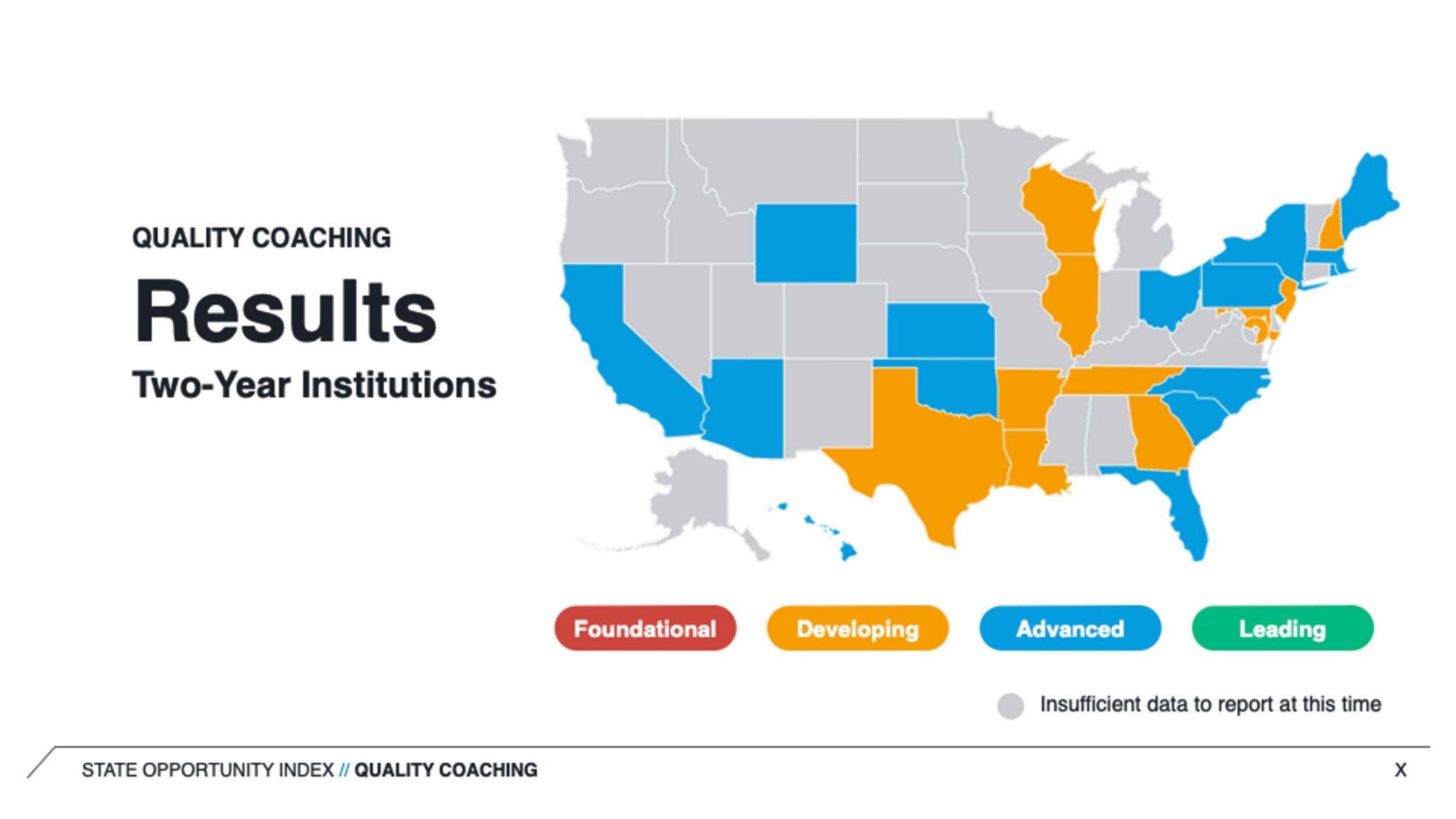
Based on Strada’s data, Robinson said students in North Carolina feel supported, but they expressed a need for more personalized guidance to help them make actual career choices.
“I’ve heard students say things like … ‘actuary sciences, I don’t know what that is. I would have never imagined or thought about exploring that,’” Robinson said. “There’s just a lot of opportunities that may exist in the labor market that students need help translating and being able to see themselves in those possibilities.”
Relative to other states, North Carolina is “asset rich,” Robinson said. For example, as early as sixth grade, students in North Carolina begin working on state-mandated Career Development Plans. Those plans then follow students into high school and ultimately include a career portfolio, documenting their postsecondary plans, completion of the FAFSA, resume, and more.
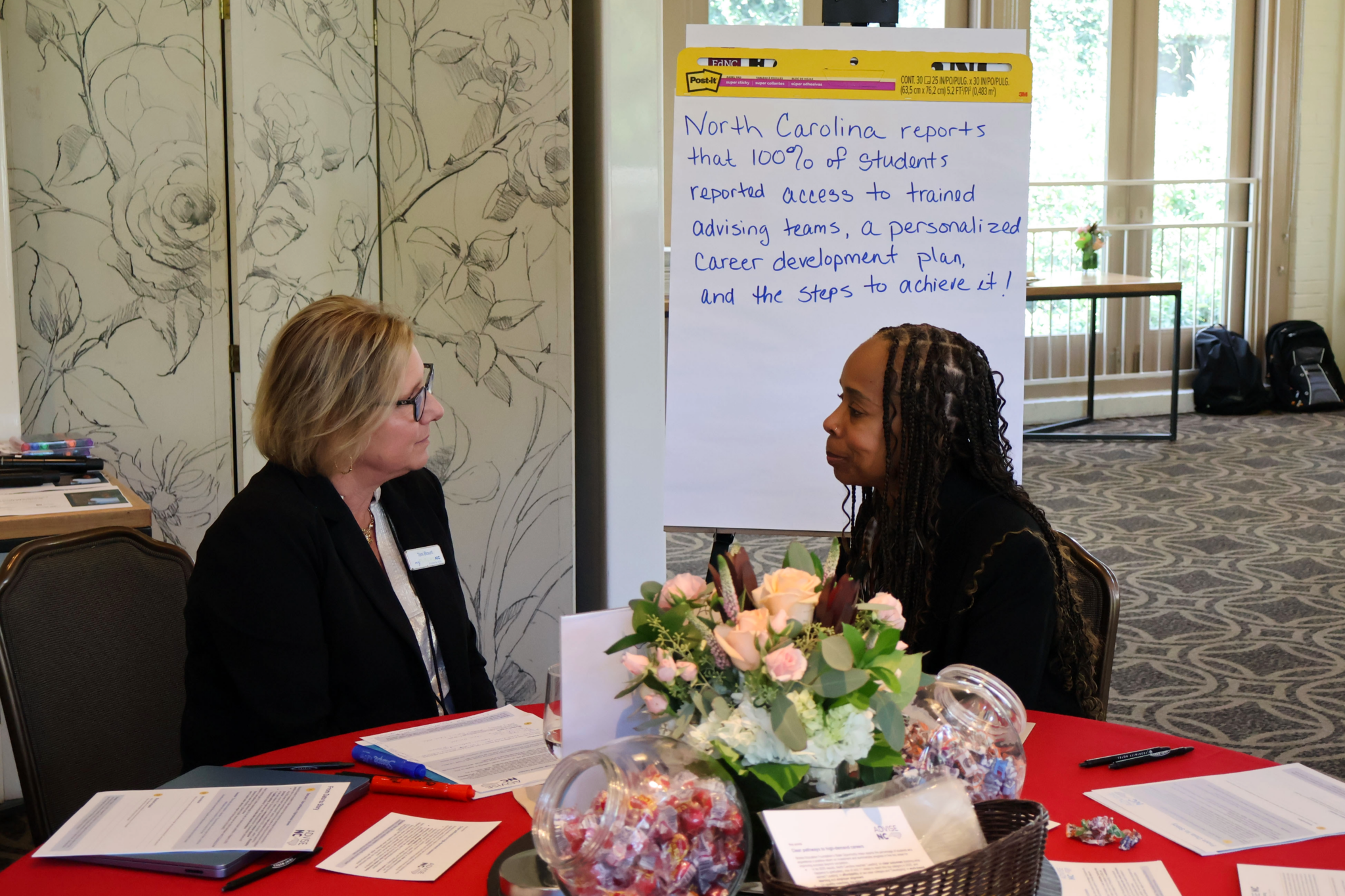
Relatedly, in August, the State Higher Education Executive Officers Association (SHEEO) announced a 20-state coalition, supported in part by Strada, that will help states build approaches to work-based learning and quality coaching. North Carolina is one of those 20 states that will receive technical assistance focused on work-based learning and education-to-career guidance strategies.
“States increasingly recognize that work-based learning, quality coaching, labor market information, and outcomes data cannot operate as separate strategies. This coalition creates undeniable momentum to improve opportunities for millions of learners,” said Robinson in a press release.
Read more

Designing the future of Advise NC
With the creation of Advise NC, North Carolina is now building a state-specific near-peer advising model that best meets the needs of its students.
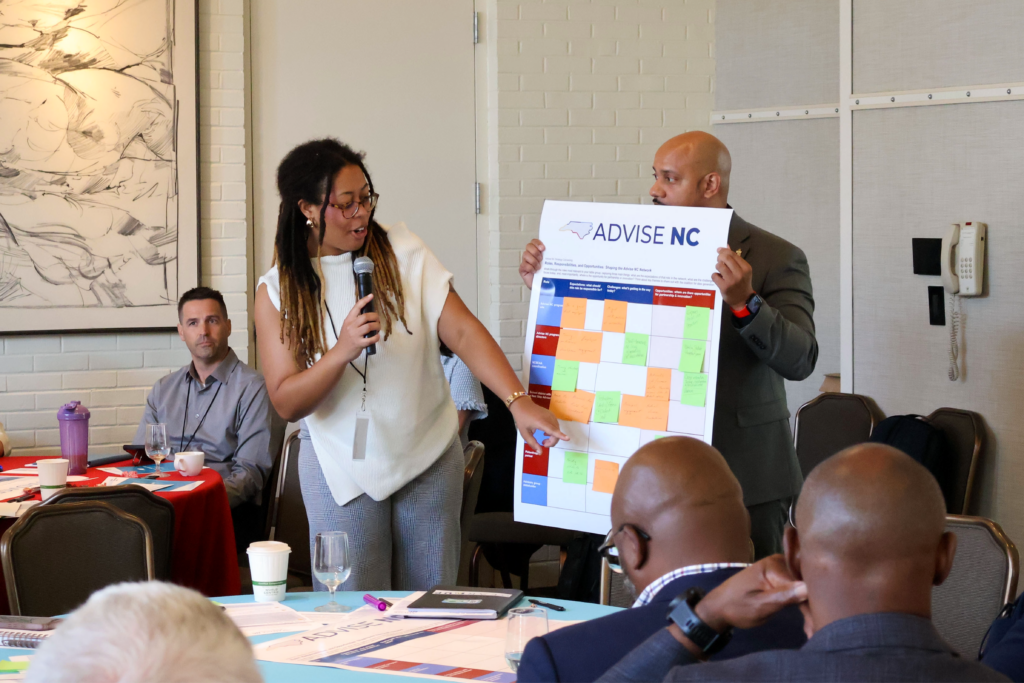
During the September meeting, attendees spent time in breakout groups discussing what the future of Advise NC should look like, including roles and responsibilities for different stakeholders, how the effort could scale, what innovation looks like in college and career advising, and more.
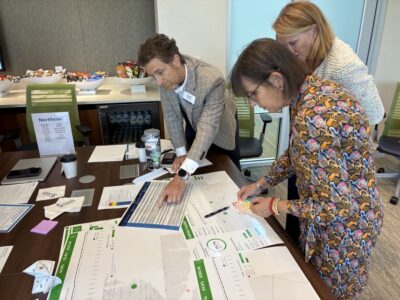
During one breakout session, participants reviewed state-specific data related to financial aid awareness, advising coverage and reach, and career pathways, and discussed ways Advise NC could innovate to solve for challenges identified in the data. They also discussed a vision for Advise NC’s future impact.
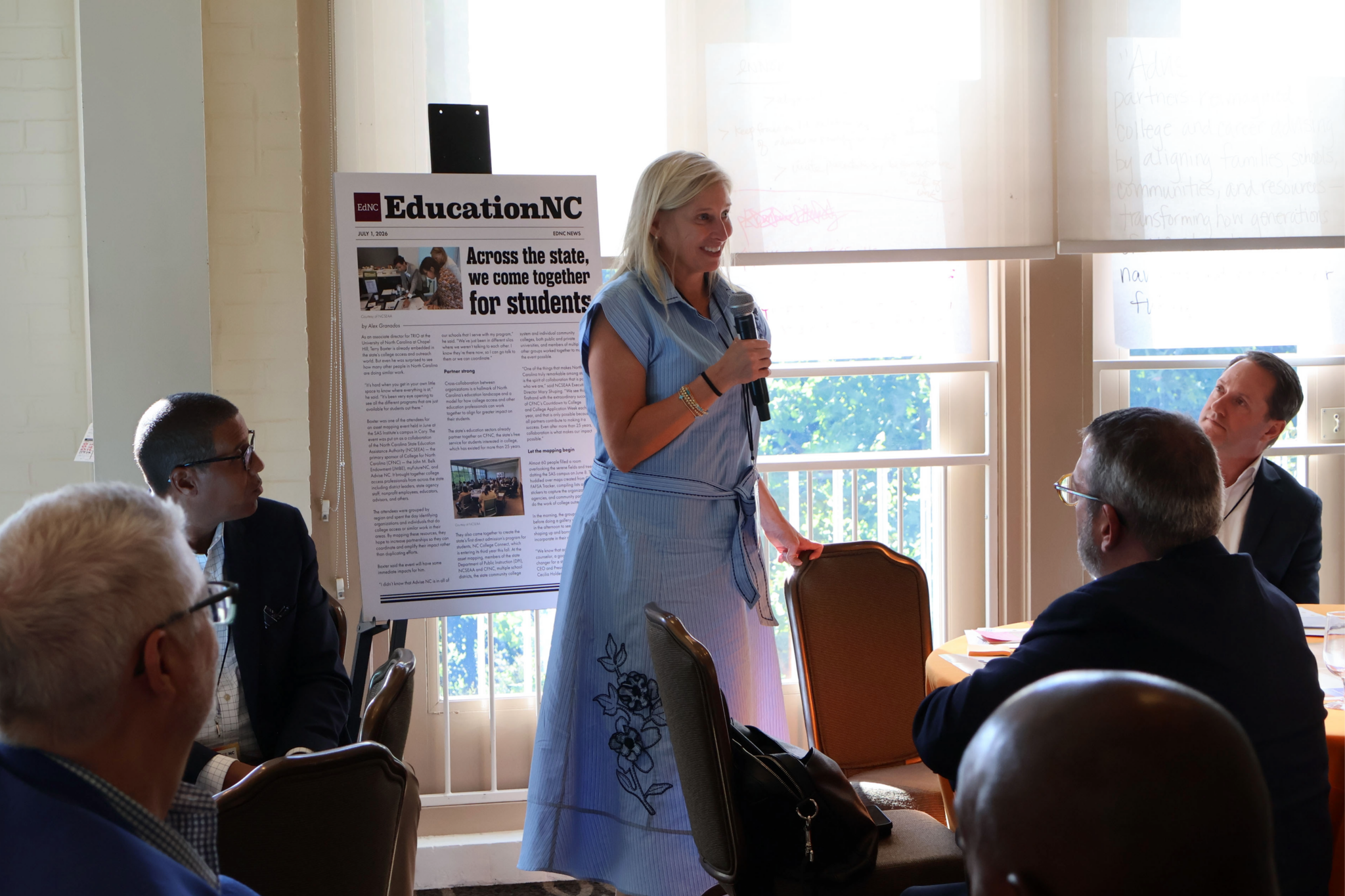
“As we were sitting at the table, we kept going back and forth about, ‘How do we do this? How do we get here?” said Dr. Joseph Rampersad, associate director of college access and outreach with NCSEAA. “The biggest thing that we talked about … was aligning. We all have to be aligned. So if you’ve ever heard the phrase, ‘If you want to go somewhere fast, you go by yourself. But if you want to go far, we all go together,’ … we’re all here today to go far.”
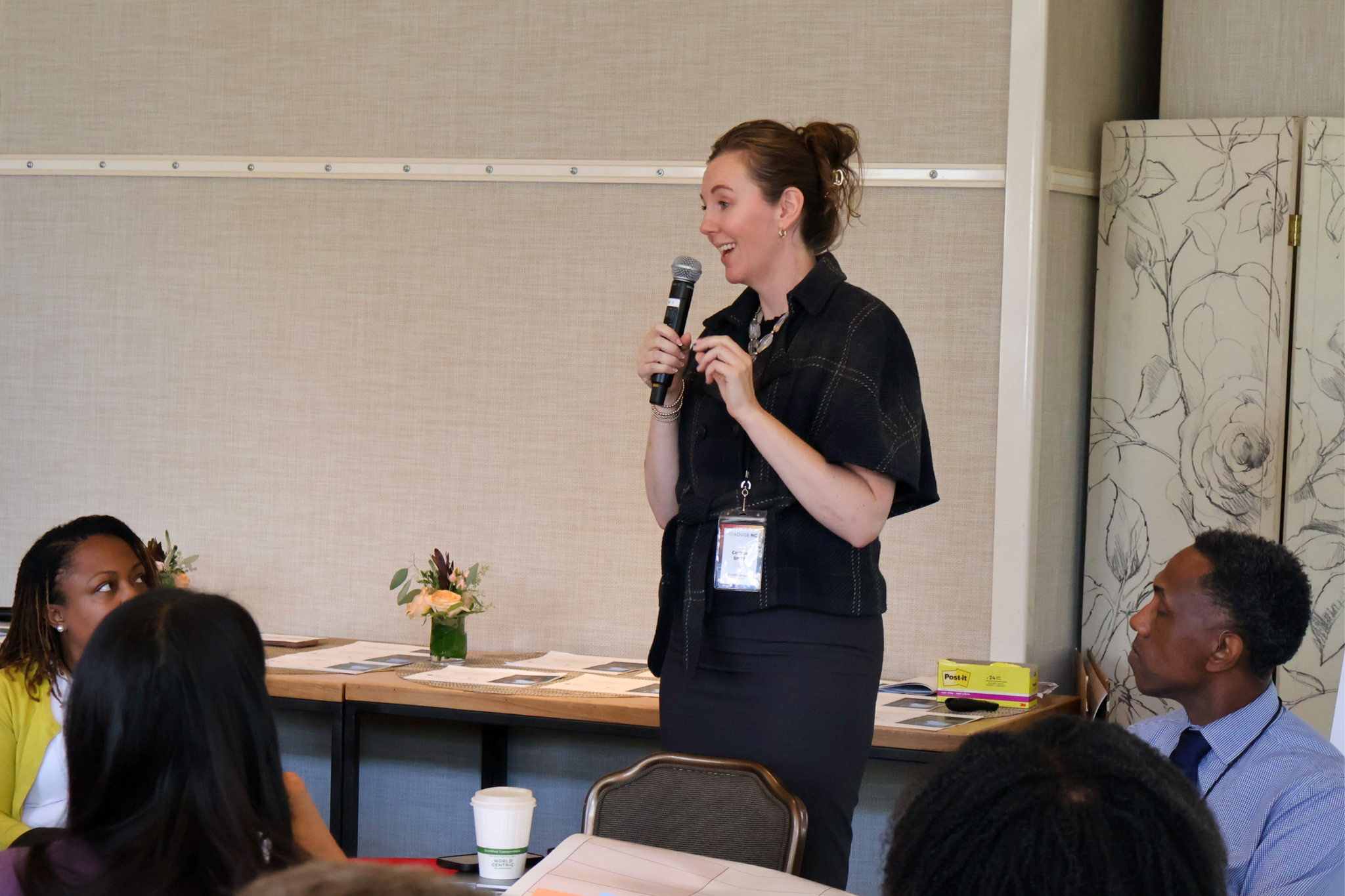
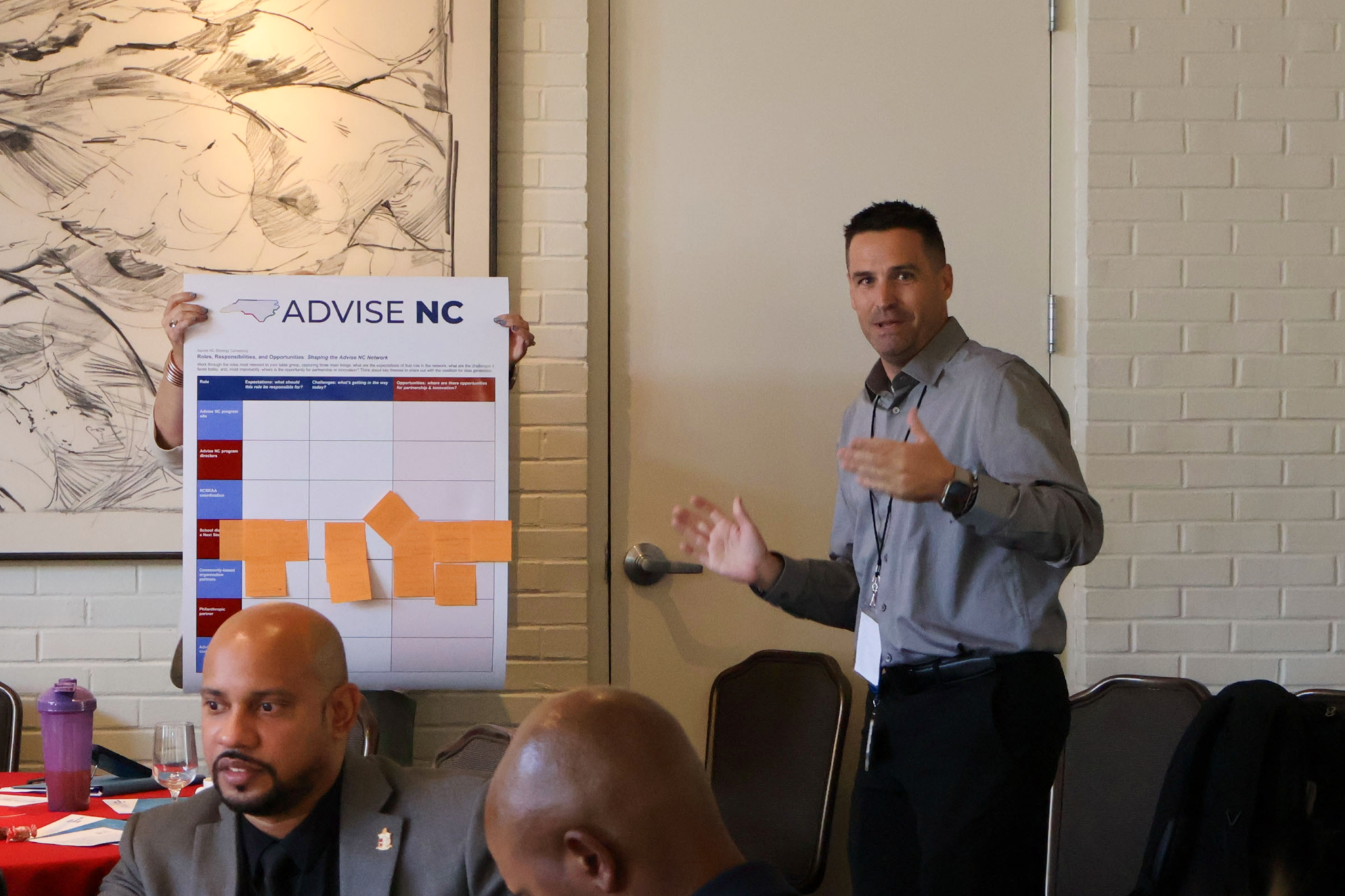
In another breakout session, participants were grouped by role and spent time discussing how different stakeholders — from universities to school districts to philanthropists — could engage in the effort, including the opportunities and challenges that exist for each role.
In the 2026-27 school year, Advise NC is prioritizing:
- Deepening the model: Strengthening Advise NC’s near-peer advising support and ensuring every senior revisits and refines their Career Development Plan.
- Broadening the aim: Expanding Advise NC’s focus to the three E’s — enrollment, employment, and enlistment — and refining how it tracks and shares impact data to reflect that. Strada Education Foundation and Project Evident, a national nonprofit that helps organizations better harness evidence and data, are supporting the development of a set of key performance indicators that reflect the impact of Advise NC and equip programs with the information needed for continuous improvement.
- Aligning the system: Creating greater alignment across all five university programs and with CFNC (College for North Carolina), and working with partner organizations to support local coordination.
“Our students have so much to offer to the world, and they have so much to offer to North Carolina and their families,” said Thomas-Carter. “Why not take that first step by pouring into them and speaking that power into them? That is why I advise.”
Editor’s note: The John M. Belk Endowment and Anonymous Trust support the work of EdNC.