Child Fatality Task Force discusses AI protections, funding for school health personnel

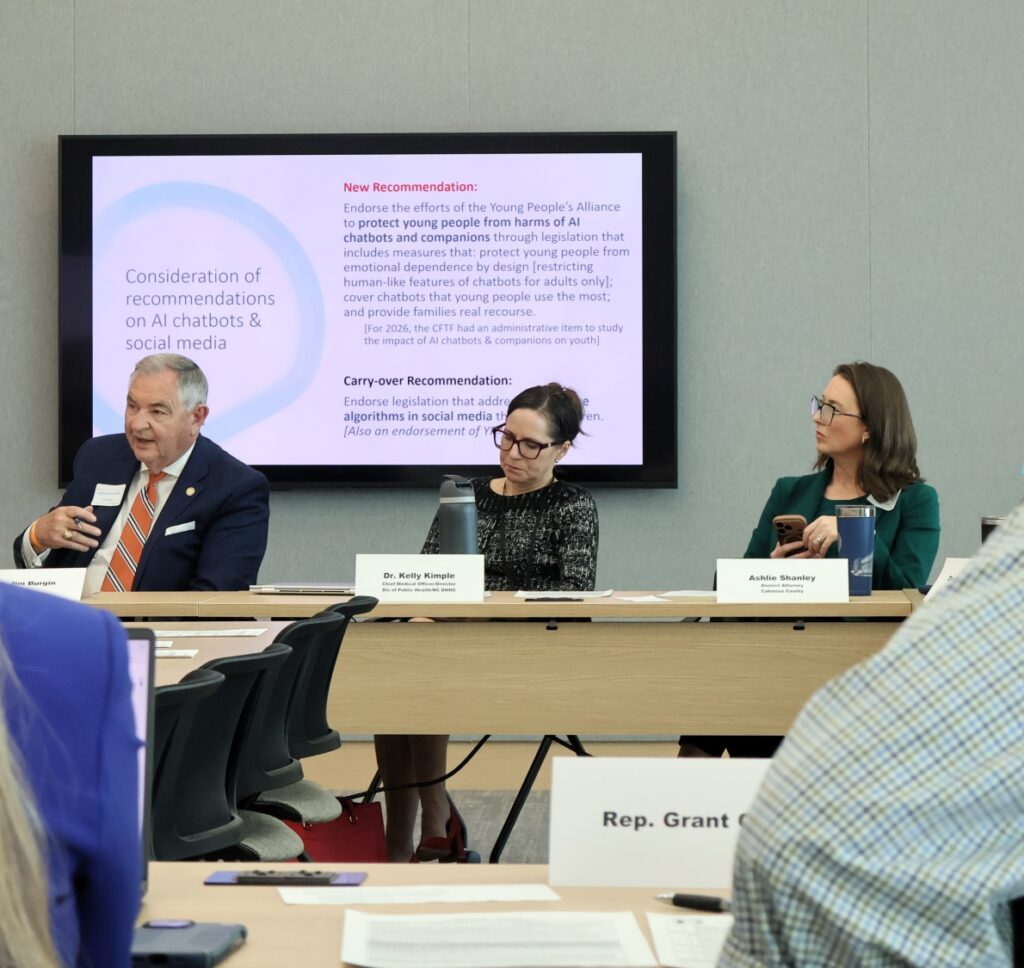
The North Carolina Child Fatality Task Force, a legislative study commission that makes recommendations to the governor and General Assembly, approved recommendations related to student well-being during its November meeting.
Advocates continue to raise concerns that addictive social media algorithms and human-like artificial intelligence (AI) chatbot designs pose a threat to child well-being. Last week, the Task Force’s intentional death prevention committee brought three recommendations that would protect children from the technology’s negative effects.
Task Force asks lawmakers to address AI chatbots and addictive social media algorithms
During its Nov. 10 meeting, the Task Force voted to adopt a new recommendation that endorses the efforts of the national nonprofit Young People’s Alliance (YPA) to develop legislation to address the impacts of AI chatbots and social media algorithms on children.
YPA co-founder Mick Tobin told the Task Force that technology developers intentionally design AI chatbots with human-like features to keep young people attached to the products for as long as possible.
Tobin said that according to one Common Sense Media report, 72% of teens report that they’ve used AI companions. In a separate study, Common Sense Media reports that using AI chatbots for mental health support is an unacceptable risk, as the technology lacks “fundamental capabilities needed for safe mental health support.”
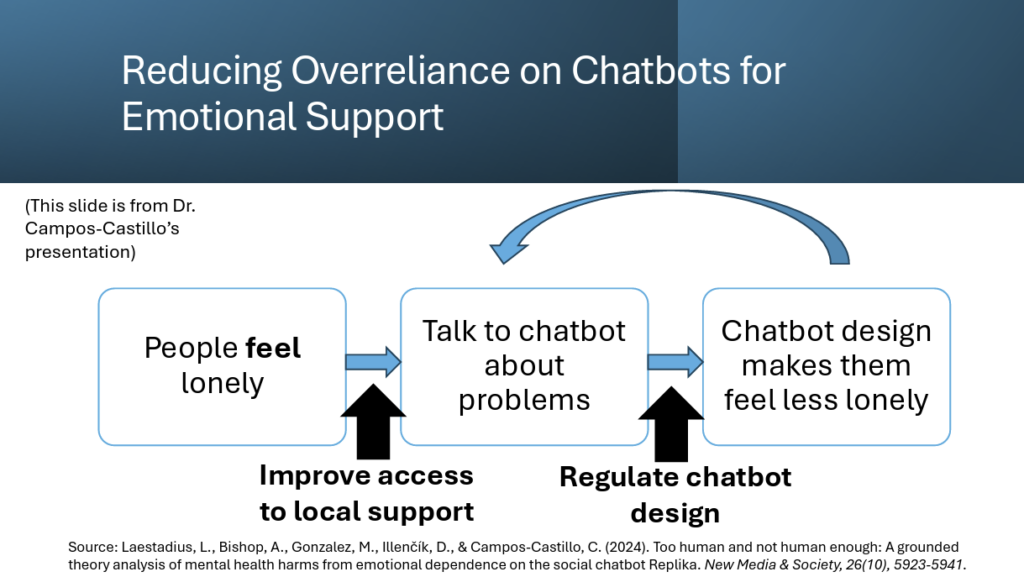
Tobin, who is originally from North Carolina, said strong legislation is necessary because AI tech companies, such as Google, write and lobby for legislation that makes it difficult for state attorneys general to actually hold tech companies accountable for their products.
“Not only are these companies building these platforms, but they’re also going into these capitol buildings and they’re introducing very weak bills, and then trying to convince lawmakers that these bills would actually help young people,” said Tobin. “In reality, they don’t do much.”
YPA consulted with young people, researchers, experts, clinicians, lawyers, and technology experts to design their 2027 model legislation. The model bill addresses three principles:
- Protect young people from emotional dependence by design
- Cover the chatbots that young people use most
- Provide families real recourse
Tobin said Sen. Jay Chaudhuri, D-Wake, and Sen. Vickie Sawyer, R-Mecklenburg, have agreed to introduce the bill.
In another endorsement of YPA’s efforts, the Task Force adopted a carry-over recommendation from its 2025 action agenda to endorse legislation that addresses addictive social media algorithms.
Tobin told the Task Force that in the 2023 and 2025 legislative sessions, 62 North Carolina legislators co-sponsored House Bill 644. Written by YPA, the bill aims to regulate manipulative social media design features. HB 644 passed its first committee with a substitution but stalled in appropriations.
Meta settlement funds could be a ‘bright spot’ in the state’s school health personnel shortage
The 2025 Youth Risk Behavior Survey showed that some indicators of student mental health have improved in the last several years. However, students continue to face challenges to their well-being.
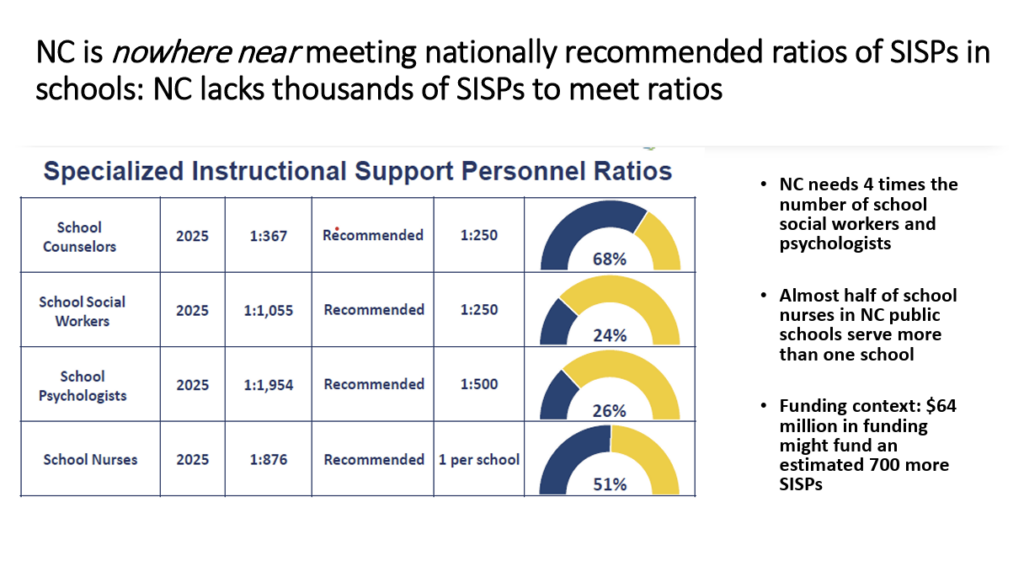
Whitney Belich, co-chair of the task force’s intentional death prevention committee, said that school health personnel — school nurses, counselors, social workers, and psychologists — are “on the front lines” of these mental health needs. But the state doesn’t have enough of them, she said.
In the 2024-25 school year, Belich said that school nurses alone reported over half a million counseling sessions. Nearly 18,000 of those session related to depression, suicidal ideation, or other mental health issues. Over 3,500 of those cases were related to violence or bullying, and almost 3,600 were related to substance use.
Districts fund school health personnel positions through a combination of local and state funds. According to Belich, the 2026 state budget included no new funding for school health personnel. She said that means that in addition to a statewide shortage, students in counties with fewer resources have little to no access to any support personnel.
Annie Goldberg, a school counselor in the Alamance-Burlington School System, told the Task Force that when her school support team was fully staffed, she was able to meet students’ needs. After COVID-19-era funding expired and her school district underwent a reduction in its teaching workforce, she said that simply isn’t the case anymore.
Last year, Goldberg was the only full-time health services employee in her building. This year, she’s the school’s only counselor for roughly 730 middle schoolers.
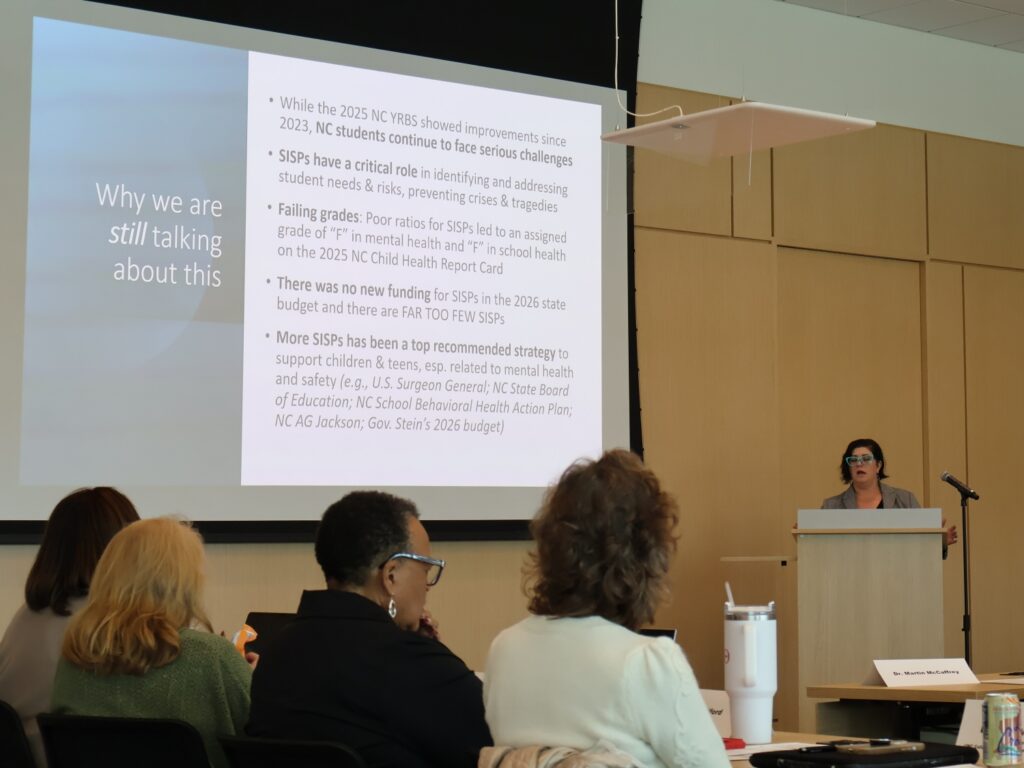
In August, North Carolina Attorney General Jeff Jackson’s office announced that the state would receive at least $451 million through its settlement with Meta for the company’s alleged harms to child users. According to Belich’s presentation, the state received its first payment of $45.17 million in October.
Belich said the settlement dollars could be a “bright spot” for districts and schools operating without a full school health personnel staff. According to her presentation, $64 million in funding might fund an estimated 700 additional school health personnel.
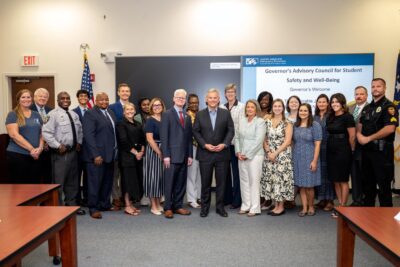
Ultimately, state legislators will decide how to allocate the Meta settlement funds. State leaders, including Jackson, Superintendent Maurice “Mo” Green, and Gov. Josh Stein have pointed to the state’s school health personnel shortage as a funding priority.
Task Force co-chair Karen McLeod said that some legislators have begun to put together bills that would ensure all of the Meta funding goes toward efforts to support students.
The Task Force adopted a recommendation to support recurring funds to increase the number of school health personnel and to move North Carolina toward achieving nationally recommended ratios. Task Force members voted to add an amendment stating that legislators should consider Meta settlement funding as a potential supplement of this needed funding.
Read more about school health personnel

Other Task Force business
The task force also adopted three additional carry-over recommendations presented by the unintentional death and perinatal committees. These include:
- Support recurring funding of $2.26 million for the NC S.A.F.E. Campaign that educates the public about safe firearm storage
- Support legislation to amend the state’s firearm safe storage law, N.C.G.S. 14-315.1(a), to remove the phrase “resides in the same premises as a minor”
- Support recurring funding of $250,000 for the state’s infant safe sleep program to prevent sleep-related infant deaths
The Child Fatality Task Force is the “policy arm” of the NC Child Fatality Prevention System that was established by state statute in 1991. The Task Force’s recommendations become part of an annual agenda that is included in an annual report to the governor and General Assembly.
The Task Force will meet next on Dec. 14.