
Charter Review Board approves 5 schools for fall launch, hears new state waitlist and enrollment data

Five charter schools have secured final approval from the North Carolina Charter Schools Review Board (CSRB) to open in August. Approval votes, which took place at the CSRB’s meeting on Monday, represented the last major hurdle for schools in the 2026 Ready to Open (RTO) cohort. Now, NC Connections Academy, Warren YES, Carolina Collegiate, RYZE Charter Academy, and IDYL-Wake receive charter agreements for their boards and State Superintendent Maurice “Mo” Green to sign.
This week also ushered in late-breaking attrition among the RTO schools. Last month, seven schools, not five, were in the 2026 charter pipeline.
One RTO school, Focus Academy, sought and received CSRB permission to delay opening until 2027. With just 83 students enrolled, the school teetered dangerously close to the 80-student minimum required by statute and was far below its break-even enrollment projection.
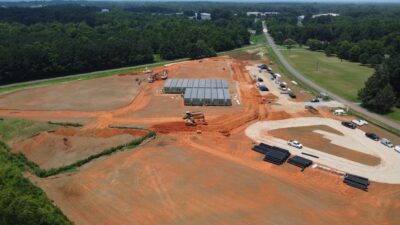
The final RTO member, BH2 STREAM School, lost its bid to open this fall. On Monday, the CSRB denied the school’s request to exit RTO, due to a lack of readiness, particularly with its facility.
“We need better. We need better circumstances, a better plan, a more complete plan, and to have readiness there for the students and the families, right?” CSRB member Rita Haire said. “We want to provide them the best… quality. This is about quality charter schools.”
 Sign up for our monthly roundup of news and updates about North Carolina’s charter schools.
CSRB members also approved the new 2025 Charter Schools Annual Report, which presents new state data on charter enrollment, waitlists, performance, and more. The report summarizes the prior school year, Ashley Logue, executive director of the Office of Charter Schools (OCS), said, but includes current data where available.
Report numbers spotlight a growing charter sector in North Carolina, where charter schools served 161,057 students in 2025-26, Logue noted in her CSRB presentation.
“We are now at over 10% of the public school membership in the state,” she said.
At the beginning of the 2025-26 school year, 213 charter schools operated statewide, the highest number on record, according to Logue. However, two mid-year school closures reduced that number to 211.
Charter demand continues to outpace supply. At the beginning of this school year, 138 charter schools reported waitlists totaling 59,081 students. According to the annual report, that figure may include duplicate names, with some students on waitlists at more than one school.
If waitlist figures are an indication, charter demand may be ebbing somewhat. The 2024 annual report showed 74,287 students on charter waitlists at 161 schools; the year before, waitlist data included 85,551 students at 169 schools.
Read more

More on the RTO schools, including approvals
Natasha Norins of OCS shared a presentation with the CSRB assessing readiness for the six RTO schools still seeking approval. Readiness indicators included meeting over 80% of projected enrollment, obtaining a certificate of occupancy for a facility, and completing RTO submissions.
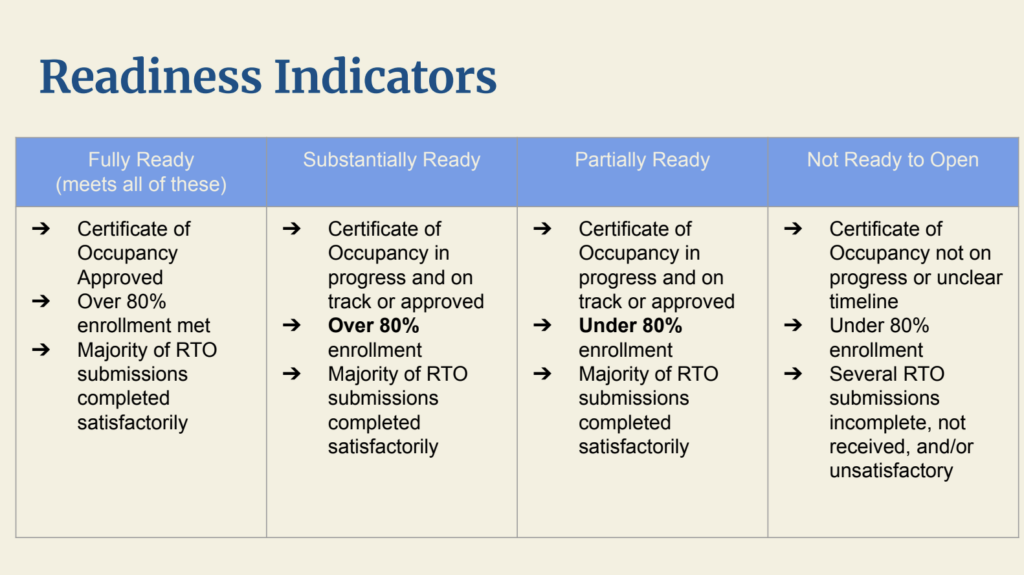
Screenshot from the OCS presentation.
These were the OCS readiness ratings, heading into Monday’s meeting:
- Fully ready: NC Connections Academy
- Substantially ready: Warren YES
- Partially ready: Carolina Collegiate, RYZE Charter, and IDYL-Wake
- Not ready: BH2 STREAM School
You can view OCS readiness reports in this folder.
Prior to voting, each school shared enrollment figures and answered questions, with the exception of the “fully ready” NC Connections Academy, which the CSRB approved with no update.
Caroline Hundley, the board chair at Warren YES, said the school had enrolled 168 students, exceeding the 140-student break-even benchmark.
RYZE Charter leaders said enrollment had increased to 201 students, with the break-even benchmark set at 130.
Gary Rodgers, board vice chair at Carolina Collegiate, pegged current enrollment at 164 students, with a break-even number of 140.
Carolina Collegiate’s approval represents a particularly notable milestone. The school, which originally planned to open in August 2023, requested three delays.
“I know this is the first time we’ve had a school go through a third year, and we’ve really appreciated the support,” Joey Webb, the executive director, said.
Yvette Munroe, IDYL-Wake’s CEO and superintendent, said enrollment had increased to 313 students. That figure is well above the school’s break-even enrollment of 210.
School leaders and board chairs at these approved schools were required to attend two days of training this week, Norins said.
For two RTO schools, delay and denial
Deliberations about the fate of the other two RTO schools — both accelerated applicants — were extensive.
According to state policy, accelerated applicants should have identified a facility that can open on an expedited timeline. They begin their planning year in the same year in which they are reviewed. In addition, policy stipulates that accelerated applicants should “demonstrate an exceptional need” in their location.
While Focus Academy had secured a facility, the school struggled consistently with enrollment.
Sherria Grubbs, the Focus board chair, said 83 students had enrolled as of Monday. That number is substantially below the school’s 146-student break-even threshold.
As a result, leaders opted for a delay. “We want to make sure that when we open, that we open right,” Grubbs said.
In their request, Focus leaders also sought permission to change the opening grade configuration from K-4 to K-5 to align with “community interest, family needs, and long-term enrollment sustainability.”
The CSRB approved the request in a split 6-3 vote.
Some members expressed concern about the precedent of allowing an accelerated applicant to slow down. Others recommended revamping the accelerated application to clarify expectations.
“This is clearly about numbers, and the enrollment’s not there after your best effort in an accelerated year,” Haire told school leaders.
“We urged the school to consider a voluntary delay if enrollment targets appeared unattainable,” CSRB Chair Bruce Friend said. “They’re doing exactly what we asked them to do.”
Historically, facility access is the biggest obstacle to acceleration, he said, but this was not a problem for Focus. The CSRB could reexamine accelerated criteria, Friend added, but should not “hold (Focus) hostage because of it.”
“I don’t feel like we’re holding them hostage, and I don’t think this is our issue,” Haire responded, noting the school had failed to meet criteria.
“If we tell each one that comes, ‘If you can’t make the accelerated deadline, then request a one-year delay,’ then we’re changing our procedure, we’re changing the steps, the expectation. And we set precedent here today, so I’m really uncomfortable,” she added.
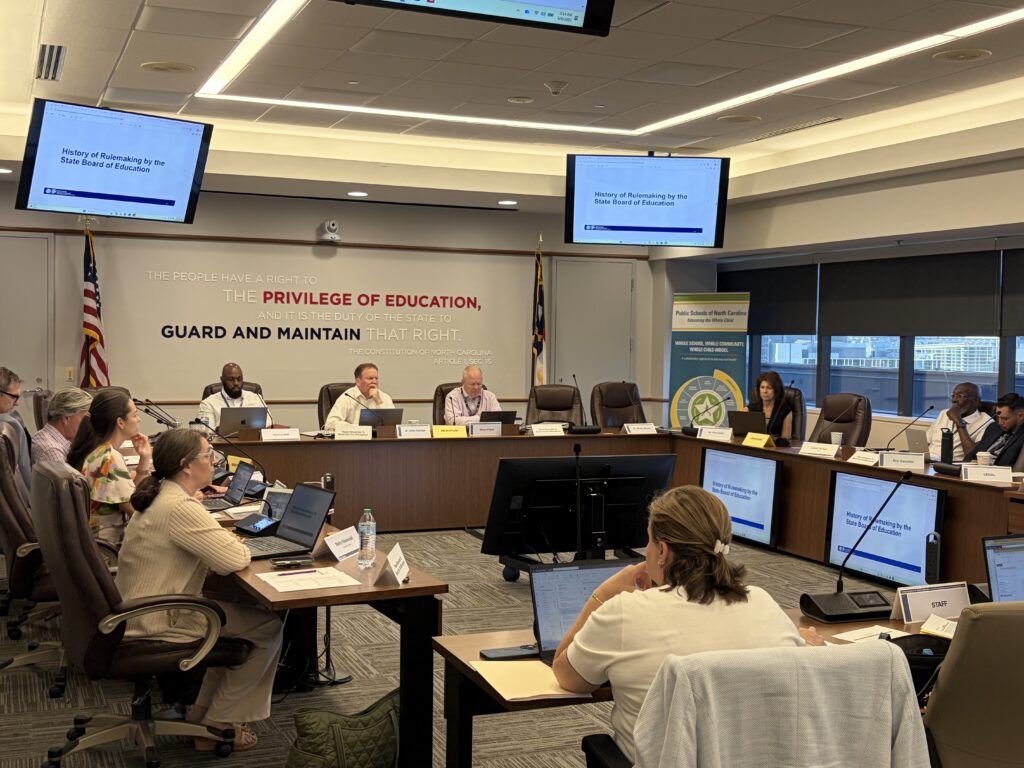
The final RTO school, BH2 STREAM, failed to quell widespread concerns about readiness.
As of Monday, BH2 STREAM had enrolled 238 students, Kristian Herring, the school administrator, told the CSRB. This represents an uptick from the 209 reported to OCS in late May. However, enrollment still fell below the school’s break-even threshold of 251 students.
BH2 STREAM was “pretty much on schedule” with modulars, Herring said, and expecting building permit approval this week.
However, independent verification revealed the school was far from ready for its Aug. 3 opening.
Logue said she visited the school site on June 5 to check the status of the construction schedule.
“I did not see any evidence of construction or site markings … utility preparation, the erosion control,” she said, noting the site looked the same as when she visited in August.
According to her written findings, “The site is not ready for modular occupancy and shows no signs of preparing for such use.”
Friend, who said he had just spoken with the planning director and zoning official in Tarboro, expressed concern about site preparation and utilities.
When asked about a delay, Herring said school leaders had considered one “ad nauseum.” However, he noted, the school was in a “difficult position,” having contracted already with a company for modular units.
“I feel like we’ve given you the benefit of every doubt in this process,” CSRB member Eric Guckian said. “You’ve been before us several times, and I just don’t have confidence that you’re ready to open.”
BH2 STREAM has 10 days to appeal the CSRB’s denial to the State Board of Education (SBE).
2025 Charter Schools Annual Report
According to the new annual report, the charter sector’s percentage of overall public school enrollment increased from 10.2% in the 2024-25 fiscal year to 10.5% in 2025-26. Figures are based on Average Daily Membership (ADM), a more accurate measure of students than actual enrollment, according to the Department of Public Instruction.
“This milestone underscores the sector’s significant role in the state’s educational landscape,” the report noted.
Charter ADM in 2025-26 grew by 4,533 students, a 2.9% annual uptick.
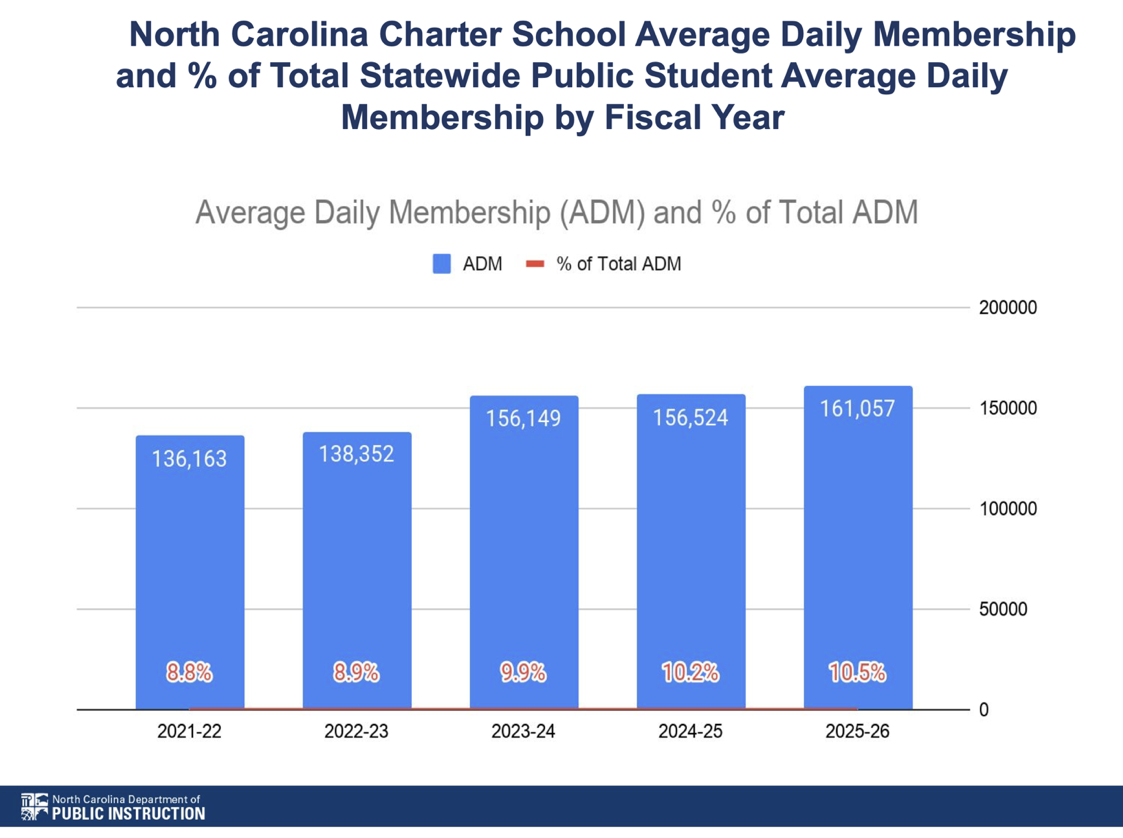
Longer-term trends and national comparisons also show notable enrollment growth.
“There has been 15% enrollment growth nationally over the last six years, even as the K-12 population is decreasing, and North Carolina was the fourth fastest-growing state for charter enrollment in the nation over the last six years,” Logue said.
She cited a National Alliance for Public Charter Schools enrollment brief tracking trends from 2019-20 to 2024-25.
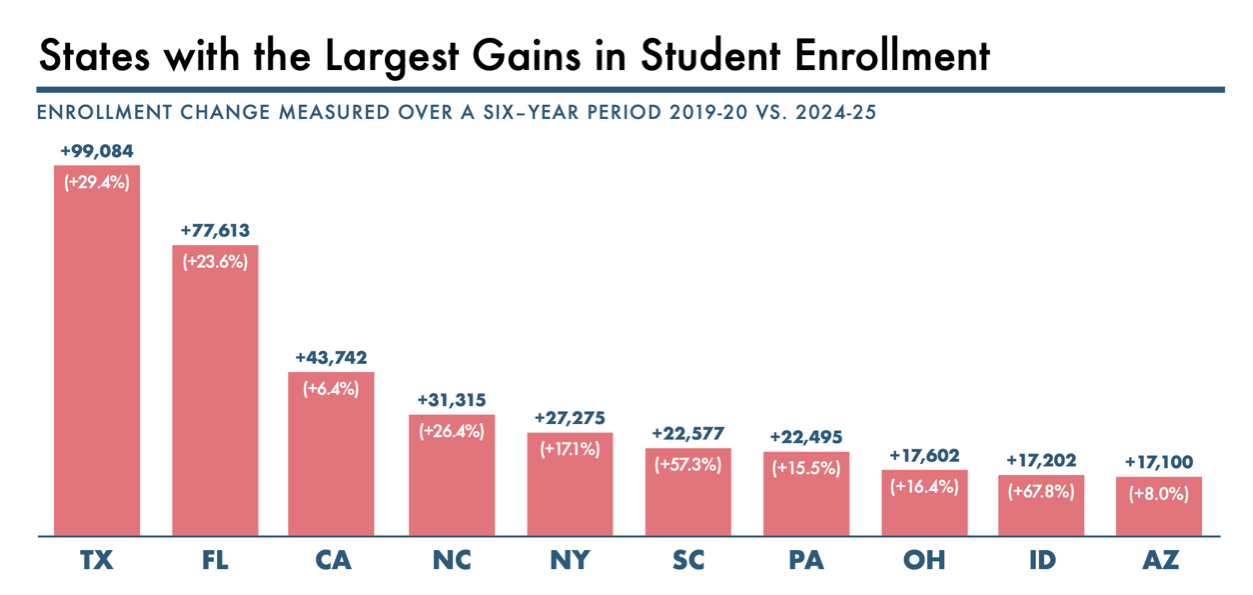
Only Texas, Florida, and California experienced more rapid charter enrollment growth, according to the brief.
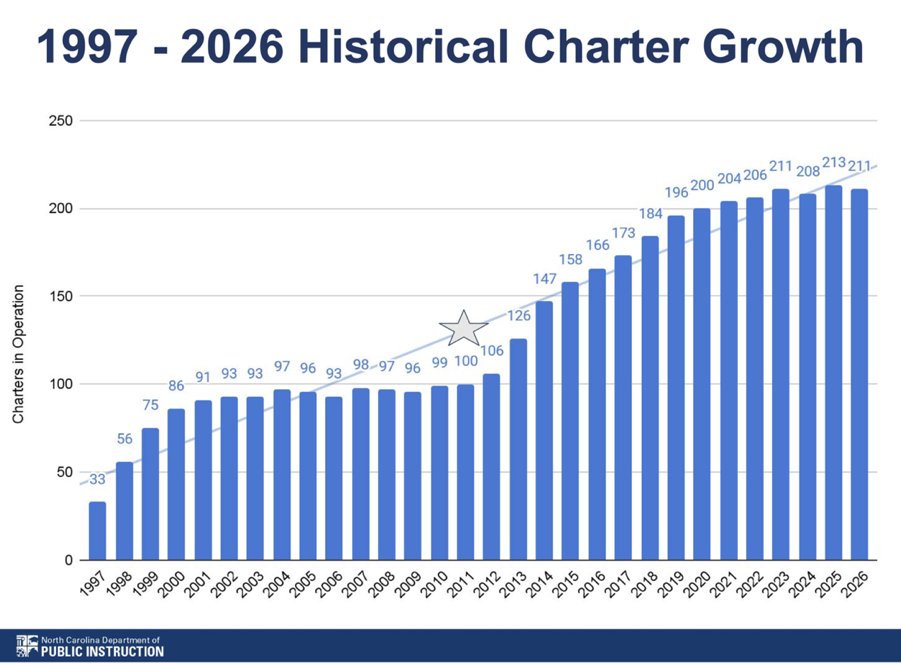
State trend lines reveal fairly steady increases in the number of schools as well, with small dips in recent years. Fifteen years ago, state lawmakers removed the 100-charter school cap (noted with a silver star in the graph above), opening the door for rapid expansion.
“Since then, the number of charter schools increased by 113%, to the highest number we had in 2025 at 213,” Logue said.
Triad International Studies Academy (TISA) and Monroe Charter Academy had their charters revoked during this 2025-26 school year. The CSRB closed TISA for falling below the statutory enrollment minimum and shut down Monroe Charter for “operating illegally,” in violation of remote learning statute.
In her summary of charter growth, Logue also highlighted school concentration in urban areas.
“Mecklenburg, Wake, Durham, and Guilford have almost half of the charter schools in the state,” she said.
As of August 2025, 92 schools — 43% of North Carolina’s charter schools — were located in these four counties.
Meanwhile, 36 counties do not have even one charter school.
Logue also shared data on remote charter academies, which are authorized to operate either as stand-alone schools or through an amendment under a school’s existing charter, she said. Ten remote charter academies operated during the 2025-26 school year.
Nineteen remote charter academies — including four statewide virtual schools — are slated to operate in 2026-27, she said.
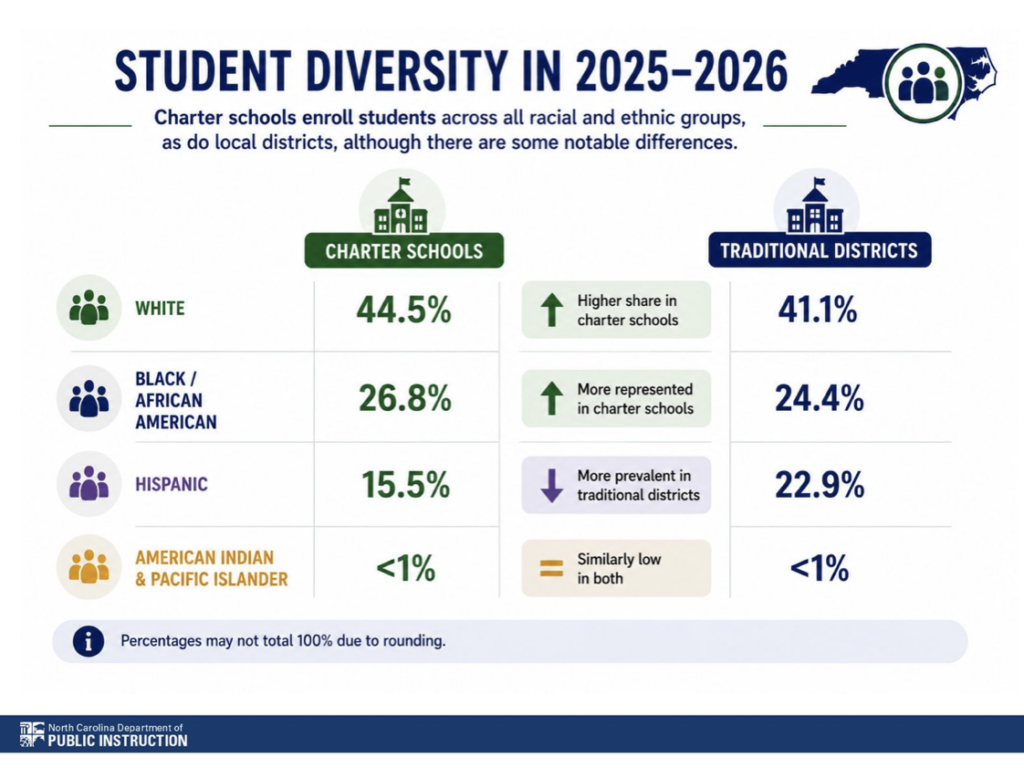
Logue also highlighted charter demographic data. Compared to district schools, charter schools serve higher percentages of white and Black/African American students, and lower percentages of Hispanic students, according to annual report data.
Hispanic charter enrollment is rising, however. “It is worth noting that the Hispanic enrollment in charter schools has grown remarkably over 15 years. It has tripled from 2010 to where it is now,” Logue said.
Screenshot from the OCS presentation.
The percentage of students with disabilities peaked in 2025 for both charter and district schools, Logue said, based on tracking since 2019. Students with disabilities comprise 12.04% of charter enrollment and 14.66% of district enrollment.
Charter schools have also seen “substantial increases” since 2019 in the number of economically disadvantaged students, Logue said. That year, 24% of charter students were economically disadvantaged, with that number “nearly doubling” to 40.9% in 2024.
In districts, 50.8% of students were economically disadvantaged in 2024. In 2025, percentages of economically disadvantaged students dropped slightly for both sectors.
Charter schools are also making modest improvements in their performance, according to the annual report.
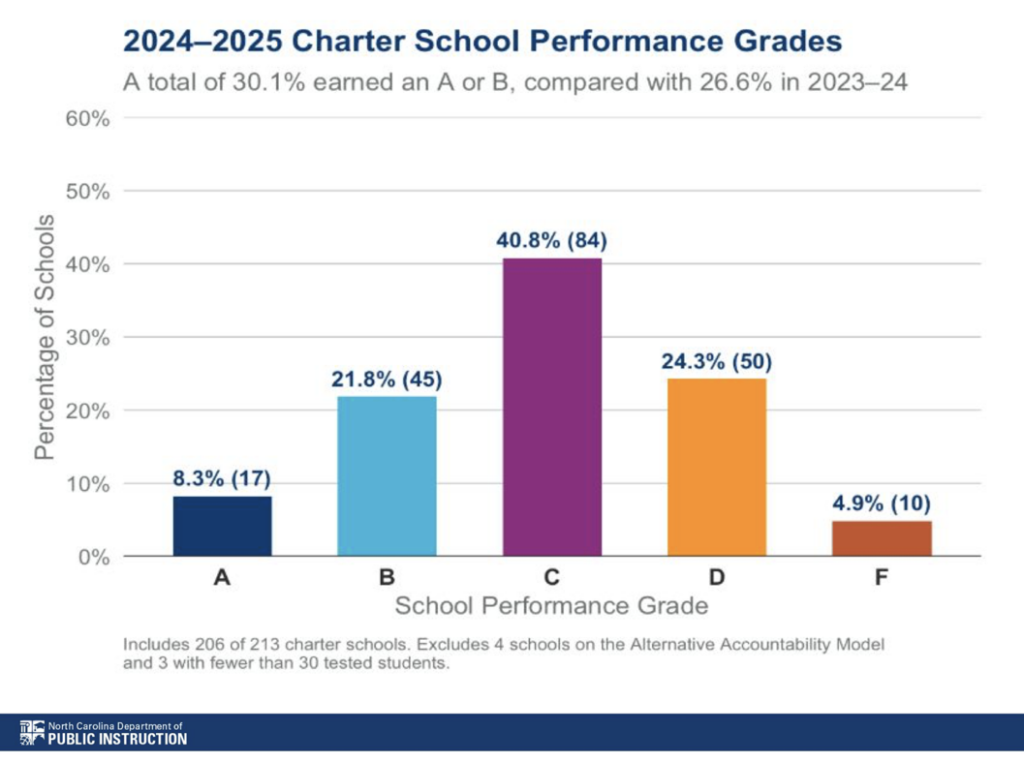
The percentage of charter schools earning A or B school performance grades increased from 26.6% in 2023-24 to 30.1% in 2024-25.
Screenshot from the OCS presentation.
In addition, more charter schools are meeting or exceeding academic growth, Logue said. In 2024-25, 72.3% of charter schools met or exceeded growth, ticking up slightly from 70.3% in 2023-24.
Recent trends also show fewer low-performing charter schools. According to the annual report, 24.9% of charters were low-performing in 2024-25, compared to 26.2% in 2023-24.
The annual report now goes to the State Board of Education and North Carolina General Assembly.
Amendments and charter application overview
The CSRB on Monday also approved requests to join the National School Lunch Program (NSLP) in 2026-27 for these schools: CIS Academy, Shining Rock Classical Academy, The Math and Science Academy of Apex, Triangle Math and Science Academy Schools , and Thomas Jefferson Classical Academy (TJCA).
In addition, the CSRB approved mission statement revisions for TJCA, along with Francine Delany New School for Children, Eno River Academy, Corvian Community School, and The Mountain Community School.
Melanie Rackley of OCS also provided an overview of 2026 charter applications. This year’s application cycle closed April 24, with 13 applications submitted. This is a drop from the 2025 cycle, when there were 17 applications.
One 2026 applicant has already withdrawn, Rackley said. Most applicants are seeking to open on a standard timeline, with one pursuing accelerated status.
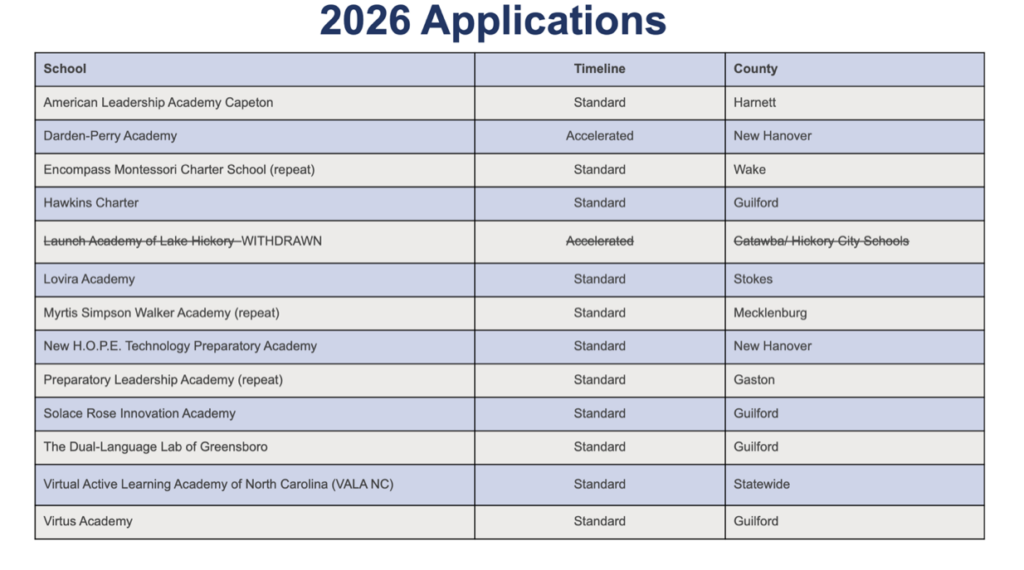
The CSRB will begin applicant interviews in September.
The Carolina Charter School Research Lab
CSRB members also welcomed the launch of a new research lab studying charter schools in the state.
“Today we are introducing a new proposed partnership between researchers at UNC-Chapel Hill, the North Carolina Collaboratory, the Office of Charter Schools, and this board, focused on a Carolina Charter School Research Lab,” said Jeni Corn, the social science research director of the North Carolina Collaboratory, in her presentation to the CSRB.
The lab, which will operate with the Collaboratory as its funding partner, will conduct “research to inform charter school policies and practices in North Carolina,” the presentation noted. Research will be conducted by a team from UNC’s public policy department, beginning in August and running through July 2030.
The General Assembly established the Collaboratory in 2016 “to utilize and disseminate the research expertise across the University of North Carolina System for practical use by state and local government.” However, its K-12 focus through the Office of Learning Research, authorized in 2024 statute, is relatively new.
Current K-12 policy priorities, Corn said, were developed through meetings with state lawmakers, superintendents, State Board members, and charter leaders.
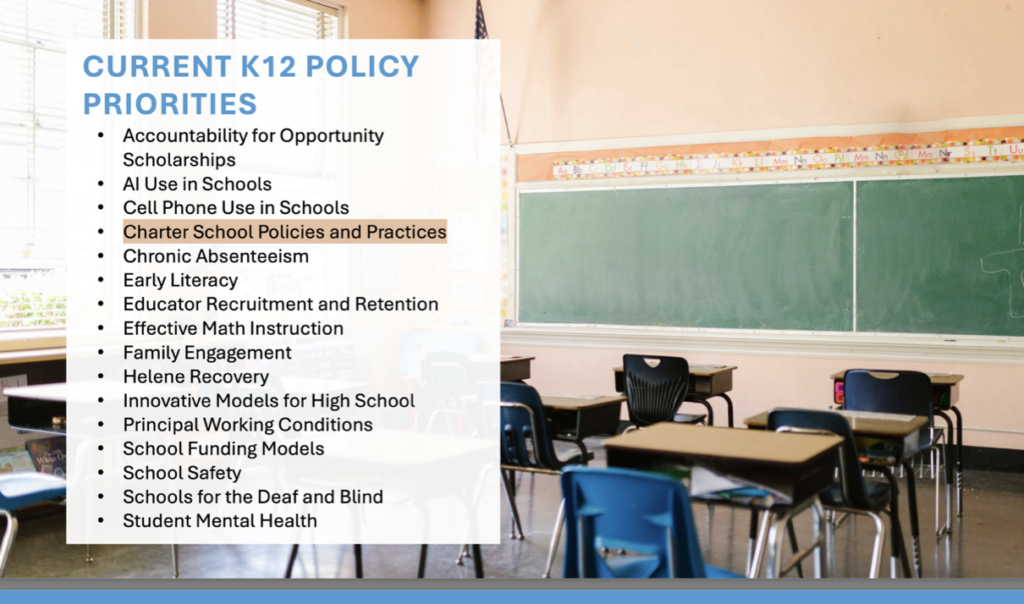
A key goal is to “provide some external research capacity to answer questions that we know have been sort of bubbling among not just this board but out in the field,” Corn said.
Proposed research topics, according to the presentation, include variation in charter school effectiveness; student factors for charter enrollment, persistence, and completion; and practices and support services promoting charter success.
“We’re not always going to tell you what you want to hear, but we’re going to tell you what you need to hear,” Corn said.
Doug Lauen, a UNC professor of public policy, joined Corn at the CSRB meeting.
“The idea here is that many minds will make the work more relevant to charter school operators in the state,” he said.
Research questions will be revisited each year, Lauen said, as researchers seek to understand what is “top of mind” for the CSRB and OCS.
CSRB members expressed enthusiasm about the lab and reinforced a pressing need for data on remote charters’ effectiveness.
“We need all the help we can get on that,” Guckian said.
Review of rules process
Ryan Collins, deputy general counsel for the SBE, shared an overview of the rulemaking process with the CSRB. Collins serves as SBE’s rulemaking coordinator.
“This is a very important topic, and this board has an important role to play in that process as it pertains to charter schools,” he said.
Collins outlined the North Carolina Administrative Procedure Act (APA), which governs administrative agencies, occupational licensing boards, and other government entities, he said.
Rules are policies subject to SBE approval and statutory requirements outlined in the APA, he noted.
Typically, the SBE considers a proposal across two meetings before voting to submit it for public comment. The rule is then published, with comments accepted for at least 60 days. The SBE reviews public comments and adopts a final rule, submitting it to the Rules Review Commission. The commission then approves or objects to the rule based on specific criteria, Collins said.
Recent statute has shifted greater oversight authority to the CSRB. Now, any rule or policy regarding charters must be approved by the CSRB before adoption by the SBE.
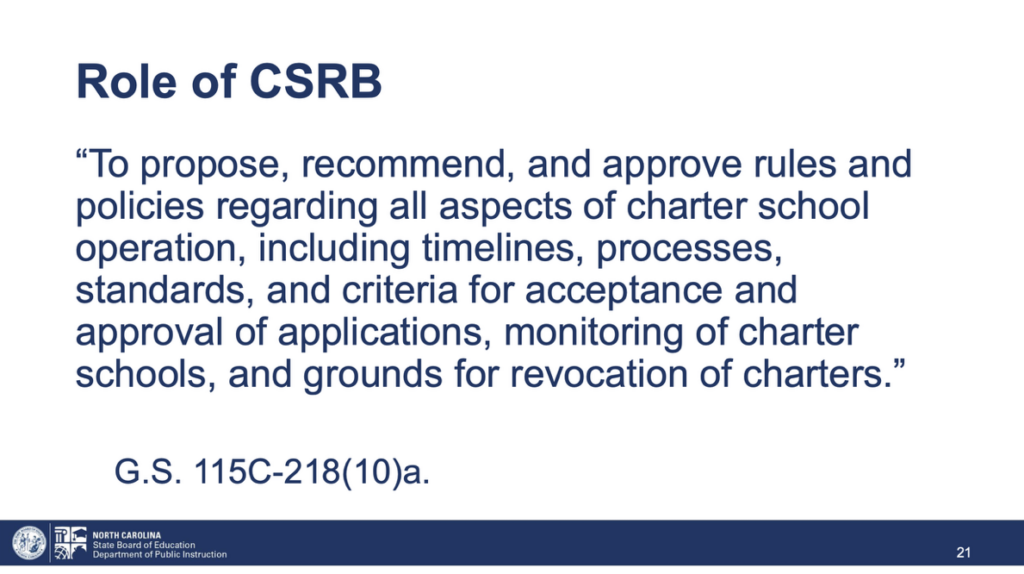
Essentially, Collins said, the CSRB is “step zero” in rules or policies impacting charters.
The CSRB will break during July and August, meeting next Sept. 8-9.
Editor’s note: EdNC has retained Kristen Blair to cover the monthly meetings of the Charter Schools Review Board. Kristen currently serves as the communications director for the North Carolina Coalition for Charter Schools. She has written for EdNC since 2015, and EdNC retains editorial control of the content.