
NC Collaboratory invites research proposals from institutions of higher education

The NC Collaboratory released an at least $1 million RFP on May 13, inviting research proposals from institutions of higher education (IHE) in North Carolina — including community colleges — to study high-priority topics in K-12 education affecting students, teachers, and communities throughout the state. Interest is strong, with more than 150 researchers registering for an informational webinar.
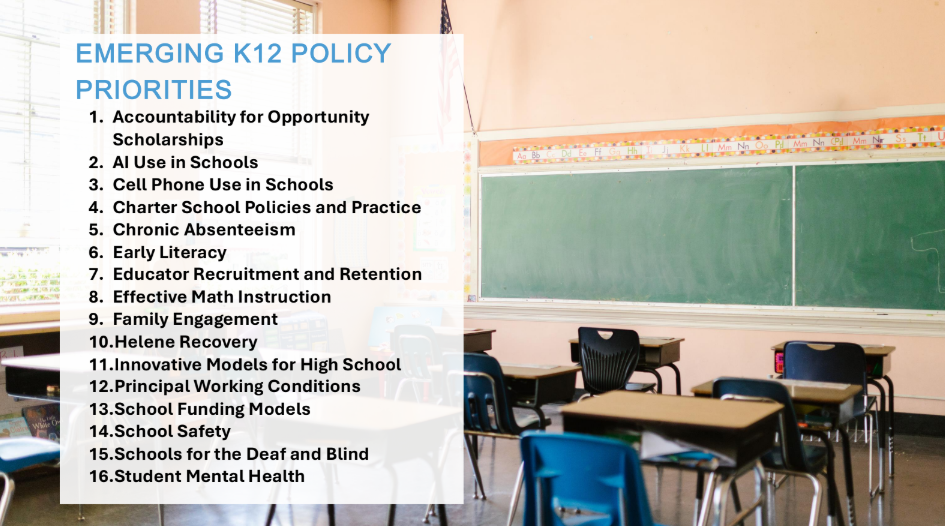
The RFP prioritizes projects that address one or more of four key areas:
- Impacts of literacy interventions (grades K-5),
- Family engagement,
- Math practices and policies (grades 4-8), and
- School safety and discipline.
Proposals on other topics will be considered but not prioritized. Additional information about the key areas can be found on pages 2-3 of the RFP below. Proposals with strong partnerships will also be preferenced.
This represents one of the largest education-focused RFPs the Collaboratory has released to date, according to Blair Rhoades, director of strategic communications.
According to the Collaboratory, all studies are expected to generate actionable recommendations and inform education policy and practice.
What is the NC Collaboratory?
Jeni Corn, who is well known for her research and evaluation at both the Friday Institute and the N.C. Department of Public Instruction, is now a research director at the Collaboratory, and she says you can think of the Collaboratory as the “research and grantmaking arm of the General Assembly,” which sets its priorities. The Collaboratory is housed at UNC-Chapel Hill.
The North Carolina Collaboratory is a research funding agency that partners with academic institutions and government entities to transform research into practical information and technologies for use by the State and local governments and the communities they serve.
Since its authorization in 2016 by the General Assembly, the Collaboratory has stewarded approximately $250 million in appropriations from the legislature, investing in over 700 research projects that have the potential to develop innovative, evidence-based solutions that benefit our State and its residents.
Initially focused on environmental and natural resources research, the scope of the Collaboratory’s portfolio has expanded to include projects focused on public health, education, technology, and infrastructure.
— NC Collaboratory website
More newly created, the Collaboratory’s Office of Learning Research (OLR) has awarded 15 grants totaling over $1.8 million in funding since its creation by the legislature in December 2024.
In 2026, as the Collaboratory is celebrating 10 years of service to the state, its annual report highlights rapid response research after Hurricane Helene and the launch of OLR. “Together, these efforts illustrate the Collaboratory’s dual mission,” says the report, “responding in real time to the needs of communities and their local governments while also investing in knowledge that will shape the State’s future.”
The Collaboratory’s “approach offers a practical blueprint for building state infrastructure capable of directing science at research universities to be nimble, accountable, and centered on delivering results for the people they serve,” says this article co-authored by Rhoades and Jeff Warren, the Collaboratory’s executive director. “By bridging academia and policy in a way few organizations can, the Collaboratory is a model that positions state-based research to inform policy while actively shaping the future of North Carolina.”
The Collaboratory is investing and building a network of NC-based researchers with expertise in elementary and secondary education and the state’s K-12 ecosystem.
What you need to know to apply and FAQs
The application deadline is July 31, 2026, at 5:00 p.m. EST.
The earliest project start date is Oct. 1, 2026.
The anticipated project duration is 18-36 months, and the anticipated range of funding per study is $150,000-$400,000.
Mixed methods social science research is allowed. The following data sources are prioritized:
- NC DPI Administrative Data and Report Card Data,
- Teacher Working Conditions Survey,
- NC School District Typology Dashboard and Methodology,
- NC DPI Discipline, ALP, and Dropout Data, and
- National Student Clearinghouse Data.
Who is eligible to apply?
Any IHE within North Carolina is eligible to apply. Any includes public or private and also two year or four year so, yes, community colleges may apply. Public IHEs are encourage to let their legislative liaisons and public affairs teams know they are applying for a grant that will make recommendations to the legislature and other governmental policymaking bodies.
Is this a limited submission opportunity?
No, there are no limitations on the number of applications that may be submitted from any eligible institution.
Are indirect costs allowed?
No, requests for indirect costs are not permitted.
Is an Authorized Organizational Representative signature required for submission?
For UNC-Chapel Hill proposals only, an Authorized Organizational Representative signature is not mandatory — a department-level signature is sufficient. Non-UNC-Chapel Hill applicants should follow their institution’s policies and procedures for signature requirements.
Are partnerships with entities that are not based in North Carolina allowed?
Yes. As with all partnerships and sub-recipients, applicants should clearly describe how this project and partnership with a potential sub-recipient would address the purpose of this funding opportunity. Lead principals investigators must be in North Carolina.
“We’re really trying to make sure that the research that we’re funding is directly connected to what is going on in schools,” said Corn on the webinar. “This is not theoretical. This is not an academic exercise.”
The application package, detailed budget template, webinar, and webinar slides are available here.
For more information or questions, email collaboratory at unc.edu with “K-12 Education RFP” in the subject line.