
‘Apprenticeship is a team sport’: How Maryland is achieving record apprenticeship growth

Editor’s note: This article is part of a series on apprenticeships for National Apprenticeship Week. See all of EdNC’s coverage of apprenticeships here. Note that all references to apprenticeship in this series refer to Registered Apprenticeships formally recognized by the U.S. Department of Labor.
In late 2024, Maryland Gov. Wes Moore launched an apprenticeship pledge, setting a goal of recruiting 500 new employers and 5,000 new registered apprentices in just one year.
Employers from “every industry and every corner of Maryland” were invited to join the pledge, new legislation invested in staff and employer incentives, and true momentum followed.
Just one year later, the governor had exciting news to share: the state achieved record growth in apprenticeships and met its pledge, partnering with more than 500 employers to recruit and hire more than 5,200 new registered apprentices in the state.
Today more than 1,000 Maryland businesses, organizations, and agencies employ and train registered apprentices, and 14,000 Marylanders participated in apprenticeship programs last year—an all-time high.
— January 2026 press release from Gov. Moore’s office
Apprenticeships, which combine paid on-the-job training with classroom instruction, have long received bipartisan support — and expanding apprenticeships has emerged as a key workforce strategy at both the state and federal levels.
In 2025, President Donald Trump signed an executive order pledging to add 1 million new active apprentices, and many states have set their own apprenticeship growth goals. In North Carolina, Gov. Josh Stein’s Council on Workforce and Apprenticeships set a goal of doubling the number of registered apprentices.
As workforce leaders in North Carolina work to scale apprenticeships, Maryland’s progress offers important insights.
Getting to the RAISE Act
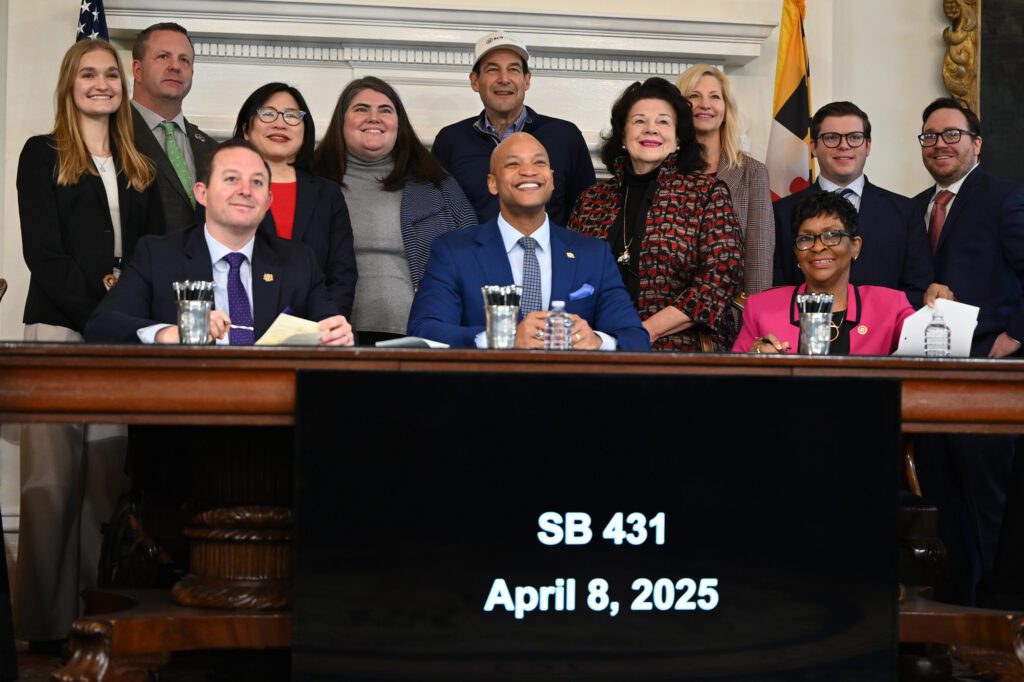
The cornerstone legislation of Maryland’s efforts to increase apprenticeships is the Registered Apprenticeship Investments for a Stronger Economy (RAISE) Act, a multipart investment signed into law by Moore in April 2025.
But the effort to align all workforce ecosystem stakeholders — including legislators, state agencies, educational institutions, employers, and labor unions — around a set of shared priorities for growing apprenticeships began years prior.
In 2023, Maryland’s General Assembly created the Apprenticeship 2030 Commission to make recommendations on expanding access to apprenticeships to “reduce skill shortages in high-demand occupations and provide affordable training” for young people.
The 23-member, cross-sector commission met throughout 2023 and 2024 and heard from employers, practitioners, and apprentices, including through in-person site visits to England and Germany. In March 2025, the commission submitted a final report with recommendations to the governor and legislature.
Just one month later, many of the commission’s recommendations were implemented through the RAISE Act.
Erin Roth, assistant secretary of the Division of Workforce Development & Adult Learning in Maryland’s Department of Labor, said having a cross-section of stakeholders in the apprenticeship community united around a set of shared goals was crucial to passing the RAISE Act at a time when the state faces fiscal constraints.
Specifically, Maryland decided to focus on expanding registered apprenticeships to more workers, with a particular focus on youth. The state also focused on expanding apprenticeships into fields that have not traditionally offered them – reflected in the recent launch of Maryland’s first state-sponsored teacher apprenticeships, environmental health specialist apprenticeships, and more.
“This was a big, big investment that I think wouldn’t have been possible had we not really listened to stakeholders, tried to find those solutions, and really have a unified, cross-section of those stakeholders to push it forth,” Roth said of the RAISE Act.
Surrounded by a group of apprenticeship stakeholders, Moore selected the RAISE Act as the first bill signing of the 2025 legislative session.
“In partnership with the General Assembly, we are building pathways to work, wages, and wealth,” said Moore in a press release. “The legislation I sign today will help grow our economy and build new pipelines to employment for all.”
Read more on apprenticeships



What is Maryland investing in?
The RAISE Act has four core components:
- Establishes a new Maryland Office of Apprenticeship;
- Establishes a program to fund intermediaries that forge connections between employers, apprentices, training providers, and the state;
- Establishes a pay per apprentice program to offset employer costs associated with starting a registered apprenticeship program;
- Expands journeyperson-to-apprentice ratios in certain nonhazardous fields.
Here’s a closer look at how each of those components is unfolding.
Expanding apprenticeship staff capacity through a new office
Chris MacLarion, director of apprenticeship and training in the Maryland Department of Labor, remembers when the state’s apprenticeship staff was just three employees.
At that time, apprenticeship efforts were largely focused on monitoring construction apprenticeships. Between compliance, data entry, and employer support responsibilities, MacLarion said he knew they needed more staff to truly grow apprenticeships.
“Phone calls are great, virtual meetings are great… but apprenticeship may be the most transactional workforce development program that exists,” said MacLarion. “When we talk about intentional, deliberate activities to grow registered apprenticeship, I really, truly believe it starts with staff.”
Recognizing the importance of staffing up to grow apprenticeships, the RAISE Act established the new Maryland Office of Apprenticeship and charged it with “developing, sustaining, and tracking registered apprenticeship opportunities.”
To fund the new office, the RAISE Act mandates that the governor include an appropriation in the annual budget bill to cover administrative costs. In FY 2026, $1.5 million was appropriated from the state’s general fund for the office, including funding to hire 14 apprenticeship navigators to market and develop new registered apprenticeship opportunities and track the results.
Now, the Office of Apprenticeship has 15 apprenticeship navigators and three regional managers based in every corner of the state, providing intensive employer engagement and personalized technical assistance to help grow apprenticeships. Separately, a small team of operations personnel in the Office of Workforce Development manage compliance and grants, allowing apprenticeship navigators to focus solely on employer engagement.
Comparing funding for apprenticeship staff in Maryland and North Carolina
Both Maryland and North Carolina are among the 33 states and territories that use a State Apprenticeship Agency (SAA) to review, approve, and oversee registered apprentices. In the remaining states, the U.S. Department of Labor’s Office of Apprenticeship serves as the registration authority.
In Maryland, the Office of Apprenticeship, established by the RAISE Act, is housed under the state’s SAA — the Division of Workforce Development and Adult Learning in the Department of Labor. North Carolina’s SAA, ApprenticeshipNC, sits within the N.C. Community College System.
While many SAA staff positions have been historically funded through federal grants, MacLarion said relying on time-limited grants that may or may not be renewed is not a sustainable approach. Recently, the Trump administration overhauled how the U.S. Department of Labor funds apprenticeship efforts, bringing further uncertainty to future funding for SAA staff.
The RAISE Act provided recurring state-level investments in Maryland’s apprenticeship navigators, whereas ApprenticeshipNC consultants — also assigned by region to provide support to employers — are largely funded through U.S. Department of Labor grants that will expire in June 2026. Without replacement funding, ApprenticeshipNC stands to lose 18 staff positions that provide technical assistance to employers.
In North Carolina’s 2026 legislative short session, the N.C. Community College System is requesting $3.1 million in recurring state funding to maintain ApprenticeshipNC staffing levels.
As Maryland works to diversify the types of industries offering apprenticeships, Roth said geographic assignments have allowed navigators to form close relationships with local economic developers, employers, and chambers of commerce, resulting in better support for apprenticeships across a range of sectors.
“About 85% of our apprenticeship programs today are in construction and the skilled trades … but we’re really looking to grow, and you can’t do that without a culture shift within a business, and that takes relationship building and persistence,” Roth said.
Now with a team of 26 staff working on apprenticeships, results are starting to show. According to MacLarion, Office of Apprenticeship staff now engage with 15 to 20 times the number of businesses each month compared to just a few years ago, and the number of new programs and new apprentices are steadily increasing.
In addition to establishing the Office of Apprenticeship, the RAISE Act created a new Registered Apprenticeship Development Advisory Board to consult with the office in its efforts to expand apprenticeships, including by reviewing outcomes and providing advice. The board includes representatives from the General Assembly, employers, and labor unions.
 Sign up for Awake58, our newsletter on all things community college.
Investing in intermediaries to coordinate and accelerate apprenticeships
The RAISE Act also created a grant program that invests in the creation and expansion of intermediaries that “help employers design, launch, and expand” apprenticeships, with a specific focus on nontraditional sectors.
According to Roth, the program’s design began with an in-depth look at labor market data to identify where jobs exist currently, where jobs will exist in five years, and which industries are experiencing recruitment and retention challenges that could be addressed by the apprenticeship model.
“One thing we heard over and over again is, in Maryland, we have a lot of small and medium sized businesses — they often have said, ‘Apprenticeship sounds great, but I feel like it’s not accessible to me,’” said Roth, adding that smaller employers often don’t feel like they have enough capacity to invest in the model.
That insight created the basis for the Industry Apprenticeship Accelerator. Leveraging labor market insights, the accelerator is specifically focused on creating and expanding apprenticeships in “sectors of Maryland’s economy where apprenticeship is uncommon or underutilized.”
The state identified six industries projected to experience growth but that currently lack apprenticeship opportunities to meet workforce demand: finance and insurance; health care and social assistance; information; professional, scientific, and technical services; public administration; and educational services.
The accelerator is structured as a competitive grant program that will fund organizations with expertise in connecting sponsors, employers, and prospective apprentices with apprenticeship programs and convening stakeholders to develop apprenticeship programs.
The first round of funding, to be announced in June, will total up to $5 million. A fiscal analysis anticipates that an additional $5 million will be distributed in fiscal year 2027, bringing initial total investments in intermediaries to $10 million.
Individual grants may range substantially — from $250,000 to $2.5 million — which Roth said was intentional to allow awards to be calibrated to the size of the industry an intermediary will support.
Funds can be used toward staffing, recruitment and outreach, curriculum development, employer convenings, and more; and projects that support high school apprenticeships, develop a consortium with employer and nonemployer partners, and braid other sources of funding will be prioritized.
Ultimately, the grant program aims to invest in organizations that become long-term intermediaries, continuing to grow apprenticeships for years to come.
“We want them (intermediaries) to have enough flexibility that they can figure out how to also monetize the process,” said MacLarion. “Bringing on employers, and bringing on apprentices — there’s a cost to it. How do we make this economically viable for the industry, the employer, and most importantly the apprentices? But also, how do we keep this thing growing?”
Funds for the accelerator — and for the state’s pay per apprentice effort, discussed below — are drawn from a $25 million Dedicated Purpose Account for registered apprenticeships, created by the General Assembly in the fiscal 2023 operating budget.

Helping employers offset apprenticeship costs through a pay for performance model
The initial costs associated with starting an apprenticeship program — ranging from curriculum design to tuition and training materials — often pose a barrier for employers interested in the model, particularly for small and mid-sized companies. To address this, many states offer some form of tax credit or reimbursement for sponsors and employers engaged in apprenticeships.
The RAISE Act created a new pay per apprentice program that offers grants to employers to reimburse them for these costs. However, rather than providing up-front funding, the program is contingent on outcomes — funds are only awarded once a new apprentice has been employed for at least seven months.
This pay for performance approach marks a departure from how traditional public funding has been allocated to support apprenticeships. The approach is also being deployed at the federal level through the U.S. Department of Labor’s new $145 million pay-for-performance incentive payments program, which represents more than half of the federal government’s $285 million registered apprenticeship budget for fiscal year 2025.
In January 2026, Maryland’s Apprenticeship Incentive Program launched with $5 million in grants. A fiscal analysis anticipates that an additional $5 million will be available in fiscal year 2027, bringing initial total investments in pay per apprentice grants to $10 million, though outcomes in fiscal year 2026 may impact the exact parameters and dollar amounts for fiscal year 2027. Similar to the intermediary program, funds are drawn from the state’s $25 million Dedicated Purpose Account for registered apprentices.
Sponsors or employers can apply for the grants on a rolling basis and may receive up to $3,000 for each newly registered adult apprentice, or up to $7,500 for each newly registered high school-level apprentice. The higher amount for the high school level reflects the state’s goal of increasing participation in registered apprenticeships among students while they are still in school. Grant funds can be used to offset a range of eligible expenses, including instructional expenses, mentorship, recruitment, supportive services for apprentices, and more.

Expanding journeyperson-to-apprentice ratios in nonhazardous fields
In many states, including North Carolina, the default guidance for a journeyworker-to-apprentice ratio is 1:1 in order to protect the safety and welfare of apprentices.
But as many new, nonhazardous occupations are launching apprenticeships, Maryland decided to reconsider that requirement, which can pose a barrier to scaling apprenticeships.
“There are times when a one-to-one ratio is extremely important — construction, manufacturing,” said MacLarion. “But also, we have to be very practical, keeping in mind that there are occupations where an expanded ratio could make sense.”
Previously, sponsors could request a deviation from the one-to-one ratio, but had to wait at least one year after registration to do so, slowing down the approval process. Roth said this created a frequent roadblock for small and medium-sized employers in nonhazardous sectors.
“For industries outside of the trades, it sort of made them feel like, why bother?” she said.
Using U.S. Department of Labor guidelines and other data, the state created a list of vetted nonhazardous occupations that may be approved to operate with an expanded ratio, including accounting, cybersecurity, child care, teacher, and more.
Now, the RAISE Act creates an “expedited pathway” to consider expanded ratios for those nonhazardous occupations when a program is first registered.
Roth said the state worked deliberately to bring all stakeholders on board with this policy change, including employers and unions, carefully balancing a desire to expand ratios in some sectors while still ensuring the integrity, safety, and rigor of apprenticeship programs.
“What would have been a revolutionary concept, just a couple years ago, we were able to bring into the RAISE Act,” MacLarion said. “We’re almost six months into this, and we’re seeing no objections from anybody out in the community.”

Maryland’s apprenticeship growth
Having already met the governor’s apprenticeship pledge, efforts to scale apprenticeships in Maryland are not slowing down.
And while apprenticeship growth goals often focus on a single metric — the number of new registered apprentices — MacLarion said it’s important to consider multiple outcomes to better understand the state’s holistic progress, including the number of new sponsors, new employers, and apprentices that graduate.
“When you’re throwing money into the mix, it’s really tempting to focus only on the growth numbers,” said Roth. “But making sure people get opportunities and continue within their career through apprenticeship is really important to us — and graduation is one metric of that.”
Maryland’s Department of Labor is also partnering with the state’s longitudinal data system to understand apprentice wage outcomes five years after exit, including analyzing that data across demographic subgroups to understand how to best refine the state’s approach.
In 2025, Maryland:
- Graduated over 1,840 apprentices
- Added 37 new apprenticeship sponsors
- Reactivated 11 dormant apprenticeship programs
- Added 231 new employers
- Registered more than 5,200 new apprentices
Reflecting on what has been most crucial to Maryland’s success, Roth put it simply: “Apprenticeship is a team sport.”
Maryland’s approach to growing apprenticeships engaged a cross-sector of stakeholders at every point along the way, including the governor’s office, legislators, Department of Labor staff, the K-12 school system, employers, intermediaries, unions, and more.
Roth’s advice to other state leaders is to recognize apprenticeship growth needs to be collaborative in order to be effective and sustainable.
“I do feel there’s room for everyone to participate and support and coalesce around a shared goal with growing apprenticeship — and defining those swim lanes is important,” she said.
MacLarion urged other apprenticeship leaders to not be afraid to challenge the status quo. Reflecting on his first meeting about expanding journeyworker-to-apprentice ratios, he recalled that many people walked out of the room — the idea was contentious, and it was hard to see a path forward.
But over time, buy in was built, something he credits to getting involved in the field and hearing directly from apprentices, sponsors, and employers.
“You’ve got to network, and you’ve got to do the work on the ground and be willing to address some of those challenges,” he said.