Six of seven new charter schools in the pipeline to open this fall are still below their break-even enrollment thresholds, the Charter Schools Review Board (CSRB) learned at its virtual meeting on Monday, April 6. Natasha Norins of the Office of Charter Schools (OCS) presented the enrollment figures in a Ready to Open (RTO) report, assessing each school’s preparedness as the planning year winds down.
While some schools are close to enrollment targets, others lag far below projections. Focus Academy, for instance, has enrolled just 32 students, significantly under its break-even threshold of 146 students. RYZE Academy has enrolled 89 of 150 students needed to break even.
School leaders must work toward reliable enrollment numbers in order to secure approval, CSRB Chair Bruce Friend said.
“Community gatherings and enrollment parties, and hope, faith, are not strategies that we need,” he said. “We need the real numbers.”
 Sign up for the EdWeekly, a Friday roundup of the most important education news of the week.
One RTO school, NC Connections Academy, is a notable outlier, with interest far beyond capacity. A stand-alone statewide remote charter academy, NC Connections received 2,953 applications, Norins said. The school is already fully enrolled with 752 students, significantly above its break-even threshold of 500 students.
CSRB members on Monday also voted to allow North East Carolina Preparatory School to shift its remote charter academy’s scope from regional to statewide. School leaders said they may admit out-of-state students into the remote academy.
State law passed in 2023 allows this enrollment flexibility for charters, with out-of-state students required to pay tuition. However, such students may not make up more than 10% of a charter’s total enrollment, according to statute.
More on RTO schools
In addition to sharing enrollment figures, Norins outlined critical factors impacting school readiness, such as facility and operations; finance and budget; staffing; and RTO participation, submissions, and governance.
OCS plans to evaluate each school through a readiness report. The coming weeks are critical: Schools deemed to be in jeopardy will appear before the CSRB in May, with final votes taking place in June.
According to OCS, CSRB has three voting options:
- A school is approved to open and receives a charter agreement.
- A school is approved with contingencies that must be fulfilled before receipt of a charter agreement.
- A school is not ready to open. CSRB votes to delay or deny the school altogether.
These are the latest enrollment numbers for RTO schools.

The three schools struggling most to meet break-even enrollment targets all received approval this fall as accelerated applicants, with the CSRB voting on RYZE and BH2 STREAM in September and Focus in October. Like standard charter applicants, accelerated applicants participate in a planning year, but planning occurs in the same year as their application review.
Citing wide enrollment variance among schools, CSRB member Eric Guckian asked about practices leading to success.
OCS provides open office hours, Norins said, and encourages schools to invite families onsite for enrollment parties or to collect registration documents. OCS also reinforces what constitutes actual enrollment.
“You can’t have an interest list to feel like families are going to commit to you,” she said. “You have to have enrolled students and extra students waiting in the wings for a waitlist.”
OCS will conduct enrollment verification with schools in mid-May, Norins added. “We are holding them accountable for this data,” she said.
Schools still falling short of enrollment minimums should not expect contingent approval in June, Friend said.
“I’m not going to support a school and give them an exit at ready to open if the contingency is that they haven’t met their enrollment criteria,” he said. “We’ve been burned twice now in the last two years on this where schools didn’t meet their minimum.”
A remote charter expands
Following this week’s CSRB approval, North East Carolina Preparatory School (NECP) is poised to expand its regional remote academy, which launched in 2024-25 and currently serves 43 students. The school’s brick-and-mortar model enrolls 1,220 students, according to Mark Cockrell, the executive director.
The remote academy’s regional scope has restricted enrollment to students in Edgecombe and contiguous counties. However, in their letter to CSRB, NECP leaders cited a “significant surge” in remote academy applications from across the state and outside North Carolina.
As the academy expands statewide, it will maintain its target grade levels (6-12) and instructional model. At capacity in its fifth year, the academy expects to serve 130 students, according to NECP’s executive summary.
Friend emphasized NECP’s testing obligation, even for students living far away.
“The school is required to provide the access to the testing to the family … You can be statewide, but you might find that serving two kids in the western part of the state that’s 300 miles away just isn’t worth the headache,” he said.
CSRB members also asked how enrolling out-of-state students would work.
The school would charge those students tuition, Cockrell said, noting NECP’s attorney was working through logistics. Out-of-state applications have come mostly from families in Georgia and some from Virginia, he said.
“There is just a need for this option and families are obviously searching, not only within the state but other states, too,” he said.
Out-of-state students would need to come to campus for end-of-year testing, he added.
Other amendments, including a relocation denial
The CSRB also approved mission statement revision requests for Maureen Joy Charter School and Pocosin Innovation Charter — but denied a relocation request from BH2 STREAM. Currently in RTO status, BH2 STREAM sought CSRB approval to move 15 miles from its original location to a temporary facility in Edgecombe County.
BH2 STREAM’s relocation request represents the school’s third proposed facility. The CSRB in February delayed a vote on a request to relocate to Nash County.
Kristian Herring, the school administrator, said leaders had obtained an educational certificate of occupancy for the proposed building’s first floor but not its second floor.
This month’s request elicited fresh concerns about the school’s lack of readiness.
“I just feel like we’re at the same point today that we were in February, being asked to approve a new site when … you don’t even have the information with a 100% guarantee that the site is a viable site,” Friend said. “You think it is, you hope it is, but you can’t say with assurance because you don’t have a traffic study done, you don’t have the final inspections done.”
“The moment you don’t have a facility, you’re no longer an accelerated applicant,” CSRB Vice Chair John Eldridge said. “Our board needs to strongly consider whether or not this application is still valid.”
Friend asked if school leaders had considered a delay in opening.
BH2 STREAM’s enrollment on March 25 was just 48 students, according to OCS. However, the school has received over 300 applications and held its first enrollment party last Thursday, with 127 families bringing enrollment applications, Herring said.
“That was a great indicator for us that we should keep going forward” toward a 2026 launch, he said. School leaders are considering pushing the July 13 opening to early August, he added.
Following the relocation denial, BH2 STREAM’s board has three options, according to the CSRB: seek approval to open at the original location, request a delay year, or turn in the application. Turning in the application voluntarily would effectively end the process.
Low-performing schools presentation
In a presentation to the CSRB, OCS also outlined efforts to support low-performing schools, which included 13 in-person and six virtual site visits this year.
Leaders from United Community School (UCS) shared improvement updates. A K-8 school, UCS has been continually low-performing for six years. The school met academic growth last year and earned a D performance grade.
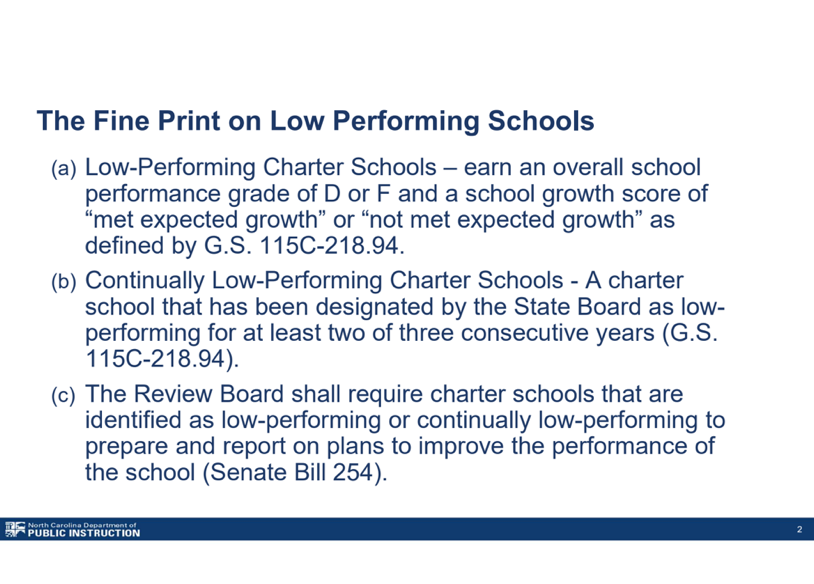
Erika Hedgepeth, the executive director, said improvement goals include exceeding growth and improving math and reading end-of-grade (EOG) scores by five points.
“We have changed our curriculum, and we have teachers and teaching partners in every classroom, pulling students into small groups — tutoring them during the school day,” she said.
UCS serves a high percentage of EC (Exceptional Children) students, and staffing has been a challenge, leaders said. Attendance has also been a difficulty, with some chronically absent or tardy students in the upper grades.
Recent high teacher retention rates have been encouraging, school leaders noted. They also cited success with EL (English Learner) students and interim growth through NC Check-Ins.
Charter legal context
OCS Executive Director Ashley Logue shared a presentation outlining the landscape of charter law, rule, and policy. The CSRB has substantially more authority over applications and the charter sector now than ever before, Logue said, due to recent legislation.
“Previously, the State Board of Education held sole authority to create rules and policies for charter schools. SL 2025-80 restructured that by requiring CSRB approval before any rule or policy affecting charter schools can take effect,” she noted in her presentation.
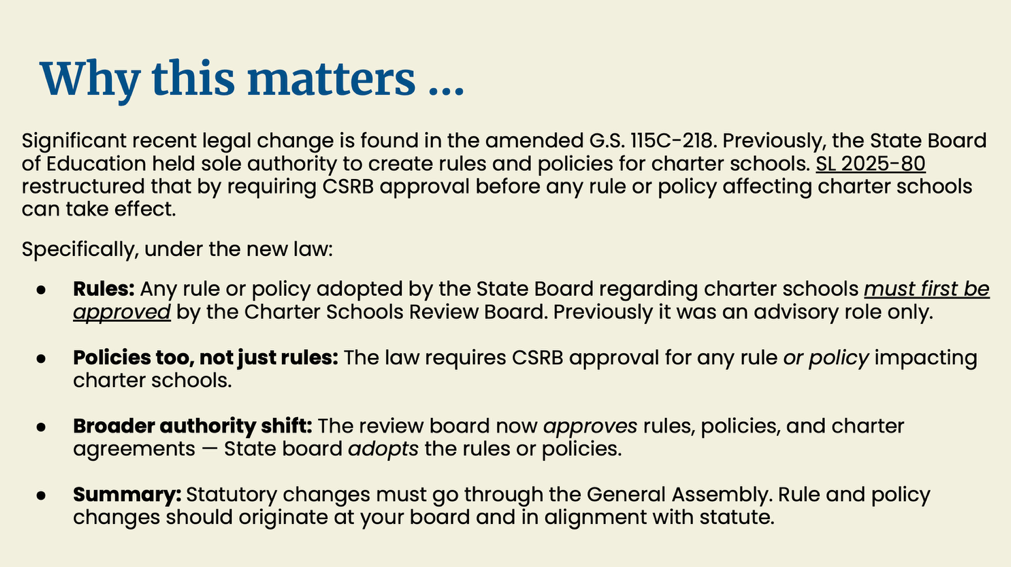
“It’s still something that needs to be looked at as a partnership,” she told the CSRB. “At least, I would argue that, because you are approving (rules and policies), but they are being adopted by the State Board.”
So far, North Carolina’s charter renewal policy is the only policy the CSRB and State Board have worked together to approve and adopt, Logue said. While other previous charter rules and policies are still in effect, the language is outdated because it does not yet reflect the CSRB.
Logue also shared legal and policy references that differentiate between accelerated applications and fast-track replications.
The original source for acceleration, Logue said, is State Board policy, CHTR-013. A related rule also allows acceleration. Both require schools to engage in a planning year, while school review is ongoing, and identify a facility.
Fast-track replication is a different application option, however, with a “very detailed statute,” Logue said. Replication is also governed by policy and rules. It is available only to existing charter boards seeking to reproduce a high-quality charter school themselves or contract with a management organization — with proven results — to do so.
Since acceleration is not in statute, the CSRB has greater opportunity to decide what it should look like, Logue said. Fast-track replications offer “very little flexibility,” given the level of detail in statute, she said.
CSRB members questioned whether acceleration was even necessary.
“I would tend to say, let’s let schools go through, go into RTO, and then come tell us when they’re ready,” CSRB member Lindalyn Kakadelis said.
Discussion also focused on the need for broader policy shifts.
“The idea of changing some of our procedures that are rooted in rules is not relegated to just accelerated applications,” Friend said. “I do think we should revisit the timeline for which applications are submitted and reviewed and approved. But that’s a separate discussion.”
Understanding true demand is also important, CSRB members noted, as is modeling national charter authorizing practices that support success.
“Very few schools” demonstrate solid data attesting to local demand and need, CSRB member Rita Haire said. “They have the urgency, but they don’t bring community evidence.”
“The goal here obviously is to scale up things that are working for kids,” Guckian added. “We want to go fast with those opportunities and slow down when folks need more help.”
The CSRB meets next on May 11.
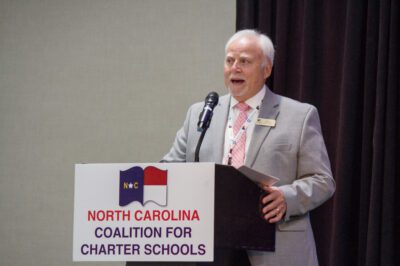
Editor’s note: EdNC has retained Kristen Blair to cover the monthly meetings of the Charter Schools Review Board. Kristen currently serves as the communications director for the North Carolina Coalition for Charter Schools. She has written for EdNC since 2015, and EdNC retains editorial control of the content.

Recommended reading