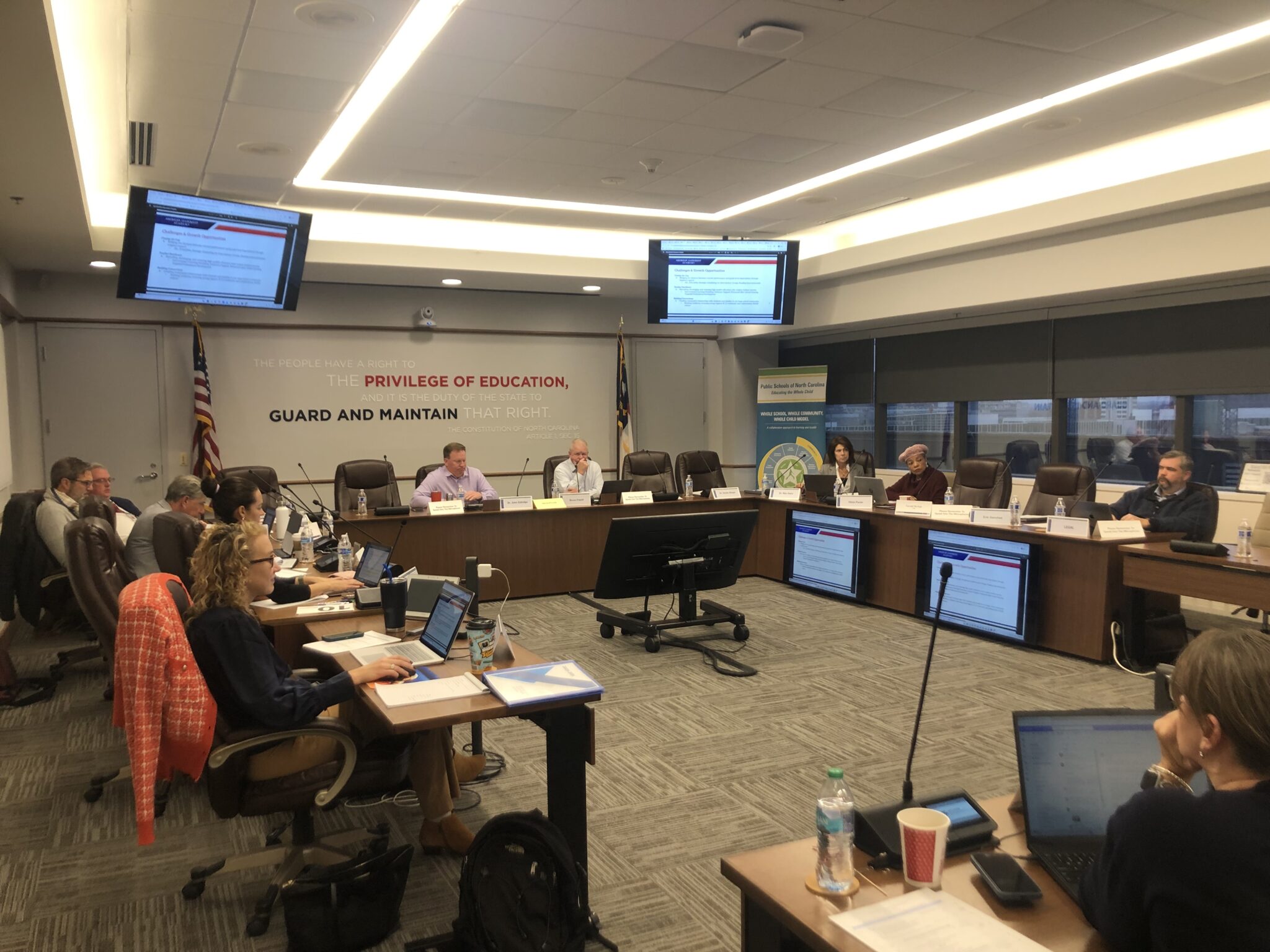
A Union County charter school that operated remotely while awaiting an educational certificate of occupancy (CO) has been ordered to close immediately. The state’s Charter Schools Review Board (CSRB) voted to terminate the charter for Monroe Charter Academy on Tuesday, Dec. 9, the second of the CSRB’s two-day meeting. According to CSRB leaders, the school was “operating illegally.”
Monroe Charter shifted to remote instruction before Thanksgiving, as it pursued a CO for a new Mecklenburg County facility. But the school quickly exceeded the five remote instruction days permitted by state law as delays in obtaining a CO accrued. On Dec. 5, Department of Public Instruction (DPI) officials notified Monroe Charter that they were freezing federal funds and had placed the school on financial noncompliance disciplinary status, due to the lack of a CO and violation of remote learning statute.
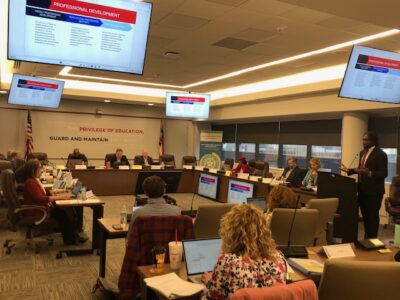
“The issue that I think we face as a board is that the school is in operation illegally,” John Eldridge, the CSRB vice chair, said during deliberations. “I don’t think this board can be complicit to one of our schools operating illegally.”
 Sign up for the EdWeekly, a Friday roundup of the most important education news of the week.
Monroe Charter’s closure is the second charter closure in just two months. In October, the CSRB closed Triad International Studies Academy (TISA) in High Point for falling below the 80-student minimum required by statute.
In both instances, schools’ clear violation of state law left the CSRB without recourse.
“There’s no joy in this,” Bruce Friend, the CSRB chair, said of the decision to close Monroe Charter mid-year. “We also can’t allow a school to continue to operate illegally.”
At this week’s meeting, the CSRB also approved two new charter applicants: Somerset Preparatory Academy NC in Union County and Celeste Beauty Academy in Mecklenburg County. However, the CSRB denied applications from Cape View Leadership Academy in Pender County and Myrtis Simpson Walker Academy in Mecklenburg County.
In addition, charter schools up for 2026 renewal updated the CSRB on their academic and other progress measures.
More on Monroe Charter’s closure
A K-8 school serving 101 students, Monroe Charter appeared before the CSRB this month as one of 10 renewal schools. However, emergent compliance and financial viability issues surfaced early on in the school’s presentation.
Just last month, Monroe Charter received CSRB permission to relocate from Union to Mecklenburg County. At that time, leaders assured the CSRB they could secure a CO for the new facility within two weeks. This month, however, they appeared before the CSRB with no CO and a bold request for a seven-year renewal.
“There’s the issue of the renewal for sure, and you’re requesting seven years, but more immediately is, what happens tomorrow?” asked Friend. “What happens next week? … You don’t have a place for the kids to go. You don’t have the funds to support the school coming in because you don’t have the CO, and you don’t have the approval to run an online school. … Is there a request to handle that?”
School leaders hoped to operate temporarily as a remote charter academy. In a written request, they noted, “Our intention is not to operate remotely as a substitute for in-person instruction, but rather to maintain educational continuity in a legally compliant way while we finalize the final phase of occupancy approval.”
Unpersuaded, the CSRB voted against a remote charter academy. Monroe Charter’s request occurred outside the standard timeline for considering remote academy applications, Friend noted. Moreover, remote academies typically represent an extension of a charter school’s brick-and-mortar campus, he said.
Read more

CSRB members also discussed the school’s fraught financial position. In November, DPI officials had placed the school on financial noncompliance cautionary status due to declining enrollment and expenditures that exceeded revenue by more than $180,000.
“They have at this point drawn nearly 100% of their annual cash from the state,” Amanda Fratrik, the school business systems manager at DPI, told CSRB members this week.
To fund operations, Monroe Charter had been using local dollars and carryover funds from last year, Camela Ford, the school’s executive director, said.
Prior to voting on a motion to close Monroe Charter, the CSRB invited school leaders to share comments. One board member asked for more time. But Jim Stegall, the acting board chair, was clear-eyed about the school’s predicament.
“As hard as this is going to be for some parents to hear, and their kids and staff … I know what you have to do,” he said.
The CSRB voted unanimously to terminate Monroe Academy’s charter, effective immediately, citing state statute. The motion stipulated the following reasons:
- Failure to meet the requirements for student performance contained in the charter. The school’s 2024-25 grade level proficiency was 12.4%, 58% below the local district’s grade level proficiency.
- Failure to meet generally accepted standards of fiscal management, “because of decreasing ADM (Average Daily Membership) and expenditures exceeding revenue by over $180,000.”
- Violation of law, including operating remotely for longer than state law allows, “resulting in a freeze of at least two funding sources.”
- Violation of the requirements of the charter by “failing to have an educational certificate of occupancy.”
Monroe Charter has the right to appeal the CSRB’s decision to the State Board of Education.
Applicant decisions
Four applicants appeared before the CSRB this week for interviews. In total, 17 prospective charter schools submitted applications during the 2025 cycle, according to the Office of Charter Schools (OCS). Five applicants withdrew.
CSRB decisions around the remaining 12 applicants are now complete. Votes this fall were evenly split, with six approvals and six denials.
Following this week’s approval, Somerset Preparatory Academy will now move forward into the Ready to Open (RTO) process. The school plans to launch in 2027 in Union County with 300 K-2 students, serving 600 K-5 students at capacity.
This is Somerset’s second bid for CSRB approval. In 2024, the CSRB denied the school’s application. This time around, Friend commended the board for its preparation.
A replication of a Florida charter school, Somerset is partnering with Florida-based Somerset Academy Inc., a charter management organization (CMO). School leaders said Somerset Academy Inc. had been awarded a CMO replication and expansion grant from the U.S. Department of Education, with the North Carolina school poised to benefit from $2 million in grant funding.
CSRB members commended the clarity of the service agreement with the management organization. “I don’t know how you could ask for anything more,” CSRB member Rita Haire said.
Celeste Beauty Academy will join Somerset in RTO, planning a 2027 launch in Mecklenburg County. That year, the school, focused on cosmetology, expects to serve 100 students in grades 9-11, growing to 230 students in grades 9-12 at capacity.
School leaders outlined plans to offer core academic courses, training, mentoring, and industry certification.
While they were supportive of Celeste Beauty’s program, CSRB members warned leaders to monitor enrollment and budget closely.
“If you guys want 100 (students), have 250 … With such a small budget, the impacts are devastating when two, three, four, five kids don’t show up,” Eldridge said.
Two other 2025 applicants will not move forward.
Cape View Leadership Academy sought to open in 2027, serving students in grades 6-12 with a CTE (career and technical education) focus. The school planned to partner with ACCEL Schools, an education management organization (EMO).
If approved, it would have been the first charter school in Pender County, according to the OCS presentation.
CSRB members affirmed the need for a charter school in that region but raised a number of concerns about Cape View’s budget and EMO agreement.
Votes on the applicant involved three separate motions across both days of the CSRB’s meeting.
A Monday motion to bring Cape View back for a second round interview failed. A second motion to deny the school’s application passed.
On Tuesday, Friend made a motion to reconsider Cape View and grant the school a second round interview. The motion to reconsider was permitted, CSRB counsel Steven Walker said, because Friend had voted on the prevailing side — against the original motion — on Monday.
“What has changed?” CSRB member Eric Sanchez asked.
“I would like to ask the education management partner some additional questions about the budget and the management agreement,” Friend responded.
The third motion failed by a 5-5 vote, leaving the CSRB’s denial in place.
The CSRB also denied the application for Myrtis Simpson Walker Academy, a Mecklenburg County K-8 charter school that hoped to open in 2027 with a single-gender classroom model, emphasizing music and entrepreneurship.
This was not the school’s first time seeking CSRB approval. The CSRB denied Myrtis Simpson’s application in 2023.
“What’s new, what’s different, and what’s improved?” Friend asked.
“Before, we were focusing on a single-gender school model,” Cynthia Johnson, the board chair, said. Revised plans emphasize a single-gender classroom model.
CSRB members expressed concern about day-to-day implementation of that model, the applicant’s lack of concrete planning, and budget issues.
“You can’t allocate x number of seats for males versus females,” Friend said. “You could have a second grade class of six females and then another second grade class of 36 males. … You can’t really afford to have a class of six (with) a dedicated teacher.”
“It just feels like it’s not carved out just yet,” CSRB member Shelly Shope said. “And I think we had that same feeling the last time they were in front of us.”
“The numbers in the budget are concerning for curriculum and instruction,” CSRB member Rita Haire added.
Both applicants may appeal to the State Board of Education.
Renewal presentations
Ten schools in the 2026 charter renewal cohort came before the CSRB this week.
The policy below outlines the state’s charter renewal guidelines.
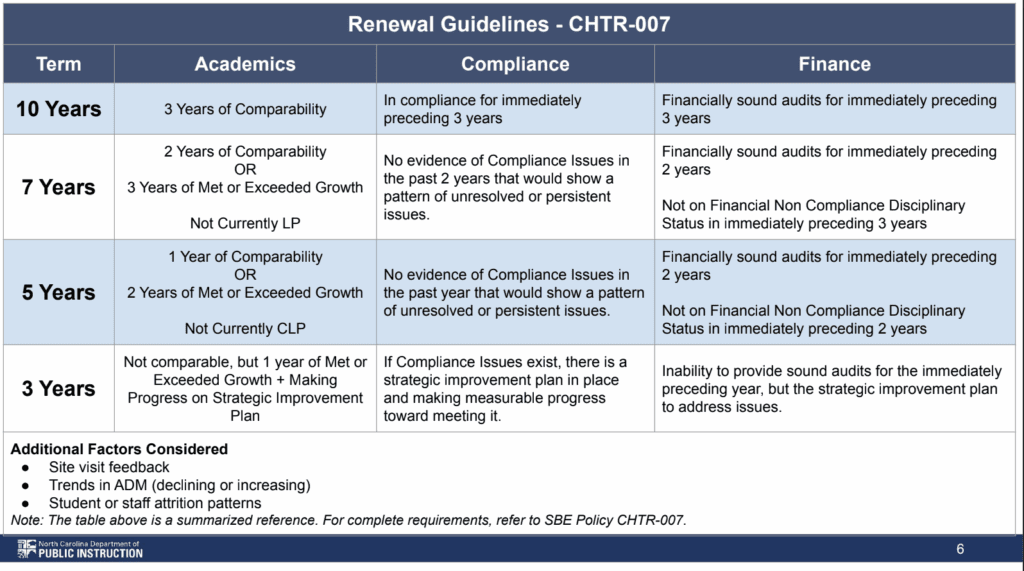
A school is deemed “comparable” when its “proficiency score is within 5 points of its local district’s composite score (based on EOG/EOC results),” according to OCS.
Low-performing (LP) schools have received either D or F performance grades and a growth status of met or not met, according to state guidelines. Continually low-performing (CLP) schools have been low performing for two of the past three years.
OCS adheres to state guidelines in recommending renewal placements. However, the CSRB makes final decisions on renewal terms for schools that do not meet statutory requirements for 10-year renewals, which are based on audit, compliance, and academic comparability data.
In addition to Monroe Charter, these nine schools presented to the CSRB this month. Renewal terms recommended by OCS are in parentheses.
- ALA Charlotte (3 years)
- The Institute for the Development of Young Leaders (7 years)
- Gate City Charter Academy (7 years)
- Success Institute Charter School (7 years)
- Union Day School (5 years)
- Asheville PEAK Academy (3 years)
- Girls Leadership Academy of Wilmington (7 years)
- Davidson Charter Academy (10 years)
- Wake Preparatory Academy (10 years)
Find schools’ OCS renewal sheets here.
Charter schools that automatically qualify for 10-year renewals based on statute and policy do not generally appear before the CSRB. Thirteen schools “fit firmly” into statutory guidelines for 10-year renewals, according to Jenna Cook of OCS, so their charters will be renewed automatically. However, two other schools that OCS recommended for 10-year renewals came before the CSRB to address performance or audit concerns.
Davidson Charter Academy, a K-8 school, met comparability criteria for a 10-year renewal, but the school is low performing, earning a D performance grade in 2024-25.
According to school leaders, Davidson Charter’s decline last year was due primarily to a significant teacher shortage. The school employed seven long-term substitutes who served as classroom teachers.
During discussion, CSRB member Todd Godbey said he was perplexed by renewal guidelines. Schools recommended for seven-year renewal terms may not be low-performing, he said, but no such language governs 10-year renewals.
“Guidelines essentially help you decide how to renew for periods of less than 10 years,” Cook said. Renewal statute, which addresses 10-year renewals, does not mention low-performing status.
Wake Preparatory Academy, another school recommended for 10-year renewal, appeared before the CSRB due to its financial noncompliance cautionary status. Based on its 2024 audit, the K-12 school had a negative general unassigned fund balance, OCS noted.
According to Kyle Schrauger, the board president, the negative unassigned fund balance amounted to around $9,000 in start-up costs incurred during the school’s first year. Now, he said, the school has a “strong positive balance of over $475,000.” Wake Preparatory outlined resolution of the issue in a Dec. 5 letter to DPI.
Some renewal schools earned commendations for notable improvement.
The Institute for the Development of Young Leaders in Durham, for instance, has exceeded growth in each of the past three years.
“The IDYL school this year was identified by the Department of Public Instruction as number one … in academic growth” among state charter schools, founder Yvette Munroe said.
“I’ve been boots on the ground to see the things that you guys are doing over there,” said Eldridge. “I’m super proud of you.”
Girls Leadership Academy of Wilmington (GLOW), which serves students in grades 6-12, has exceeded academic growth in each of the past two years.
Godbey, a CSRB member, is GLOW’s CEO.
GLOW’s recent accomplishments are the result of targeted interventions, according to Kate Tayloe, the school’s principal.
“At GLOW Academy’s last renewal, the school was low performing, having consistently held a school performance grade of D and never having met growth,” she said.
Beginning in 2021, GLOW “implemented a series of cultural, structural, and instructional changes” addressing teacher support and academics, Tayloe added. Those changes have borne fruit.
“If you’re really looking to make change in your schools, and you’re willing to look in the mirror like these guys did, go see them,” Sanchez said.
According to OCS, DPI’s Office of School Business will share an update on renewal schools in January, followed by CSRB voting on renewal terms in February and March.
Other business
The CSRB also approved an enrollment reduction request from Centerpoint Classical Academy, a current RTO school in Guilford County. Centerpoint, which plans to open in August 2026, sought to reduce its projected enrollment from 316 to 148 students.
In a cover letter to the CSRB, school leaders outlined concerns about capacity at their temporary facility as well as new schools’ enrollment struggles. Enrollment shortfalls “caused the board to reconsider and adjust the original opening plan,” they wrote.
Finally, the CSRB will wait to approve changes to the state’s RTO process. Ashley Logue, the OCS director, had proposed changes at last month’s meeting. She will continue to gather feedback over the next month.
In January, she will host a public session to explain RTO and solicit ideas for improvement, according to OCS. “Sometimes the feedback we get isn’t that relevant,” Logue told the CSRB. She plans to bring more information back in January or February.
The CSRB meets next on Jan. 12-13, 2026.
Editor’s note: EdNC has retained Kristen Blair to cover the monthly meetings of the Charter Schools Review Board in 2025. Kristen currently serves as the communications director for the North Carolina Coalition for Charter Schools. She has written for EdNC since 2015, and EdNC retains editorial control of the content.

Recommended reading