
Charter Review Board approves new Harnett County school, denies two others, and addresses growth score controversy

A Harnett County charter school secured initial approval this week from the Charter Schools Review Board (CSRB) for a 2028 opening. The K-8 school, American Leadership Academy – Capeton, will partner with Charter One, a national education management organization (EMO) for help with operations. Based in Arizona, Charter One currently manages charter schools in three states, including seven North Carolina schools.
A lone standout, ALA-Capeton was the only 2026 applicant to secure approval across the CSRB’s two-day meeting on Monday and Tuesday. The other applicants appearing for interviews — Virtual Active Learning Academy (VALA) of NC and New H.O.P.E. Technology Preparatory Academy — both lost bids to open.
A K-12 remote charter school, VALA planned to operate statewide, while H.O.P.E. Preparatory sought to launch as an all-boys charter high school in Wilmington.
So far this year, the CSRB has approved two charter applicants and denied three. Darden-Perry Academy, denied last month, has formally appealed the CSRB’s decision to the State Board of Education and is awaiting a hearing.
 Sign up for our monthly roundup of news and updates about North Carolina’s charter schools.
The CSRB also discussed new concerns from eight charter leaders — including CSRB Vice Chair Bruce Friend and member Eric Sanchez — regarding 2025-26 school growth scores. In a letter sent to CSRB members, the leaders cited a sharp drop in growth scores, “even as student achievement rose.” They attributed the drop to a policy change from the Department of Public Instruction (DPI) that excluded summer retest gains from 2025-26 growth calculations and increased within-year retesting.
“Changes that were made to the testing and accountability, particularly how growth is calculated or impacted last year, had a negative effect on several schools — in some cases, a dramatic effect on their growth scores in our charter community and perhaps beyond,” Friend said on Tuesday.
Charter leaders had raised the issue with DPI leaders, Friend said, but still had concerns.
DPI “does not recommend and does not intend to pursue a recalculation or replacement” of the schools’ results, said Jeanie McDowell, DPI’s director of communications and public information, in an Oct. 7 response to the letter. A technical review “did not identify a data or calculation error,” she said.
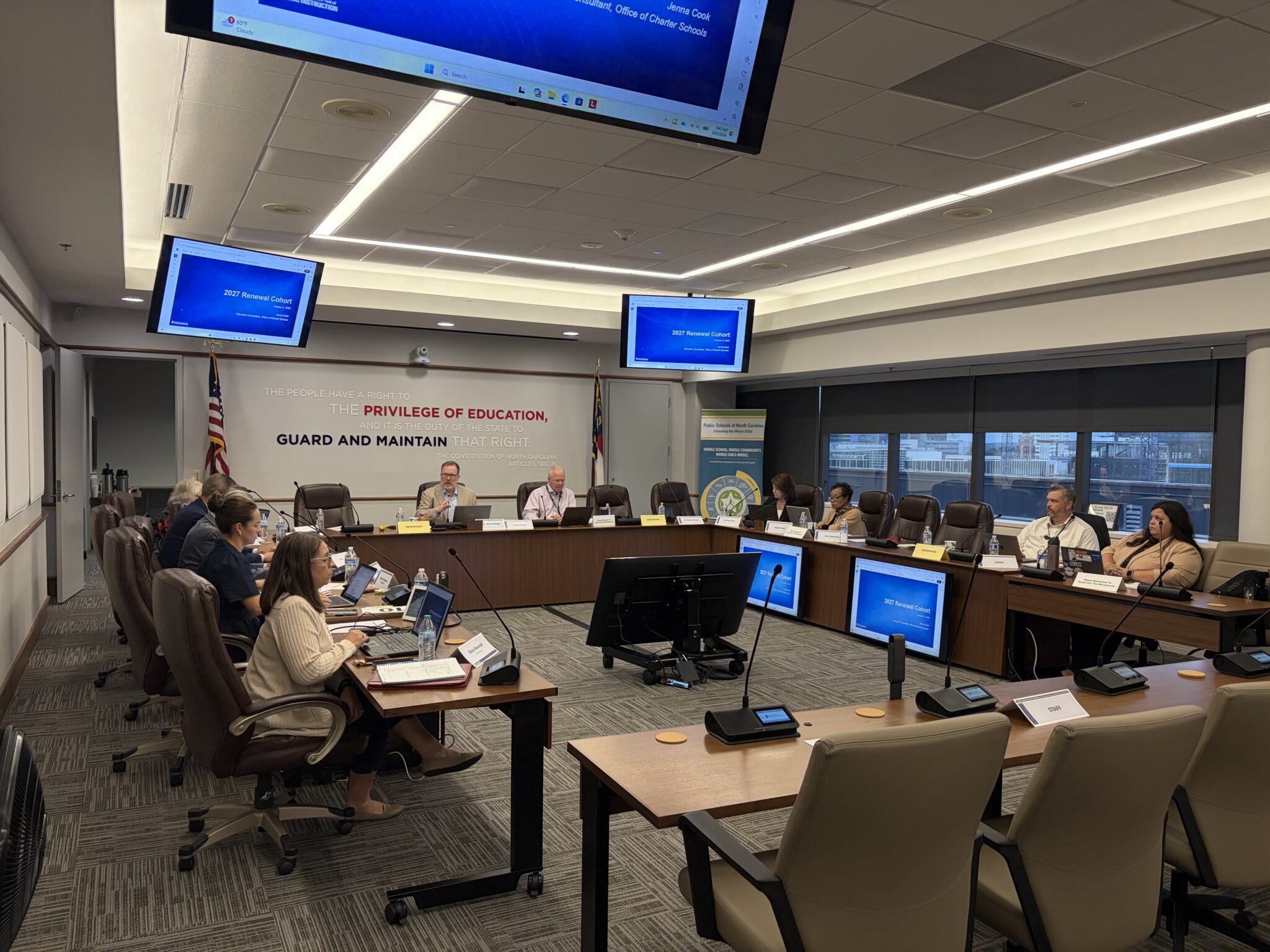
CSRB members also reviewed the 2027 charter renewal cohort, along with proposed changes to state rules impacting charter schools. In addition, they heard about a scratch cooking pilot at RISE Charter School, plans for strengthening charter schools, and new K-12 research mandates.
More on applicant decisions
High population growth and strong local interest are driving the need for ALA-Capeton, school leaders said.
Already, 1,500 families — representing approximately 3,000 students — have signed an interest form over the past 12 months, said Dawn Forrest, the board president.
Currently, just two charter schools are operating in Harnett County, along with 29 traditional public schools, according to an OCS presentation.
ALA-Capeton projects high enrollment at its inception. According to the OCS snapshot, the school plans to launch with 900 students.
That plan elicited questions from CSRB members, who said enrollment is a top concern.
Charter One has “demonstrated a strong ability to meet enrollment targets upon school opening,” Forrest said.
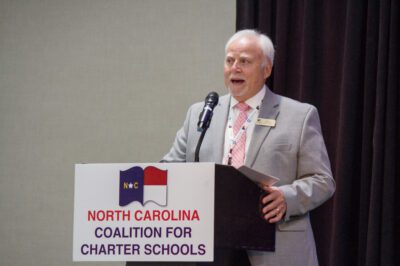
Dave Machado, an ALA-Capeton board member and executive director of the North Carolina Coalition for Charter Schools, provided details about Charter One’s track record of launching large schools. Wake Prep opened in 2023 with 1,982 students and ALA-Johnston opened up the year after that with 1,759 students, he said.
CSRB members also raised questions about the EMO agreement.
Charter One will manage all financial operations, compliance, human resources, marketing services, academic support and coaching, Machado said, noting that the 15% EMO fee reflects a 12% management fee and 3% finance fee.
“We know that seems to be a little high,” he said. “When I was at Lincoln Charter School — that was an independent charter school — we did everything in-house, and we were not able to do that at 15% of revenue. So, we feel like we’re certainly getting our money’s worth.”
ALA-Capeton now enters the Ready to Open planning process.
VALA, which planned to open in 2028 with a STEAM focus and AI-enhanced learning, would have added to the state’s growing virtual charter landscape. Four stand-alone remote charter schools are currently serving students across North Carolina, with another 15 remote charter academies operating under the umbrella of a brick-and-mortar charter school, according to OCS.
VALA leaders proposed incremental enrollment growth, serving 330 K-5 students in year one and 905 K-12 students by year five, according to the OCS snapshot.
They also sought to persuade CSRB that VALA offered something novel in the virtual space.
“What VALA NC stands for is a more interactive environment than what we currently have in other online schooling,” one school leader said.
During discussion, CSRB members praised the board’s commitment and credentials. Cevdet Akbay, a chemistry professor at Fayetteville State University, is the board president.
However, need and family interest remained unclear, with just 71 survey results by the time of the application, according to CSRB member Rita Haire. An updated figure during the school’s interview pegged that number at 80 students.
CSRB members also questioned the board’s experience in online learning and overall readiness.
“They don’t have a great deal of experience in setting up and running an actual online learning program,” Friend said, noting the board was also still figuring out curriculum.
“Credentials and passion exist on this board in spades, and I think that they have some really good ideas,” CSRB member Todd Godbey said. “They didn’t have enough answers to some very critical questions.”
Leaders from New H.O.P.E. Technology Preparatory Academy also came up short, even as CSRB members affirmed the school’s mission and leadership.
“H.O.P.E. stands for helping ordinary people excel,” board chair Rob Campbell said, as he outlined the school’s origins. The nonprofit he runs, New Hope Community Development Center (CDC), plans to sponsor the school.
“What you have before you today is a convergence of community that’s trying to make a difference,” he said.
Seven charter schools and 43 traditional public schools currently operate in New Hanover County, according to OCS.
H.O.P.E. Prep planned to open with just 95 students, expanding to 380 students in grades 9-12 by year five, based on the OCS snapshot.
That small opening size worried CSRB members, who referenced the state’s statutory minimum of 80 students as well as the school budget.
“Your first year is 95 students,” CSRB member Lindalyn Kakadelis said. “The breaking point is 80, as you know. That’s very close. So, it’s not wrong. It’s just a concern.”
School leaders defended the smaller size, noting research revealed an increase in discipline with class sizes over 100 students. Still, that perspective did not assuage pervasive concerns about a very tight budget.
“It’s almost as if you start at risk,” Haire said. “The funding is very lean.”
Friend also noted that the school had no funds budgeted for facilities.
The New Hope CDC planned to purchase the building and donate it to H.O.P.E. Prep, school leaders said.
“Your budget absolutely relies on that,” Friend responded. “With 95 students after year one, you’re only at a $13,000 surplus. So, anything that gets in the way of the scenario you just described really puts this budget in jeopardy.”
“I just don’t think we have a budget that supports the application,” he added.
Both VALA and H.O.P.E. Prep have the right to file an appeal with the State Board of Education within 10 days of the CSRB’s decision.
More on growth score concerns
Friend opened Tuesday’s session by summarizing the letter to CSRB from leaders at Henderson Collegiate, TMSA Public Charter Schools, Pine Springs Preparatory Academy, Sallie B. Howard School, Sugar Creek Charter School, and Anderson Creek Academy. Coalition leader Machado also signed the letter.
In their letter, charter leaders requested a review of the “effect of the 2025 to 2026 retest policy on charter school growth scores.” They also sought help escalating their request to the State Board of Education and asked the CSRB to consider the context from the letter “in any review that relies on these scores.”
Here is how they outlined their concerns:
On September 25, 2025, after the school year had begun, the Department of Public Instruction (DPI) limited students scoring Not Proficient to one retest. Retests given within the 10-day testing window counted toward both proficiency and growth. Summer remediation retests counted toward proficiency only. The rise in in-window retesting pushed statewide growth norms up. Schools that relied on summer remediation were then measured against those higher norms, and their own retest gains were excluded.
The letter cited impacts at several charter schools. For instance, Henderson Collegiate, led by Sanchez, “reached a nine-year achievement high while its growth index fell 13.73 points” in 2025-26.
Charter leaders also wrote that 23 schools “saw achievement rise while their growth index dropped by 8 or more points,” compared to four schools in 2024-25 and one in 2023-24. Of those 23 schools, 13 are charters and 15 are Title I schools serving higher percentages of low-income students.
In mid-September, charter leaders met with DPI officials as well as a representative from SAS, which runs the state’s EVAAS system for the purposes of growth calculations. According to the letter, State Superintendent Maurice “Mo” Green “found no calculation errors and declined a statewide rerun.”
On Tuesday, Sanchez said DPI’s review should have been more intensive.
“I still don’t think there’s depth to the review that should have been done based on these statistical anomalies, and that’s why I’m signing my name to this,” he said.
CSRB leadership planned to request a presentation from DPI’s Accountability and Testing division regarding the effects of last year’s changes on growth calculations.
McDowell provided a detailed statement from DPI in response to the letter:
The North Carolina Department of Public Instruction (NCDPI) takes questions about the accuracy and fairness of the accountability system seriously, particularly when a school’s results differ substantially from its prior experience.
NCDPI and SAS previously reviewed the concerns raised by Henderson Collegiate, TMSA-Triad, Pine Springs Preparatory Academy and other public school units. That technical review did not identify a data or calculation error.
An increase in achievement accompanied by a decline in growth is not, by itself, evidence of an inaccurate growth calculation. Proficiency reflects whether students met an achievement standard at a particular point in time. Growth reflects students’ progress relative to their expected performance, based on their prior assessment histories and the growth observed statewide during the current year. The 2025-26 EVAAS growth model operated as intended and applied the same statewide methodology to charter schools and traditional public schools.
This determination resulted from the technical review conducted by NCDPI and SAS. It should not be characterized as a personal calculation or finding by Superintendent Maurice “Mo” Green.
The review did not establish that within-year retesting raised statewide growth expectations or caused the declines reported by these schools. The information presented also does not demonstrate a disproportionate impact on charter or Title I schools.
View the full statement from DPI here.
Renewal cohort, charter rules, and more
At its meeting, the CSRB also approved a mission statement revision from Endeavor Charter School.
In addition, Jenna Cook of OCS provided a preview of the 2027 renewal cohort, which includes 38 charter schools.
Options for renewal decisions include three-, five-, or seven-year terms — even nonrenewal. However, criteria for 10-year renewals are mandated by statute. If schools have been comparable academically to the local district for the last three years, have financially sound audits, and are compliant with the law, the CSRB must grant a 10-year renewal.
Renewal statute is silent on whether a school is designated as low-performing.
Based on preliminary data, 22 schools meet statutory criteria for a 10-year term, Cook said. One is continually low-performing.
Godbey asked about correcting renewal statute, stating that 10-year renewal should not be automatic for a continually low-performing school.
The CSRB could make a recommendation to the General Assembly, CSRB chair John Eldridge said, noting that he agreed with a fix.
Ashley Logue, the OCS director, also shared an overview with CSRB members about proposed changes to four rules pertaining to charter schools — addressing admission, renewal, application and review, and the planning year for new charters.
Some changes, she said, reflect simple wording revisions. Others involve corrections or aligning rules with recent statutory changes.
“There are a number of reasons to do this,” Logue said. “One is they’ve never been revised since we initially went through the rules process which started back in 2018, and so there’s certainly things that have changed since then.”
“This also seemed like an opportune time now that you have rules approval power to bring back all of the rules and talk through any changes that you might want to consider,” she added.
In 2023, the North Carolina General Assembly passed legislation converting the then-Charter Schools Advisory Board to the CSRB, transferring decision-making authority over charter applications, renewals, and revocations from the State Board of Education to the CSRB. Additional legislation passed in 2025 gave CSRB more authority, requiring that any rule or policy impacting charter schools be adopted by the CSRB before SBE adoption.
In all, Logue said she plans to bring “about 20” rules before the CSRB.
OCS will accept public comment over the next month and bring changes to the CSRB for a vote in November, Logue added.
The process includes multiple stages, with the Rules Review Commission providing final approval.
Related reads

Other meeting business
Dawn Arthur, the executive director at RISE, also provided an update on the school’s scratch cooking pilot.
A K-8 Raleigh charter school serving 550 students, RISE launched the pilot in August as a partnership with Chef Dean Ogan of Rocky Top Catering, Food Paradigm, and Overflowing Hands.
RISE participates in the National School Lunch Program, operating under the Community Eligibility Provision, Arthur said. This allows the school to offer all students free breakfast and lunch every day.
Now with the scratch cooking pilot, meals are healthy, delicious, and “made from real food that day,” Arthur said.
Pilot goals include increasing breakfast and lunch participation, and ensuring federal reimbursements cover 90% of costs, she said.
While the program has proven to be popular, its future is not guaranteed.
“It’s a pilot because we don’t know if it will succeed or not,” Arthur said. “What we know without a shadow of a doubt is that all of our students and our families and our staff want us to figure this out because it is too good.”
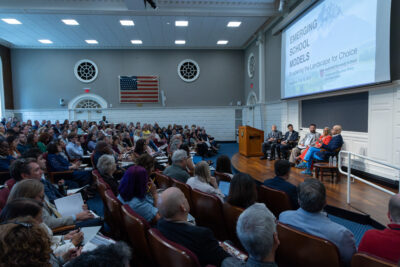
Another presentation from Charlie Lyons and Rachel Ksenyak, vice presidents at MGT Consulting, addressed strengthening North Carolina charter schools.
“They’re here because I’ve asked them to put a proposal together for us to consider,” Eldridge said. “There’s been a lot of good work done to correct and to improve our processes, but we can always get better and that’s what I’ve asked them to take a look at.”
“You all as the CSRB have a huge opportunity to strengthen the charter school sector by strengthening the front end,” Ksenyak said.
MGT proposes to use national charter authorizing practices to “set the bar” for North Carolina.
“I am a broken record about looking for national best practice to inform our work,” CSRB member Eric Guckian said, describing himself as an enthusiastic supporter.
Finally, Jeni Corn, the research director for social sciences at the North Carolina Collaboratory, shared a presentation outlining 15 new K-12 research study mandates included in the new budget.
Studies reflect a range of priorities, including secondary school literacy, math supports, and weighted student funding. Most will involve charter schools in some way, she said.
“That’s why we just felt like it was important to … set the stage, do a quick overview of the studies,” she said.
The CSRB meets next on Nov. 9-10.
Editor’s note: EdNC has retained Kristen Blair to cover the monthly meetings of the Charter Schools Review Board. Kristen currently serves as the communications director for the North Carolina Coalition for Charter Schools. She has written for EdNC since 2015, and EdNC retains editorial control of the content.