
Perspective | What parents want is what kids need


In his poem, “My Father Never Ate Until Everyone Had Eaten,” Jose Hernandez Diaz writes that his father regularly skipped family dinners, saying he wasn’t hungry to ensure his family had enough to eat. Diaz recognizes his father’s sacrifice as an act of “ineffable love,” but mourns the time around the dinner table with his dad that he missed out on as a result.
Diaz’s father’s story — in which structural gaps lead to missed opportunities for meaningful connection — is too often the story of parenting in North Carolina. Strained household budgets due to rising gas and grocery costs, cuts to food stamps (SNAP), and lack of affordable child care or health insurance sets up our children for dinner tables with empty chairs and empty plates. Sometimes it’s not just dad who goes hungry.
Impossible decisions
When we think about what parents sacrifice for their children, many of us think about physical/mental health. Stopping there misses out on something which can be predictive of the kind of relationships being formed between caregiver and child — quality time. The absence of this can look like unopened books, unsung lullabies, or diminished laughter.
The Children’s Home Society of NC recently led a discussion on “time poverty,” an underappreciated consequence to the impossible decisions that families make each day. In 2024, the surgeon general shared an advisory titled “Parents Under Pressure,” outlining some parental stressors, their impact on mental health, and the consequences this has on a “child’s emotional and cognitive development.”
 Sign up for Early Bird, our newsletter on all things early childhood.
More recently, the think tank New America’s New Practice Lab introduced the 2026 National Parent Survey. They asked parents “directly and at scale, what they actually want their lives to look like” instead of assuming what they need or want. They heard from 5,472 parents from across the country, including 2,915 parents with lower incomes.
A dad of two in North Carolina responded saying, “what I hope is true is that I’m the one who makes my family financially stable so my kids don’t have to worry about anything after me.” Financial stability drives many of the decisions that parents make for their children.
A mom of three in North Carolina shared, “You want to be the best parent. You want to find reliable care for your child when it’s time to head back to work. I wish it was more convenient and consistent child care.” Impossible decisions indeed.
Innovation, plus time-tested supports
It may not be surprising that 72% of parents in the 2026 National Parent Survey desire increased quality time with their children, a hope which holds true across gender, income, geography, and race/ethnicity. If we want parents to enjoy this quality time, which kids need, we’re going to need both innovative approaches and time-tested supports (like the parental leave benefits found in the Nordic countries, which are often associated with a range of significant benefits for children and parents).
There is research in Michigan around a community-wide and unconditional prenatal and infant cash prescription program called Rx Kids. Enrollment in the program was associated with “improved economic stability, mental health, and well-being.” Just published findings detailed the positive effects Rx Kids is having on improving birthing outcomes, something relevant to Michigan and North Carolina who both received D+ ratings in the March of Dimes’ 2025 Report Card.
Another support that many of us are familiar with is child care. An EdNC piece details how North Carolina’s child care is in crisis, and how it’s being approached as a business issue. It’s not just a business issue; it’s also a moral one. What kind of childhoods do we want our kids to have, what kind of parents do we want to be? Whatever the exact mechanism — whether public, or public and private — fully funding child care and other structural supports is in line with who we are.
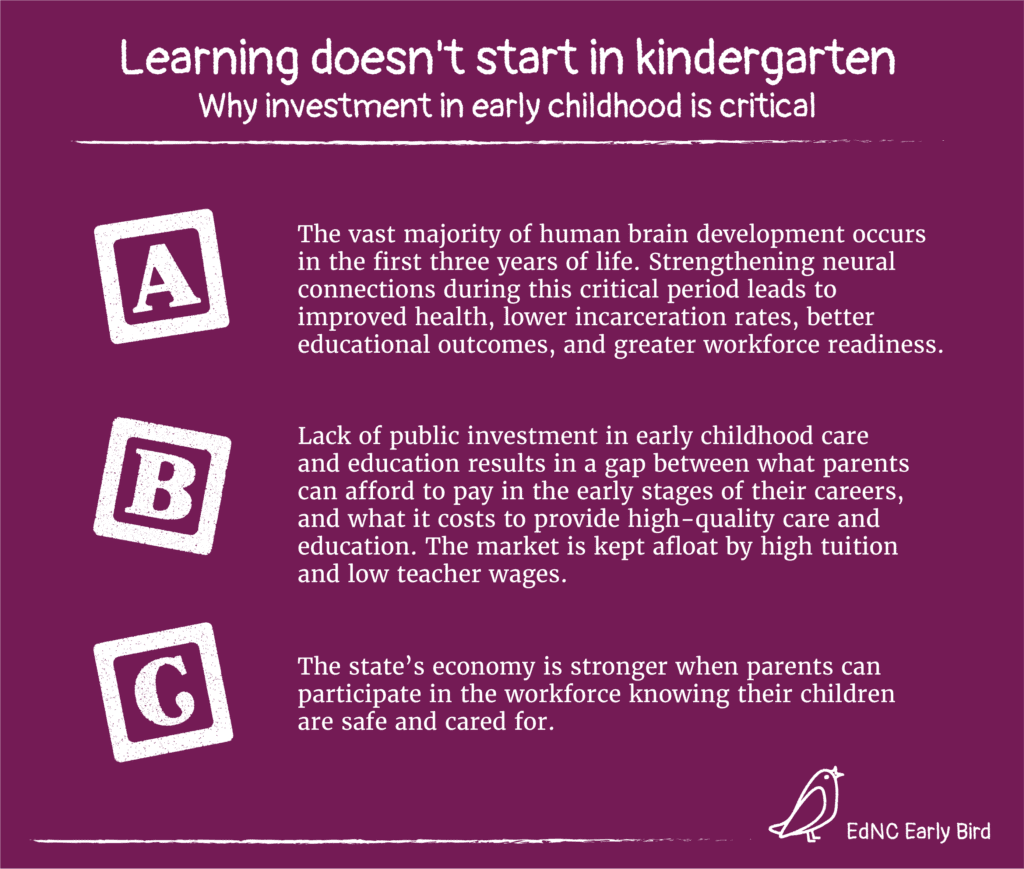
One way we can make this work is simultaneously recognizing child care pluralism while making a wide variety of child care options affordable and available to parents, sustained by public and private investments, which some have highlighted. The wide variety of child care needs as described in the 2026 National Parent Survey tells us that flexible options will be necessary if we hope to meet parents and families where they are, across the political and cultural spectrum.
The value of quality time
What parents want, kids need. It looks like dinner tables where families are present together, story times, lullabies, and time spent playing during kids’ most formative years. It looks like parents who feel at ease when they leave their children in the care of family, friends, and early childhood educators when they return to work.
Parents miss out on quality time with their children due to the structural barriers that make it difficult, if not impossible, for them to balance making ends meet and caring for their children. There may not be a perfect arrangement of policy solutions, but I think it is opportune for us to have an honest conversation about the values that inform where we are coming from and what we hope for when it comes to cohesive supports in place for families.